Disclaimer: This is my original work with details sourced from reading the comic book and doing personal research. Anyone who wants to use this article, in part or in whole, needs to secure first my permission and agree to cite me as the source and author. Let it be known that any unauthorized use of this article will constrain the author to pursue the remedies under R.A. No. 8293, the Revised Penal Code, and/or all applicable legal actions under the laws of the Philippines.
Welcome back superhero enthusiasts, 1990s culture enthusiasts and comic book collectors! Today we go back to the year 1990 to take a close look at one of the more significant non-superhero crossover comic book events ever published – Aliens vs. Predator!
In my previous review, the humans of Prosperity Wells begin to get impacted by the presence of the Predators and the Aliens. A family got killed by Predator hunters at their home in the wilderness and only a young boy was able to get away and catch people’s attention in the outpost. Machiko Noguchi and her team initiate defensive measures in response to what has been happening. Two people even brought back a living Predator with them from the ruins of a Predator ship they inspected in the wilderness.
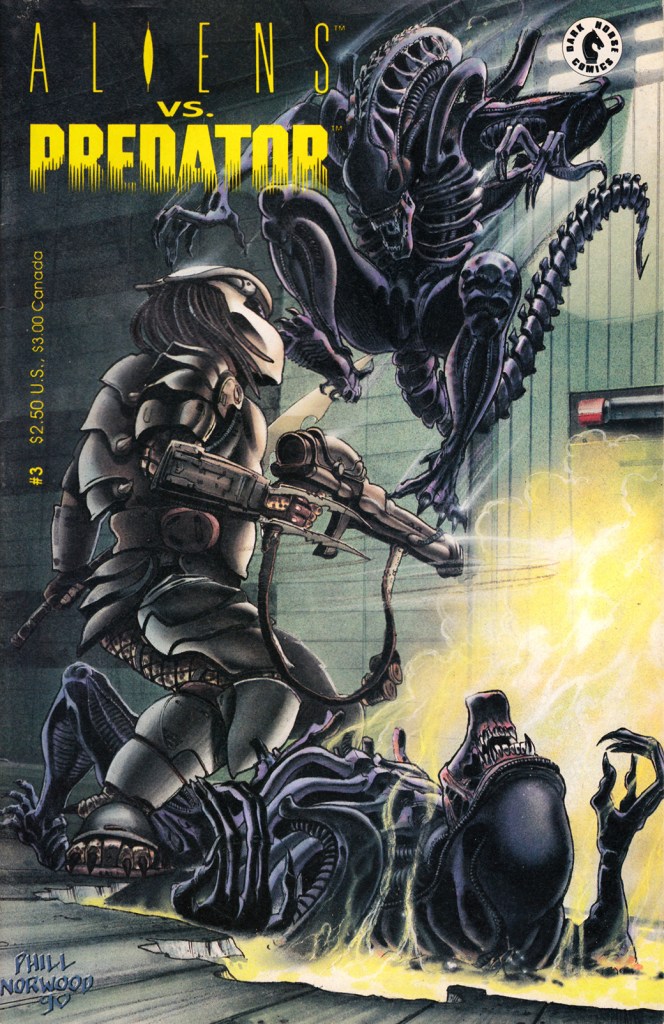
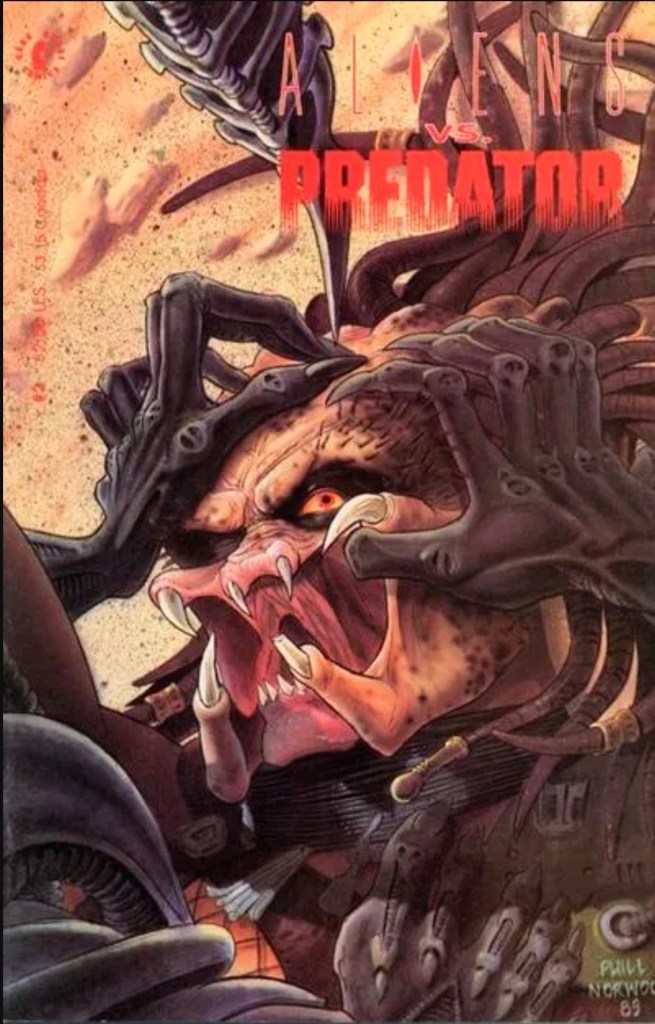
With those details laid down, here is a look back at Aliens vs. Predator #3, published in 1990 by Dark Horse Comics with a story written by Randy Stradley and drawn by Phill Norwood.
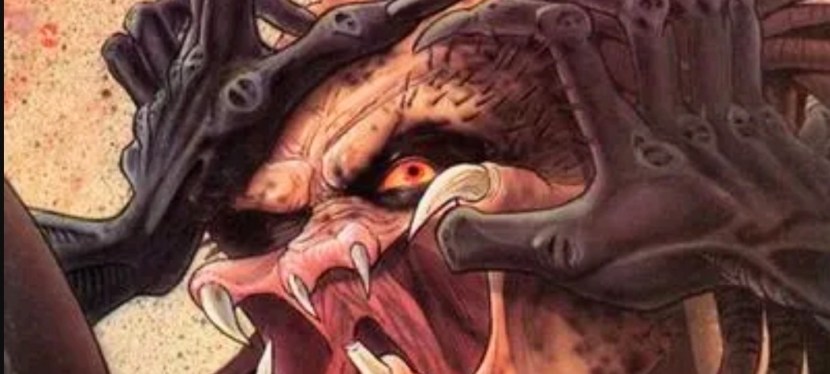
The cover.
Early story
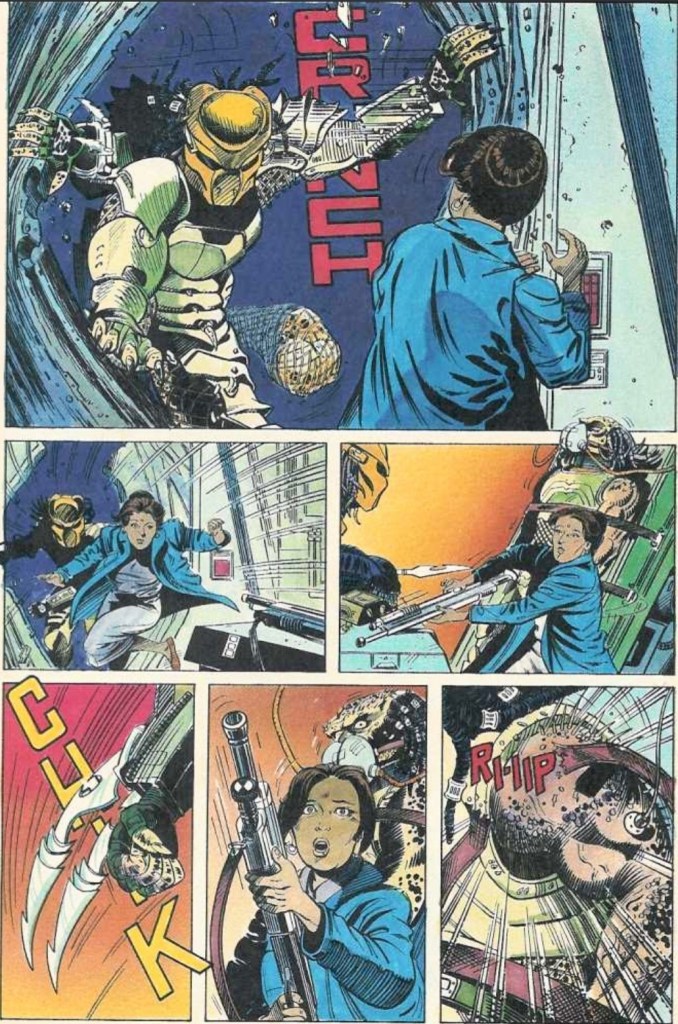
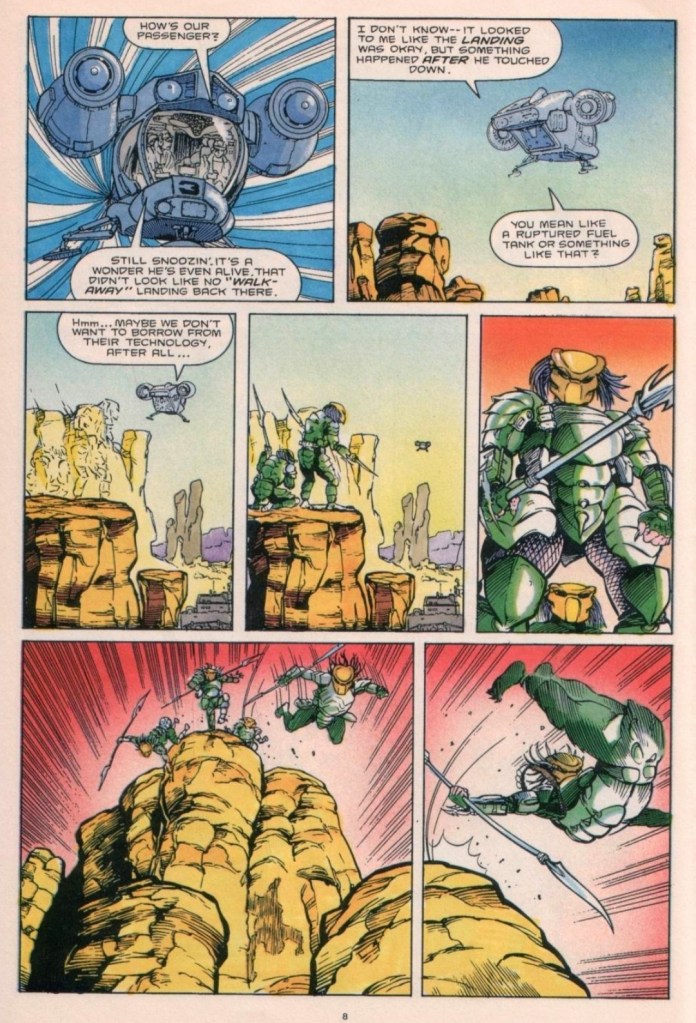
The story begins with Noguchi who finds herself in a dangerous position. In front of her is a horde of Xenomorphs and behind her is one Predator warrior who even assisted her a few moments prior. Armed with futuristic weapons, the armored warrior suddenly jumps above her and right into the Xenomorphs. The Predator efficiently slashed off the parts of a few Aliens using a bladed weapon and blew up one of them using another weapon.
The warrior eventually gets overwhelmed by more Aliens that came into the action. As the Xenomorphs focused strongly on the downed Predator, Noguchi takes advantage of the situation to run away and somehow get back to protecting the people as the outpost has been clearly invaded by two deadly non-human species.
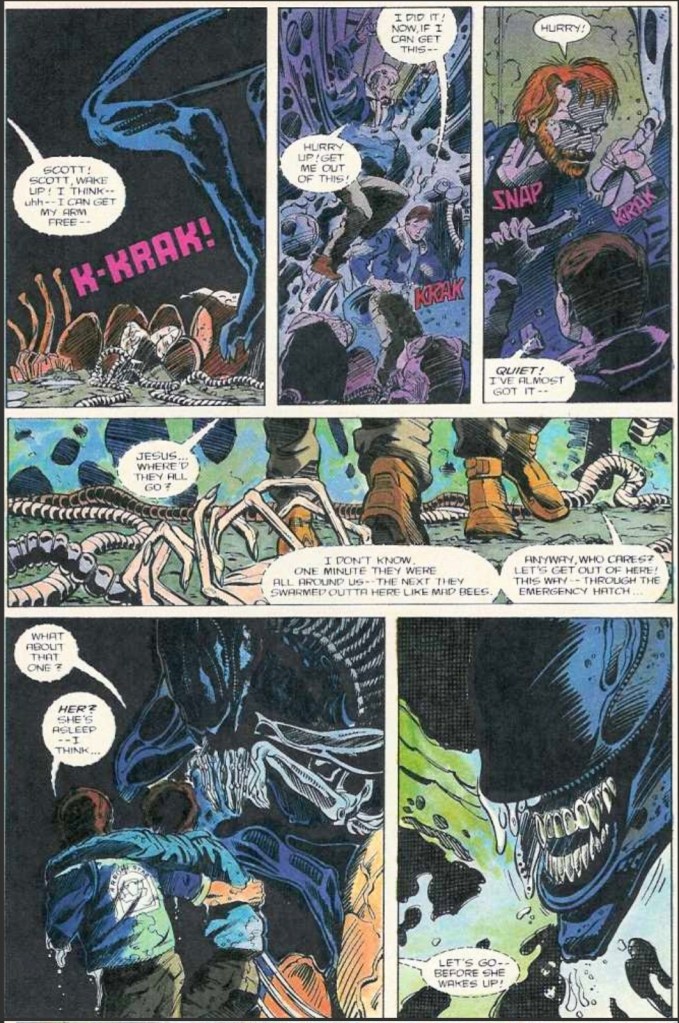
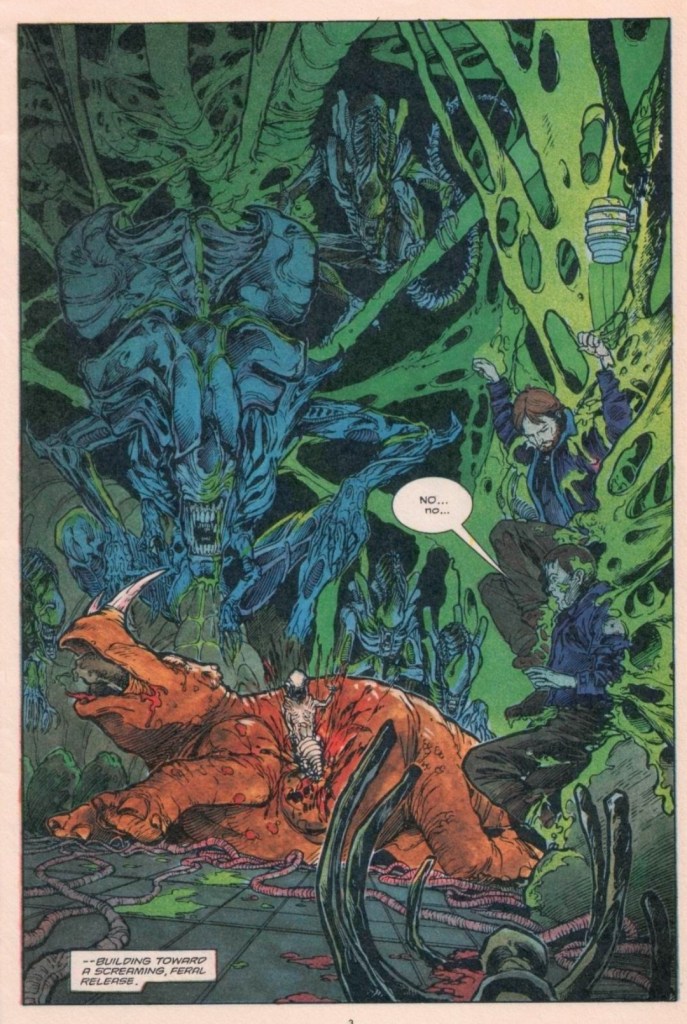
Meanwhile inside the huge cargo ship that did not launch, two crew members freed themselves from the Xenomorphs’ restraints and try to sneak by the Alien Queen which they perceived to be sleeping…
Quality
This is a fine example by the creative team on telling a sequence of intense moments without a single word of dialogue.
From a storytelling point-of-view, this one is a huge pay-off to the build-up established in the first two issues and I can say I enjoyed this one. At this stage of the 4-issue mini-series, the human colony has turned into a battle zone between the Predators and the Xenomorphs and this obviously results in a lot of action scenes and other wild turns of events. It is also in this story where you will get to see Machiko Noguchi at her bravest yet, as well as her uncompromising way of protecting her people and solving the crisis at hand. As she and her fellow humans are in the middle of a crisis, nothing straightforward could happen nor could they make solid plans with any real chance of succeeding. The decisions Noguchi made here came with risks and through her struggles, you will be able to relate with her and you will also witness how the series of unfortunate events turn out with unpredictable ways which added some suspense and surprise to the narrative.
The spectacle here, unsurprisingly, are the battles between the Aliens and Predators. Such conflicts happened mostly in the background which is effective enough to establish the chaos that the humans have to endure. One of the Predators – which does not have a name – became a notable additional supporting player to the cast and his presence and actions added some intensity to storytelling even as the narrative consistently focused on Noguchi.
The way the story is told, this one maintains the natural progression of details from issue #1 and even though the action has been ramped up, there were still plenty of opportunities for readers to understand the details and grasp the plot. There is also rising tension as the narrative moves forward.
Conclusion
There is nothing like trying to sneak past an Alien Queen in an area surrounded by multiple eggs laid by her.
Being a big pay-off to the huge build-up of issues #1 and #2, Aliens vs. Predator #3 (1990) is highly entertaining and compelling to read! The action scenes and chain of incidents were ramped up a lot and yet this comic book never turned into a brainless fest of violence. The creative team managed to add some breathing space to not only let readers absorb the story details but also to immerse themselves with the situations. By the time I reached the end, I experienced this great satisfaction as well as further motivation to discover how the story will conclude in the next issue.
Overall, Aliens vs. Predator #3 (1990) is highly recommended!
Disclaimer: This is my original work with details sourced from reading the comic book and doing personal research. Anyone who wants to use this article, in part or in whole, needs to secure first my permission and agree to cite me as the source and author. Let it be known that any unauthorized use of this article will constrain the author to pursue the remedies under R.A. No. 8293, the Revised Penal Code, and/or all applicable legal actions under the laws of the Philippines.
Welcome back superhero enthusiasts, 1990s culture enthusiasts and comic book collectors! Today we go back to the year 1990 to take a close look at one of the more significant non-superhero crossover comic book events ever published – Aliens vs. Predator!
In my previous review, most of the humans living and working in Prosperity Wells are unaware about the creeping danger coming at them. Alien eggs were laid in the wilderness while a ship carrying multiple Predator hunters has landed. At the human outpost, the leader Machiko Noguchi remains disrespected as the staffers and ranchers still trust her predecessor Hiroki Shimura.
With those details laid down, here is a look back at Aliens vs. Predator #2, published in 1990 by Dark Horse Comics with a story written by Randy Stradley and drawn by Phill Norwood.
The cover.
Early story
The story begins with the huge spaceship still at the launch platform of Prosperity Wells. The ship should have launched already with a huge cargo of indigenous animals – the Rynth – for export. It turns out that the two human pilots were captured by the Xenomorphs and in the presence of the Alien queen inside the ship, they witness one rynth (part of the herd from the ranching) die as a Chestburster alien comes out of its body.
Meanwhile, Machiko wakes up as her respected predecessor Shimura arrives and tells her that Dr. Revna still has not returned. During her talk with the wife (also a doctor), Machiko learns that the missing doctor was on his way to Iwa Gorge to find more aliens (note: the Facehugger alien) and that a lady worker (who made the first discovery of a Facehugger) informed him of the place.
As Machiko and Shimura analyze what they know, two outpost personnel discover the remains of a destroyed Predator space ship and, more notably, one unconscious Predator hunter…
Quality
The Predators looks really odd with the colors implemented on them by the creative team of this comic book.
If you were deeply engaged in issue #1, then you will have a lot to be engaged with in this issue. The script by Stradley is very solid and with a medium pace, details were consistently laid out for readers’ understanding while the build-up for the inevitable chaos – between Xenomorphs and Predators with humans in the middle literally – is strongly felt.
Machiko Noguchi’s management and ability to analyze situations really get tested in this story and along the way, you will see how much the outpost changes reflecting the moves made by her administration which is ultimately a response to a brewing crisis. At this stage of the comic book mini-series, the danger of the two galactic species begin to make impact on innocent humans in violent ways. The scene showing the home of people (located some distance away from the main complex of the outpost) getting invaded by the Predators has uncompromising violence which makes the incidental action look really disturbing.
More on the human characters, this comic book has very rich dialogue backed with special attention to details implemented by Stradley. This is very evident in the scene in which Machiko, Roth, Ackland and Shimura talk intensely about what happened and what factors caused those things to happen. Through the verbal exchange, you will witness Machiko’s bravery and leadership come to life as she confronts a rebellious rancher (who insulted her in a very personal way) over the truth about what happened. Not only that, you will also feel the stress she experiences as she manages the outpost at a time of crisis.
For the fans of Predators and Aliens reading this, you will see a lot more of them in this issue and I can assure you that Norwood is really great in visualizing them and showing them with violent action that will remind you of the movies. As with the previous issue, the colors implemented on the Predators remains very odd to look at.
Conclusion
Live humans helplessly watching an animal die as a Chestburster alien comes out of it in the presence of the Alien queen.
Aliens vs. Predator #2 (1990) is a great follow-up to issue #1. As expected, the stakes were raised higher and the tension really intensified as the narrative went on. The creative team really should be admired for not only crafting this high-quality chapter of the mini-series, but also for their believable and engaging build-up of the plot, the characters and conflict altogether. This comic book is a lively reminder of how great a non-superhero comic book crossover could be.
Overall, Aliens vs. Predator #2 (1990) is highly recommended!
Disclaimer: This is my original work with details sourced from reading the comic book and doing personal research. Anyone who wants to use this article, in part or in whole, needs to secure first my permission and agree to cite me as the source and author. Let it be known that any unauthorized use of this article will constrain the author to pursue the remedies under R.A. No. 8293, the Revised Penal Code, and/or all applicable legal actions under the laws of the Philippines.
Welcome back superhero enthusiasts, 1990s culture enthusiasts and comic book collectors! Today we go back to the year 1990 to take a close look at one of the more significant non-superhero crossover comic book events ever published – Aliens vs. Predator!
For the newcomers reading this, the respective movie franchises of Aliens and Predator started many years before the comic book crossover event happened. By the year 1990, moviegoers had enjoyed Alien (1979), Aliens (1986), Predator (1987) and Predator 2 (late 1990). Cinematic between Arnold Schwarzenegger and the Predator in the jungle and that of Sigourney Weaver and the Queen Alien became unforgettable sequences for many millions of people. It should be noted that an Alien head was shown near the end of Predator 2 emphasizing a crossover.
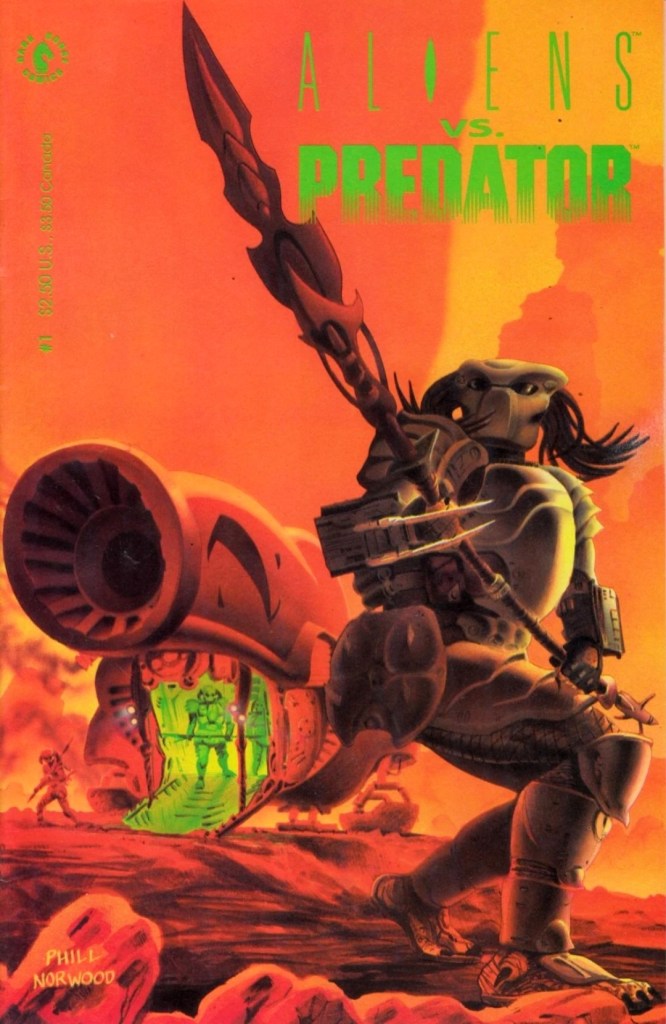
With those details laid down, here is a look back at Aliens vs. Predator #1, published in 1990 by Dark Horse Comics with a story written by Randy Stradley and drawn by Phill Norwood.
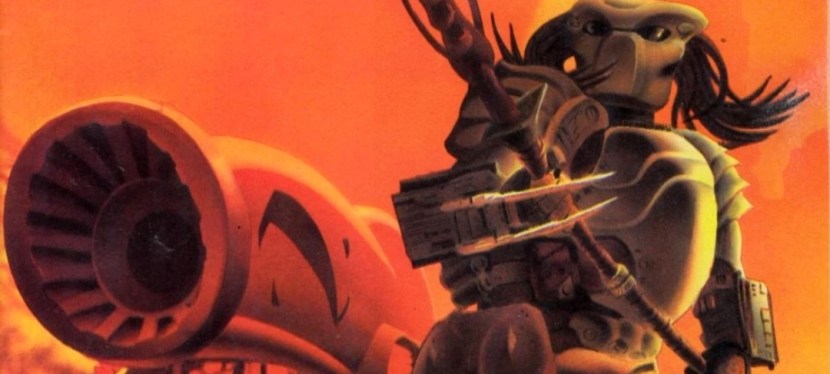
The cover.
Early story
The story begins in space when a fast-moving ship enters the atmosphere of Ryushi, a planet at the edge of the Chigusa Corporation’s holdings in the Beta Cygni System. On the planet is Prosperity Wells, a human outpost with a population of one hundred fifteen composed of freelance ranchers, their families and a staff of corporate overseers.
The ship’s presence gets detected by operators at Prosperity Wells and one of them speculated it to be a meteor that shows no signs of breaking up. Seeking Hiroki Shimura (no longer the head of the outpost), the operator instead contacts his replacement Machiko Noguchi and informs her about the perceived meteor. After talking with the operator, Noguchi tells her predecessor near her that even though she has been leading the outpost for nearly six months, people are still reporting to him as they treat her like a stranger. Shimura tells her that she’s been trying to adapt the job to her rather than adapting herself to it, and that she cannot just run an operation while hiding from it.
Meanwhile in the wilderness, a machine starts to climb out of the pit and starts releasing Alien eggs…
Quality
Whenever there are Alien eggs, trouble is inevitable.
I can say that this comic book is essentially one long build-up that intends to execute the conflict between the Aliens (also referred to as the Xenomorphs) and Predators later. While the two galactic species are indeed here, the narrative is told mainly through the humans whose operations – ranching, business administration, outpost activities – are emphasized with heavy and precise details. The result here is that by the end of the comic book, you will be fully immersed with the sci-fi concept, the characters and the related developments which ultimately will prepare you for the inevitable Aliens-Predator conflict. To put it clearly, Stradley crafted a script that efficiently introduces the characters (note: Noguchi is the clear protagonist), emphasize what has been going on while also moving the story forward in a well-paced manner without compromising the details.
That being said, don’t expect the Aliens and Predators to fight each other immediately here. This is one big build-up as a whole and very notably, there is nothing boring and there were no useless scenes portrayed. Everything told and shown in this comic book made sense, and if you are the kind of person who likes paying close attention to details of the story as well as the gradual development of the key characters, you will find this one an engaging read. The narrative moved at a medium pace and cleverly the suspense happens whenever the creative team gradually build-ups the tension for the inevitable Aliens-Predators fight.
As with many other entertainment tales across varied media forms, this story has a critical portrayal of the corporation slightly emphasizing greed while making the contractors (technically the laborers) look disadvantaged. It is not a one-sided portrayal against corporatism, however, as there were moments showing the contractors relying on deception (note: disregarding quality and the safety of consumers who will soon consume the products from the ranching operation) just to achieve their goals.
More on the protagonist Machiko Noguchi, she is not the typical corporate figure for readers to hate. In fact, she is somewhat sympathetic as she is has yet to earn the respect of others even though she had been working as the head of the outpost for months. The grudge against her is subtle yet clear. The comic book also made clear that she is destined for something significant in the upcoming fight between the two galactic species.
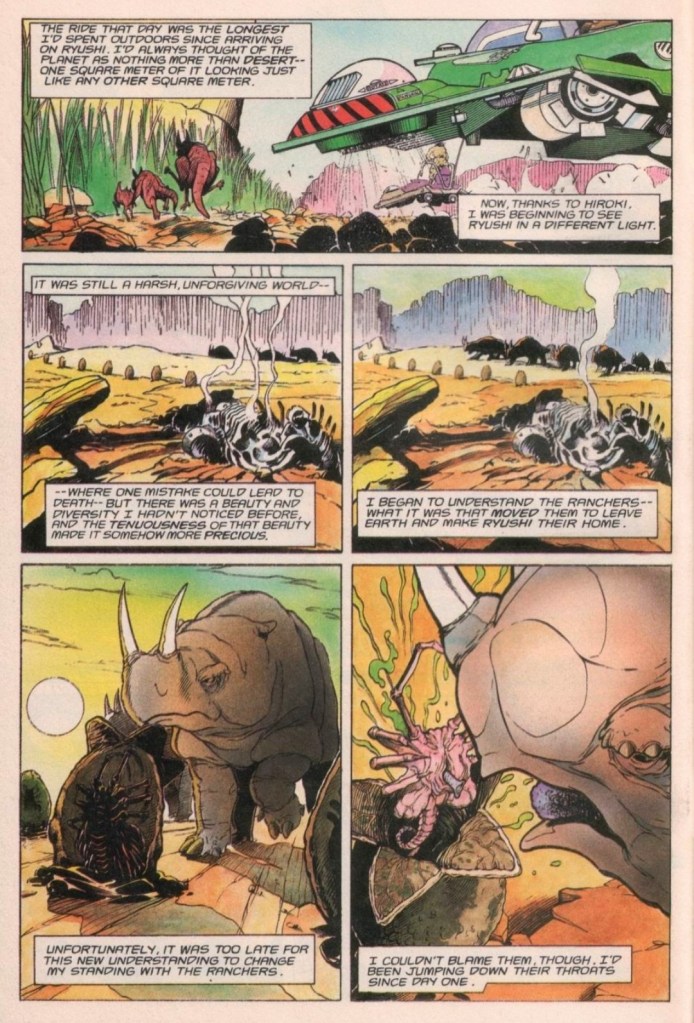
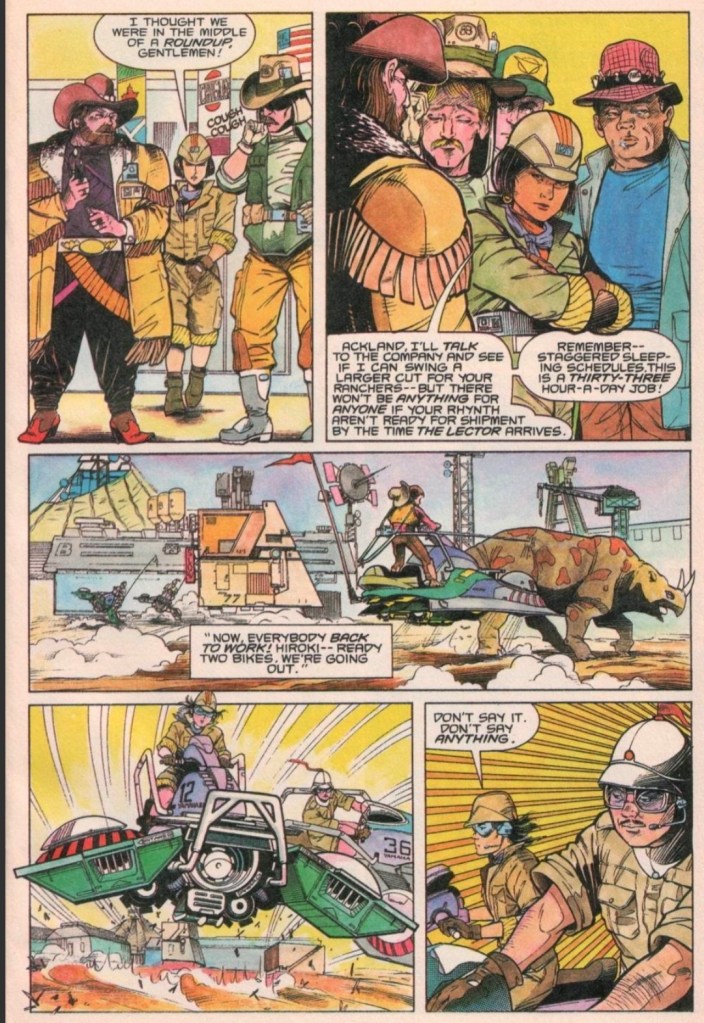
The art by Phill Norwood is very good. While the characters have that comic book aesthetic, the Aliens and Predators are easily recognizable and were drawn with sufficient visual details. What I find weird is the creative team’s approach on applying color on the Predators. Norwood also has a really nice approach on illustrating futuristic stuff (examples: the technologies, office equipment, clothes of the characters) while also emphasizing the wilderness of Ryuchi.
Conclusion
Machiko Noguchi takes charge even though she is despised by many.
Aliens vs. Predator #1 (1990) is one very detailed build-up type of comic book that happens to be pretty engaging to read and the set-up for the expected conflict between the two species worked nicely. By the time I reached the end of this tale, I got immersed into its concept, the situations and characters. The build-up also came out with really interesting parts here and there which made the reading experience a very good one. Right now, I am eager to read the next issue.
Overall, Aliens vs. Predator #1 (1990) is highly recommended!
Disclaimer: This is my original work with details sourced from watching V: The Original Miniseries and doing personal research. Anyone who wants to use this article, in part or in whole, needs to secure first my permission and agree to cite me as the source and author. Let it be known that any unauthorized use of this article will constrain the author to pursue the remedies under R.A. No. 8293, the Revised Penal Code, and/or all applicable legal actions under the laws of the Philippines.
Way back in 1983, I was fortunate to watch the 2-episode sci-fi mini-series on television titled V: The Original Miniseries. Because there was no Netflix, no YouTube, no Internet access and no DVD at the time, getting to replay the said mini-series as well as its sequel V: The Final Battle was really hard. Replays of them on local TV rarely happened.
Then in 2001, V: The Original Miniseries was released on DVD format and I got to watch it all over again with a good amount of enjoyment. In recent times, I purchased the Blu-ray release and replayed the original miniseries in high-definition at last!
You must be wondering if the original mini-series aged well through the decades, and is it still good to watch by today’s standards? While I will comment about its overall quality below, what I can say is that its theme about people fighting to be free from fascism, oppression, terrorism and dictatorship remains relevant to this day.
For his part, star Marc Singer stated: “I think themes of what holds society together and what tears society apart, those themes are universal themes and I think they’re always going to be relevant. I think there’s going to be a necessity for things like V to be revisited in order that society remember what it is that’s cohesive and coherent about it and why is it that we should all stand together and treat each other well.”
With those details laid down, here is a look back at V: The Original Miniseries, written and directed by Kenneth Johnson. The first episode was broadcast on television in the United States on May 1, 1983.
V: The Original Miniseries
Early story
The story begins in El Salvador where camera operator Mike Donovan (Marc Singer) and his companion Tony risk their lives capturing footage of an armed conflict. As the two tried their best to move away from the heat of battle, a helicopter of the enemy tracks them and corners them. Just as hope seems lost for Mike Donovan, the helicopter suddenly flies away. He turns to the other direction and witnesses the presence of a huge, floating saucer-like space ship coming his way. He begins to record footage of it.
Soon enough, several other space ships arrive and float above many other cities around the world. In America, medical student Julie Parrish (Faye Grant) and her colleagues carefully watch the TV news coverage. In a nice neighborhood, several residents – including Robin Maxwell (Blaire Tefkin), Eleanor Dupres (Neva Patterson), Daniel Bernstein (David Packer) and his grandfather Abraham (Leonardo Cimino) to name a few – marvel at the sight of a space ship above them. At another location, the research of scientist Robert Maxwell (Michael Durrell) and his colleague got interrupted with the arrival of a space ship.
The Visitors formally begin their new relationship with the people of Earth.
Diana of the Visitors played by Jane Badler.
Some time later, the Visitors make verbal contact with the people around the world using varied languages of Earth. In a special arrangement held at the top of the United Nations (UN) building in New York closely viewed on TV by the general public, the Visitors reveal themselves represented by John (Richard Herd) who expresses their message of reaching out peacefully to the people of Earth, seek their help and, in return, share with them their advanced technologies that could help humanity a whole lot for future generations. The Visitors are human in appearance but speak with very distinct sounds.
As a result, the governments of Earth agree to the offer of the Visitors and establish ties with them. Symbolically, a large group of Visitors’ engineers led by Diana (Jane Badler) and security chief Steven (Andrew Pine) arrive at a refinery to formally begin collecting chemicals and minerals.
Then things start to turn bad…
Quality
I can clearly declare that the writing and directing done by Kenneth Johnson remains great, and for many reasons why. On storytelling, Johnson (who was inspired by the anti-fascist novel It Can’t Happen Here and made an adaptation of it before finally coming up with V) clearly took his time on establishing the core concept stage-by-stage, and he also found efficient ways of explaining details to viewers by using in-story news reports and videos and retrospective as effective tools of exposition (these helped cut down the reliance on expository dialogue).
As the story goes on, Johnson carefully introduced the many characters on-screen (including the use of quick introductions of some characters who are located away from others they are connected/related with), established who they are and, most notably, showed how the events that took place affected them.
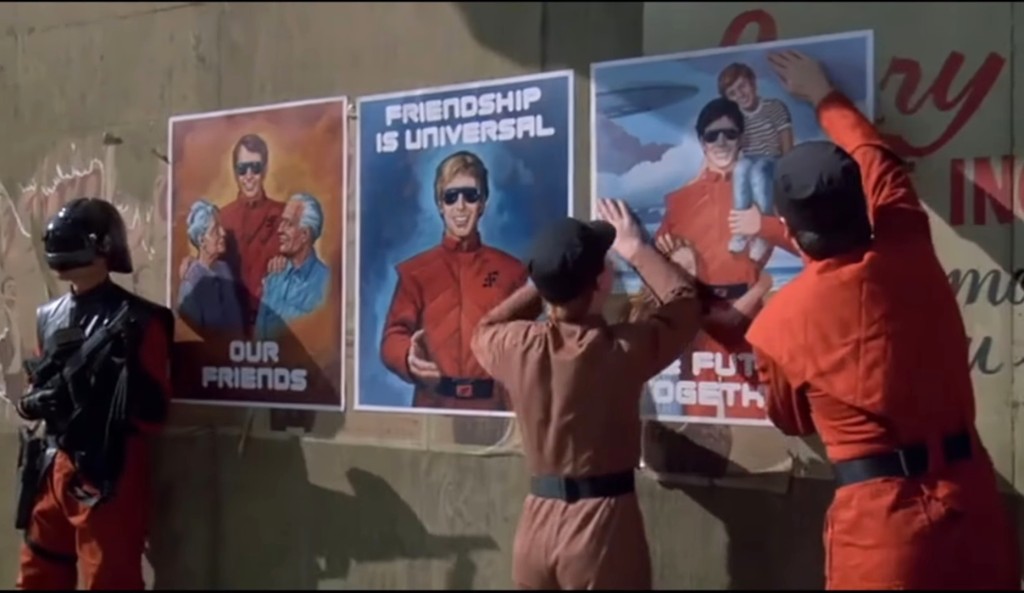
The Visitors (and one member of their youth auxiliary movement wearing brown) posting propaganda material to condition people’s minds they are friendly and trustworthy. These posters are familiar to many Nazi propaganda materials used in Europe decades earlier. Prior to the release of the Original Miniseries, a real-life marketing campaign of putting up such posters happened in real life.
Johnson also used symbolism which reflects what happened decades ago in Europe with the rise of the Third Reich. The Visitors’ symbol resembles the Nazi Swastika while the persecution of scientists (as well as their families and associates) resembles the Nazi persecution of Jewish people, and the scene of Daniel Bernstein joining the Visitors through their “Friends of Visitors” movement recalls memories of the Hitler Youth. I should state that Earth citizens who chose to collaborate with the aliens from space (strongly symbolized through Eleanor Dupres), images of the armed Visitors watching several helpless Earth people being taken away from their homes and the dominance of propaganda over the free press also reflect what happened back in World War II when the Nazis occupied many parts of Europe. The fact that Johnson used alien humanoids as the Visitors make them a more universal antagonistic force that viewers can relate with.
When it comes to the cast members and their respective performances, there is a whole lot to enjoy here and I can confirm that the quality of dramatic performances is pretty good and adds a whole lot of believability to the story. The most notable performer here is none other than Faye Grant who believably portrayed Julie Parrish on her in-depth transformation from a promising medical student to a reluctant organizer of a movement of freedom-loving people called the Resistance. Faye Grant excellently portrayed emotions and even showed the fragile side of Julie as she struggles to strengthen herself to lead her fellow people who seek freedom and survival. Julie also is the most charismatic and likable character in my view.
Marc Singer’s Mike Donovan is the closest thing this miniseries has to an action hero. Donovan is not a soldier, nor a policeman, nor a combat specialist. He is a hard-working media employee who has covered a lot of armed conflicts overseas and along the way he learned how to fight. As he is not a fighting machine, Donovan was portrayed to be vulnerable and really ends up struggling a lot. In a way, Donovan symbolizes people who take action once they realize what is wrong and what lies they have been fed with. It should be noted that before Bruce Willis wowed audiences as the vulnerable hero John McClane in Die Hard, Marc Singer’s Donovan was the vulnerable and struggling action performer realized ahead in time. On the dramatic side, Donovan’s talk with his mother Eleanor is a great scene to watch, and his contrast with Kristine Walsh (Jenny Sullivan) must be seen! If you ask me, Mike Donovan is Marc Singer at his best!
Faye Grant’s portrayal of Julie Parrish is highly believable complete with a good range of emotions. Her character development all throughout the Original Miniseries is very believable.
Marc Singer as Mike Donovan.
The other most notable role is none other than the Visitors’ commander Diana excellently played by Jane Badler. Diana was played to be charismatic, powerful, and sadistic at the same time. She is not a mere evil figure nor is she your typical pure evil antagonist. In fact, she is the powerful extension of an unseen high authority of the aliens and this alone makes her worth your attention. Also, through her interactions with her fellow aliens Steven and Brian (Peter Nelson), you will see very interesting traits of Diana’s personality. I should state that Jane Badler’s eyes and expressions really gave her character a very commanding presence on-screen. Even though her screen time is not dominant, Diana’s impact remains very strong.
As for the other cast members and their contributions in the film, I can state that Robert Maxwell was excellently portrayed by Michael Durrel to be the very caring father striving to protect his family even as society has been manipulated to demonize scientists like him. Daniel Bernstein is clearly the traitorous Earthling who has gotten so involved with the Visitors, and I am confident that David Packer will get on your nerves. Willie is the good-natured Visitor who tries to fit in with the people of Earth and his friendship with Harmony Moore (Diane Cary) is very symbolic. Given the reputation of Robert Englund as a horror icon, his performance as Willie is a must-see!
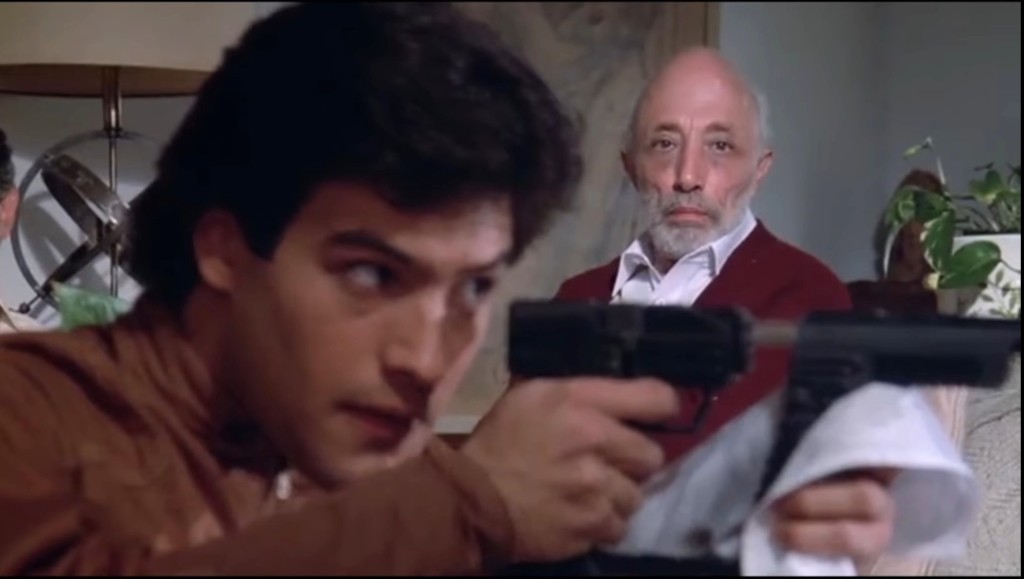
The most notable of all the supporting cast members here is none other than Leonardo Cimino’s Abraham Bernstein who is a Jewish man who went through the Holocaust and survived to establish the family in America only to see evil return in the form of the Visitors. His dramatic scene of protecting a certain family is a must-watch, and most likely it will stir your emotions.
This scene shows the contrast between Abraham Bernstein (Leonardo Cimino) in the background and his grandson Daniel (David Packer) in the foreground. Abraham is an old Jewish man who went through the Holocaust and lived on. Daniel, who is 17-years-old, willingly joined the Visitor’s youth auxiliary movement which parallels that Hitler Youth.
In addition to being successful with telling the story, spreading the details and getting solid performances from the cast, Kenneth Johnson also proved to be really crafty with the way the camera captured images and how the very important moments were presented to captivate viewers. Johnson’s work here is clearly a labor of love. As for the music, Joseph Harnell did a good job overall. His style gives V a distinct aesthetic on tunes and I noticed his music becomes more lively late in the 2nd episode. Harnell also knew how to add musical excitement when the narrative needed a boost of energy or speed.
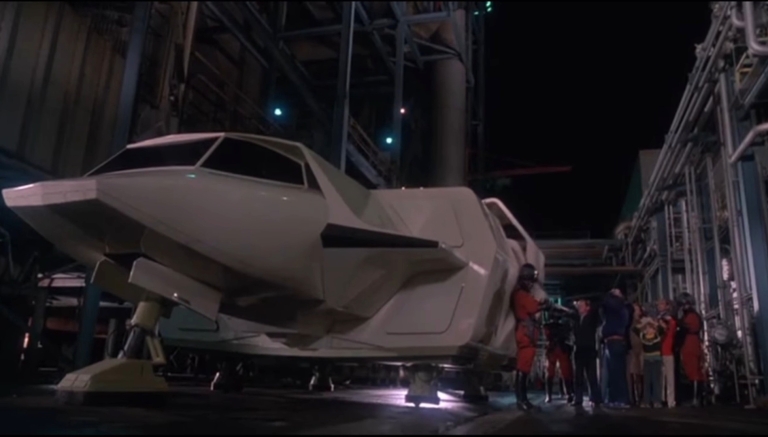
People of Earth, including children, are helpless under the Visitors.
Last but not least, I want to talk about the action and visual effects here. The action is, for the most part, raw and believable to watch. The action performers dressed as the Visitors never looked like they were trained but at least their ways of positioning themselves to fire their laser weapons made up for it. The hard action has that raw aesthetic which I actually liked because the action performers – including Marc Singer himself – were convincing with the way they exerted efforts. In this modern age of wire works and digital effects, seeing raw action and real human effort combined with risk taking is refreshing to watch.
More on the action scenes, I should state that the concept of showing the humans using conventional guns against the laser-armed Visitors was done in a satisfying and believable manner on-screen. Such concepts could have turned out bad had Kenneth Johnson and his team lacked talent and precision. As for the visual effects, they resulted a mixed bag as far as quality and artistry are concerned. While the laser blasts still look very good (and their impact was felt thanks to excellent timing with the on-set explosions and fireworks), the huge motherships really look dated as they were matte images (not miniatures), and in a few shots the matte lines were clearly exposed in high-definition which broke the immersion for me. The smaller space crafts that were shown flying also had that similar, out-of-place look (note: they did not match the lighting of the live-action footage). Still, the practical effects used are good to see and the matte paintings used for two key shots in the 2nd episode were photo-realistic.
Conclusion
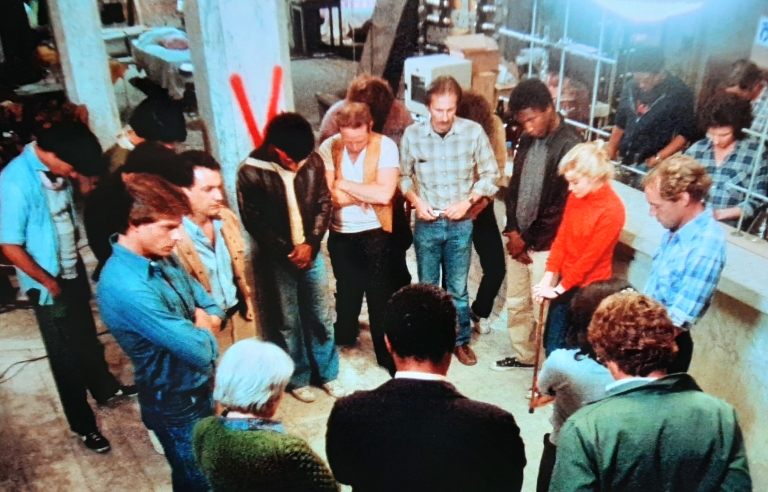
The free and righteous praying to the Lord.
As it is clearly still great and engaging to watch, V: The Original Miniseries (1983) certainly aged well, it remains essential to watch even by today’s standards and most of all, its theme about the conflict of freedom and dictatorship makes it completely relevant to this day. It is a reminder about what your part in your society is, who you are, what your values are, and why you have freedom in your local society which can be destroyed by an alienating force once your fellow people refuse to resist it. As mentioned earlier, the cast is great and I am confident that you readers will find a character or two to relate with.
The focus of this miniseries on fascism invading the lives of the free people easily reminds me about how, in this modern age, sinister influences like Marxism, socialism, Communism, unrestrained political correctness and fascism poisoned the minds of millions of people through the academic system and turned them into social rebels, domestic terrorists, looters, rioters and new criminals who are so determined to go against their fellow people who do not share their beliefs. In modern-day America, the ongoing movements of Black Lives Matter, Antifa, SJWs, the anti-Semitic BDS movement, the rabid LGBTQ+ movement, the so-called democratic socialists and other agents of Satan have been harming patriotic Americans, attacking their values, taking the innocence of the youth and children away, destroying businesses and tearing down societies as we know it. The 1983 mini-series will remind you that from time to time, social order will be pushed hard by the invaders (be it people or be it influences so alien to the society) and the people who are righteous can choose to restore the said order as well as their respective lives.
Seriously, if you value your freedom, your culture, your values, your people and your faith in the Lord, you certainly would not want to submit yourselves to a foreign people who intend to destroy you.
No matter what happens, people should never lose faith in the Lord and they must look up to Him for deliverance. The Lord will punish the wicked and make ways happen to lift up the faithful. Clearly, V’s theme about the fight for freedom is truly universal.
Symbolism and socio-political relevance aside, V: The Original Miniseries (1983) also comes with a good amount of spectacle that make sense within the narrative. Do not expect to see extensive, over-the-top action scenes of modern-day cinema/television here but I assure you that the spectacle (note: even with the flawed matte imagery of the visual effects) in this production paid-off nicely in relation to the build-up of events throughout the story.
I strongly recommend you acquire V: The Original Miniseries on Blu-ray while it is still available. Watching it in high-definition is a great experience on my part.
Overall, V: The Original Miniseries (1983) is highly recommended! That being said, I strongly encourage you to buy it on Blu-ray disc format while it is still available and affordable. If you want more of Kenneth Johnson’s other work related to V, I suggest you to look for his book V: The Second Generation. Don’t forget to visit Johnson’s website at http://www.kennethjohnson.us/
+++++
Thank you for reading. If you find this article engaging, please click the like button below and also please consider sharing this article to others. If you are looking for a copywriter to create content for your special project or business, check out my services and my portfolio. Feel free to contact me as well. Also please feel free to visit my Facebook page Author Carlo Carrasco and follow me at HavenorFantasy@twitter.com
For more V-related writings of mine, check out my retro comic book reviews of the V comic books (published by DC Comics) issues #1, #2, #3 and #4.
When it comes to science fiction movies of Hollywood, the 1980s was quite an interesting decade. Released during the decade were these epic sci-fi flicks like The Empire Strikes Back, Return of the Jedi and Dune. Not to be outdone were the low-budget sci-fi movies that made an impact on pop culture like The Terminator and E.T.: The Extra-Terrestrial.
Within the big mix of these kinds of films during the 1980s was Starman which was overlooked.
Released in 1984 to positive reviews (and later an Academy Award nomination for Best Actor for Jeff Bridges), Starman was directed by John Carpenter who established himself nicely in Hollywood with 1978’s Halloween. Between Halloween and Starman, Carpenter also directed genre classics Escape from New York and The Thing.
Starman follows an alien creature whose ship (a UFO) was shot down by fighter jets that acted in defense. The alien finds its way into the house of Jenny Hayden (Karen Allen) who is grieving over the sudden death of her husband Scott (Jeff Bridges) watching a personal video of their past and drinking lots of liquor. Inside the house was an album which contained a lock of hair which the alien used to create a clone of Scott instantly from infant to full adult which is the titular Starman (also played by Bridges).
This of course shocks Jenny. She sees her husband return yet it’s not really him. Starman – the alien – clearly is not used to occupying a human body but does his best to communicate with her in English. He also carries with him seven silver spheres that allow him to do special things (specifically manipulating matter) that would appear as miracles to others. Starman wants Jenny to bring him to the Barringer Crater in Arizona within three days in order to be picked up by his fellow aliens. Otherwise he would die.
Although frightened and hostile towards him, Jenny still was considerate enough to drive him far away.
If there is anything significant about this movie, it is the sheer depth of character development of both Jenny and Starman. Equally significant is the chemistry between Karen Allen and Jeff Bridges who made their characters believable.
Jeff Bridges is excellent in his portrayal of Starman. He’s clearly an alien who is not only struggling on being in a human body but also struggles to learn about the many ways of life and expression around him on his time on Earth. This includes learning gestures, saying words and doing things that people already find normal to do.
Karen Allen delivered a fine performance as Jenny Hayden. In fact when it comes to character development, I see Jenny a more significant character than her counterpart from outer space. While Starman adapts to life on Earth, Jenny’s character is gradually and convincingly transformed from one who is stuck with the past and being bitter into a person who gets renewed by understanding that life does have more to offer, that hope exists, that miracles do happen and finding new love and inspiration to live on.
As a Born Again Christian who went through personal transformation, who gained renewed faith in the Lord, and who left the old life behind to live on with a new purpose in life, I strongly relate with Jenny’s character development a lot. The concept of renewal and personal transformation portrayed by Karen Allen is much clearer to me than ever. Not to be outdone is the element of the healing of the soul of Jenny as a result of learning and understanding Starman.
The movie also has a solid supporting character in scientist Mark Shermin nicely played by Charles Martin Smith. Shermin is the typical sympathetic and willing-to-understand scientist who strives to discover first-hand an actual living alien which puts him into conflict the National Security Agency’s plan to capture Starman dead or alive. His talk with Starman reminds us viewers that humanity is always flawed and has many times resorted to violence as a means of accomplishment whenever a challenging situation (read: the visit of Starman to Earth by space ship only to be shot down due to fear of being invaded) happens.
With regards to storytelling, Starman is a nice mix of genre elements that goes beyond science fiction. It is also a road movie and a romance. At the same time director John Carpenter told the story with a controlled pace that gives viewers ample time to understand what’s been going on and a decent amount of spectacles that highlight Starman’s miracles.
Speaking of which, the film has elements of Christianity and the miracles of Starman are just the start of it. I could emphasize further here what the other elements are but that would mean spoiling the story and that is something I won’t do. You just will have to watch the movie to realize it.
Is Starman a wonderful movie? Absolutely! Is it one of the best works of John Carpenter? Truly it is and it deserves any moviegoer’s attention. How does it compare with other friendly alien movies like E.T.: The Extra-Terrestrial and Close Encounters of the Third Kind? Compared to those two flicks, Starman has the best and most mature character development of its protagonists. Its dramatic performances are also better.
Starman is a true sci-fi classic that deserves your attention even if you are not fond of sci-fi or UFO movies. I highly recommend buying this movie on Blu-ray disc or by streaming it.
Thank you for reading. If you enjoyed this article, please click the like button below and also please consider sharing this article to your fellow John Carpenter fans and sci-fi movie fans. Also my fantasy book The World of Havenor is still available in paperback and e-book format. If you are looking for a copywriter to create content for your project or business, check out my services.
Author’s Note: This article was originally published at my old Geeks and Villagers blog. What you read on this website was an updated and expanded version. In other words, this newest version you just read is the most definitive version.








 Author Carlo Carrasco