A Look Back at Spider-Man 2099 #12 (1993)

Welcome back superhero enthusiasts, 1990s culture enthusiasts and comic book collectors! Today we go back to the year 1993 to explore a part of the Marvel Comics shared universe through a tale of the Spider-Man 2099 monthly series.

By 1993, the 2099 lineup of comic books became popular with Marvel Comics readers and it was the series of the futuristic Spider-Man that engaged readers a lot thanks to the in-depth writing of the late Peter David. It should be stated that David also wrote a lot of stories of the classic Spider-Man (Peter Parker) years before Marvel even launched the 2099 franchise of comic books.

With those details laid down, here is a look back at Spider-Man 2099 #12, published in 1993 by Marvel Comics with a story written by Peter David and drawn by Rick Leonardi.
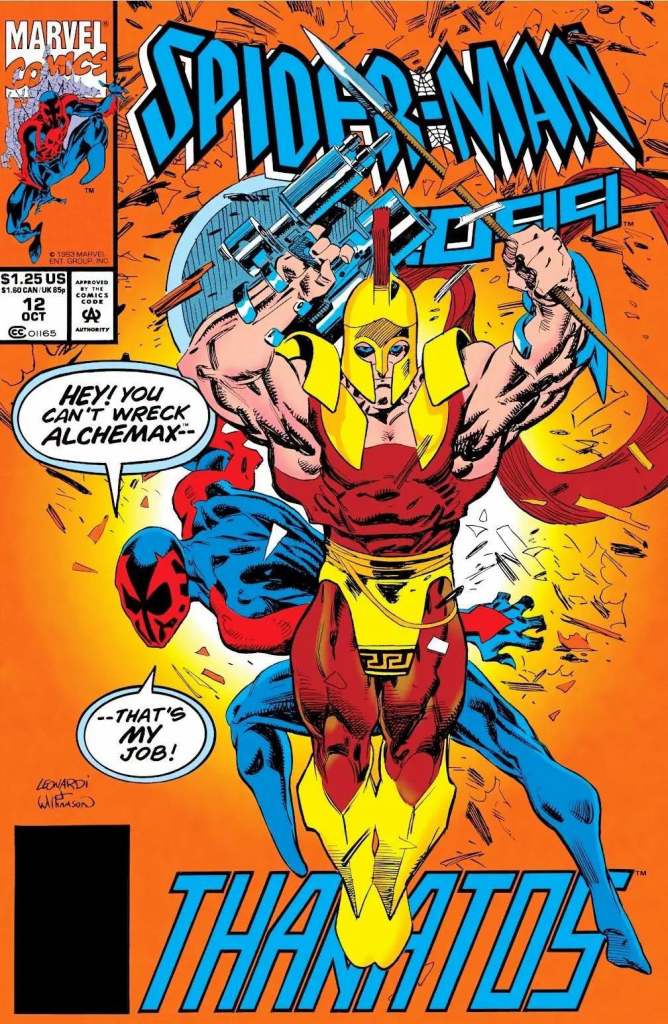
Comic book cover featuring Spider-Man and a character named Thanatos. Spider-Man is seen in a dynamic pose, while Thanatos, wearing a gold and red costume with a helmet, is prominently displayed. The background is orange with comic-style text.
The cover.

Early story

The story begins in an Alchemax facility with Tyler Stone talking with Dana at work. As Miguel O’Hara walks by the virtuality unreality office, a huge explosion sudden hits them. It turns out there was an experiment by Jordan Boone that went wrong and Miguel finds him. As the two talked, Jordan remains arrogant and sarcastic towards O’Hara.

Elsewhere, the mysterious man wearing armor and a helmet uses his device to scan the Alchemax facility and he spots Tyler Stone and Dana talking with each other. He listens to their conversation closely…

Quality
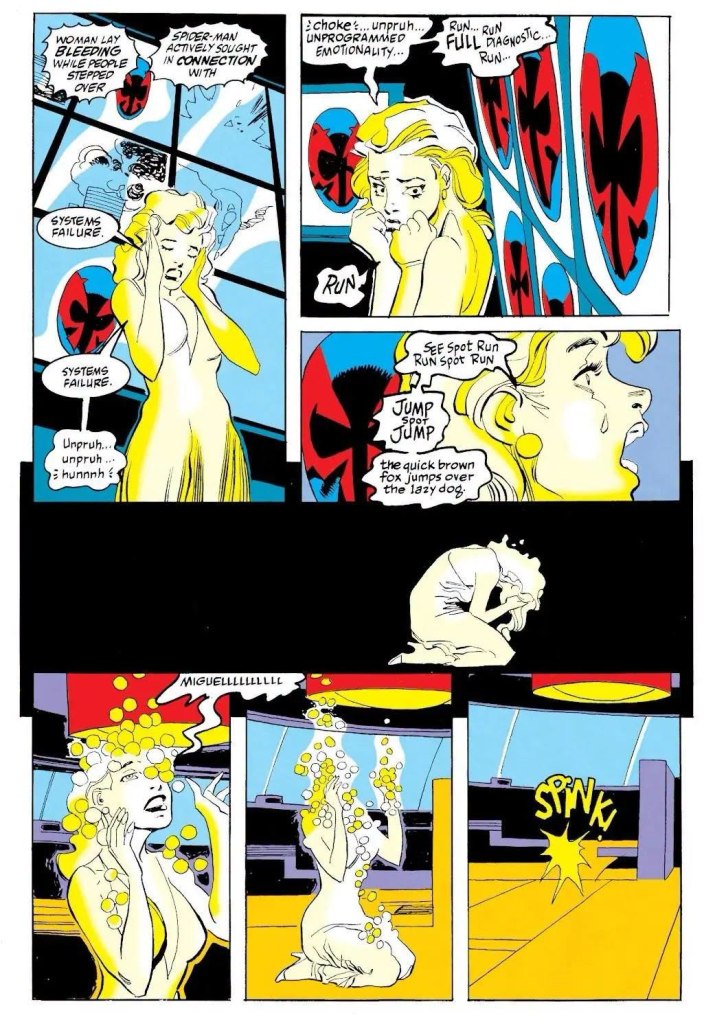
A comic strip featuring a distressed woman with long blonde hair expressing emotional turmoil amidst a backdrop of technological failure. The panels depict her hesitation, thoughts on running, and a call to someone named Miguel. The scene is vibrant with bright colors, emphasizing her emotional state.
Not even Miguel O’Hara’s AI assistant could handle the news.

This is a tale that has a careful mix of complexity and twists within. It technically is about the business of Alchemax getting disrupted from within and from the outside with the mysterious Thanatos pursuing something deep within the secrets of the company.

Miguel O’Hara is in a bind here as Dana (who is his fiancée) gets involved in a dangerous situation because of Thanatos’ sudden forced entry into Alchemax targeting Tyler Stone. At the same time, O’Hara values the company and prefers it does not collapse because of Thanatos. As expected, Miguel changes into the futuristic Spider-Man and carefully deals with Thanatos not by force but with strategic negotiation and discussion. Since he does not know what Thanatos is truly after, he has to play along while ensuring nobody from the company suffers (even though Alchemax itself has some very undesirable personalities within).

All throughout, this tale is heavy on the dialogue and there are a lot of details that you will need to absorb in order to understand the story and what Thanatos is pursuing. Along the way, this story reveals Alchemax has something valuable that has nothing to do with wealth. This is where the virtual unreality division of the company comes into place and Jordan Boone (who later becomes the fake Loki in the Fall of the Hammer storyline and also Halloween Jack in later X-Men 2099 tales) has a very notable role here. The story moves mostly in a medium pace and the build-up of the plot happens gradually. As such, there is some suspense and intrigue here.

Thanatos here is a pretty calculating antagonist. He is capable of killing others to get what he wants, but he prefers to do things patiently and strives get what he wants without using force as the primary option. There is richness in the dialogue here and his interactions with Spider-Man and Tyler have a cerebral touch throughout.

Conclusion
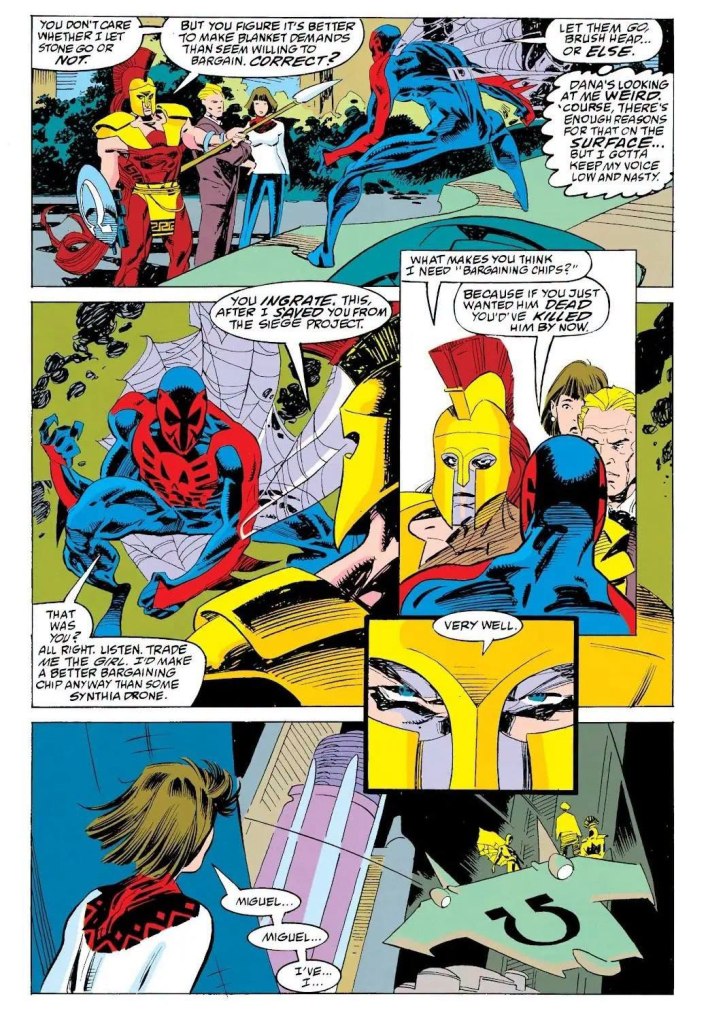
A comic book panel featuring characters in superhero costumes interacting, with one character in a red and black suit resembling Spider-Man, and another in a yellow and blue suit. Dialogue bubbles reveal a tense negotiation. The scene includes two other characters standing nearby, with a futuristic background.
Spider-Man carefully talks with Thanatos to let Dana go free. Dana does not know Miguel O’Hara and Spidey are one and the same person.

Spider-Man 2099 #12 (1993) is a really intriguing read filled with suspense and twists. This is not your typical superhero story about the hero fighting hard with the villain, and Thanatos is a pretty unique antagonist who puts Alchemax and others on the edge of danger. That said, this tale is the start of a new storyline and there is more that have yet to be revealed. 

Overall, Spider-Man 2099 #12 (1993) is recommended.

+++++

Thank you for reading. If you find this article engaging, please click the like button below, share this article to others and also please consider making a donation to support my publishing. If you are looking for a copywriter to create content for your special project or business, check out my services and my portfolio. Feel free to contact me with a private message. Also please feel free to visit my Facebook page Author Carlo Carrasco and follow me on Twitter at @HavenorFantasy as well as on Tumblr at https://carlocarrasco.tumblr.com/ and on Instagram at https://www.instagram.com/authorcarlocarrasco
A Look Back at Doom 2099 #14 (1994)

Disclaimer: This is my original work with details sourced from reading the comic book and doing personal research. Anyone who wants to use this article, in part or in whole, needs to secure first my permission and agree to cite me as the source and author. Let it be known that any unauthorized use of this article will constrain the author to pursue the remedies under R.A. No. 8293, the Revised Penal Code, and/or all applicable legal actions under the laws of the Philippines.

Welcome back, superhero enthusiasts, comic book collectors, fans of 1990s pop culture and fans of Marvel Comics! We return to The Fall of the Hammer crossover storyline of Marvel’s 2099 universe and this is my first time to review a comic book of Doom 2099 (note: this comic book marks the 4th chapter of the crossover).

Last time around, the X-Men of 2099 got involved in the events and their member Skullfire got reunited with them thanks to some help by Doom of 2099. The self-proclaimed Thor realizes that a powerful friend of his is down on the floor.

With those details laid down, here is a look back at Doom 2099 #14, published in 1993 (cover dated 1994) by Marvel Comics with a story written by John Francis Moore and drawn by Pat Broderick.

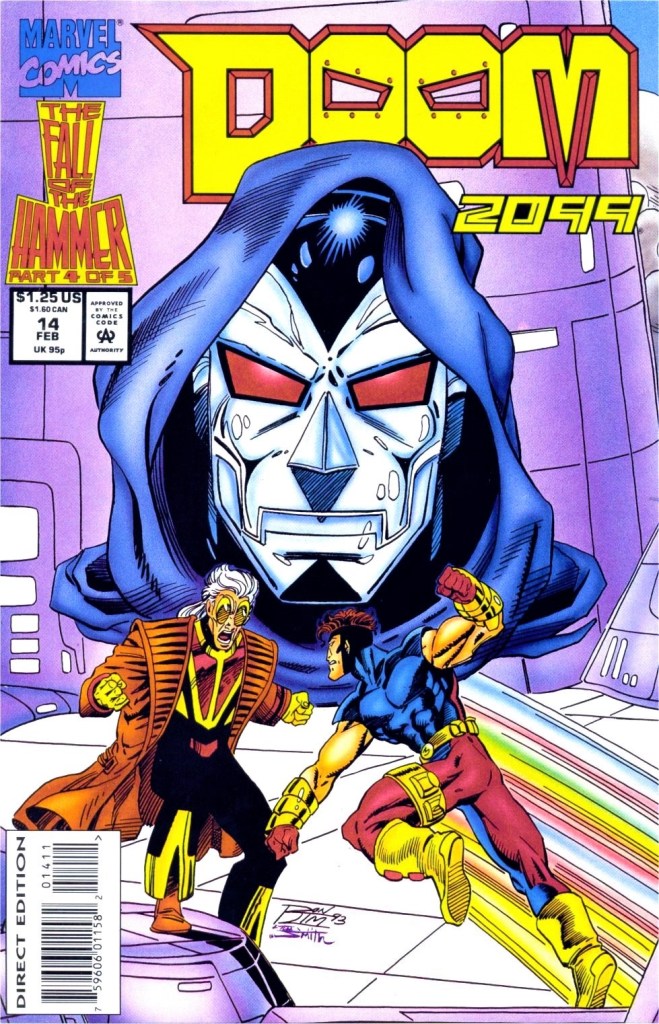
The cover.

Early story

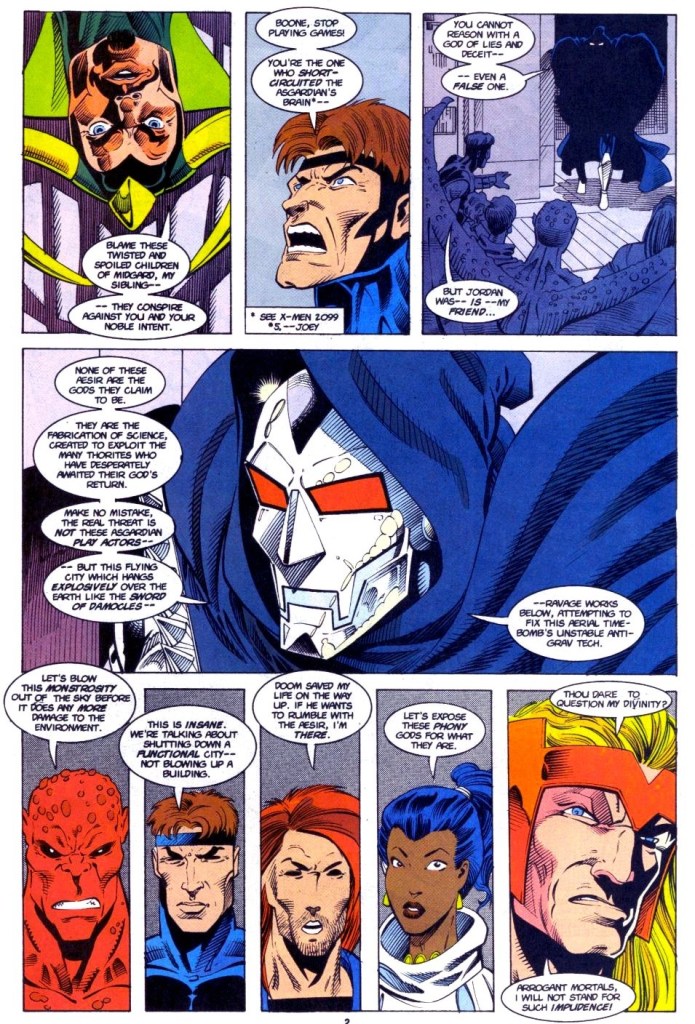
The story begins in Valhalla where Thor sees his powerful friend lying down helpless. X-Men’s Bloodhawk, Krystalin, Meanstreak, Skullfire and the self-proclaimed Loki witness Thor’s curiosity. Loki, who is actually Meanstreak’s friend Boone in disguise, tells Thor to blame what he calls the spoiled children for conspiring against him. Meanstreak tells Boone to stop his act and reminds him that he was the one who caused the short-circuit.

Doom 2099 then tells them that none of the gods are real for they are the fabrication of science created to exploit the believers of Thor who have desperately awaited the return of their god. Doom points out that the real threat is not the Asgardian play actors but rather the flying city of Valhalla itself.

After hearing the ramblings of the others, Thor then makes his move to strike Doom 2099…

Quality

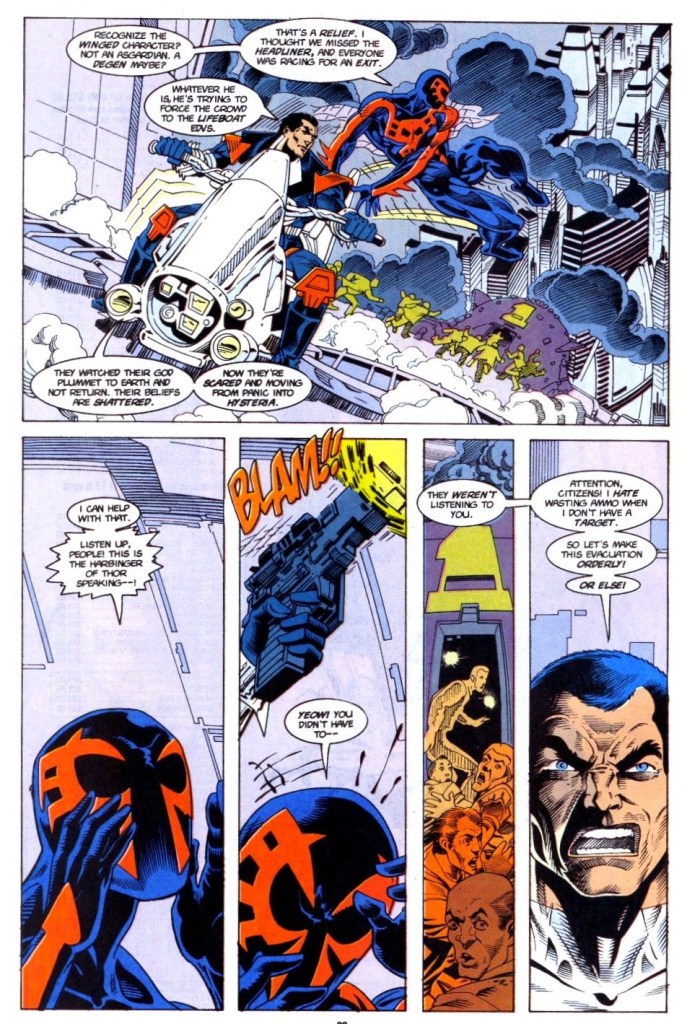
This comic book shows Spider-Man and Punisher of 2099 finally ending their long ride together.

As expected, there is indeed pay-off executed in this comic book in relation to the gradual build-up that took place in the first three chapters (Spider-Man 2099 #16, Ravage 2099 #15, and X-Men 2099 #5). You must be wondering how was the pay-off…I can say it was executed good enough. Not only does this comic book reveal the truth about the so-called Asgardian deities, it also sheds light on who the pretenders really are and, more notably, who is the mastermind behind everything and why did all these unfortunate events happen in the first place.

Behind it all, there is subversion in the form of criticism and accusations against corporations, against people of faith and even against idolaters who don’t realize that idolatry is unholy and foolish. In a certain way, this comic book made its case in support of Marxism, socialism, Communism and atheism even though those four forms of evil were not explicitly emphasized.

When it comes to the characters, Doom 2099’s presence here is actually light but it should be noted that his civil discussion with a powerful figure behind the scenes gave the story a lot of weight. What I enjoyed about Doom 2099 is his Darth Vader-like way of talking and taking action.

The X-Men of 2099 surprisingly have a good share of the spotlight here while Spider-Man 2099 and Punisher 2099 finally stopped riding together and begin to get involved with the troubles of Valhalla. I should state that the first-ever meeting between Spider-Man 2099, Punisher 2099 and Doom 2099 is a short yet powerful scene.  

Conclusion

Doom 2099, the X-Men 2099 members, Loki and Thor on the 2nd page.

Being the fourth chapter of The Fall of the Hammer crossover storyline, I can say that Doom 2099 #14 (1994) proved to be the most engaging chapter yet mainly due to its pay-off in relation to what was built-up before it. The revelations were quite strong and clearly this comic book was the tuning point of the storyline, and even set the stage for the concluding chapter. I caution you, however, that the anti-capitalist and anti-faith themes of this comic book can lead you to trouble if you decide to take them seriously. It is bad enough that American society today is being torn down by Marxist, socialist, Communist and atheistic forces. You have been warned!

If you are seriously planning to buy an existing hard copy of Doom 2099 #14 (1994), be aware that as of this writing, MileHighComics.com shows that the near-mint copy of the regular edition costs $60 while the near-mint copies of the newsstand edition and the signed-and-numbered edition cost $180 and $300 respectively.

Overall, Doom 2099 #14 (1994) is recommended.

+++++

Thank you for reading. If you find this article engaging, please click the like button below and also please consider sharing this article to others. If you are looking for a copywriter to create content for your special project or business, check out my services and my portfolio. Feel free to contact me as well. Also please feel free to visit my Facebook page Author Carlo Carrasco and follow me at HavenorFantasy@twitter.com

A Look Back at X-Men 2099 #5 (1994)

Disclaimer: This is my original work with details sourced from reading the comic book and doing personal research. Anyone who wants to use this article, in part or in whole, needs to secure first my permission and agree to cite me as the source and author. Let it be known that any unauthorized use of this article will constrain the author to pursue the remedies under R.A. No. 8293, the Revised Penal Code, and/or all applicable legal actions under the laws of the Philippines.

Welcome back, superhero enthusiasts, comic book collectors, 1990s culture enthusiasts and fans of Marvel Comics! This is the continuation of a look back at the Marvel 2099 crossover storyline The Fall of The Hammer which started in Spider-Man 2099 #16 followed next in Ravage 2099 #15. The 3rd chapter of the said crossover filled the fifth issue of the X-Men 2099 monthly series.

For the newcomers reading this, a few of the X-Men of the far future were officially involved in this 5-part crossover storyline that was meant to celebrate the Marvel 2099 franchise back in the 1990s. This was the reason why Skullfire, Meanstreak, Krystalin and Bloodhawk were separated from their team leader Xi’an and the remaining teammates. Last time around, three of the mentioned X-Men got involved with Ravage and eventually reached the floating city of Valhalla together only to get separated.

With those details laid down, here is a look back at X-Men 2099 #5, published in 1993 (cover dated 1994) by Marvel Comics with a story written by John Francis Moore and drawn by Ron Lim.

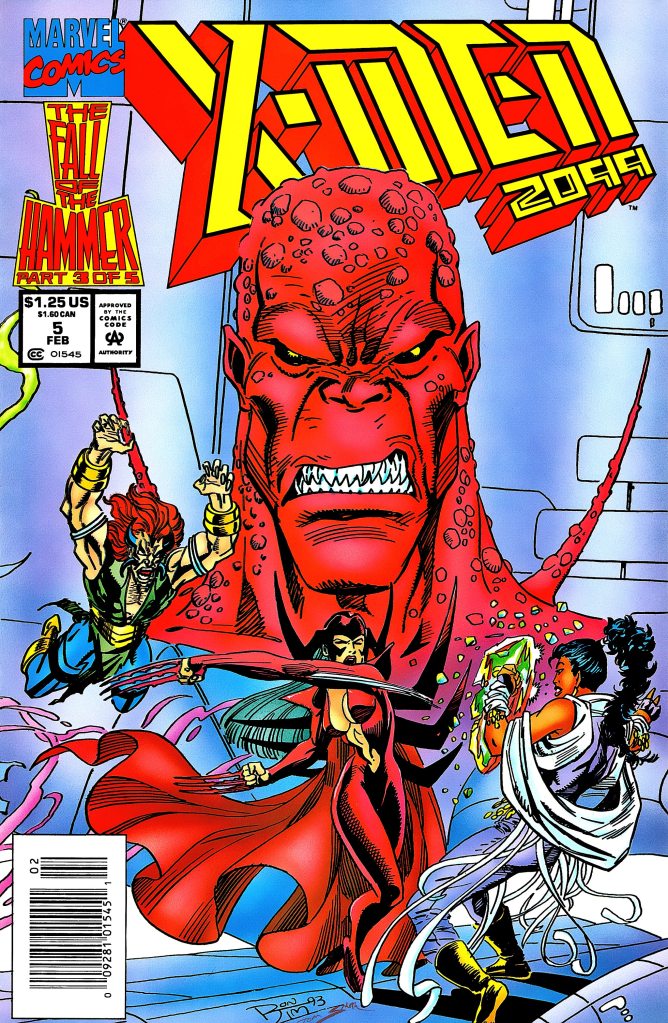
The cover.

Early story

The story begins in New York City where a vehicle moves at high speed until it hits a wall and stops. Out comes Tim Fitzgerald/Skullfire who moves away and spots Valhalla above him. In the floating city, Krystalin, Meanstreak and Bloodhawk are in confrontation with a powerful enemy called Heimdall who tells them to bow to him and swear allegiance.

Bloodhawk attacks Heimdall only to get pushed back. Krystalin fires crystal bits at him but to no success. Thinking that he’s too fast for Heimdall, Meanstreak tries a sneak attack from the side only to be hit hard, lose control and crashes to a wall. As the X-Men’s fastest member is down, a shadowy figure approaches him nearby…

Quality

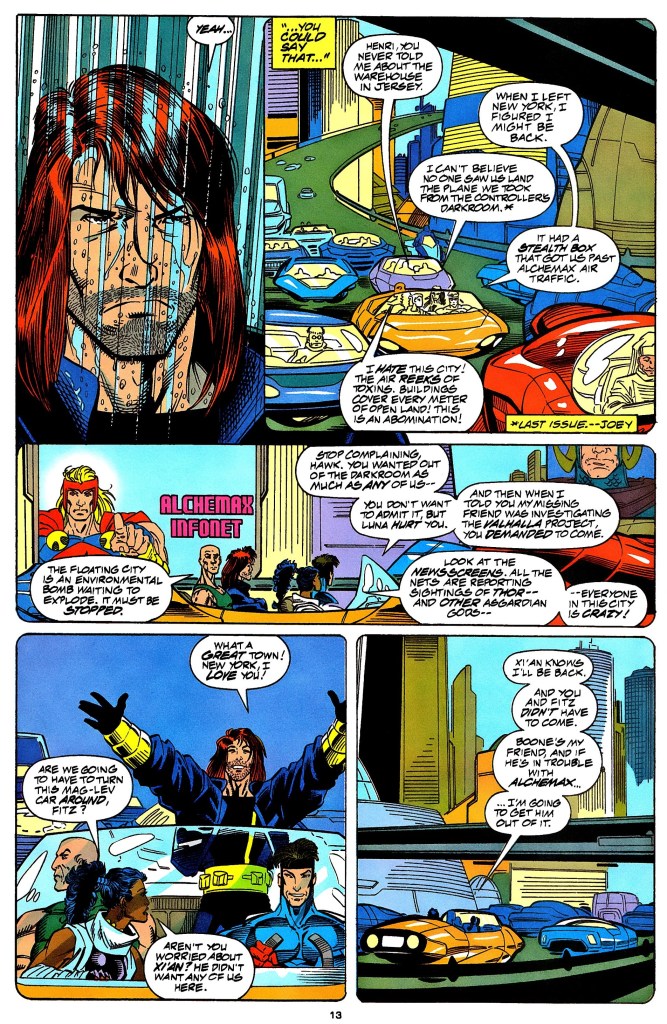
This quick flashback explains how the four X-Men 2099 members went to New York.

As an X-Men 2099 tale, this one felt like a catch-up for Skullfire who was absent in the first two parts of The Fall of the Hammer storyline even though it was confirmed in X-Men 2099 #4 that he joined his teammates and help Meanstreak find his friend Jordan. That being said, there is a good amount of scenes focused on Skullfire as he makes his way up to Valhalla. There is also a quick flashback showing that indeed he was with his teammates as they arrived in New York only to get separated (which explains why only Krystalin, Bloodhawk and Meanstreak approached Ravage). More importantly, the flashback also contains additional details that explain what the X-Men discovered before arriving at Valhalla and why they decided to approach Ravage.

As the 3rd chapter of The Fall of The Hammer storyline, this comic book barely moved the present-day narrative forward mainly due to having to use a few but precious pages to tell the short flashback to explain the X-Men’s involvement. Still, key revelations related to what happened behind-the-scenes added a lot of depth to the narrative and this properly sets the stage of for the remaining chapters. The 2099 major figures like Spider-Man, Punisher, Doom and Ravage all appeared here but very sparsely.    

Conclusion

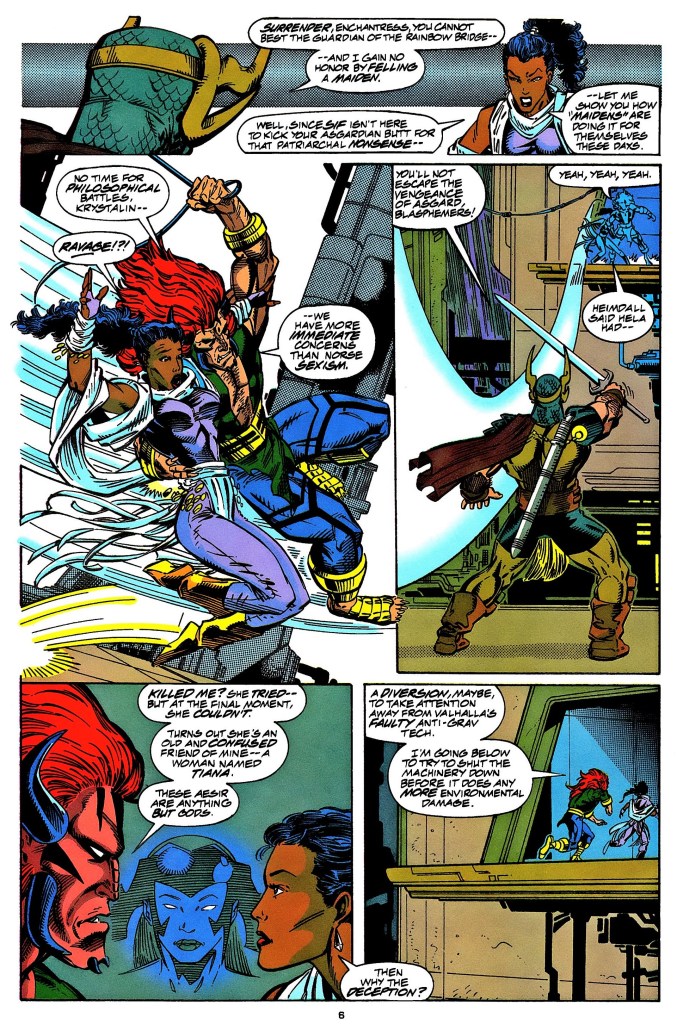
Ravage 2099 helps Krystalin.

X-Men 2099 #5 (1994) pushed the narrative of the crossover a few notches forward but the revelations written saved it from being a throw-away story. For fans of X-Men 2099, there is a lot to like here and Skullfire’s late entry into the crossover will delight them. The writing was good enough and by the end of the story, the explanations were satisfying and the ending suggested that the stakes would be raised for the final two chapters of the crossover. Those who missed the presence of Thor 2099 should be happy to see him here, even though it was clear that he was being conserved for the last two chapters.

If you are seriously planning to buy an existing hard copy of X-Men 2099 #5 (1994), be aware that as of this writing, MileHighComics.com shows that the near-mint copy of the regular edition costs $6 while the near-mint copy of the newsstand edition costs $18.

Overall, X-Men 2099 #5 (1994) is recommended.

+++++

Thank you for reading. If you find this article engaging, please click the like button below and also please consider sharing this article to others. If you are looking for a copywriter to create content for your special project or business, check out my services and my portfolio. Feel free to contact me as well. Also please feel free to visit my Facebook page Author Carlo Carrasco and follow me at HavenorFantasy@twitter.com