A Look Back at Wonder Woman #23 (1988)

Disclaimer: This is my original work with details sourced from reading the comic book and doing personal research. Anyone who wants to use this article, in part or in whole, needs to secure first my permission and agree to cite me as the source and author. Let it be known that any unauthorized use of this article will constrain the author to pursue the remedies under R.A. No. 8293, the Revised Penal Code, and/or all applicable legal actions under the laws of the Philippines.

Before I start another retro review of the post-Crisis Wonder Woman comic book series, I need to share to you readers my observations about the recent social media trends that happened inside three Wonder Woman-focused groups within Facebook.

For one thing, I asked a simple question on all three WW FB groups asking the members if they would want to see Zack Snyder replace Patty Jenkins as the director of future Wonder Woman movies. Their reactions were pretty mixed and among them were a few very toxic responses. One group member asked me why do I hate Patty Jenkins (I have no hatred for her and in fact I admired her work in the 2017 Wonder Woman movie and pointed out her work in my piece about the No Man’s Land scene). Another member (an openly feminist-minded male) condemned me of sexism (completely false).

And in most recent times, I posted a few not so favorable media reviews of Zack Snyder’s Justice League on those same three WW groups on Facebook. This member called me a hater (I’m not a hater and I cannot judge a movie I have not even viewed), another member thought I allowed the negative review to influence me (sharing a post of an unfavorable review does NOT mean I believe in it), while another member took it very personal against me by means of verbal attacks (that person does not even know me and he allowed his uncontrolled fanaticism to go on the offense) on me.

Whew! There sure are a lot of Wonder Woman fans out there who are over-sensitive, who lacked self-control, who allowed themselves to be influenced by the socialists, and who allowed themselves to be swallowed by unrestrained political correctness. Clearly there are lots of hostile minds and likely believers of Cancel Culture among fellow WW fans which is unfortunate. What I posted on those FB groups were simply about entertainment, not identity politics and certainly not about attacking others.

I am still standing here!

Anyway, last time I reviewed an issue of Wonder Woman that I determined lacked depth and only served to build-up suspense and anticipation for future events. What will happen next to Wonder Woman and her companions? Will there be a pay-off to the build-up that happened in the pages of issue #22? We can all find out in this look back at Wonder Woman , published by DC Comics in 1988 with a story written and drawn by George Perez with finishes done by Will Blybers.
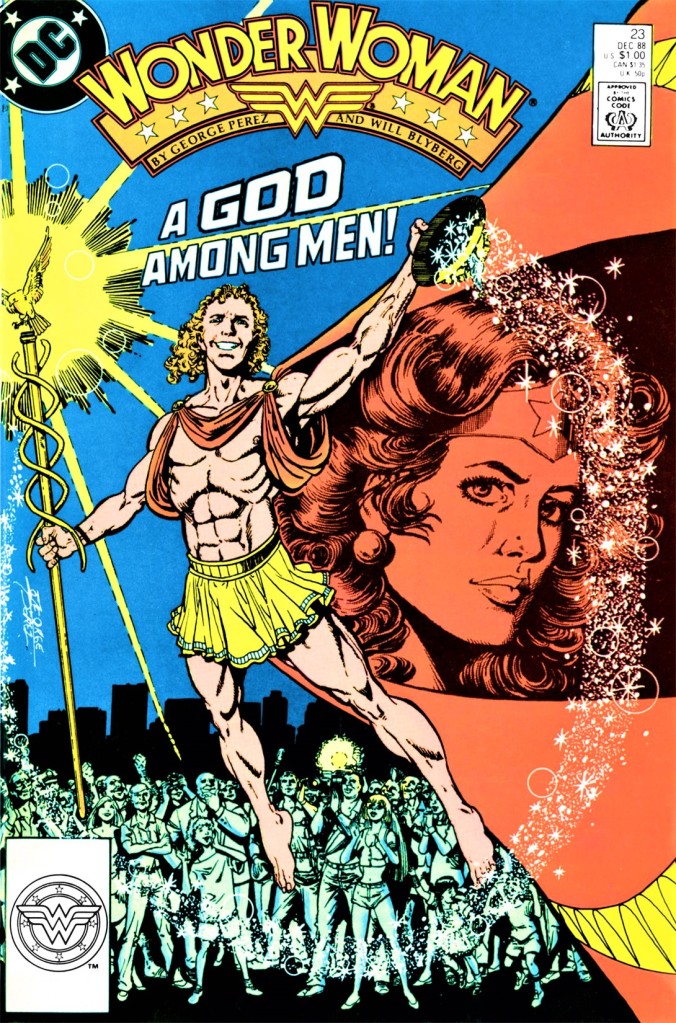
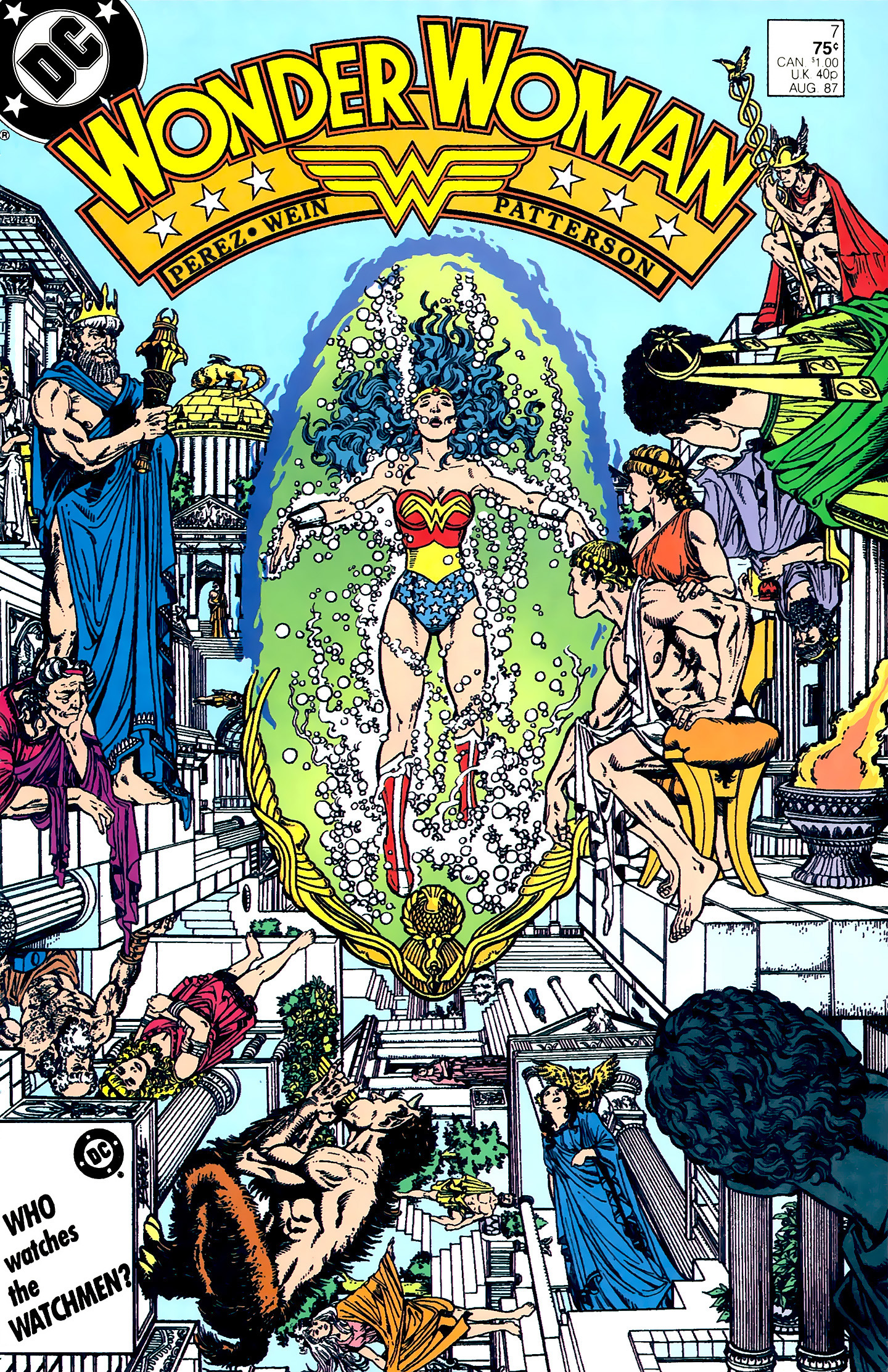
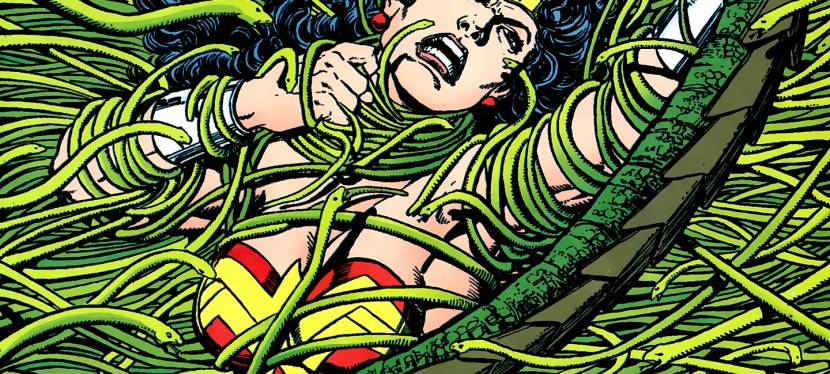
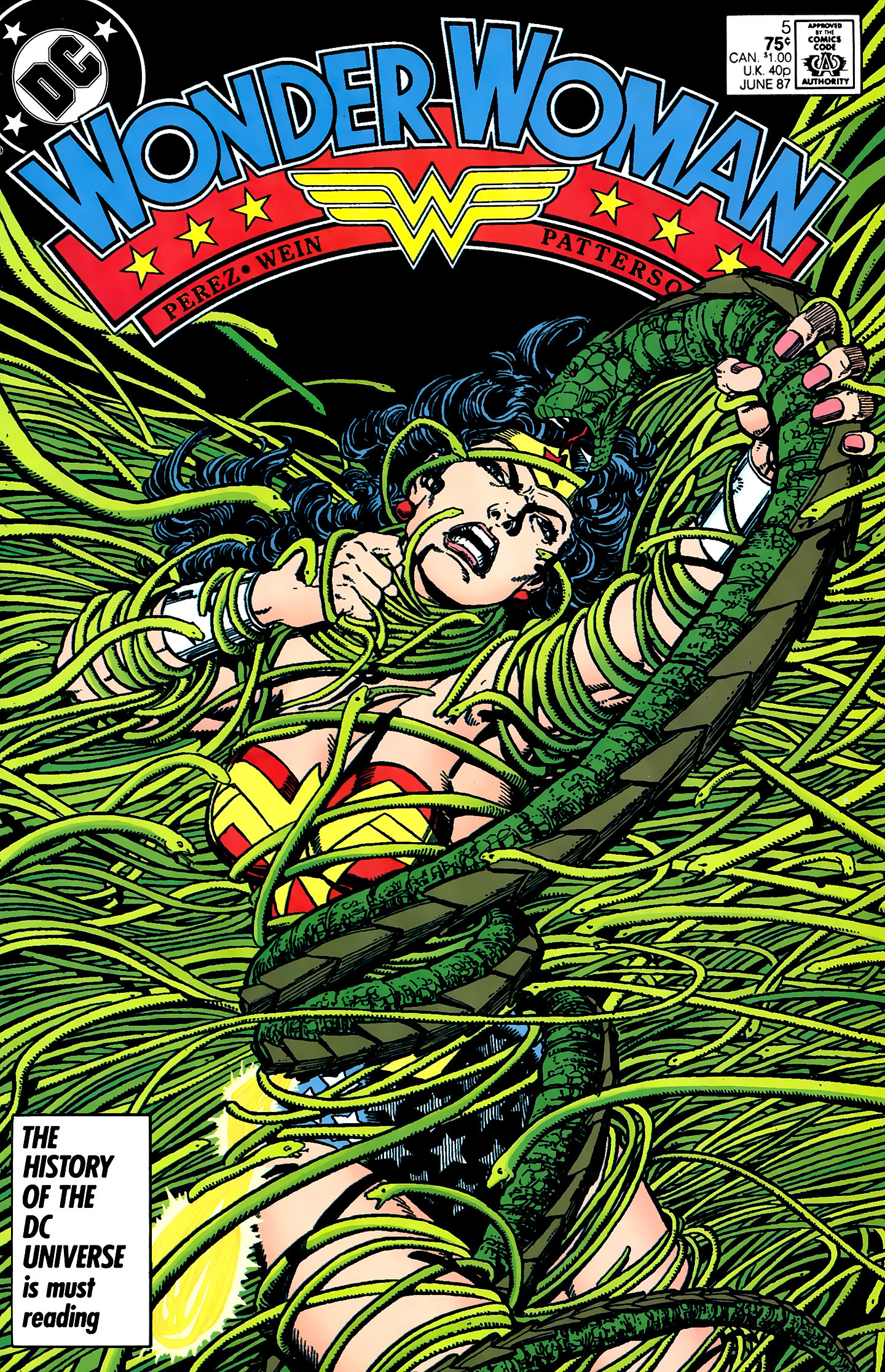
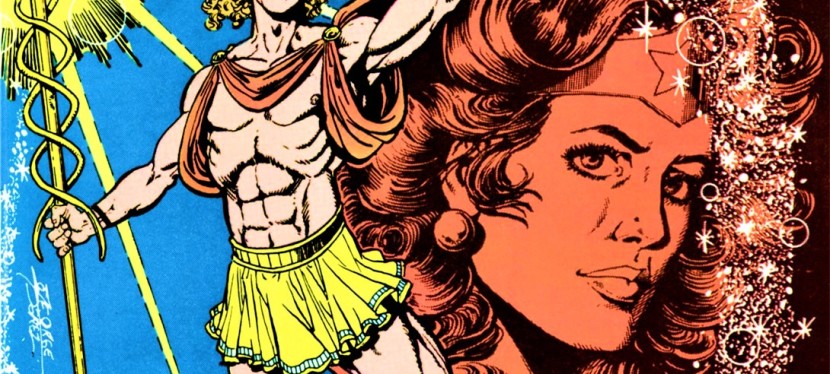
The cover.

Early story

The story begins with a print media blast of Diana, her mother Queen Hippolyte, as well as Julie Kapatelis and her daughter Vanessa all occupying varied parts of the front cover of The World Today magazine with a feature about the royal family of Themyscira. At the corner of the cover says, “Memories of a Boston teen.”

At school, the teenage Vanessa (referred to as Nessie) is completely surrounded by other students who want her to sign their respective copies of the said magazine. She is enjoying the attention being the close, personal friend of the Amazons. Vanessa’s friends Eileen and Meekins can only watch the activity from a distance feeling lonely and let down.

In New York, Wonder Woman delivered a speech to the United Nations general assembly. She spoke on behalf of her mother and formally announced that the gates of Themyscira will be opened to the rest of the world (which is the result of the Amazons’ majority vote in issue #22). The response to her speech ranged from enthusiastic to apathetic.

After the speech, Diana finds herself surrounded by news reporters who ask her a lot of questions about her homeland, Queen Hippolyta’s potential visit to man’s world (AKA patriarch’s world) and the way some assembly members reacted to her speech.

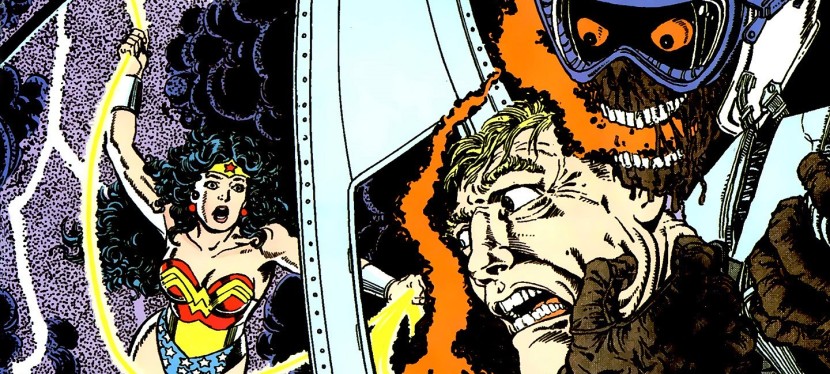
Suddenly a mysterious figure whose head and face cannot be seen emerges. Diana senses something is wrong…

Quality
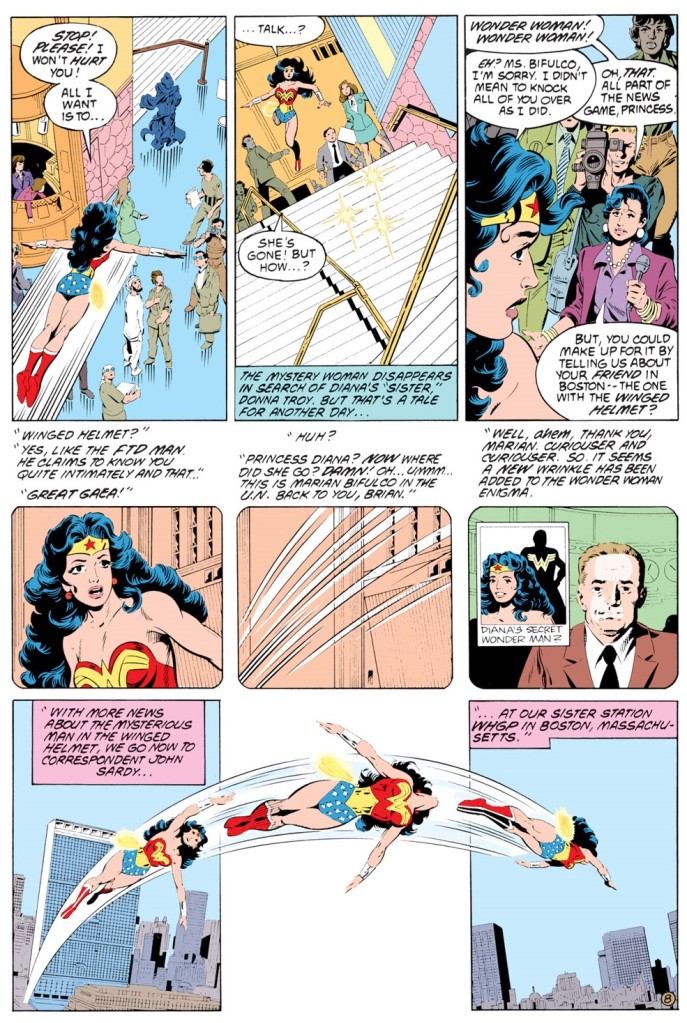
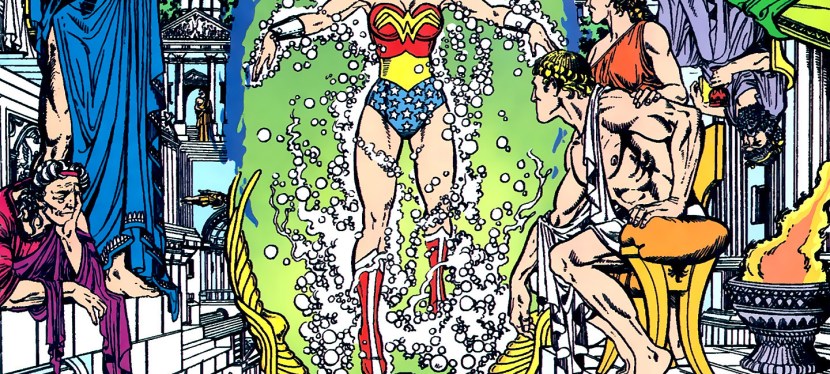
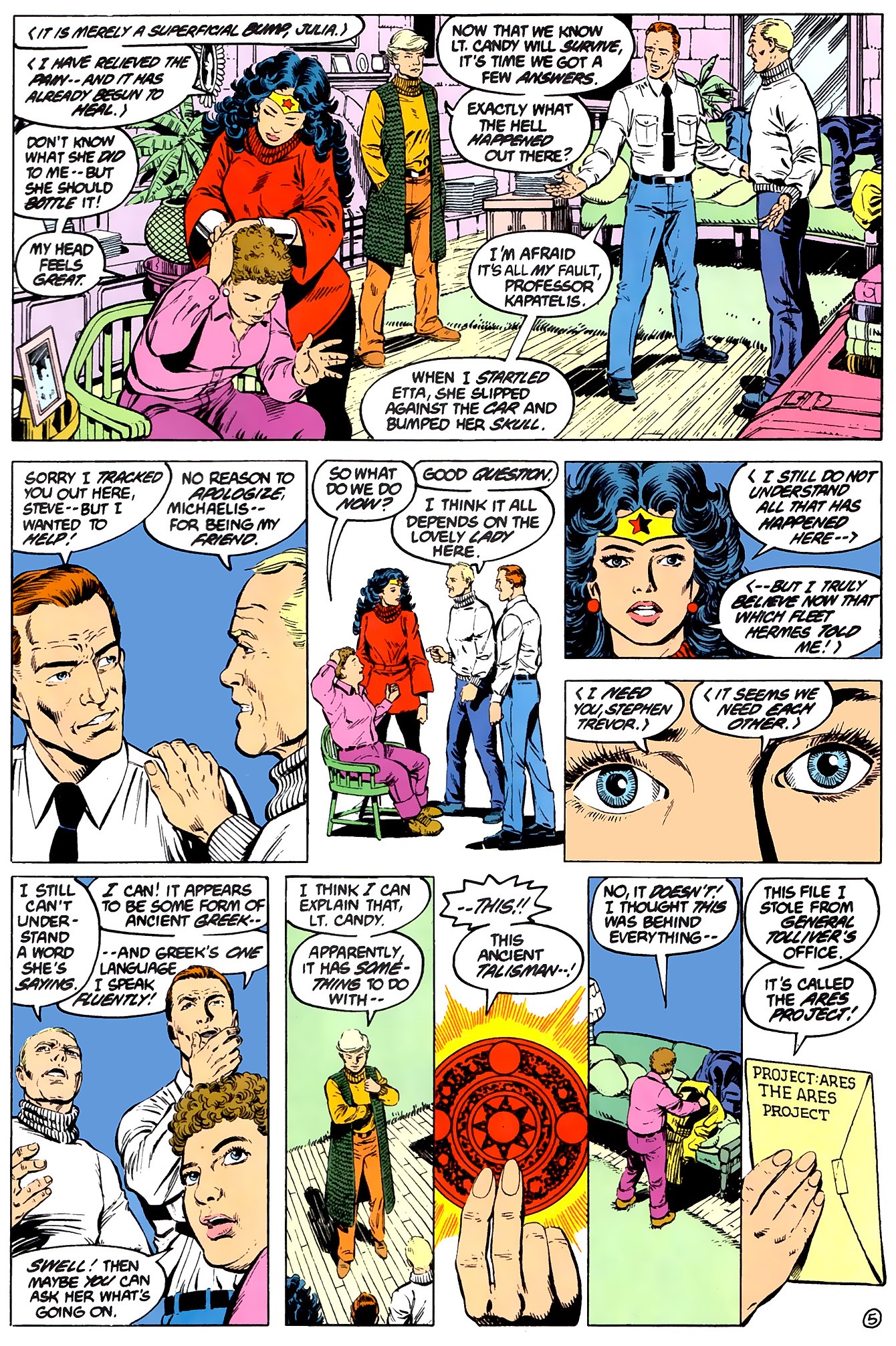
Wonder Woman flying in search of the mysterious figure.

I will start first by confirming that indeed, this comic book’s story has some pay-off to the suspense built-up in issue #22. Take note…some pay-off. It might sound disappointing for those who read issue #22 expecting a big pay-off but after going through the theme of this particular story, it is clear that there were planned plot events lying ahead related to the build-up (in issue #22).

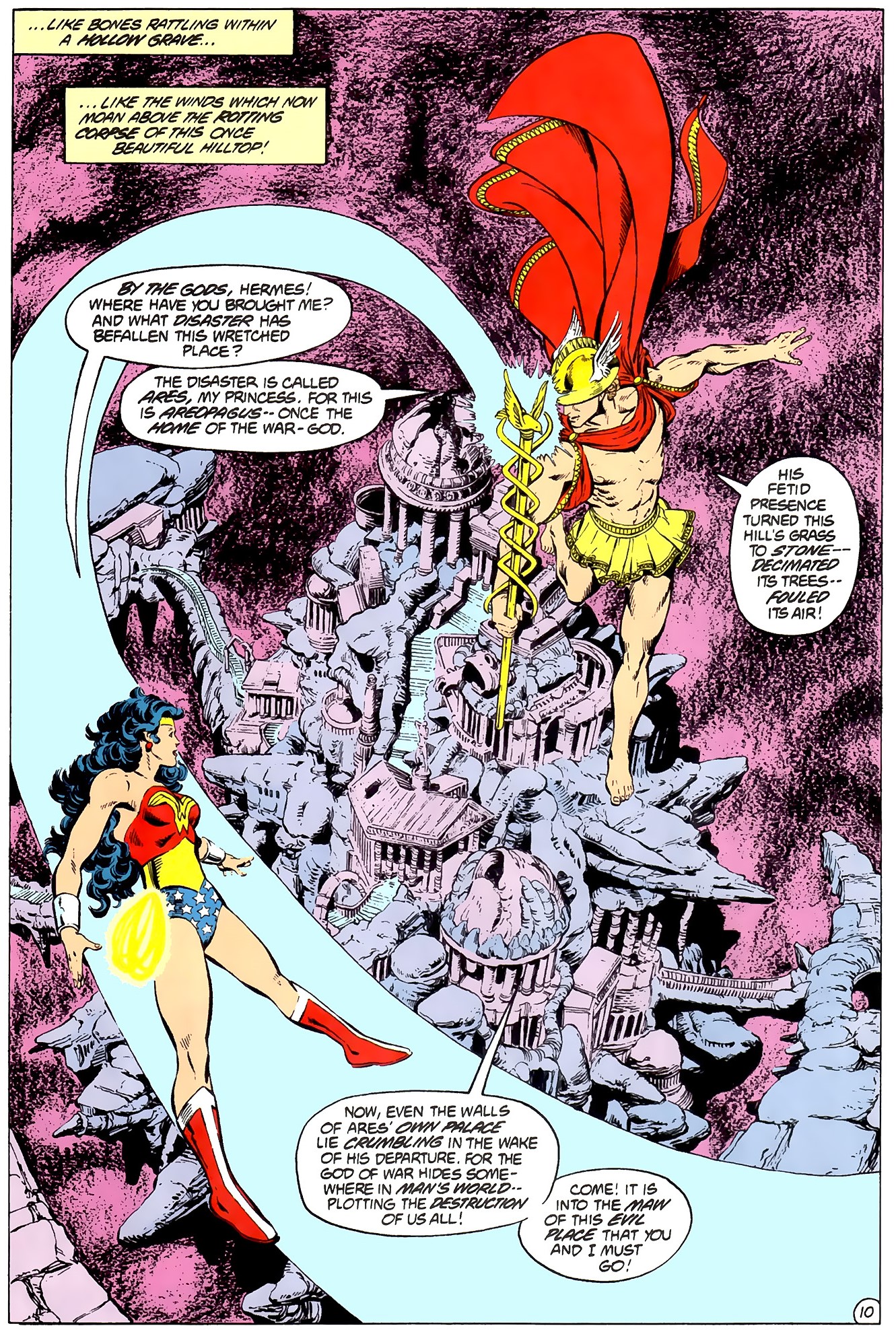
More on the story itself, without spoiling much, I can say that George Perez pushed the envelope yet again by involving Hermes a lot more with Wonder Woman here. A lord to Diana, Hermes appeared not merely for a cameo appearance nor as a guide as seen in the early issues of this series, but rather he has a much bigger role than before. Hermes does not just appear with Wonder Woman who strictly follows him, he also makes an impact with the people on Earth.

When it comes to moral lessons, this comic book is boldly written by touching on themes such as how a deity from Olympus would impact people by bribing them, why mortals let their guard down when they believe what they saw or witnessed, and why would a foreign deity (from Olympus specifically) does not want mortals to challenge their authority.

The good news here is that everything is very well written from the way the plot was structured, the clear presence of emotion that filled much of the dialogue and the notable presence of philosophies that added depth to the dialogue.

When it comes to Wonder Woman herself, I love the way how Perez portrayed her on her struggle of doing her duty (for Themyscira and her deities) and maintaining friendship with the people she loved in man’s world. There is that nice touch of fragility on Diana’s personality and the same can be found on Julie Kapatelis whose struggle with being a mother and a friend is nicely dramatized.

Conclusion
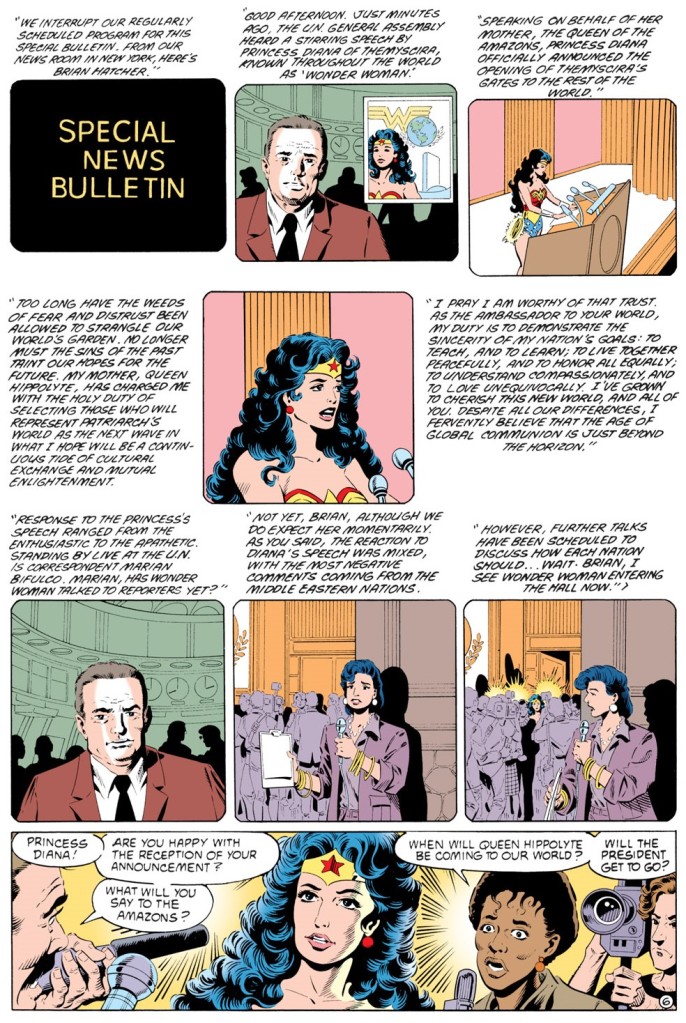
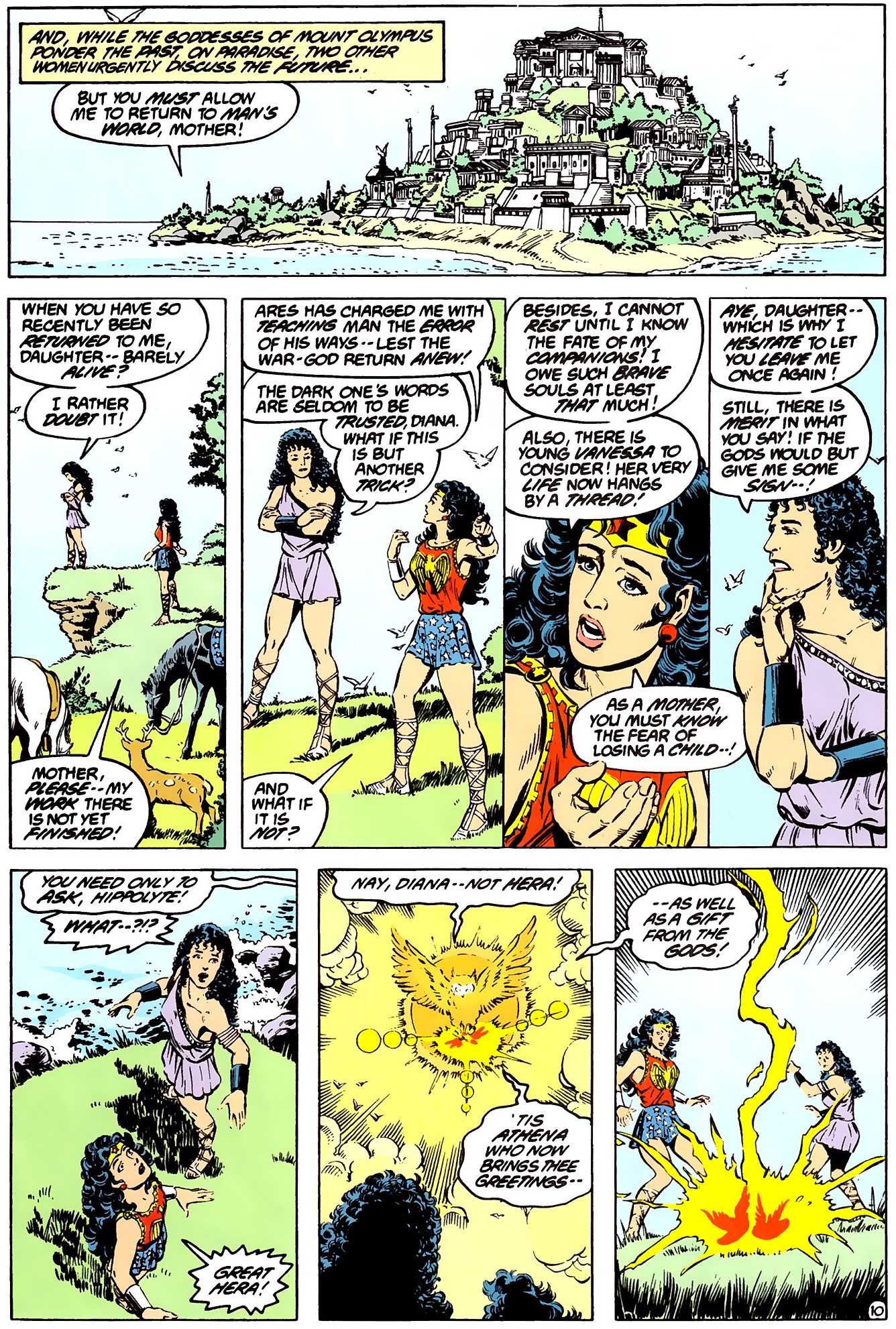
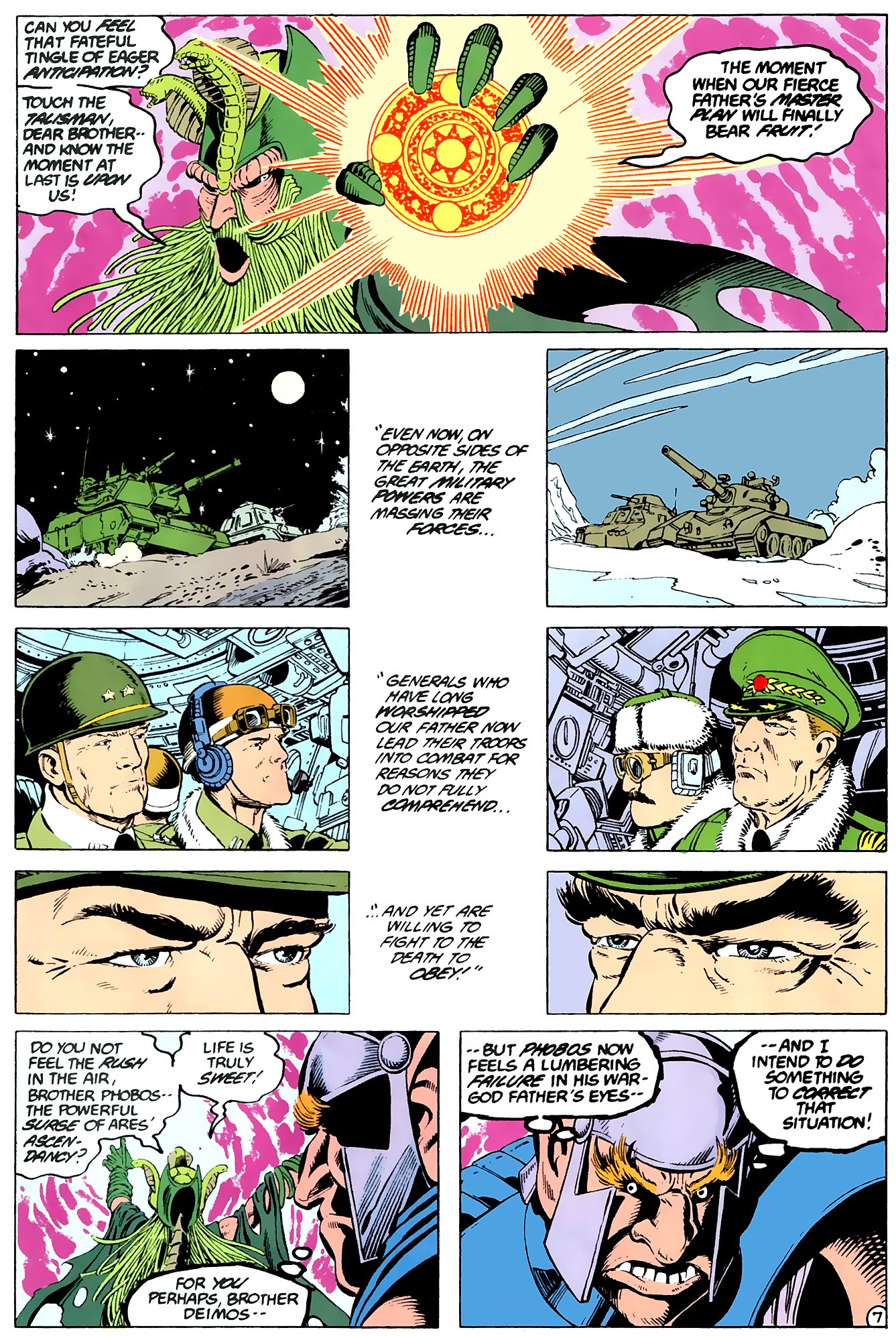
Wonder Woman faces the world through the corrupt United Nations.

I can say that Wonder Woman (1998) is a clear improvement over its predecessor by means of having a solid story concept backed with nice artwork (no surprise) and in-depth writing done by George Perez. I also like the fact that Wonder Woman herself gets upstaged in a rather reasonable way which shows Perez was not afraid to take risks when it comes to redefining the Queen of Superheroes in the post-Crisis era of DC Comics. Lastly, this comic book shows how faith is not to be practiced and why deities of Olympus are not worthy of faith and trust of the people. It also shows idolatry is foolishness.

If you are seriously planning to buy an existing hard copy of Wonder Woman (1988), be aware that as of this writing, MileHighComics.com shows that the near-mint copy of the regular edition costs $35 while the near-mint copy of the 2nd print edition costs $350.

Overall, Wonder Woman (1998) is highly recommended!

+++++

Thank you for reading. If you find this article engaging, please click the like button below and also please consider sharing this article to others. If you are looking for a copywriter to create content for your special project or business, check out my services and my portfolio. Feel free to contact me as well. Also please feel free to visit my Facebook page Author Carlo Carrasco and follow me at HavenorFantasy@twitter.com
A Look Back at Wonder Woman #20 (1988)

Disclaimer: This is my original work with details sourced from reading the comic book and doing personal research. Anyone who wants to use this article, in part or in whole, needs to secure first my permission and agree to cite me as the source and author. Let it be known that any unauthorized use of this article will constrain the author to pursue the remedies under R.A. No. 8293, the Revised Penal Code, and/or all applicable legal actions under the laws of the Philippines.

It’s the second week of March already. That means we are slowly but surely inching closer to the March 30, 2021 scheduled releases of Wonder Woman 1984 on 4K Blu-ray, Blu-ray and DVD! If you have not yet ordered a copy of the sequel starring Gal Gadot as the Queen of Superheroes, you can do so now if you want to. I already ordered my copy. You can also read my retro review of the 2017 Wonder Woman movie.

On to literature! Last time, the George Perez-led story not only saw the end of Diana’s visit of Greece, it also fully presented to readers what was back then the modern portrayal of Circe (DC Comics’ own take on the false Greek goddess) who proved to be at the time the most sinister and most powerful supervillain Wonder Woman faced. Wonder Woman also showed the Queen of Superheroes in her most vulnerable state.

Now that Diana and her friends have returned to America, we can find out what happens next in this look back at Wonder Woman , published by DC Comics in 1988 with a story written and illustrated by George Perez based on an idea by Carol Flynn. Bob McLeod was in charge of the finishes.

The cover.

Early story

The story begins in the City of Boston at night. Three Chinese men are running away from something until Wonder Woman confronts them. One of the men fires several bullets at her but each bullet got blocked by her using her tremendous reflexes and braces. After Wonder Woman disarms the gunman, another Chinese man tries attacking her with sharp weapons only to be defeated easily. The other Chinese man tries to run away but gets caught by Wonder Woman who uses her lasso. In reaction to his question, Wonder Woman demands answers.

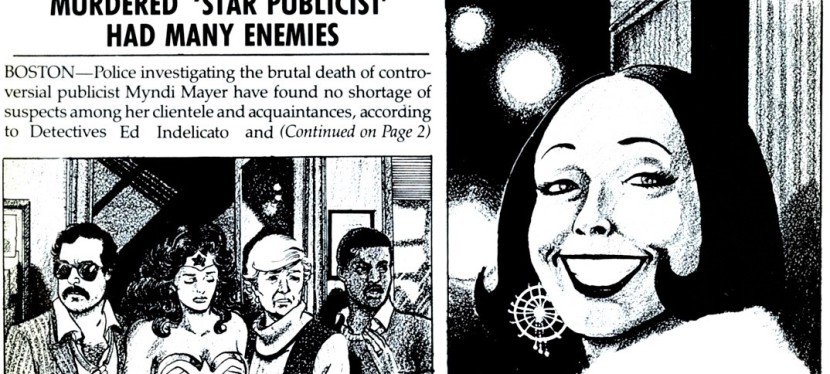
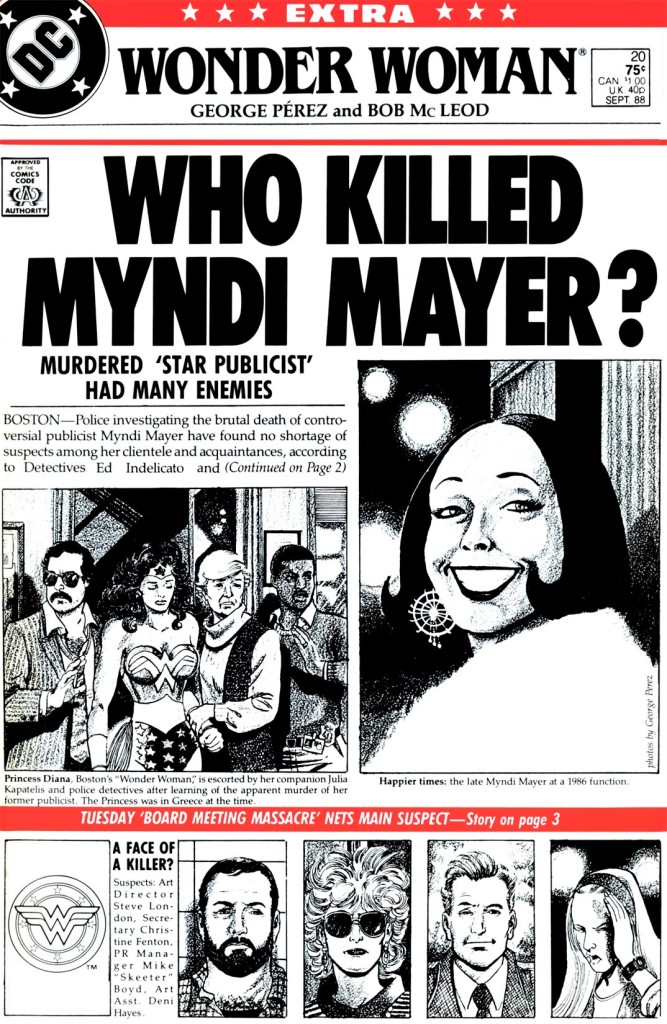
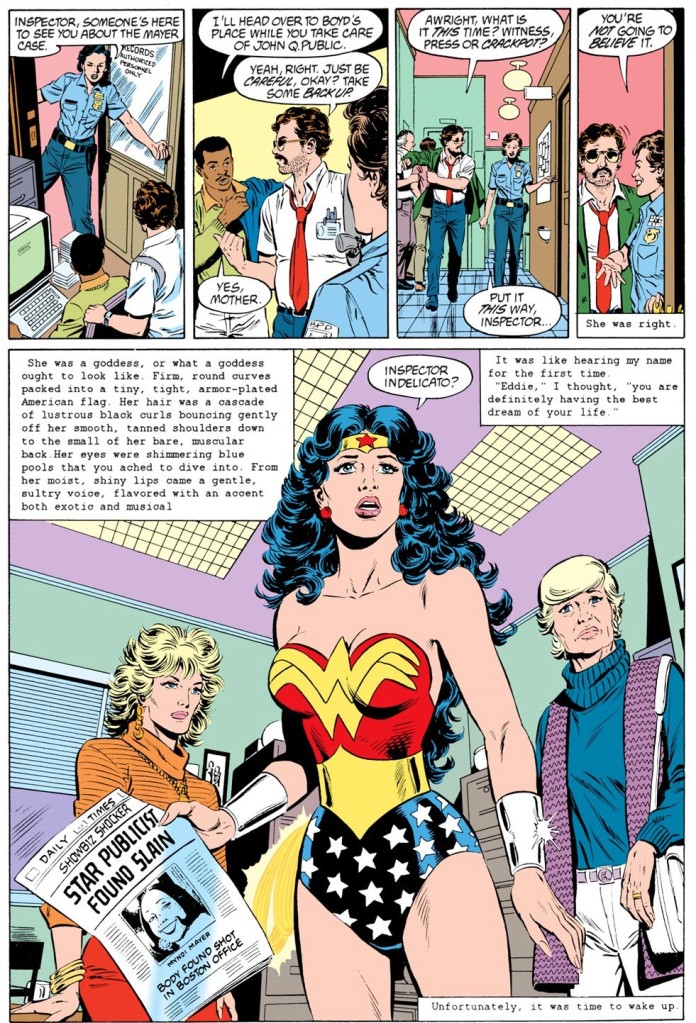
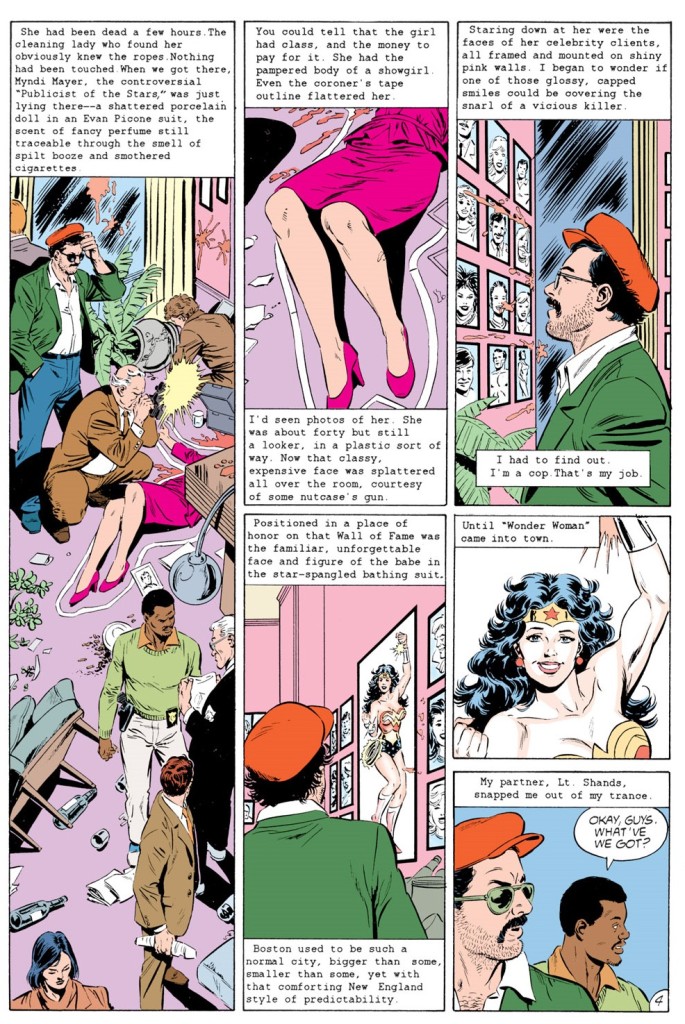
Elsewhere, investigators are searching for clues and details inside a lady’s modern looking office. Lying on the floor is the dead body of a victim and according to the investigator’s report, she had been dead for a few hours. The victim is none other than Myndi Mayer, a highly successful publicist who made a career out of the media and celebrities. Wonder Woman happened to be her most recent, high-profile client. Mayer was involved in the Wonder Woman fair.

Based on their findings, Myndi Mayer looked like she didn’t go without a fight. A bloody letter opener was found in her hand and her purse was found next to her body emptied. Traces of white powder were found on her desk. Mayer’s secretary Christine Fenton was visited by the investigators who told her about the death of her boss. She did not express any surprise and told them that it was only a matter of time before Mayer’s end came. Christine added that she warned Mayer about a certain man.

The investigators then show Christine the sketch of man based on the description of an eyewitness. She expressed surprise as she recognizes him…

Quality

Wonder Woman takes part in the search for truth.

Wow! This is one dark Wonder Woman story to read and I can say that it is a very inspired work written by George Perez based on an idea by Carol Flynn. This is not your typical story of showing the Queen of Superheroes fighting someone evil or saving people from disaster. This is a murder mystery that is laced with corporate intrigue, crime, legal wrangling and the everlasting struggle to determine the truth.

Myndi Mayer’s death really set of a series of events and revelations that are no less striking. Considering the many details about law, crime, investigations and corporate intrigue, the in-depth writing here indicates that George Perez did a lot of researching and found ways to tell a very cohesive story with Wonder Woman playing a role. I should state that as of this writing, this particular story comes close to becoming realistic and reflective of 1980s life. This is top-notch writing by Perez!

When it comes to characterization, Myndi Mayer was deeply portrayed to be in deep trouble both personally and professionally. Of all the Wonder Woman comics of the post-Crisis era of DC Comics I’ve read so far, this one clearly defines Mayer and goes beyond her usual appearance as a prolific publicist.

On Wonder Woman, as mentioned earlier, she does not get to fight a super villain. Rather she takes part in the search for truth and tries her best to solve the mystery even though she is not even fully familiar with the way law and order works in the world of man. In some ways, her approach to literally putting pieces of the puzzle into place and approaching people in different places reminds me somewhat of Batman’s detective work but without the vigilante approach.

Conclusion

This page about the murder investigation at the scene of the crime has some Watchmen vibes to it.

I can say that Wonder Woman (1988) is not only a great comic book to read but also one of the most unique stories about the Queen of Superheroes ever published. By this time, George Perez has proven himself to be very prolific in storytelling on top of his great ability to draw art. I should state I love the way the story was structured and the way it ended delivered both impact and intrigue.

If you are seriously planning to buy an existing hard copy of Wonder Woman (1988), be aware that as of this writing, MileHighComics.com shows that the near-mint copy of the comic book costs $41.

Overall, Wonder Woman (1988) is highly recommended!

+++++

Thank you for reading. If you find this article engaging, please click the like button below and also please consider sharing this article to others. If you are looking for a copywriter to create content for your special project or business, check out my services and my portfolio. Feel free to contact me as well. Also please feel free to visit my Facebook page Author Carlo Carrasco and follow me at HavenorFantasy@twitter.com
A Look Back at Wonder Woman #11 (1987)

Disclaimer: This is my original work with details sourced from reading the comic book and doing personal research. Anyone who wants to use this article, in part or in whole, needs to secure first my permission and agree to cite me as the source and author. Let it be known that any unauthorized use of this article will constrain the author to pursue the remedies under R.A. No. 8293, the Revised Penal Code, and/or all applicable legal actions under the laws of the Philippines.

Welcome back, superhero enthusiasts, comic book collectors and fans of Wonder Woman! Previously I reviewed a story in which the stakes were raised for Wonder Woman and her fellow Amazons as a result of egos among the deities of Olympus with Zeus being reckless to show himself to Diana. Eventually the deities issued their challenge which Diana accepted but the effects were not limited to her alone. Queen Hippolyte is very disturbed by the challenge issued to her daughter as she believes that as ruler of the Amazons, she should be the one to meet the challenge. The queen expressed her view the the goddesses who bore the Amazons surrender to every whim of Zeus. While Hippolyte remains very uneasy, the Amazons support Wonder Woman’s mission and escorted her to the demonic lair beneath their island.

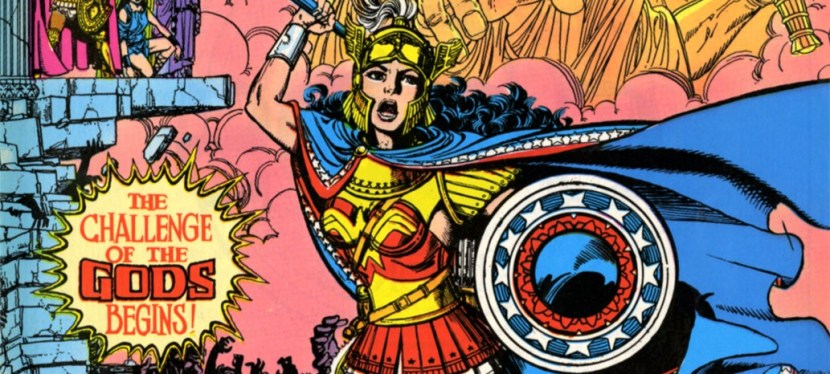
That being said, the Challenge of the Gods storyline continues in this look back at Wonder Woman , published in 1987 by DC Comics with a story written by George Perez and the late Len Wein. Perez’s art was inked by Bruce D. Patterson.

The cover.

Early story

The story begins deep within the lair as Wonder Woman encounters the large 7-headed beast called Hydra. Zeus and the other deities of Olympus carefully watch the conflict happen. Zeus thinks Wonder Woman won’t survive the encounter and Pan (the Satan-like figure) states that the destruction of the Amazon will make her sisters more compliant to Zeus’ wishes. Queen Hera however believes Diana would not fail.

As the conflict underneath Themyscira goes on, the deities discuss what would happen should Wonder Woman fail or succeed. In the heat of battle, Diana analyzes carefully her situation and strives hard to defeat Hydra which is blocking the portal to her next destination…

Quality

Wonder Woman’s mother takes action!

I can start by saying that the story here is more spectacular in terms of presentation highlighted with a strong sense of discovery and wonder mixed with high-octane action here and there. To put it short, this comic book is yet another big pay-off executed following the intense build-up in the previous issue. The Challenge of the Gods storyline really started to move in high-gear with the spectacle while successfully defining the fantasy and mythology elements in Wonder Woman’s realm. This is not your typical superhero tale rather it is presented with a much strong element of fantasy laced with suspense and even a bit of horror. As the story unfolds, you will not only witness Wonder Woman struggle with the challenge of the deities, you will also relate with her on a personal level.

Along the way, the creators made one page that followed the experiences of Steve Trevor who in the post-Crisis universe is a much older character still serving in the military. The slow Steve Trevor scene provided a short break from the high-tension of Wonder Woman’s scenes. Not to be outdone in sharing the spotlight is Queen Hippolyte who takes action in connection to the challenge Wonder Woman is handling. Through the queen, her views and personality got developed even further by the Perez-Wein and her struggle on leading the Amazons while being a mother made more sense literally.  

Conclusion

Now this is a really striking set of images.

As it was made with the usual high-quality from the Perez-Wein creative team, Wonder Woman (1987) is a very dramatic, action-heavy and dynamic read that kept on defining the Queen of Superheroes (and even Queen Hippolyte) while keeping the narrative fresh with revealing fantasy elements. Wonder Woman’s bravery here is really tested a whole lot, and her uncompromising desire to accomplish the challenge of the deities. While this comic book is a great pay-off to the build-up done in issue , it also builds up to something very unexpected on the final page. I should also state that the story is very unpredictable and at times it played on my expectations.

If you are seriously planning to buy an existing hard copy of Wonder Woman (1987), be aware that as of this writing, MileHighComics.com shows that the near-mint copy of the regular edition costs $30 while the near-mint copy of the newsstand edition costs $60.

Overall, Wonder Woman (1987) is highly recommended!

+++++

Thank you for reading. If you find this article engaging, please click the like button below and also please consider sharing this article to others. If you are looking for a copywriter to create content for your special project or business, check out my services and my portfolio. Feel free to contact me as well. Also please feel free to visit my Facebook page Author Carlo Carrasco and follow me at HavenorFantasy@twitter.com
A Look Back at Wonder Woman #10 (1987)

Disclaimer: This is my original work with details sourced from reading the comic book and doing personal research. Anyone who wants to use this article, in part or in whole, needs to secure first my permission and agree to cite me as the source and author. Let it be known that any unauthorized use of this article will constrain the author to pursue the remedies under R.A. No. 8293, the Revised Penal Code, and/or all applicable legal actions under the laws of the Philippines.

Having reviewed the first nine issues of the 2nd Wonder Woman monthly series (1987-2011) that was handled with care initially by great creators George Perez and Len Wein, I can say that the Queen of Superheroes herself was redefined not only for the readers of the post-Crisis era but in general. Under the Perez-Wein team, Wonder Woman was portrayed to be human and compassionate as she gradually discovers what her destiny is just as she takes part in the struggles and affairs of her fellow Amazons led by her mother Queen Hippolyte.

Also told along the way was the story of the deities of Olympus headed by Zeus. In their realm, the deities are divided and each has his or her own ego and agenda. Because they have tremendous power, they are able to manipulate events on the physical world and make mortals struggle. Under them, the Amazons have struggled and even people of Earth got affected as well.  

When I reviewed the ninth issue, it was the full debut of the modern Cheetah who proved to be a worthy adversary for Wonder Woman. By the way, Cheetah is the antagonist in the new film Wonder Woman 1984 portrayed by Kristen Wiig. By the end of issue , Wonder Woman returned home to Themyscira leaving her American friends Julia and Vanessa Kapatelis in tears.

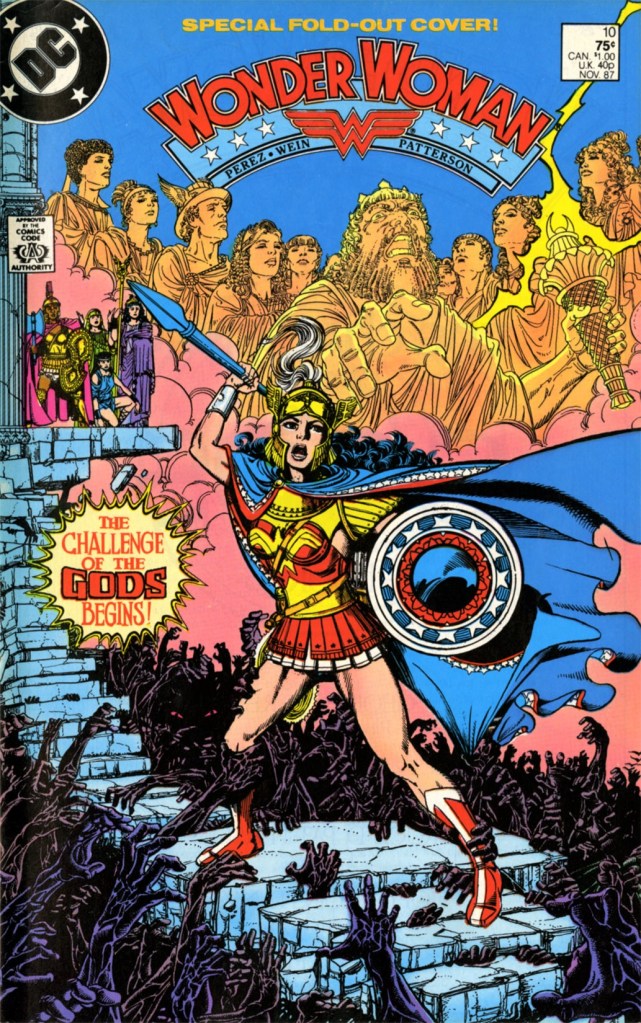
So what happened next? We can all find out in this look back at Wonder Woman , published in 1987 by DC Comics with a story written by George Perez and Len Wein. Perez did the art with inkwork by Bruce Patterson. This is the first chapter of the Challenge of the Gods storyline.

The cover.

Early story

The story begins in the realm of the deities. They noticed Pan has been joyful recently and Zeus states that has been the case since Wonder Woman thwarted the scheme of Ares. Pan approaches Zeus and followed-up on him regarding a past conversation they had. Zeus then looks Themyscira, finding it secluded yet a true paradise. A paradise worthy of his personal favor.

On Themyscira, Princess Diana/Wonder Woman and a fellow Amazon ride horses not knowing Zeus and the others are watching them. Pan tells Zeus that as Heracles (Zeus’ son) once favored Queen Hippolyte (Diana’s mother), it is only fitting that Diana should be the first among the Amazons to experience his manly grace. Zeus then decides to come to the Amazons and tells Pan to play a love song.

Hestia and Artemis notice Zeus’ decision. An angry Artemis makes her move stating that Paradise Island (Themyscira) will be no one’s brothel.

Diana and Euboea talk while riding their horses slowly on a beach. She states that it is good to be home. She learned so much from the world of men finding its people so different and yet so much the same, that the Amazons all could learn from one another.

Meanwhile the Amazons’ council of justice discuss the gifts and records Diana brought home. Queen Hippolyte is in attendance…

Quality

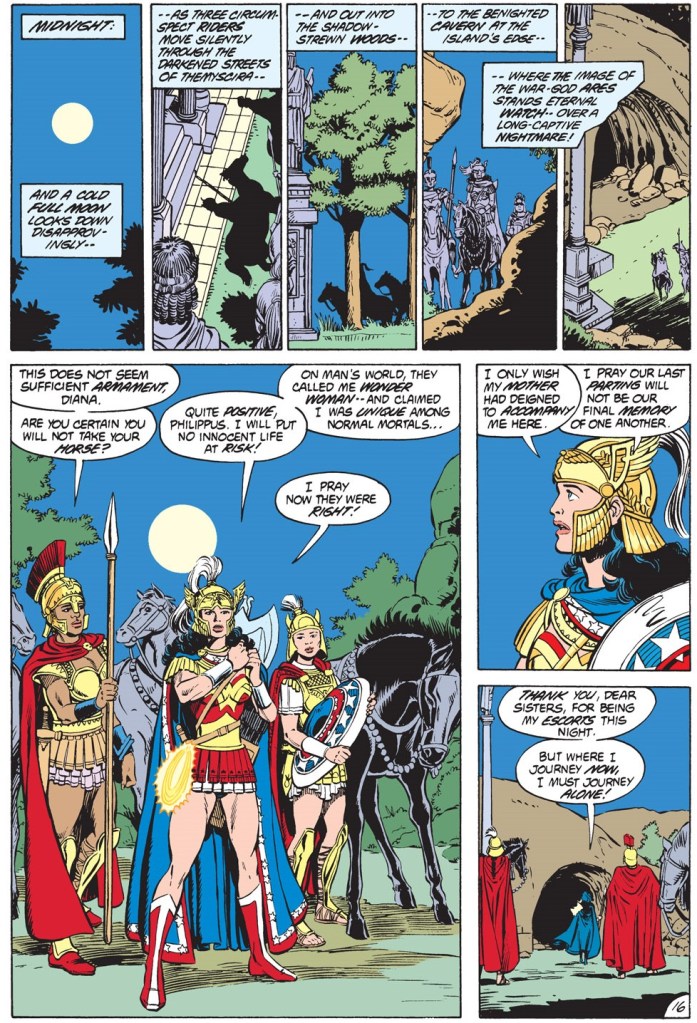
Wearing armor and a helmet, Wonder Woman prepares to start taking on the challenge of the deities.

I can say that this story not only marked the beginning of a new Wonder Woman storyline but also it marked a new turning point not just for the Queen of Superheroes but also for her fellow Amazons as this involves the Olympus deities a whole lot more. The good news here is that the script is of high-quality writing and has special care made on it by the Perez-Wein creative team. As the story is more focused on Themyscira and Olympus, more details about the history and legacy of the Amazons is revealed and it is all done with a deep amount of engagement. The way the details and events were handled, it looked like Perez and Wein had these story elements planned ahead of time as they continued to develop and redefine Wonder Woman in the post-Crisis era of DC Comics.

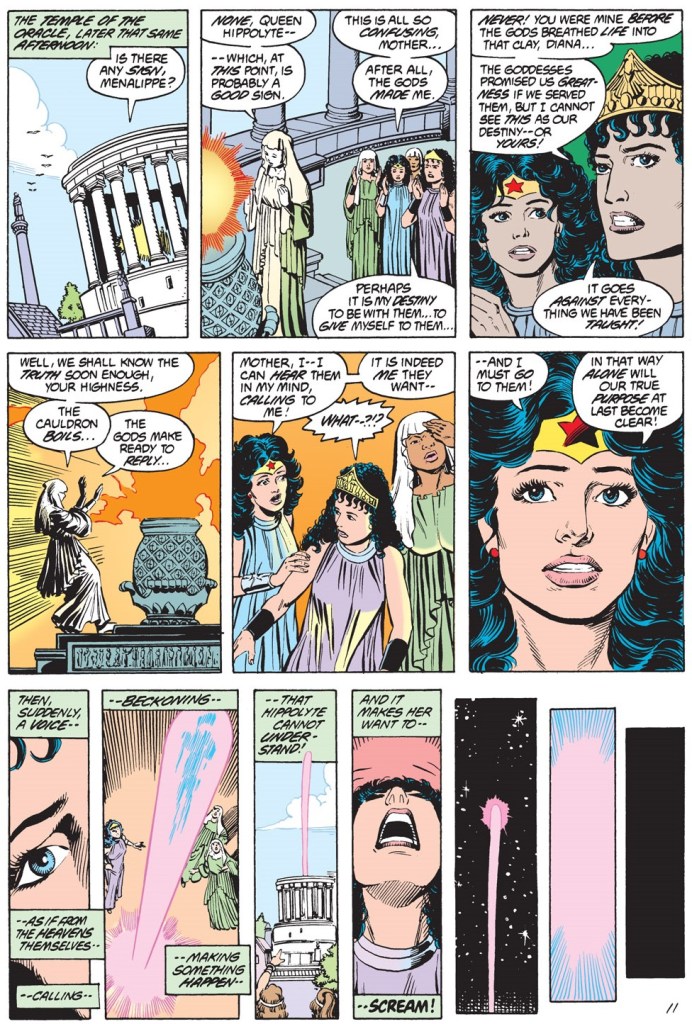
At the heart of the first chapter of the Challenge of the Gods storyline is the link between the Amazons (who rely on Wonder Woman to represent them) and the divided deities of Olympus. With very compelling writing and visuals, you will get to see how fragile Diana, Queen Hippolyte and their Amazon sisters really are when facing the deities. In relation to that, it is a unique reading experience to see Wonder Woman struggle with interacting with Zeus and the other deities directly.

Conclusion

Princess Diana, her mother Queen Hippolyte and the Amazons analyze their situation.

Wonder Woman (1987) is clearly a great comic book to read and it marked the continued excellence done by George Perez, Len Wein and their creative team.

If you are seriously planning to buy an existing hard copy of Wonder Woman (1987), be aware that as of this writing, MileHighComics.com shows that the near-mint copy of the regular edition costs $60 while the near-mint copies of the fold-out edition and the newsstand edition cost $30 and $120 respectively.

Overall, Wonder Woman (1987) is highly recommended!

+++++

Thank you for reading. If you find this article engaging, please click the like button below and also please consider sharing this article to others. If you are looking for a copywriter to create content for your special project or business, check out my services and my portfolio. Feel free to contact me as well. Also please feel free to visit my Facebook page Author Carlo Carrasco and follow me at HavenorFantasy@twitter.com
A Look Back at Wonder Woman #8 (1987)

Disclaimer: This is my original work with details sourced from reading the comic book and doing personal research. Anyone who wants to use this article, in part or in whole, needs to secure first my permission and agree to cite me as the source and author. Let it be known that any unauthorized use of this article will constrain the author to pursue the remedies under R.A. No. 8293, the Revised Penal Code, and/or all applicable legal actions under the laws of the Philippines.

With the combined talents of George Perez, Len Wein, Greg Potter plus others, the reintroduction of Wonder Woman during the early stage of the Post-Crisis era of DC Comics is not only great but an essential read and a true superhero literature classic! When it comes to the presentation, the origin of not only Wonder Woman but also the Amazons was retold with a stronger emphasis on Greek mythology.

To put things in perspective, Wonder Woman #6 saw Ares’ plan on completely ruining man’s world defeated while Wonder Woman #7 saw the revival of Princess Diana as the deities of Olympus bless her and the Amazons. Where could George Perez, Len Wein and the creative team take the post-Crisis Wonder Woman story to?

That we will precisely find out in this look back at Wonder Woman , published by DC Comics in 1987 with a story written by George Perez and Len Wein. The art was done by Perez and inked by Bruce D. Patterson.

Cover
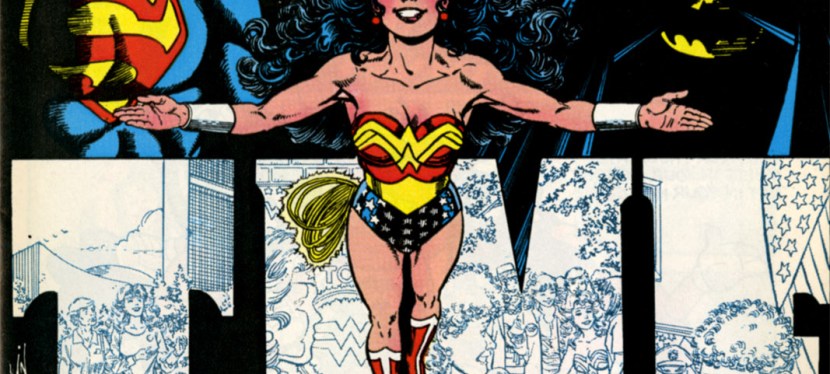
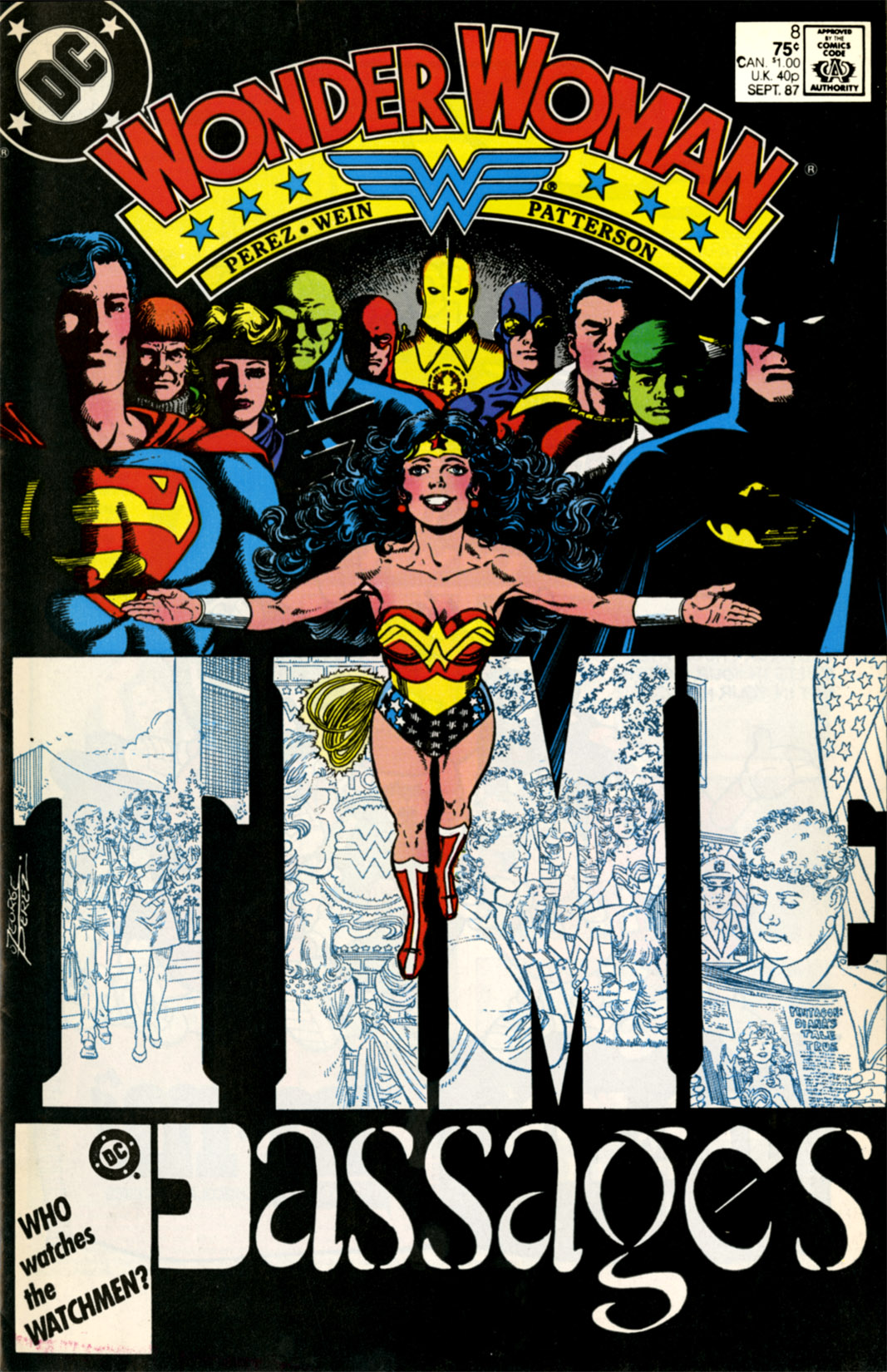
The cover.

Early story

The story begins in Boston, specifically at the Harvard University office of academic veteran Julia Kapatelis. She starts typing her recollections about Diana who, by this time, became a celebrated figure with the public thanks in part to Myndi Mayer’s publicity engine. Julia expressed how astonished she was with Wonder Woman’s ability to assimilate a lot of information so quickly (note: when she first arrived in man’s world, she did not even know how to speak English).

She recalled during their time at the United Nations that there were some nations that refused to listen to her and that the delegate from Russia protested Wonder Woman’s star-spangled costume on political grounds.

While Wonder Woman is loved by the public, there still were those who opposed her. Julia recalls the national campaign to outlaw all superheroes launched by the psychologist G. Gordon Godfrey who even won the support of some of America’s political figures. Julia also noticed the effects of Godfrey’s campaign on the minds of some of her students and the division that followed.

Wonder Women went on to interact with other superheroes as she strived to do good and save people. She even got invited to join the newly reformed Justice League with Superman, Batman, the Flash and many others present…

Quality

16
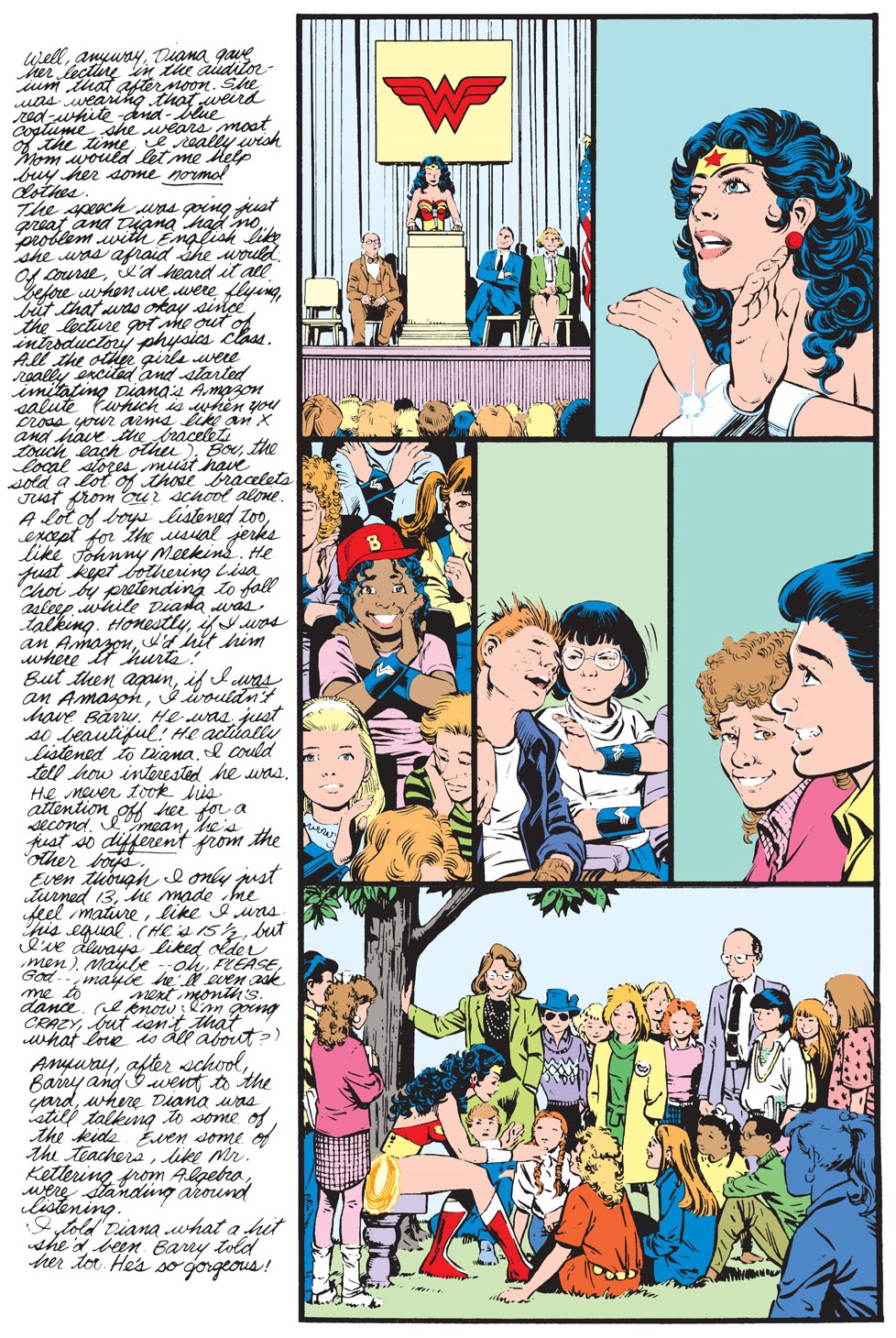
Wonder Woman as recalled by Vanessa.

Before describing the quality of this comic book, I should state that Wonder Woman is not your typical superhero comic book at all. In reality, to reflect the title Time Passages, this one is technically a collection of journals that efficiently showed how much has changed for Wonder Woman and the people around her since after the Ares Affair happened.

When it comes to quality, each journal fictionally authored by Julia Kapatelis, Etta Candy, Vanessa Kapatelis and Myndi Mayer, was well-written by Perez and Wein. Apart from describing what happened and how much had changed with Wonder Woman in their presence, each character’s journal had its own distinct view apart from style of writing. Each journal is important to read and through them you will realize how much impact Wonder Woman had on their society and on themselves.

Still on the writing, there were some pages that provided relief to readers. In between the journals are story pages focused on Dr. Barbara Minerva and her short male companion which served as the build-up leading to the first appearance of the post-Crisis Cheetah.

And there is all the beautiful art provided by Perez. Each page of a fictional journal has artwork that visualize what was told. There are also whole pages highlighting the passage of time and the characters who made each journal. Even with the unusual format used, this is still very good looking comic book to see!

Conclusion

10
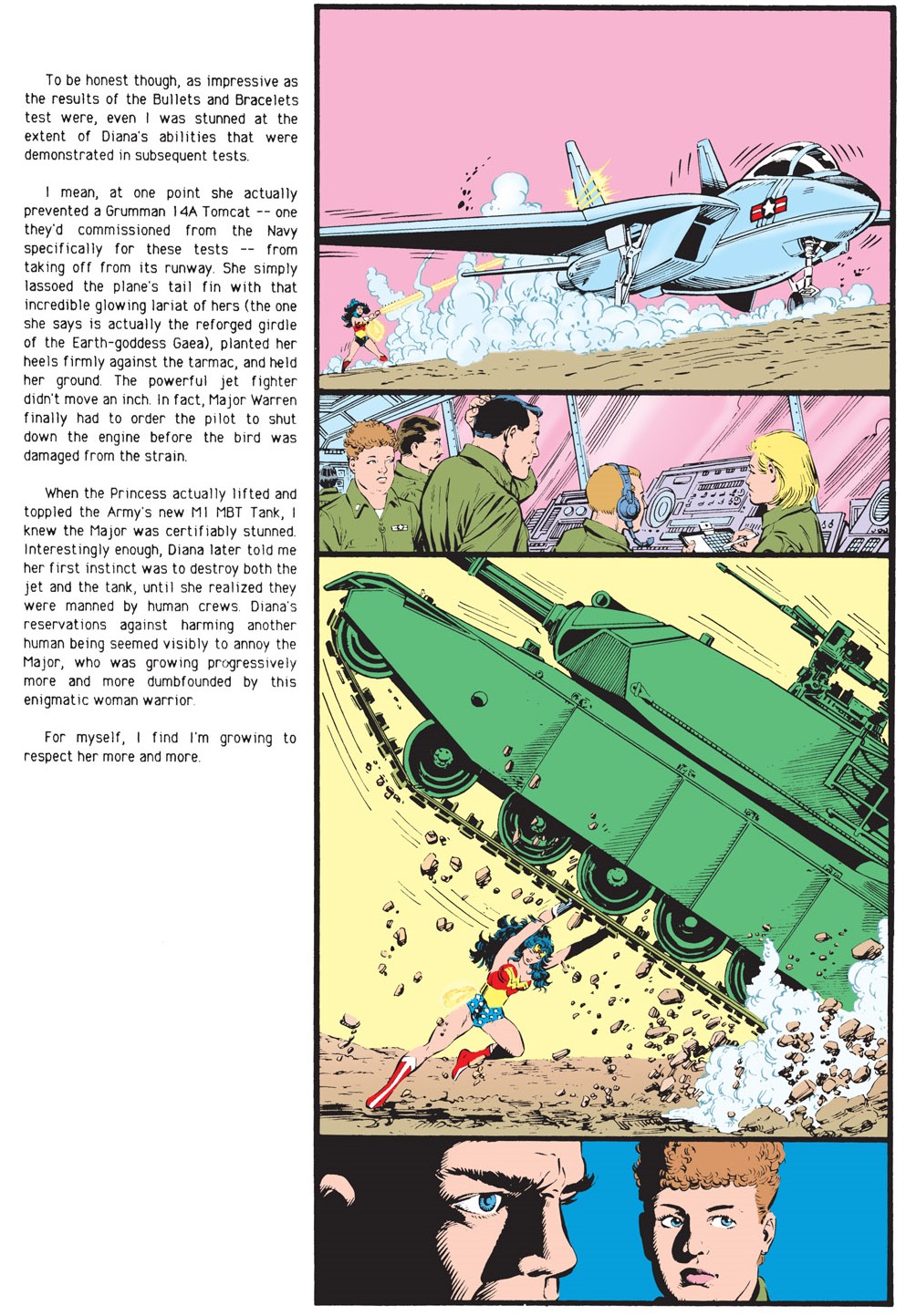
The test of Wonder Woman with the military as recalled by Etta Candy.

To describe it bluntly, Wonder Woman is an exposition-heavy, very wordy, time-passing comic book that succeeds in what it was meant to achieve: move Wonder Woman’s post-Crisis development forward efficiently (note: without having to create multiple comic books reflecting the events told) while emphasizing how people look at her, how she connects with other DC Comics superheroes and the like. It was nicely crafted by Perez and the creative team and each page showed that a lot of special care was done. With regards to modernizing Wonder Woman for the 1980s, this comic book is a success.

If you are seriously planning to buy an existing hard copy of Wonder Woman (1987), be aware that as of this writing, MileHighComics.com shows that the near-mint copy of the regular edition costs $26 while the near-mint copy of the newsstand edition costs $51.

Overall, Wonder Woman (1987) is highly recommended!


Thank you for reading. If you find this article engaging, please click the like button below and also please consider sharing this article to others. If you are looking for a copywriter to create content for your special project or business, check out my services and my portfolio. Feel free to contact me as well. Also please feel free to visit my Facebook page Author Carlo Carrasco and follow me at HavenorFantasy@twitter.com

A Look Back at Wonder Woman #7 (1987)

Disclaimer: This is my original work with details sourced from reading the comic book and doing personal research. Anyone who wants to use this article, in part or in whole, needs to secure first my permission and agree to cite me as the source and author. Let it be known that any unauthorized use of this article will constrain the author to pursue the remedies under R.A. No. 8293, the Revised Penal Code, and/or all applicable legal actions under the laws of the Philippines.

Having seen Wonder Woman in cinemas in 2017 and having reviewed the comic book Wonder Woman #6 of 1987 recently, I can say that I enjoyed the two different battles between the Queen of Superheroes and the war deity Ares. Both battles had their respective styles of art and presentation and there were a few similarities between them.

I like both conflicts equally and that’s in relation to very different formats used – cinematic and comic book. Also, the Wonder Woman-Ares battles served as effective story turning points on both the big screen and the comic book. In the case of the Post-Crisis era of DC Comics, the major battle was the climax of the brewing, global military aggression (due to Ares influencing people of man’s world to destroy each other) in which Wonder Woman got involved not only with the Cold War but also with the connections between man’s world, Themyscira and Olympus.

That being said, now is time to move forward with the Post-Crisis Wonder Woman saga with this look back at Wonder Woman , published in 1987 by DC Comics with a story co-written by George Perez and Len Wein. Perez drew the story which was inked by Bruce D. Patterson.

Cover
The cover.

Early story

The story begins in Olympus with Hermes spreading the news that the threat by Ares has ended. Zeus declares the news are true and issues a decree of a feast of celebration. The others smiled in reaction. As others make merry to the music of the spheres, Athena reminds Zeus that Prince Diana/Wonder Woman lies at death’s threshold emphasizing the her victory of Ares came at such a high price. Realizing the Amazons’ value, Zeus decides to keep a closer look at them.

Over at Themyscira, the Amazons (under the watch of Queen Hippolyte) perform a ritual of revival for their fallen sister Diana. They noticed no progress has been made. From high above, Zeus and his fellow deities watch…

Quality

9
A mother-daughter scene.

Top-notch quality once again achieved by the creative team led by George Perez and Len Wein. While the previous two issues had high fantasy concepts with battles as the highlights, Wonder Woman is much more character-driven showing Wonder Woman’s recovery from the great battle and how the Greek deities’ view of the Amazons changed as a result of Ares’ defeat. Specifically, there is a lot of richness emphasizing Wonder Woman’s continued development as the daughter of Queen Hippolyte and as the continued doer of missions as her people’s representative in man’s world. I also like the way the comic book creators explored the divisions between the deities of Olympus.

Without spoiling all the details, this story resolved the crisis on the part of Vanessa, the young daughter of Julia Kapatelis and it also added to Diana’s evolution as a loving and caring superhero. The academic professional Julia – who has grown into a close friend of Wonder Woman’s – also was developed nicely here. And then there is the introduction of someone who is very savvy with the media.

In stark contrast to issues , and , Wonder Woman does not have any superhero action as it was much more focused on character development. That’s not to say that it is all just characters talking several lines of dialogue and looking dramatic. This story still has that epic fantasy look as it provides readers a good look at Olympus. This comic book really pushed the narrative far more than the three previous issues.

Conclusion

8
The deities in the spiritual realm.

Another great comic book this truly is. Then again, it should not be a surprise at all considering the great talents of George Perez and Len Wein combined. By the time I finished reviewing Wonder Woman , I am convinced that the creative team in-charge of this Post-Crisis version of the Queen of Superheroes not only worked with a high level of confidence but also carefully crafted their plans on reintroducing Wonder Woman with the 1980s in mind and making her much more relevant with the public. Storywise, this comic book marks a turning point in the Wonder Woman monthly series.

Other than being another great Wonder Woman story, Wonder Woman also marks the first-ever appearance of Dr. Barbara Minerva (in civilian form specifically) who would later become the Post-Crisis era’s Cheetah a few issues later. For the newcomers reading this, Barbara Minerva/Cheetah was portrayed by Kristen Wiig in the upcoming superhero movie Wonder Woman 1984. With regards to that movie, reading Wonder Woman is a must!

If you are seriously planning to buy an existing hard copy of Wonder Woman (1987), be aware that as of this writing, MileHighComics.com shows that the near-mint copy of the regular edition costs $77 while the near-mint copy of the newsstand edition costs $153.

Overall, Wonder Woman (1987) is highly recommended!


Thank you for reading. If you find this article engaging, please click the like button below and also please consider sharing this article to others. If you are looking for a copywriter to create content for your special project or business, check out my services and my portfolio. Feel free to contact me as well. Also please feel free to visit my Facebook page Author Carlo Carrasco and follow me at HavenorFantasy@twitter.com

A Look Back at Wonder Woman #5 (1987)

Disclaimer: This is my original work with details sourced from reading the comic book and doing personal research. Anyone who wants to use this article, in part or in whole, needs to secure first my permission and agree to cite me as the source and author. Let it be known that any unauthorized use of this article will constrain the author to pursue the remedies under R.A. No. 8293, the Revised Penal Code, and/or all applicable legal actions under the laws of the Philippines.

There is nothing like witnessing the development of a pop culture icon like Wonder Woman with modern society in mind. After completing Crisis on Infinite Earths in the mid-1980s, DC Comics restarted their entire superhero universe opening lots of opportunities to reintroduce their superheroes, super villains and other characters to readers updated with the times. The Post-Crisis Wonder Woman involving the legendary George Perez and other creators saw the Queen of Superheroes updated with the 1980s in mind.

Even though Princess Diana and her fellow Amazons clearly expressed themselves in English to use readers, it turned out within the comic series that English was not their native language. In fact, Wonder Woman and her Amazon sisters all spoke Themysciran which is derived from Greek. Fortunately for Diana, she met someone who could understand her and communicate well. The language barrier is just one of the challenges Diana had to go through as she discovers man’s world.

We can now rejoin Wonder Woman and her journey of discovery in man’s world with this look back at Wonder Woman , published by DC Comics in 1987 with a story co-written by George Perez and Len Wein. Perez’s art was inked by Bruce D. Patterson.

Cover
A really striking cover by George Perez.

Early story

The story begins in Themyscira where the Amazons wait as Menalippe (their oracle) tries communion with their deities. One of the women expressed worry that the god of War – Ares – continues to gain power across the world. Even as she tries, Menalippe could not figure out the signs from their gods and Queen Hippolyte is eager to find out something about her daughter Diana.

Beneath Mount Olympus, Apollo remains in dreamless sleep. The women, in the presence of Hermes, remain uncertain about what has been going on. An ancient is near them.

In man’s world, war and chaos spreads. Steve Trevor appears in the television news as a rumored spy of the Soviet Union. At the same time, Wonder Woman makes waves in the news as a result of her battle with Decay

Quality

4
Wonder Woman and the supporting players.

Unsurprisingly, the very high quality of art, storytelling and characterization that started since issue is well maintained by the creators in this comic book. What I love in Wonder Woman aside from her continued journey of discovering more of man’s world and interacting with more with Steve Trevor (plus Etta Candy and other supporting characters) is the strong shift into the realm of fantasy which is full of action and other forms of spectacle!

For the plot, George Perez and Len Wein made a fascinating story that had a nice mix of Greek culture, fantasy and contemporary military battles. There were layers of intrigue as the creators made clear how Ares and his minions from the spiritual realm (related to Olympus and their deities) influenced mortals to fight each other so fiercely without even pausing to be clam and reasonable. This raises the stakes for Wonder Woman who is still adjusting to man’s world.

On characterization, each character here is well-written and clearly defined as believable individuals. The interactions between Wonder Woman and the others (plus their interactions in between themselves) are very rich to read and analyze.

When it comes to spectacle, this one is really loaded and, at the same time, much more imaginative! The shift from man’s world into the realm of fantasy (specifically a location often inaccessible to mortals) gave this comic book a fantastic atmosphere! There is a lot to enjoy here.

While it is not surprising that George Perez excellently illustrated this comic book, I should mention that his use of multiple panels per page here is quite clever. While using more than five panels per page is considered excessive by today’s standards, Perez managed to tell clearly the story and took time to control the pace. The spectacle scenes are fast but never disorienting. The character development and worldview scenes are never boring to look at.

Conclusion

6
One of Ares’ sons influencing the world into war.

Undoubtedly, Wonder Woman is a great comic book. Elements of militarism, fantasy and Greek mythology were excellently blended here and ultimately it presented Wonder Woman’s personal development and interaction with the supporting players with a lot of depth. At this stage, her interaction with Steve Trevor as well as Julia Kapatelis really blossomed here.

If you are seriously planning to buy an existing hard copy of Wonder Woman (1987), be aware that as of this writing, MileHighComics.com shows that the near-mint copy of the regular edition and the newsstand edition costs $26 and $51 respectively.

Overall, Wonder Woman (1987) is highly recommended!


Thank you for reading. If you find this article engaging, please click the like button below and also please consider sharing this article to others. If you are looking for a copywriter to create content for your special project or business, check out my services and my portfolio. Feel free to contact me as well. Also please feel free to visit my Facebook page Author Carlo Carrasco and follow me at HavenorFantasy@twitter.com

A Look Back at Wonder Woman #4 (1987)

Disclaimer: This is my original work with details sourced from reading the comic book and doing personal research. Anyone who wants to use this article, in part or in whole, needs to secure first my permission and agree to cite me as the source and author. Let it be known that any unauthorized use of this article will constrain the author to pursue the remedies under R.A. No. 8293, the Revised Penal Code, and/or all applicable legal actions under the laws of the Philippines.

There is no doubt that George Perez’s famous handling of Wonder Woman (that became a key part of the Post-Crisis era of DC Comics) is influential for other creators. Over at Comic Book Resources, I read a 2017 article in which Wonder Woman movie director Patty Jenkins confirmed that Perez’s work on the Queen of Superheroes helped influence the movie.

Below is what Jenkins said in response to CBR’s question involving George Perez:

I think it was the fact that he expanded the role of the gods. It was always there — nothing he did contradicted what William Marston did and created, I think it only expanded upon and fleshed out who the gods are. What that relationship is, and how that works. What was a wonderful thing for us to take from.

I personally love the Wonder Woman movie and truly Gal Gadot IS Wonder Woman! As George Perez’s work on the Queen of Superheroes was influential to the director, it is clear that he set the standard on presenting Wonder Woman to the world.

With the movie and history talk over, we can now proceed on revisiting the Post-Crisis era of DC Comics with this look back at Wonder Woman , published in 1987 by DC Comics with a story by George Perez and Len Wein (script) and art by Perez (inked by Bruce D. Patterson).

Cover
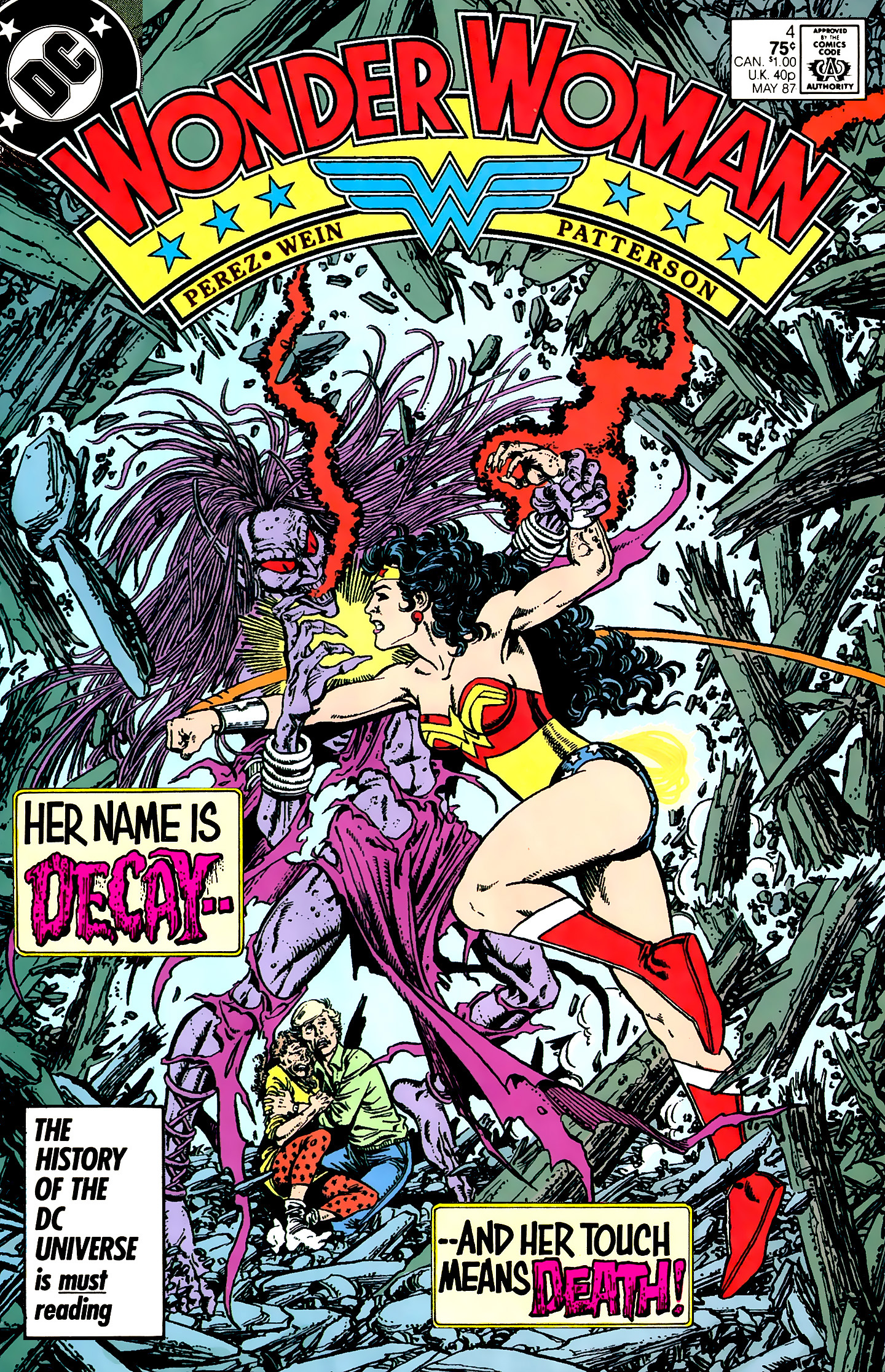
The cover.

Early story

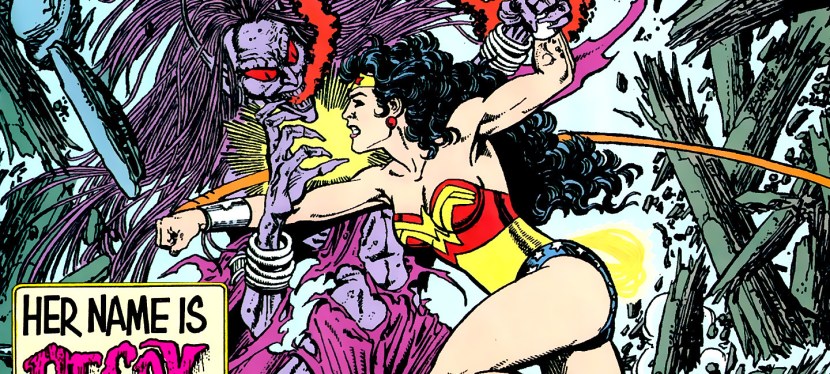
The story begins with Wonder Woman carrying Julia Kapatelis and her daughter Vanessa moving away from the villainess Decay (daughter of Medusa) as a huge portion of the Kapatelis home collapses. As expected, the next-door neighbors got disturbed and went out of their homes to see what’s going on.

While taking a break just out of the rubble, Julia checks on Vanessa and asks: “What has that monster done to her?”

Suddenly, Decay rises from the rubble and answers Julia’s question directly stating she will do the same thing to her and Wonder Woman. Decay has Wonder Woman’s tiara with her.

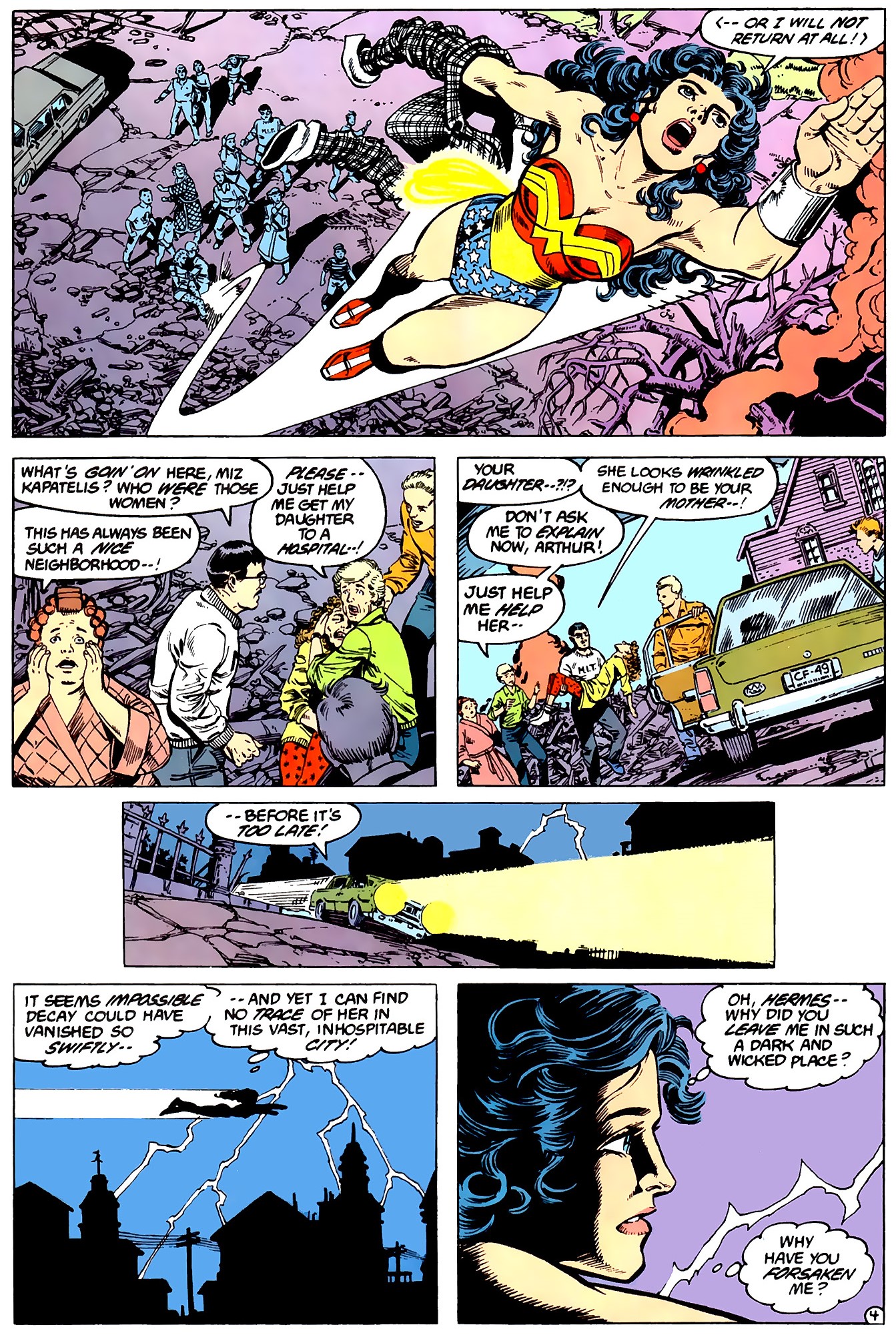
Decay’s appearance scares many onlookers. Wonder Woman tells Julia to keep the neighbors back. Decay says that she came only for the symbol of Wonder Woman’s power (the tiara specifically) which she will use to symbolize her power. Decay then flies away.

Before flying off, Wonder Woman tells Julia that she will return with a cure for her teenage daughter whose body got heavily wrinkled by Decay…

Quality

9
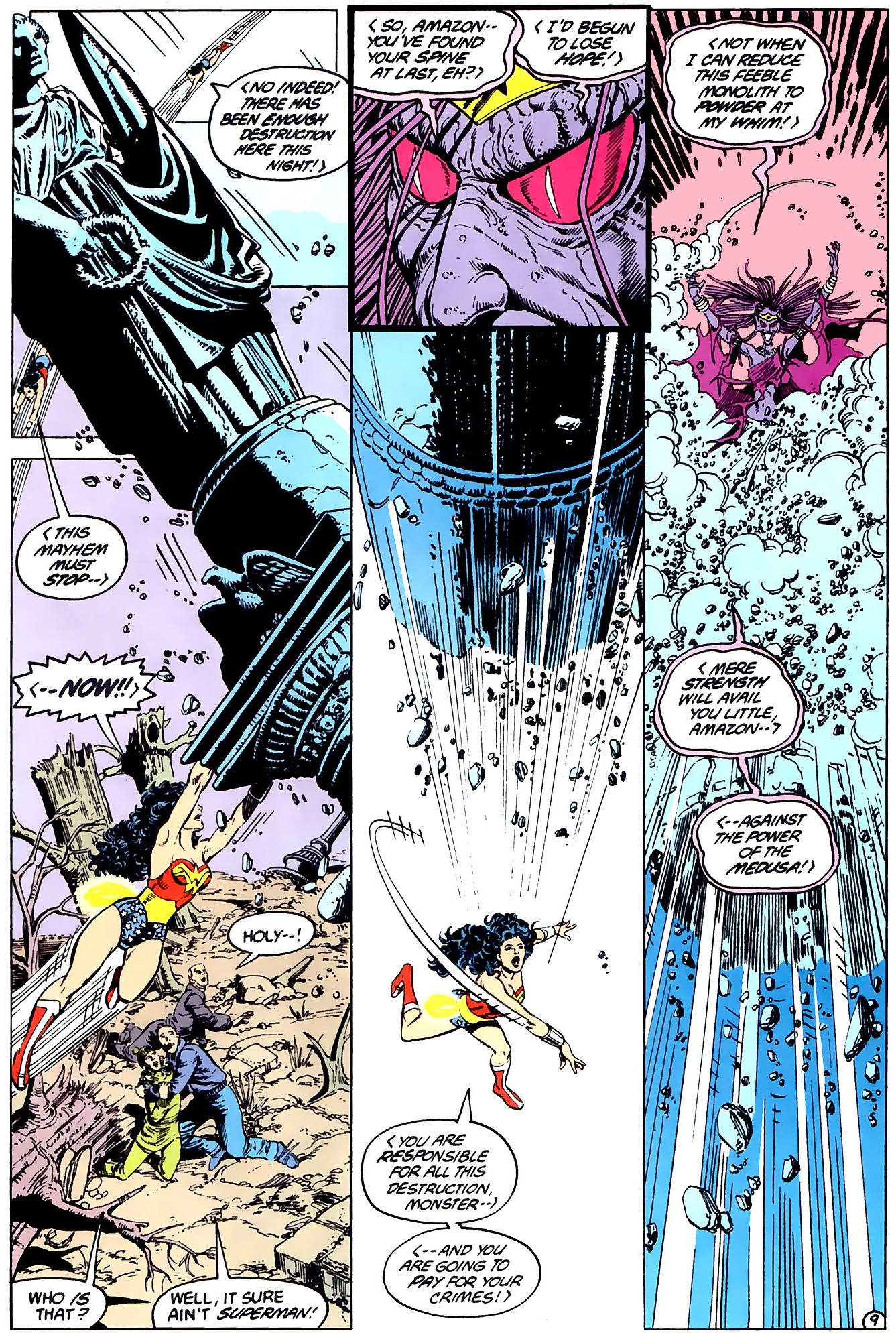
I hope Wonder Woman 1984 and future Wonder Woman live-action movies will have more hard-hitting action scenes like this.

Once again, George Perez and Len Wein crafted another excellent Wonder Woman comic book that is timeless and symbolic. While Wonder Woman marked Princess Diana’s arrival in man’s world, this comic book marked her first-ever battle in the same world complete with disturbance on the local society. Take note that at this point, Wonder Woman still has yet to understand and speak English and she has not fully adjusted to the local culture and society. She also just befriended Julia, the university professor and only person who could communicate with her by talking in Greek. Even with all the trouble caused by Decay, Wonder Woman’s heroism laced with love and compassion backed by her Amazon values remains intact and this aspect alone makes this comic book worth reading.

Apart from focusing on Wonder Woman and the supporting players, the comic book gives a close look at what has been happening at Mount Olympus where the Greek gods and goddesses discuss the situation of Princess Diana. There are also a few scenes set in the American military base wherein Lieutenant Etta Candy secretly does detective work to find out what caused the anomaly that led the higher-ups to suspect Steve Trevor of wrongdoing.

As for the artwork, George Perez’s work here is excellent as expected. When destruction is shown, there is a strong sense of danger. When hard superhero action occurs, there is a lot of impact shown! I just love looking at scenes showing Wonder Woman saving people from certain death. Also there were some really powerful executions of action here (involving Wonder Woman) that I wish future Wonder Woman movies will someday replicate.

Conclusion

4
Wonder Woman striving hard to go after Decay, the monster responsible for the destruction seen here.

Wonder Woman of 1987 is excellent! Apart showing the first time ever that Wonder Woman engaged in battle in man’s world, this comic book also has an intimate look on how Princess Diana struggles with focusing on her mission while adjusting to the local culture and making sure that evil beings from her culture would not succeed in destroying the people of man’s world.

If you are seriously planning to buy an existing hard copy of Wonder Woman , be aware that as of this writing, MileHighComics.com shows that the near-mint copy of the regular edition and the newsstand edition cost $25 and $51 respectively.

Overall, Wonder Woman (1987) is highly recommended!


Thank you for reading. If you find this article engaging, please click the like button below and also please consider sharing this article to others. If you are looking for a copywriter to create content for your special project or business, check out my services and my portfolio. Feel free to contact me as well. Also please feel free to visit my Facebook page Author Carlo Carrasco and follow me at HavenorFantasy@twitter.com

A Look Back at Wonder Woman #2 (1987)

Disclaimer: This is my original work with details sourced from reading the comic book and doing personal research. Anyone who wants to use this article, in part or in whole, needs to secure first my permission and agree to cite me as the source and author. Let it be known that any unauthorized use of this article will constrain the author to pursue the remedies under R.A. No. 8293, the Revised Penal Code, and/or all applicable legal actions under the laws of the Philippines.

After the end of publishing their landmark maxi-series Crisis on Infinite Earths, DC Comics gained an all-new slate to literally fill up by rebooting their entire superhero comics universe. They started the new universe (now referred to as the Post-Crisis Universe) with Superman, Batman and some others.

Then in late 1986, DC Comics reintroduced the post-Crisis version of Wonder Woman creatively led by the legendary George Perez (who was assisted by writer Greg Potter) with the release of the comic book Wonder Woman (cover dated February 1987). That particular comic book retold (in great detail with Greek mythology) the origin of the Amazons who were reincarnated women (the souls of which came from women whose deaths were caused by men). The Amazons and Hippolyta (Hippolyte in this comic book) eventually got betrayed by Heracles and his men leading to a period of tremendous hardship. Beatings were obvious and rape was implied.

After getting freed, they are sent to the island of Themyscira. It was there when Hippolyta learned that she died previously as a pregnant woman. Using the clay of the island, the Amazons’ queen formed an infant girl. Then after communicating with the midwives in the spiritual realm, the soul of Hippolyta’ unborn daughter arrived into the clay child. This marked the birth of Princess Diana who would become Wonder Woman. For the newcomers reading this, Diana is the only Amazon who grew up from child to adult in Themyscira.

Right here is my retro comic book review of Wonder Woman published in 1987 by DC Comics with the story done by George Perez and Greg Potter. The art was done by Perez.

Cover
Cover drawn by George Perez. 

Early story

The story begins in man’s world, at an American military base. Colonel Steve Trevor meets with his superior General Kohler who tells him that he has been chosen for a special mission which involves the use a new, modified fighter plane. Steve reacted that the coordinated provided lead to nothing out there. The general instructs him to shut his mouth and do what he was ordered to do.

In Themyscira, Princess Diana is set to start her first-ever mission as Wonder Woman. Her mission pits her against a god gone mad, and her mother Hippolyta and the Amazons are deeply concerned. Suddenly, the Lasso of Truth from Olympus arrives which Diana picks up. Immediately after that, the messenger of the gods Hermes arrives marking the first time in centuries that any Amazon saw him.

45

After a brief talk, Diana travels away with Hermes who could only guide her. They disappeared suddenly surprising the Amazons and Hippolyta who was not given an opportunity to bid farewell to her daughter.

Quality

As expected, Wonder Woman has great qualities with regards to storytelling, characterization and artwork. With Greg Potter assisting George Perez, this comic book told not one but three story arcs each with a good amount of details and, amazingly, such stories were told rather efficiently complete with very believable dialogue. I’m talking about impressive writings and descriptions of the characters, apart from Wonder Woman herself, that include the Amazons, the gods and goddesses of Olympus and the American military.

The story also comes with a very nice touch of discovery which readers can easily relate with through Wonder Woman. As Diana develops and learns more, the reader gets connected with her even more. This is the Queen of Superheroes I’m talking about and the writing is truly excellent.

At the same time, continuing with what was first presented in Wonder Woman , this comic book also explores how much of a threat Ares (god of war) truly is not only to Wonder Woman and her Amazons but also on people in man’s world. The build-up of the tension is really nice and the pay-off is worth it.

Unsurprisingly, this comic book has great looking art. It’s done by George Perez after all supported with ink work by Bruce Patterson. Perez knows how to dramatize characters, pull of amazing shots of action and other forms of spectacle, and most of all, illustrate the very visual elements of Greek mythology complete with other visual concepts of the fantasy genre.

Conclusion

As it is clear it is not the launch issue of its monthly series, Wonder Woman is still very significant as it marks the first-ever mission of Wonder Woman in the post-Crisis universe of DC Comics and also her first encounter with a modernized (for the 1980s specifically) Steve Trevor. Remember the first time Diana and Steve met in 2017 Wonder Woman movie? Remember how Wonder Woman reacted to see a mortal man for the first time ever as played by Gal Gadot and Chris Pine on the big screen? You will see some common elements between the film and this comic book about the two characters. Even the Amazons’ reaction to Steve alone makes this comic book worth reading and it should encourage readers to go back to first issue to understand the details about the Amazons’ culture and mindset.

10
Heavy inspiration about Greek mythology, culture and arts is evident not only in the artwork by Perez but also on the script itself.

If you are seriously considering acquiring an existing copy of Wonder Woman , be aware that according to MileHighComics.com as of this writing, a near-mint copy of the regular edition costs $24, while a near-mint copy of the newsstand edition costs $49. As for the other edition that does not have a month printed on the cover, a near-mint copy costs $77.

Overall, Wonder Woman (1987) is highly recommended!


Thank you for reading. If you find this article engaging, please click the like button below and also please consider sharing this article to others. If you are looking for a copywriter to create content for your special project or business, check out my services and my portfolio. Feel free to contact me as well. Also please feel free to visit my Facebook page Author Carlo Carrasco and follow me at HavenorFantasy@twitter.com