In what is an acknowledgment of slowing growth, the government of the Philippines officially reduced its economic growth targets until the year 2027, according to a news report by BusinessWorld.
To put things in perspective, posted below is an excerpt from the news report by BusinessWorld. Some parts in boldface…
The Philippines trimmed its economic growth targets until 2027, after growth likely slowed to about 4.8% to 5% this year, according to Economy Secretary Arsenio M. Balisacan.
In a briefing on Monday, Mr. Balisacan said the Development Budget Coordination Committee (DBCC) had lowered its gross domestic product (GDP) growth targets to 5%-6% for 2026 and 5.5%-6.5% for 2027. It kept the GDP growth target at 6%-7% for 2028.
The government earlier aimed to achieve 6%-7% GDP growth annually from 2026 until 2028.
This comes after Mr. Balisacan said the economy likely grew by 4.8-5% in 2025. This is much slower than the 5.7% GDP growth in 2024, and below the government’s 5.5-6.5% growth target.
“The emerging number, growth scenario for 2025, is something like 4.8 to 5%,” he said. “But if you achieve 5% for the entire year, because the first three quarters’ average is already 5%, that still puts the economy into one of the fastest growing economies in Asia.”
Economic growth slowed to an over four-year low of 4% in the third quarter, as the flood control scandal affected government spending and hurt business and consumer confidence.
“The developments last year are likely still to be felt this year, although in a diminishing effect, and so we expect growth perhaps in the first quarter or at least in the first half to be still quite not as rosy as we would want it to be,” the Economy chief added.
Let me end this post by asking you readers: What is your reaction to this recent development? Do you think the government spending this year should be increased somehow so that it will stimulate the national economy to grow more? Do you think investors based overseas are not convince to invest in the country soon?
It has been months since the flood control corruption scandal rocked the entire Philippines and the economic situation has turned for the worse along the way (click here, here and here). In the view of Fitch Ratings, the scandal puts the nation’s credit rating at risk, according to a news report by BusinessWorld.
To put things in perspective, posted below is an excerpt from the report of BusinessWorld. Some parts in boldface…
THE Philippine economy continues to bear the brunt of the ongoing flood control corruption scandal, Fitch Ratings said, noting that further unrest could spill over to the country’s credit rating.
Fitch Ratings Head of Asia-Pacific Sovereigns Thomas Rookmaaker said the controversy surrounding the anomalous government flood control projects threatens the country’s political stability, fiscal policy implementation, as well as business and consumer confidence.
“We believe that the flood control corruption scandal in the Philippines poses an ongoing risk to political stability, fiscal policy execution, and business and consumer confidence,” Mr. Rookmaaker told BusinessWorld in an e-mail.
Government officials, lawmakers and contractors have been accused of getting billions of pesos in kickbacks from substandard or nonexistent flood control projects. This has triggered widespread protests, slowed government spending, and hurt investor and consumer sentiment.
“The overall impact the scandal will have on the Philippines’ public finances is still uncertain,” Mr. Rookmaaker said.
“Public investment spending is likely to remain weak for quite some time, but continued social unrest could simultaneously lead to spending pressures to head off public discontent.”
In October, government spending fell for a third straight month to P430.6 billion, down 7.76% from P466.8 billion a year ago. Revenues likewise slipped by 6.64% to P441.7 billion from P473.1 billion last year.
Mr. Rookmaaker noted that the immediate impact of the scandal was reflected in the sharp economic slowdown in the third quarter.
Philippine gross domestic product (GDP) expanded by an over four-year low of 4% in the third quarter, as household final consumption expenditure and government spending slowed amid the corruption mess.
For the first nine months, GDP growth averaged 5%, well-below the government’s 5.5-6.5% full-year target.Public investments likewise took a hit from the corruption issues, he added.
In the third quarter, foreign investment pledges approved by investment promotion agencies plunged by 48.7% to P73.68 billion, Philippine Statistics Authority data showed.
“Persisting social tensions could become more of a drag on growth if confidence among foreign and domestic investors suffers,” the Fitch analyst said. “Tensions could also serve as a distraction for policymakers, impeding the passage of reforms that have the potential to enhance economic productivity and competitiveness.”
Mr. Rookmaaker said implementing reforms to enhance accountability and governance could bolster private investments and promote growth in the medium term.
Let me end this post by asking you readers: What is your reaction to this recent development? Did you think Fitch Ratings is correct with its economic analysis of the Philippines and the flood control corruption scandal? Do you think foreign investors have been turned off by the scandals and social unrest?
Even though there already is a foreign tourism boom in Southeast Asia, the Philippines has literally been left behind by its neighbors as it attracted only 5.235 million international tourist arrivals for the period of January to November 2025, according to a news report by BusinessWorld.
To put things in perspective, posted below is an excerpt from the report of BusinessWorld. Some parts in boldface…
VISITOR ARRIVALS in the Philippines fell by 2.16% in the first 11 months, amid a decline in tourists from South Korea and China, Tourism department data showed.
Data from the Department of Tourism (DoT) showed international tourist arrivals dropped to 5.235 million in the January-to-November period from 5.35 million in the same period in 2024.
Of the tourist arrivals, the bulk or 4.918 million were foreign tourists, while the rest were overseas Filipinos.
South Korea remained the biggest source of tourists in the first 11 months, accounting for 21.66% of the total. While 1.134 million South Koreans visited the Philippines as of November, this was a 21% decline from the 1.436 million Korean tourists a year ago.
The US was the second-biggest source of tourists, at 894,835 or 17.09% of the total as of end-November. This was 6.57% higher than last year’s 839,635 tourist arrivals from the US.
Japan was the third-biggest source of tourists, accounting for 406,794 or 7.77% of the total, 15.36% up from 352,630 a year ago.
Tourist arrivals from Australia increased by 16.17% to 268,892 in the 11-month period. Meanwhile, tourists from China fell by 16.55% to 248,339 as of end-November.
The other top markets were Canada, Taiwan, the United Kingdom, Singapore, and Malaysia, which cumulatively accounted for 793,750 of the total arrivals.
“The weaker South Korean won amid a volatile political and economic situation over the past year and slower economic growth in China, which is the world’s second-biggest economy, on top of territorial disputes partly weighed on foreign tourism numbers,” Rizal Commercial Banking Corp. Chief Economist Michael L. Ricafort said in a Viber message.
Mr. Ricafort noted that the government should improve infrastructure to make it more convenient for tourists to travel around the country.
“Challenges include the need to further expand and develop tourism-related infrastructure such as airports, seaports, accommodation facilities, and train systems, including the Metro Manila subway and toll roads,” he added.
Despite the decline in the first 11 months, Mr. Ricafort said that it is still possible for the country to surpass the tourist arrivals last year, which reached 5.949 million.
“It is still possible, considering some seasonal increase in foreign tourists during the Christmas holiday season, especially overseas Filipino workers and balikbayans, to spend the most festive time of the year, while others escape winter,” he said.
“A higher US dollar-peso exchange rate would make it cheaper for foreign tourists to come to the Philippines,” he added.
Meanwhile, Mr. Ricafort noted the growth in tourist arrivals from India and other countries, which helped “offset the decline in major traditional sources such as South Korea and China.”
India was the 11th biggest source of tourist arrivals in the January-to-November period, accounting for 85,885 or 1.64% of the total. Tourists from India increased by 17.06% from 73,369 arrivals in the same period in the previous year.
Earlier this year, the Philippines and India signed the Implementation Program on Tourism Cooperation for the years 2025 to 2028.
For his part, Colliers Research Director Joey Roi H. Bondoc said that with only 5.235 million as of end-November, it will be difficult for the country to even surpass last year’s arrivals.
“I think it will be very difficult… We may not be able to beat that or even meet that, but of course we want to end the year stronger,” he said in a phone interview.
“We see a lot of foreign tourists still in December because of the holiday season. Definitely that optimism should spill over to next year,” he added.
As for the drop in arrivals from South Korea, Mr. Bondoc attributed this to the economic downturn and political crisis in the country.
“If you look at some integrated casinos, they were initially targeting Koreans… so they are experiencing the pinch of slower arrivals from South Korea,” he said.
Mr. Bondoc said the Philippines should try to attract tourists from other markets.
For further insight about the tourism industry problem of the Philippines, watch the CNA Insider video below.
Let me end this post by asking you readers: What is your reaction to this recent development? Did you think the Philippines can still beat its 2024 record of international visitor arrivals and generate huge revenues for the economy? Do you think the current administration will be able to improve the nation’s infrastructure and make travel more efficient and convenient for all tourists? Do you think the Philippines is too expensive when it comes to air travel?
A new age for the famous Alabang Town Center (ATC) in Muntinlupa City will soon begin as the developer Ayala Land Inc. (ALI) will sell its 50% stake in Alabang Commercial Center Corp. (ACCC) to the Madrigal family in a deal with P13.5 billion, according to a Manila Bulletin business news report.
For the newcomers reading this, the ACCC is the private entity that owns and operates ATC. Already, it has been reported that the Madrigal family is talking with Rockwell Land Corp. about redeveloping the high-end Alabang mall.
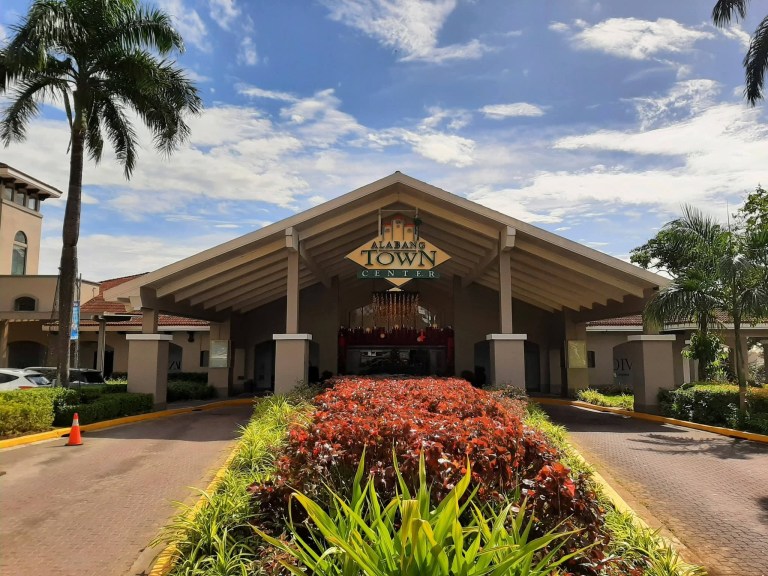
The front of Alabang Town Center along Madrigal Avenue.
To put things in perspective, posted below is the excerpt from the business news report of the Manila Bulletin. Some parts in boldface…
Ayala Land, Inc. (ALI) has agreed to sell its 50 percent stake in Alabang Commercial Center Corp. (ACCC), the entity that owns and operates the prominent Alabang Town Center mall in Muntinlupa City, back to the Madrigal family for ₱13.5 billion.
The real estate giant announced in a disclosure to the Philippine Stock Exchange that it executed a share purchase agreement with its existing joint-venture partner. The transaction is contingent on standard closing conditions.
“The unsolicited offer from our joint venture partner provided a premium, allowing ALI to recognize gains from the sale and monetize its stake in Alabang Town Center,” said ALI Chief Finance Officer and Treasurer Jose Eduardo A. Quimpo II.
He added that the “Proceeds from the sale will fuel further growth in our Leasing portfolio and provide our stakeholders with return of capital.”
In a separate statement, ALI said the deal allowed the company to realize “compelling value for the mature asset, crystallizing future earnings potential today.”
“This move is a deliberate execution of Ayala Land’s strategy to be a premier creator of value,” the company said. “It showcases a disciplined approach of developing assets, stabilizing their operations, and monetizing them at an optimal valuation to aggressively fund future growth and enhance shareholder returns.”
ALI President and Chief Executive Officer Meean B. Dy noted the firm’s strategic focus.
“Our strategy is focused on a dynamic cycle of value creation. We build, we stabilize, and we unlock value at the right time to fuel our next wave of innovation,” Dy said.
“This transaction is a prime example of that strategy in action. We are monetizing a legacy asset at peak valuation to accelerate the rollout of our expansive pipeline of commercial and retail spaces, which will define the Ayala brand of development for the next decade,” he added.
The proceeds from the sale are slated to be a key driver in funding ALI’s leasing pipeline, which includes nearly 700,000 square meters of new gross leasable area (GLA) over the next five years. This expansion is set to transform the commercial landscape in key growth centers across the Philippines.
Chinabank Capital Corp. Managing Director Juan Paolo Colet described the deal as “an opportunistic transaction that enabled Ayala Land to exit their joint venture with the Madrigal family at an attractive price. The company can readily use the cash for various projects in its growth pipeline.”
Colet noted that the future plans for the property remain uncertain.
“It remains to be seen what the Madrigal family will do with their prime commercial property. Given the price they paid, they would need to unlock more value from the asset. A major redevelopment might be on the table,” he said.
Situated adjacent to exclusive gated residential communities and active business developments, Alabang Town Center serves as a community anchor with multiple al fresco areas that contribute to a relaxed, homey atmosphere consistent with the local lifestyle.
Let me end this post by asking you readers: What is your reaction to this recent development? If you are a resident of Muntinlupa City, do you think the P13.5 billion deal will lead to a major redevelopment of Alabang Town Center in the near future? If you have visited the ATC before, how often do you visit the high-end shopping mall in Alabang? Do you feel confident the ATC will evolve and possibly expand under the control of the Madrigal family and Rockwell Land? Does Alabang Town Center’s current design and structure look old or outdated to you?
For more South Metro Manila community news and developments, come back here soon. Also say NO to fake news, NO to irresponsible journalism, NO to misinformation, NO to plagiarists, NO to reckless publishers and NO to sinister propaganda when it comes to news and developments. For South Metro Manila community developments, member engagements, commerce and other relevant updates, join the growing South Metro Manila Facebook group at https://www.facebook.com/groups/342183059992673
The inflation rate of the Philippines eased further this past November landing at 1.5%, according to a business news report by GMA News.
To put things in perspective, posted below is an excerpt from the business news report of the GMA News. Some parts in boldface…
The country’s inflation rate slowed down in November 2025 on the back of slower increase in food costs during the period, the Philippine Statistics Authority (PSA) reported on Friday.
At a press conference, PSA Deputy National Statistician Divina Gracia del Prado said the overall inflation —which measures the rate of increase in the prices of goods and services— clocked in at 1.5%. This was slower than the 1.7% rate seen in October 2025.
November’s inflation rate brought the year-to-date national average to 1.6%, well within the government’s comfortable ceiling of 2% to 4%.
“Ang pangunahing dahilan ng mas mababang antas ng inflation nitong Nobyembre 2025 kaysa noong Oktubre 2025 ay ang mas mabagal na pagtaas ng presyo ng Food and Non-Alcoholic Beverages na may 0.1% inflation rate,” del Prado said.
(The main reason for the lower inflation rate in November 2025 versus October 2025 was the slower increase in the prices of Food and Non-Alcoholic Beverages with an inflation rate of 0.1%.)
The inflation rate for the heavily weighted index clocked in at 0.5% in October 2025.
The Food and Non-Alcoholic Beverages index contributed 85.3% to the country’s overall inflation print.
Meanwhile, food inflation —which tracks the price movements of food items in a “basket” commonly purchased by households— registered a negative rate of 0.3% from 0.2% in the prior month due to slower increase in vegetable prices at 4% from 16.4% month-on-month as well as the slowdown in the growth of meat prices at 4.2% from 5.2%.
Let me end this post by asking you readers: What is your reaction to this recent development? Did you think the nation’s inflation could slow down even more to as low as 1% by the end of December?
The World Bank (WB) sees the economy of the Philippines making a gradual recovery in 2026 and 2027 fueled by strong domestic demand, according to a news report by BusinessWorld. The WB also stressed that corruption is unacceptable.
To put things in perspective, posted below is an excerpt from the report of BusinessWorld. Some parts in boldface…
THE WORLD BANK (WB) sees a gradual recovery for the Philippines in 2026 and 2027, after growth slowed this year due to weaker investment and sluggish consumption, compounded by a corruption scandal and a string of natural disasters.
In its latest Philippines Economic Update released on Tuesday, the multilateral lender trimmed its Philippine gross domestic product (GDP) growth forecast to 5.1% for this year from 5.3% in its June report. For 2026, it lowered its Philippine GDP growth forecast to 5.3% from 5.4% previously.
The World Bank also cut its Philippine GDP growth projection for 2027 to 5.4% from 5.5% previously.
These latest projections are below the government’s 5.5-6.5% growth goal for this year and the 6-7% target for 2026 to 2028.
“To borrow from Torsten Slok, chief economist at Apollo (Management), it’s a Nike swoosh pattern. He describes the US economy, and I’m describing our forecast for the Philippines as a kind of Nike swoosh. We have a dip in 2025, and then we have a gradual recovery in 2026 to 2027,” World Bank Senior Economist Jaffar Al-Rikabi said during a briefing.
He noted the average growth of the Philippines over 2025 to 2027 will be lower than 2024 when GDP expanded by 5.7%.
“For 2025… the growth is largely weighed down by domestic factors. In particular, lower construction activity and weaker consumption growth,” he said.
The Philippine economy expanded by a weaker-than-expected 4% in the third quarter, bringing nine-month growth to 5%, as the pace of household final consumption expenditure and government spending slowed amid a corruption scandal.
Mr. Al-Rikabi also noted the deceleration in fixed investment and private consumption due to higher-than-expected number of natural disasters that hit the Philippines this year.
“But for 2026 to 2027, we think that it’s likely that external factors will weigh more heavily on growth, largely slower export demand,” Mr. Al-Rikabi said.
The US imposed a 19% tariff on most goods from the Philippines starting August, dampening export demand.
The World Bank said the Philippine economy’s growth will pick up in 2026 and 2027, fueled by strong domestic demand.
“Private consumption is projected to strengthen as inflation stays low, employment remains robust, and monetary easing lowers interest rates, making it easier for businesses and households to borrow,” it said in the report.
According to the World Bank, private consumption, which accounts for more than 70% of the economy, is projected to expand by 4.8% this year, slowing from 4.9% in 2024. This is expected to pick up to 5.3% in 2026 and 5.4% in 2027.
The World Bank said investment is likely to recover as public infrastructure projects regain momentum, while recent liberalization reforms in telecommunications, transport, logistics and renewable energy improve the business climate.
The multilateral lender also expects headline inflation to average 1.8% this year, describing the pace as “very moderate” and a key source of resilience. This forecast is slightly above the Bangko Sentral ng Pilipinas’ (BSP) 1.7% projection for 2025 and the 1.6% average recorded in the first 11 months.
‘CORRUPTION IS UNACCEPTABLE’ – Even as the Philippine economy will see a gradual recovery in the next two years, Mr. Al-Rikabi noted risks are tilted to the downside, with “more prominent” domestic drivers.
“There is a continued challenge of heightened perceptions around governance risks. This could, if it continues, erode investor confidence. It could delay public investment execution, and it could weaken growth,” he said.
The World Bank economist also noted there may be delays in fiscal and structural reforms amid the current domestic environment, “which could slow consolidation and weigh on growth over the medium term.”
A corruption scandal involving anomalous flood control projects has already triggered protests, slowed economic activity, and shaken investor confidence in the country.
“From the World Bank perspective, corruption is unacceptable,” World Bank Country Director for the Philippines, Malaysia, and Brunei Zafer Mustafaoğlu said during the same briefing.
“The World Bank considers it detrimental to any country and has been fighting against corruption in all the member countries that we operate in,” he added.
Mr. Mustafaoğlu said the Philippine government could take this opportunity to increase transparency and modernize its budget execution system “that could actually support longer-term growth and can increase investment confidence (and) can increase long-term potential growth,” he said.
Let me end this post by asking you readers: What is your reaction to this recent development? Did you think the national economy will recover gradually in 2026 and 2027 as the World Bank predicted? With inflation being low, do you feel confident about spending for your needs and wants in the short term?
As the signs are clear that economic growth of the Philippines has weakened, President Marcos called on financial giant HSBC to help foreign investors realize the economic opportunities in the country, according to a Philippine News Agency (PNA) news article.
To put things in perspective, posted below is an excerpt from the news article of the PNA. Some parts in boldface…
President Ferdinand R. Marcos Jr. has called on international bank HSBC to help more foreign investors see the huge economic opportunities the Philippines has to offer.
“Together let’s build a more progressive Philippine economy, where people can access reliable financial services, obtain meaningful opportunities, and live more dignified, comfortable lives,” he said in a speech at HSBC’s 150th year anniversary gala in Taguig City on Tuesday night.
“Let us continue creating an environment where investors, stakeholders, and most importantly, our citizens see the Philippines as a nation of promise,” he added.
He acknowledged the foreign bank’s support for government initiatives, including its participation in recent bond issuances such as the SEC-registered USD3.3 billion-equivalent dual currency global bond that aims to ensure the continuation of vital government programs.
“These programs, whether on infrastructure, education, or social protection, directly benefit our people, especially those who rely on stable public services,” he said.
He also cited HSBC’s strong collaboration with relevant economic agencies and its contribution to increasing the country’s exposure to foreign investors.
From its first branch in Binondo in 1875, Marcos said HSBC’s growing presence in the Philippines serves as a vote of confidence in the future of the Philippines.
On the part of the government, he said the administration continues to strengthen its financial systems to protect depositors.
The Bangko Sentral ng Pilipinas, he added, is refining capital, liquidity, and governance standards to ensure that banks are resilient.
The country, he said, also adopts reforms such as the Basel III New Standardized Approach, the National Risk Assessment, and clearer guidelines for the disqualification of erring officers.
“Today, as HSBC adapts to a rapidly changing economy, we are confident that the bank will remain true to its commitment to making its services more inclusive, more secure, and accessible to Filipinos,” the chief executive said.
HSBC, the leading international bank in the country, serves 41 million clients across 57 markets, with over USD3 trillion in assets.
In his remarks, HSBC Interim Group Chairman Brendan Nelson said the firm has “strong” confidence in the Philippines and is ready to work with the country to sustain its growth momentum.
He said HSBC is “determined to continue growing” in the Philippines as he noted its strategic position in Southeast Asia, one of the regions, he noted, is set to benefit most from the “configured globalized world.”
Let me end this post by asking you readers: What is your reaction to this recent development? Do you think economic growth of the Philippines will get stronger in 2026? Do you think foreign investors will take a new look at the Philippines for economic opportunities soon?
The 3rd quarter growth of only 4% the Philippines achieved has been on people’s minds a lot lately. As such, the country is at risk of falling behind its neighbors in Southeast Asia in terms of economic growth and gross domestic product (GDP) per capita, according to a BusinessWorld news report.
To put things in perspective, posted below is an excerpt from the news report of BusinessWorld. Some parts in boldface…
The Philippine economy is at risk of further falling behind its Southeast Asian neighbors, an economist said, noting it may take two years to catch up with Vietnam and up to 70 years to catch up with Singapore.
“(T)he Philippines could find itself lagging behind if alleged public spending issues continue to divert attention and resources away from the structural reforms needed to accelerate economic development,” Bank of the Philippine Islands (BPI) Lead Economist Emilio S. Neri, Jr. said in a commentary on Wednesday.
In the third quarter, Philippine gross domestic product (GDP) grew by 4%, its slowest pace in over four years amid slower household and public infrastructure spending as the flood control scandal dampened investor and con-sumer sentiment.
In the nine months to September, GDP growth averaged 5%, putting the government’s 5.5%-6.5% full-year growth target further out of reach.
“The Philippine economy is growing, but not enough to close the economic gap with other countries,” Mr. Neri said.
He noted the Philippine GDP per capita is lower compared with other economies in the region. Citing International Monetary Fund (IMF) data, he said the Philippines’ GDP per capita stood at $4,078 in 2024.
“At the current growth rate, it would take the Philippines two years to catch up with the GDP per capita of Vietnam, 4 years with Indonesia, 14 years with Thailand, 26 years with Malaysia, and 70 years with Singapore, assuming their incomes remain stagnant. In reality, their GDP per capita continues to grow, which means the gap could persist or even widen,” Mr. Neri said.
The Philippines lagged behind Singapore which had a GDP per capita of $90,674 in 2024, followed by South Korea ($36,128), Japan ($32,498), China ($13,312), Malaysia ($12,540), Thailand ($7,491), Indonesia ($4,958) and Vietnam ($4,535).
“Before the pandemic, the Philippines had a higher GDP per capita than Vietnam, but has since been overtaken. At current trends, it would take the Philippines two years to catch up with Vietnam, but that gap could increase to 13 years by 2044,” Mr. Neri said.
The BPI economist said the Philippines needs structural reforms to accelerate growth in order to close the widening gap with its neighbors.
“The current economic model of the country is not enough, as shown by the country’s inability to grow faster than 6% in recent years,” he said.
Mr. Neri said the economy has been “too reliant” on consumer spending, driven by overseas Filipino worker (OFW) remittances and the business process outsourcing industry.
“There is a need to diversify its sources of growth. The economy must improve in terms of production, especially in agriculture and manufacturing, as they will allow the economy to be more self-sufficient and to reach foreign markets. These industries have been critical to Vietnam’s success and could play a similar role for the Philippines,” he said.
However, Mr. Neri said implementing these reforms will be hard if the government lacks focus.
“Public spending issues divert fiscal resources and policymaking focus away from long-term development priorities. Efforts to strengthen safeguards against potential issues in government spending are essential, enabling the country to work on structural reforms that could improve the economy,” he said.
Let me end this post by asking you readers: What is your reaction to this recent development? What do you think should the government do to accelerate economic growth?
With the weakening economic growth and growing socio-economic uncertainty affecting the entire Philippines, prominent business groups reaffirmed their commitment to invest and create jobs in the country, according to a Manila Bulletin news report.
To put things in perspective, posted below is an excerpt from the news report of the Manila Bulletin. Some parts in boldface…
Six prominent groups representing the business sector reaffirmed their commitment to invest and create jobs in the Philippines amid weakening sentiment in the economy, which is fueled by what they described as a “political turmoil” stemming from the ongoing corruption scandal.
In a rare joint statement sent to the media moments after a pivotal reshuffle in the administration’s economic team, the business groups emphasized that they remain committed to supporting the Philippine economy.
“While the current political turmoil raises understandable concerns, we stress that the country’s long-term fundamentals remain strong; anchored by a well-regulated financial system, a stable banking sector, and companies that continue to invest in and believe in the Philippines,” the groups said on Monday, Nov. 17.
The statement was signed by Makati Business Club (MBC), Management Association of the Philippines (MAP), Philippine Chamber of Commerce and Industry (PCCI), Financial Executives Institute of the Philippines (FINEX), Philippine Finance Association, and Institute of Corporate Directors (ICD).
In a statement that essentially serves as a pitch to potential investors, the six business groups said that the institutions safeguarding local markets “continue to operate independently and rigorously.”
The groups cited the Bangko Sentral ng Pilipinas (BSP) and the Securities and Exchange Commission (SEC) as among the most reliable government partners when it comes to businesses.
Both the BSP and the SEC uphold regulatory frameworks aligned with global standards, ultimately ensuring market integrity, prudent risk management, and strong investor protection, they said.
“The Philippines continues to meet international benchmarks on capital adequacy, disclosure requirements, and corporate governance,” the groups said.
The business groups also took note of the corporate earnings of publicly listed companies, which reflect the economy’s underlying strength.
They noted that even during periods of global instability, such as the Covid-19 pandemic, companies continued to demonstrate resilience with growing revenues and stable margins.
Further, the groups said that investment sentiment in the country remains robust, with gross fixed capital formation ranging between 22 percent and 27 percent of gross domestic product (GDP) over the last 10 years.
“This ongoing level of capital spending, mainly driven by business growth, clearly indicates that Philippine companies continue to build capacity, expand operations, and invest in the country’s long-term prospects,” the statement read.
While upholding optimism, the six business groups stressed that investor confidence is influenced not only by economic fundamentals but also by governance.
Let me end this post by asking you readers: What is your reaction to this recent development? Does the joint statement of the prominent business group boost your confidence about the future of the country? Do you think the Philippine economy will be able to bounce back strongly next year? Does the continuing media coverage of the flood control corruption scandals and investigations continue to bother you?
To put things in perspective, posted below is an excerpt from the news report of BusinessWorld. Some parts in boldface…
APPROVED foreign investment pledges plunged nearly 50% in the third quarter as investor sentiment soured due to the corruption scandal involving government infrastructure projects, the local statistics agency said.
Preliminary data from the Philippine Statistics Authority (PSA) showed the value of foreign commitments approved by investment promotion agencies (IPAs) fell by 48.7% to P73.68 billion in the July-to-September period from P143.74 billion in same period last year.
However, this was the highest amount of investment pledges since the third quarter of 2024.
Ser Percival K. Peña-Reyes, director of the Ateneo Center for Economic Research and Development, said the decline in approved investments can be attributed to the weaker investor sentiment.
“Tingin ko. Wala pang nakukulong eh (I think so. No one has been imprisoned yet),” he said in a Viber message, when asked if this sharp slump in approved investments will likely persist in the fourth quarter until 2026.
Quarter on quarter, the approved pledges rose by 9.34% from P67.38 billion in the second quarter.
Singapore was the top source of foreign investment pledges in the third quarter with P20.26 billion (27.5%), followed by Japan with P13.59 billion (18.4%) and Cayman Islands with P13.14 billion (17.8%).
Investment commitments from South Korea stood at P5.57 billion (7.6%), while those from China stood at P4.51 billion (6.1%)
PSA data showed the investment pledges were approved by seven IPAs — the Authority of the Freeport Area of Bataan, Bases Conversion and Development Authority (BCDA), Board of Investments (BoI), Clark Development Corp., Clark International Airport Corp., Philippine Economic Zone Authority (PEZA), and Subic Bay Metropolitan Authority.
Let me end this post by asking you readers: What is your reaction to this recent development? What do you think the government must do to convince foreign investors to become more confident about investing in the Philippines? Do you think the investigation and pace of justice related to the flood control corruption scandal is moving too slowly?