

Disclaimer: This is my original work with details sourced from reading the comic book and doing personal research. Anyone who wants to use this article, in part or in whole, needs to secure first my permission and agree to cite me as the source and author. Let it be known that any unauthorized use of this article will constrain the author to pursue the remedies under R.A. No. 8293, the Revised Penal Code, and/or all applicable legal actions under the laws of the Philippines.
Welcome back literature enthusiasts, 20th century arts and culture enthusiasts, Marvel Comics fans and comic book collectors! Today we go back to the year 1975 to take a close look at Marvel Comics’ very own comic book adaptation of the science fiction film Planet of the Apes (1968).
The first time I ever saw the Charlton Heston-led movie was on local TV but I could only watch a few portions of it as my access to TV was very limited on the day of its broadcast. It took me a purchase of the DVD copy of Planet of the Apes in 2001 and the use of a relative’s TV and DVD player to finally see it entirely.
As the movie was highly philosophical and symbolic with its presentation, I could see why a lot of people regard it as a sci-fi classic. I should state that I do not believe in human evolution nor do I believe that humans and apes share a common genetic ancestor. Science and technology could never solve God’s designs and power of creation of life. As such, the concept of Planet of the Apes – which started as a novel before being adapted into film with the involvement of Rod Serling of The Twilight Zone – is nothing more than fantasy.
As the 1968 movie turned out successful, it not only spawned cinematic sequels but also an official comic book adaptation by Marvel Comics.
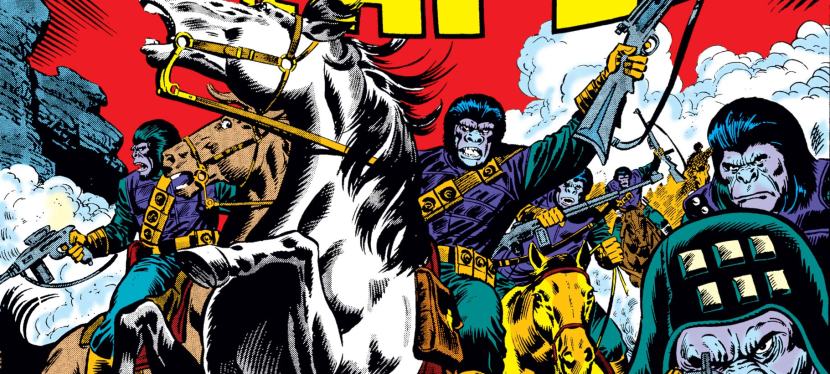
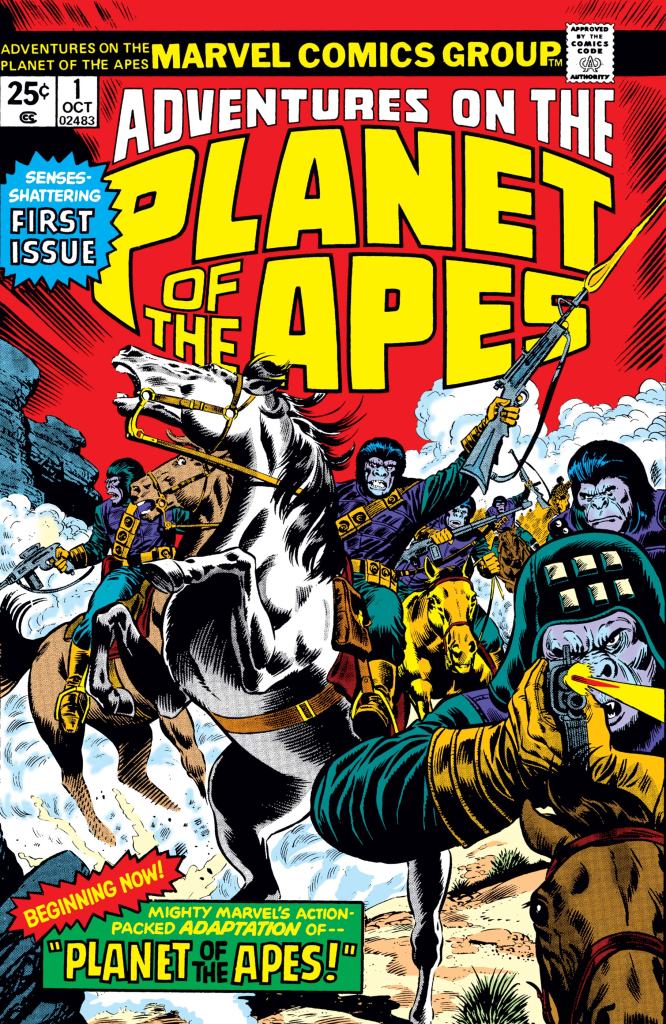
With those details laid down, here is a look back at Adventures on The Planet of the Apes #1, published in 1975 by Marvel Comics with a story written by Doug Moench and drawn by George Tuska. This is the first chapter of a 6-part adaptation of the 1968 movie.
Early story
The story begins in deep space. Inside the speeding space ship is the American pilot Taylor doing an audio recording of mission details and his thoughts. He mentions the theory of Dr. Hasslein stating that centuries have already passed back on Earth even though he and his companions Dodge, Landon and Stewart (all three already in a state of suspended animation) hardly aged at all. He then joins his teammates for the long-term sleep expecting that by the time they wake up, they will their destination.
A very long time later, the ship enters the atmosphere of a breathable planet and crash lands on water. Now with facial hair, Taylor, Dodge and Landon wake up and they are shocked to see that Stewart is already dead. Suddenly, water begins to enter the interior of the ship forcing the three men go outside and ride on a boat with the equipment they managed to bring out. They move on as their ship sinks below the water.
Taylor, Dodge and Landon arrive on shore and they realize they are in the middle of a wasteland…
Quality
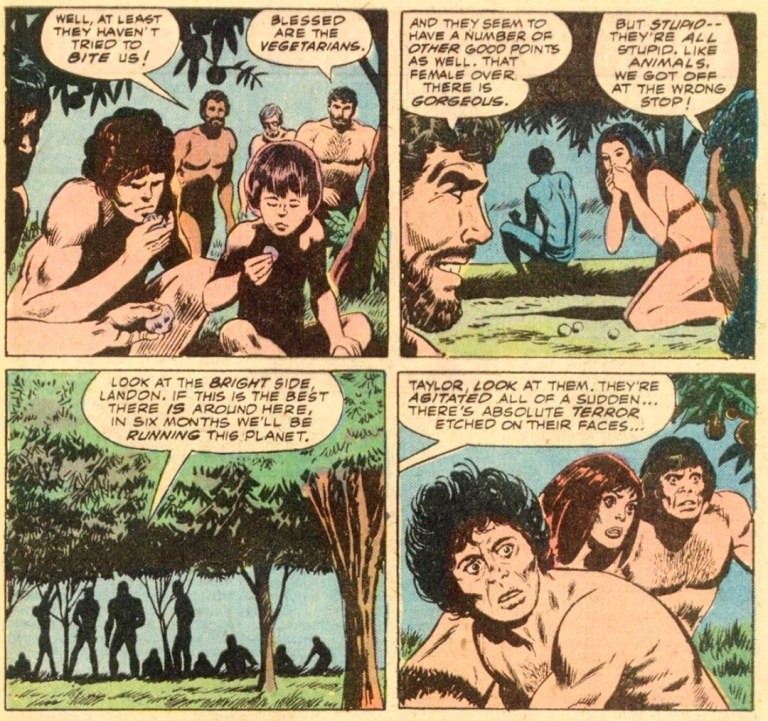
I am surprised to see that this literary work turned out to be faithful to the movie (specifically from the start until Taylor got shot during the ape-led hunt). It is not a 100% accurate which is not surprising as Marvel’s creators balanced the amount of details for adaptation while still having some space left for them to implement their own creative way of dramatizing the characters.
Writer Doug Moench clearly paid close attention to the details from the movie while ensuring that the adaptation will work within the limitations of the comic book format. For his part, artist George Tuska did a fine job drawing the characters, the environments and the apes. The way he drew Taylor, Landon and Dodge, there is clearly some 1970s influence on their space suits and the character designs (example: Dodge has an afro hairstyle). Tuska’s art on the apes unfortunately lacked details and they look rushed. The way they appeared in the comic book, the apes don’t look intimidating at all.
When it comes to adapting scenes from the movie script into comic book form, there were clear differences with regards to the arrangement of the details. For example in the movie, Charlton Heston’s Taylor talks a lot more in the opening scene (inside the space ship) expressing his lack of faith in humanity and desire for something better than his own species. In this comic book, Taylor talked much less in the beginning but his cynicism as well as his sarcastic views on humanity and nation were revealed in a scene when he and his companions were in the middle of the wasteland. Literary Taylor’s putdowns on Landon are much more detailed than what was shown in the movie. In some ways, the dialogue in this comic book is more philosophical than what was executed in the movie when it comes to the common scenes (between comic book and film).
Another example was the scene showing the three men and the waterfall. In the film, they took their clothes off and started swimming in the lake without even checking the quality of the water. In the comic book, Dodge actually tested the water and declared it safe for them to swim in. The comic book also showed more of Dodge’s dedication to scientific testing.
Conclusion
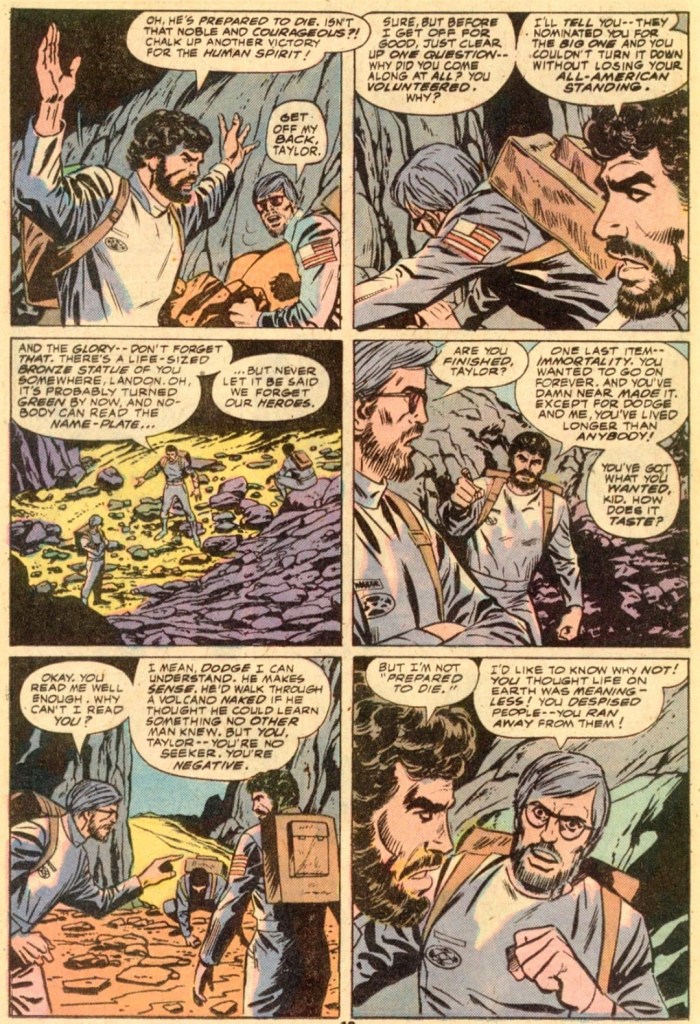
I can say that Adventures on The Planet of the Apes #1 (1975) is an entertaining read and a good enough start of the 6-part adaptation of the movie. The Moench-Tuska duo’s efforts resulted in an engaging tale of Taylor and his two teammates who find themselves in a strange world that turned out to have apes being armed and riding horses. This comic book is mostly composed of build-up of details and expository dialogue, and yet the action scenes on the last three pages resulted in a short yet sufficient pay-off.
Overall, Adventures on The Planet of the Apes #1 (1975) is recommended.
+++++
Thank you for reading. If you find this article engaging, please click the like button below, share this article to others and also please consider making a donation to support my publishing. If you are looking for a copywriter to create content for your special project or business, check out my services and my portfolio. Feel free to contact me with a private message. Also please feel free to visit my Facebook page Author Carlo Carrasco and follow me on Twitter at @HavenorFantasy as well as on Tumblr at https://carlocarrasco.tumblr.com/ and on Instagram at https://www.instagram.com/authorcarlocarrasco
 Author Carlo Carrasco