The uncertainty about this year’s economic growth for the Philippines has gotten stronger as the Department of Finance (DOF) admitted that achieving 6% growth is quite difficult, according to a Manila Bulletin news report. The DOF pointed to external shocks that are affecting the national economy.
To put things in perspective, posted below is an excerpt from the Manila Bulletin news report. Some parts in boldface…
While the Philippine economy has already been recovering from its deep recession during the height of the Covid-19 pandemic, hitting its growth potential of six percent would be challenging given the global uncertainties spilling over domestically, according to the Department of Finance (DOF).
“We do think that the potential of the Philippines is at the minimum six-percent growth. But of course, it’s quite difficult, especially knowing some of the challenges that we’re seeing,” DOF Undersecretary and Chief Economist Domini Velasquez told reporters during the Philippine thrift banks’ annual convention on Tuesday, July 15.
Just before the initial three-month pause on reciprocal tariffs ended on July 9, United States (US) President Donald Trump had stretched it to Aug. 1, but hiked the rates for Philippine exports to 20 percent from 17 percent previously, repeatedly citing the “significant and persistent trade deficit” that the trade giant has with its former colony.
Velasquez noted that the tariff hike was among the uncertainties that the Cabinet-level Development Budget Coordination Committee (DBCC) had considered in downscaling its growth target for the year, through 2028.
Last month, the economic team slashed its 2025 GDP growth target to between 5.5 percent and 6.5 percent from six- to 6.5-percent previously. Cited as factors were heightened external uncertainties, especially the ongoing conflicts in the Middle East and the imposition of US tariffs.
Finance Secretary Ralph G. Recto told reporters during an informal press chat on Wednesday, July 16, that he expects the economy to accelerate “significantly” in the second quarter compared to the previous quarter.
“In effect, the target is still six percent for the year,” Recto noted, taking off from the recently revised growth goal. “Realistically, it’s probably around 5.7 percent or 5.8 percent for the year. It depends, because there’s a lot of uncertainty—uncertainty with trade policy.”
“But I think the second quarter will definitely be better than the first,” Recto said, noting that the improvement will be driven by both government and household consumption.
The DBCC had also narrowed the growth target range for 2026 to 2028 to six to seven percent, from the previously more ambitious six to eight percent.
“We did recognize those [tariffs]. When we dialed down on our growth target in 2025, it’s really because of the external factors that we were seeing,” Velasquez said.
Let me end this post by asking you readers: What is your reaction to this recent development? Do you think the national economy is not strong enough to achieve 6% GDP growth by the end of this year? What do you think the national government should do to strengthen economic growth and make the Philippines more attractive to foreign investors? Do you think the Philippines still has a chance to convince America to lower its planned tariff on Philippine-made goods?
Welcome back fellow geeks, Blu-ray collectors and movie buffs!
When it comes to watching movies – both old and new – the best place for me is still the movie theater. The very large screen, high-tech sound systems and comfortable seats of the cinema all make the theater viewing experience very immersive which streaming apps and the home theater setup could never match. The cinema experience is always better than streaming.
That being said, it is disappointing for me – as a resident of Muntinlupa City here in the Philippines – that local theaters in Alabang had to close down. The original cinemas of Festival Mall, which first opened in 1998 and grew from six to ten screens, are no more. Before they were all closed down, those cinemas had deteriorated over time and I still remember how bad the projection in one of their premium cinemas was when I saw Star Trek Into Darkness in 2013. It was like I was watching a VHS copy of the movie on their screen. It was that bad!
This year, the 4-screen cinemas of Commercenter in Filinvest City had closed down (refer to my past blog posts by clicking here and here) and it is very unfortunate not just for me but also for others who enjoyed watching movies at that mall. In my experience, Commercenter was my favorite local place to watch movies at and the cinema operators were consistent with maintaining each screen, the comfortable chairs and the sound systems. At the same time, it was pretty convenient for me to park the car in the basement parking (really spacious), climb up to the cinemas at the 2nd floor (ticket counter and snacks counter were beside each other), enjoy a movie, and visit a local store or a restaurant within the mall after leaving the cinema.
With the closure of Festival Mall’s original cinemas and Commercenter cinemas, that is a combined loss of ten screens along with the many seats and equipment combined. Along the way, many people who worked directly in those lost cinemas either became unemployed or got re-assigned to a new task within the local establishment. Sadly, not too many people here in the Philippines are talking about the jobs lost with the closure of cinemas.
Cinemas of Commercenter have been closed down since March 15, 2025.
This brings me to my next point – BusinessWorld published an article exploring the current struggle of Philippine cinemas in what is now the post-pandemic era. For the newcomers reading this, the Philippines economy has been growing strongly year-by-year after the COVID-19 period ended but the nation’s cinema industry is still struggling in terms of sales and attracting paying customers. The Filipinos’ love for streaming is huge factor but there are also other reasons why not enough moviegoers are supporting cinemas.
To put things in perspective, posted below is an excerpt from the BusinessWorld article. Some parts in boldface…
KAREN LUSTAÑAS, 30, tries to watch a movie in the Philippine capital at least once a month, if the budget allows it.
“I try to save time and money for films that I really want to see,” she told BusinessWorld in a Facebook Messenger chat. “I can barely afford it, but if I’m a fan of the director or actors, I really have to watch it.”
“Otherwise, I’ll just watch it on a streaming platform,” she added.
As good as the movie industry is in imagining alternate realities, it didn’t see this one coming. Five years after the coronavirus disease 2019 (COVID-19) decimated the box office here and all over the world, movies are still struggling to come back.
Philippine gross movie ticket sales fell 3.7% year on year to $45.5 million (P2.5 billion) last year, a far cry from the $144.5 million posted in 2019, before the pandemic hit, according to US-based box office revenue tracker Box Office Mojo. In 2020, gross sales plunged 95% to $7.7 million.
Global cinema ticket sales fell 8.8% last year to €28 billion (P1.8 trillion) from 2023, the first annual drop since COVID-19, the European Audiovisual Observatory (EAO) said last month.
Regular movie ticket prices cost P300 to P400 in Metro Manila, or about half the daily minimum wage. On the other hand, the basic monthly subscription to streaming platforms like Netflix, Max (HBO) and Disney+ costs P150 to P250, and the titles are virtually endless.
“If you think about it, it’s really worth it and more practical to go with Netflix,” Ms. Lustañas, a freelancer, said.
The annual Metro Manila Film Festival (MMFF) grossed P800 million last year, hitting the target but failing to top 2023’s record P1 billion despite a week-long extension.
The pandemic forced people to watch movies at home, aiding streaming services like Netflix, whose revenue grew 14% annually to more than $39 billion last year from 2019, according to computations by BusinessWorld using data from the company’s website. Netflix subscribers also doubled to about 300 million over the five-year period.
Since 2020, local box office hits have been few and far between. The latest was Star Cinema’s My Love Will Make You Disappear starring Kim Chiu and Paulo Avelino, grossing P12 million on its opening day in March.
“Today, going to the cinema is a more intentional experience, rooted not just in the movie being shown but in the overall ambiance that brings the film to life,” Hamm E. Katipunan, Ayala Malls’ Asset Management head, said in an e-mailed reply to questions.
“It’s not just about waiting for blockbusters to hit streaming sites; Filipinos appreciate the good feeling of watching movies that are truly worth experiencing on the big screen,” he added.
While cinemas run by Ayala Malls, SM Supermalls and other mall chains have diversified their offerings, a pattern has emerged in the top-grossing Filipino films that have drawn people to cinemas.
GMA Pictures and Star Cinema’s co-production Hello, Love, Again starring Alden Richards and Kathryn Bernardo set the record for the highest opening day gross for a local film with P85 million in November, surpassing the P75-million gross from The Super Parental Guardians in 2016.
‘FORMULAIC STORIES’ – It shows that Filipinos watch a movie mainly because of its main cast, Film Development Council of the Philippines (FDCP) Chairman Jose Javier Reyes told a news briefing in March, citing a council-funded study involving 800 respondents.
“They can’t afford to go regularly to the movies anymore,” he said. “The biggest blow is that people don’t repeat screenings. They just wait for it to go on streaming platforms.”
The study, done in 2024 in collaboration with De La Salle University to explore the evolving habits, preferences and challenges shaping the local film industry, found that Filipinos from the A, B, and a small part of the C socioeconomic classes regularly watch movies.
The study, which will be released in July as part of the launch of FDCP’s Philippine Film Industry Roadmap, also found that streaming services have become the primary platform for 67% of Filipinos.
Only 21% still frequent cinemas, with many complaining about repetitive movie themes and high ticket prices.
Though stars are still the main movie drawer, the study also found that Filipinos are “sick of formulaic stories,” Mr. Reyes said. He added that the roadmap, mandated by the government, would shed light on how to better support the industry.
In October last year, President Ferdinand R. Marcos, Jr. placed the Film Academy of the Philippines under the Department of Trade and Industry (DTI) to boost Filipino film development.
Trade Secretary Ma. Cristina A. Roque earlier said the budget for the film industry would increase next year as part of the roadmap. She noted that other countries have been using movies and the creative industry to boost tourism and trade.
Mr. Reyes said movie outfits should improve the quality of their films to boost their success overseas. “In the Philippines, star power is important, but the moment you cross borders, there’s a market for people who are more interested in the material itself,” he pointed out.
Rico V. Gonzales, head of distribution at Warner Bros. Pictures Philippines, said the company supports the local industry by distributing two to three Filipino movies yearly, along with the usual foreign releases from Warner Bros. and Universal Pictures.
“It’s part of the goodwill of the company to help local producers who don’t have a distribution arm, compared with the likes of Star Cinema and GMA Pictures, which have the power to do it themselves,” he said.
The current state of the cinema industry of the Philippines is disappointing and the future looks uncertain as of this writing. While a lot of my fellow Filipinos chose streaming to watch movies in the comfort of their home, I prefer watching movies on Blu-ray and 4K Blu-ray disc format. The most phenomenal 4K Blu-ray experiences I had was Top Gun: Maverick and that movie never failed to amaze me each time I saw it using my 4K Blu-ray disc player. I also enjoyed watching my 4K Blu-ray copies of Casablanca, Interstellar, Total Recall (1990), and Star Trek: First Contact.
Going back to the state of cinema here in the Philippines, I did not watch a single movie in the cinema in 2024. In fact, the last time I saw a movie on the big screen locally was Sound of Freedom in 2023 (read my review by clicking here). This is because the new movies that were released in 2024 did not interest me at all and the fact that a lot of new Hollywood movies had woke garbage in them turned me off. Not only that, there were times when news movies from overseas were not even released in Philippine cinemas at all such as Jesus Revolution (note: I had to buy the movie on Blu-ray just to watch it).
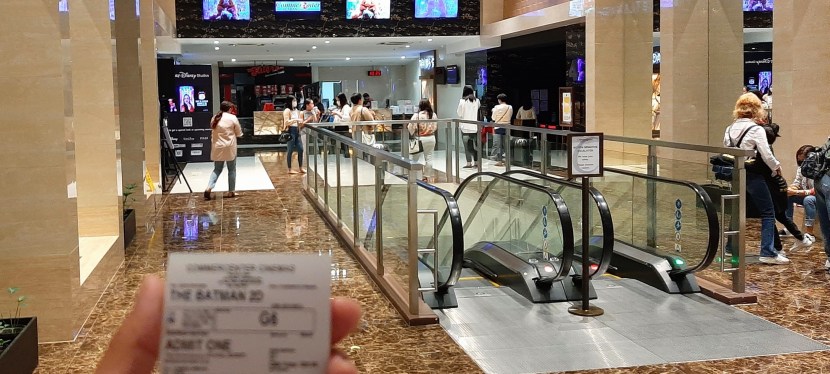
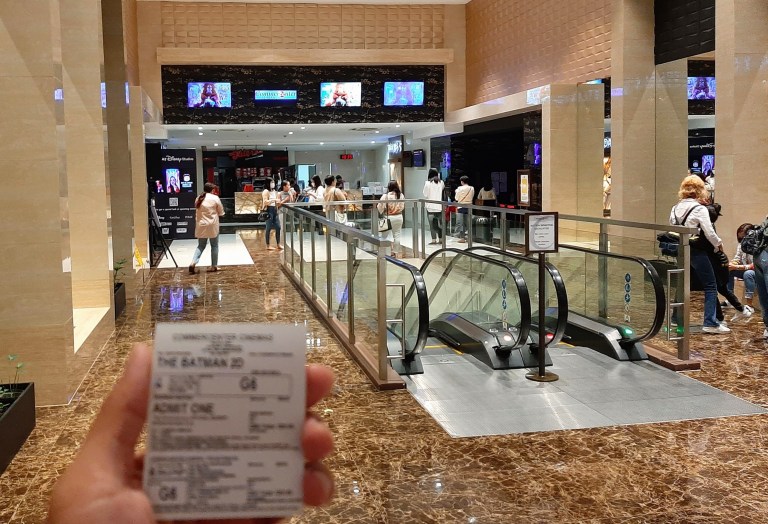
I saw The Batman at Commercenter’s cinema on March 2022.
As of this writing, the direction of the entire cinema industry of the Philippines remains uncertain and so far there were no real breakthroughs that happened. That being said, I still remember when in 2015, there were long lines of moviegoers at Commercenter waiting to enter the cinemas to watch Jurassic World. Such a memory won’t be repeated here in Alabang and without its cinemas, Commercenter’s value as a place for fun has gone way down.
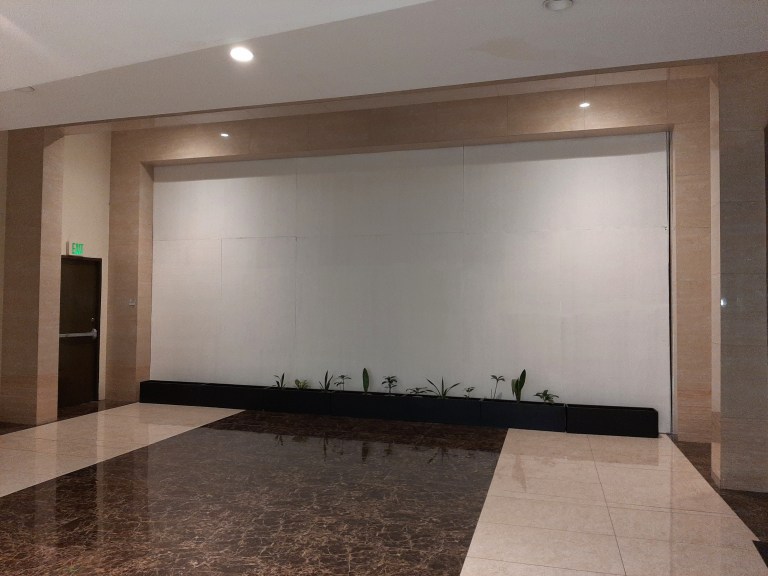
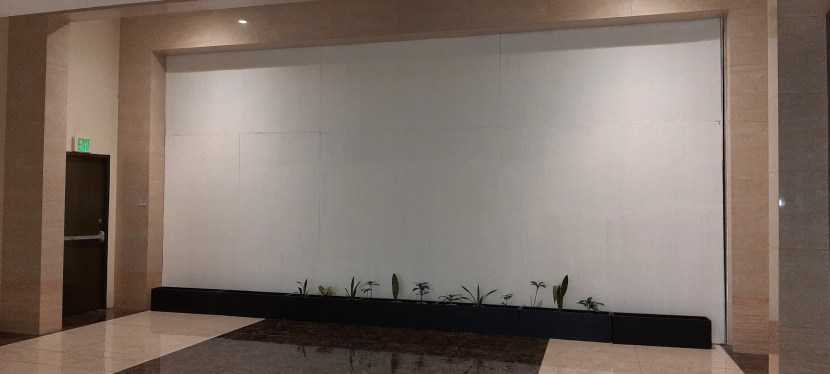
For those of you who have been missing out on developments here in Alabang, Commercenter officially closed down their cinemas (4 screens) on March 15, 2025 fulfilling their announcement (click here and here) They did, however, announce that something new will materialize but there are no details as to what that might be.
During one of my recent visits at the high-end shopping mall in Filinvest City, I noticed that the 2nd floor path leading to what used to be the cinemas was sealed shut which you can see in the video below.
For the newcomers reading this, Commercenter’s cinemas operated for a little over ten years starting in the 2nd half of 2014. The cinemas had 4 screens and each screen had a sitting capacity of over 100 seats. Outside of the screens, the ticket desk and the concessionaire were right beside each other. Having seen a lot of movies at Commercenter, I can say that watching films inside the cinemas was often comfortable, convenient and pleasant.
As many of us know, the COVID-19 pandemic really hit the cinemas industry of the nation very hard as other types of businesses also went down. The nationwide shutdown of movie theaters caused by government pandemic restrictions really hurt not only the cinema operators but also their employees. When the restrictions were eased, cinemas around the country gradually reopened and for a time moviegoers had to wear face masks when watching movies. When I saw The Batman in Commercenter in March 2022, me and others had to wear face masks because they were required.
A post-pandemic economic recovery happened here in the Philippines but it looks like the cinemas industry has yet to achieve the pre-pandemic numbers of moviegoers. That being said, I can only speculate that the rise of ticket prices, the preference of locals to watch new movies by streaming, and the rise of varied operating expenses probably contributed to the closure of cinemas not only in Commercenter but also those in Festival Mall.
With regards to inflation, the rise of ticket prices at Commercenter during the post-pandemic persion were noticeable. I paid P320 for The Batman in March 2022 and P380 for Sound of Freedom in September 2023 at Commercenter. Before the mall closed down its cinemas, foreign movie tickets were being sold at P400 each. Clearly, there were unfavorable economic forces that happened.
Without the cinemas, Commercenter lost entertainment value. I remember back in 2015 when a lot of people formed long lines to watch Jurassic World which also explained why the mall’s basement parking almost reached full capacity. There were also busy weekends for blockbusters films like Wonder Woman, Avengers: Endgame, Mission: Impossible – Fallout, Mad Max: Fury Road and others right there.
Before the closure of the cinemas happened, this movie poster of the 2025 Superman movie (directed by James Gunn) was displayed inside Commercenter. The film is set to open in cinemas worldwide this July and Commercenter’s cinemas have been closed since March 15. The display of this movie poster is pointless now.
Before the pandemic struck, Commercenter was a fun place for moviegoers and I personally know friends based outside of Muntinlupa City who came to the said mall for movies. That means Commercenter really had a unique attraction that made it competitive with Alabang Town Center and Festival Mall when it comes to attracting people who love movies. At the same time, the mall has nice places where visitors can have meals or coffee after watching a film.
Of course, the cinemas of Commercenter are no more and we can only remember the old days of fun-filled moviegoing at its cinemas through pictures, social media posts and collected movie tickets.
In my honest opinion, watching movies in Alabang will never be the same.
For more South Metro Manila community news and developments, come back here soon. Also say NO to fake news, NO to irresponsible journalism, NO to misinformation, NO to plagiarists, NO to reckless publishers and NO to sinister propaganda when it comes to news and developments. For South Metro Manila community developments, member engagements, commerce and other relevant updates, join the growing South Metro Manila Facebook group at https://www.facebook.com/groups/342183059992673
Recently in the City of Muntinlupa, the city health office stated that there are no cases of the new variants of COVID-19, according to a Manila Bulletin news report.
To put things in perspective, posted below is an excerpt from the Manila Bulletin report. Some parts in boldface…
The Muntinlupa City Health Office said there are no cases of the new variants of Covid-19 in the city amid the start of screening for arrivals at the country’s points of entry.
Dr. Juancho Bunyi, CHO head, said as of May 28, there are only four active Covid-19 cases with mild and moderate symptoms in the city confined at the city-run Ospital ng Muntinlupa in Alabang.
“No new variants reported as per DOH [Department of Health],” said Bunyi.
The country’s Bureau of Quarantine ordered the screening at points of entry on all arrivals from countries where Covid-19 FLiRT cases have been reported.
The DOH said based on the update by the World Health Organization (WHO), the three new variants of Covid-19 being monitored are JN.1.18, KP.2 and KP.3, which are “descendants of JN.1.”
It said KP.2 and KP.3 are known as the “FLiRT” variants, “a nickname coined by some researchers to describe amino acid changes in the COVID-19 virus’ spike protein, specifically from phenylalanine (F) to leucine (L) at position 456, and from arginine (R) to threonine (T) at position 346.”
WHO observed that “there are currently no reported laboratory or epidemiological reports indicating any association between VOIs/VUMs and increased disease severity.”
In the Philippines, the DOH reported that from May 7 to 13, a total of 877 new Covid-19 cases were recorded with an average of 125 reported cases per day.
It said that while there is an increase of Covid-19 cases in the country recently, it is small and lower compared to previous observed increases.
Of the 877, seven had severe or critical disease and five people died, which occurred from April 30 to May 13.
“All Philippine regions remain to be at low risk for COVID-19. There is no scientific basis for travel restrictions to any country because of an increase in COVID-19 cases. The Department remains to be in close coordination with international health authorities, and its Bureau of Quarantine is keeping watch over points of entry nationwide. The voluntary use of face masks should be done properly, along with standard precautions like hand washing, avoiding crowds, and choosing good airflow,” the DOH said.
As of May 12, only 11 percent (119/1,117) of dedicated Covid-19 ICU (intensive care unit) beds were occupied and only 13 percent (1,238/9,571) of dedicated Covid-19 non-ICU beds were occupied, the DOH added.
Let me end this post by asking you readers: What is your reaction to this recent development? If you are a resident of Muntinlupa City, are you concerned FLiRT variants of COVID-19 could be detected in the city soon?
For more South Metro Manila community news and developments, come back here soon. Also say NO to fake news, NO to irresponsible journalism, NO to misinformation, NO to plagiarists, NO to reckless publishers and NO to sinister propaganda when it comes to news and developments. For South Metro Manila community developments, member engagements, commerce and other relevant updates, join the growing South Metro Manila Facebook group at https://www.facebook.com/groups/342183059992673
More patients around the country can avail of the bivalent vaccines for COVID-19 as a result of the Department of Health’s (DOH) revision of its guidelines, according to a Manila Times news report. This developed as less than 50% of the initial batch of bivalent vaccines have been used on patients limited to health care workers and senior citizens.
To put things in perspective, posted below is an excerpt from the Manila Times report. Some parts in boldface…
THE general population can now be administered with Covid-19 bivalent vaccine after the Department of Health (DoH) issued revised guidelines on the updated jab.
A bivalent vaccine protects against both the original virus that causes Covid-19 and the Omicron variants.
In a memorandum dated July 10 but was released to the public only this week, the DoH said those under the A3 group, meaning persons with comorbidities and compromised immunity, can now receive the Pfizer bivalent vaccine in hospitals and health facilities nationwide.
Health Secretary Teodoro Herbosa added that the general public can also avail of bivalent vaccine, noting their decision stemmed from the slow consumption of the updated jab among the A1 (health care workers) and A2 (senior citizen) subgroups. He said only 38 percent of the 391,000 donated doses allotted for these groups were used.
“Because of that, we have decided to make it available to those who want to get vaccinated with the booster. We only decided on this last week as the uptake was slow,” Herbosa said in Filipino and English in a radio interview.
The government’s stock of donated bivalent vaccines are set to expire on July 31, with an extension date of August 30.
Herbosa said a person can only receive a bivalent vaccine four to six months after getting the second booster dose.
He added that the government is negotiating with the global Covax Facility for additional bivalent vaccine doses.
Pfizer, Herbosa said, has issued a certificate of product registration that would make the vaccine available in drugstores across the country, but the lack of local cold chain storage proves to be a hindrance.
Let me end this piece by asking you readers: What is your reaction to this recent development? Are there many people in your local community who have been wanting to get immunized with the bivalent vaccines?
It has been more than three years since a national emergency was declared in response to COVID-19 and in a recent ambush interview, new Department of Health (DOH) Secretary Ted Herbosa said he would recommend the lifting of the nation’s emergency, according to a GMA Network news report.
To put things in perspective, posted below is an excerpt from the GMA news article. Some parts in boldface…
Health Secretary Ted Herbosa said Monday that he would recommend lifting the country’s COVID-19 state of public health emergency.
In an ambush interview, Herbosa stressed that COVID-19 no longer posed an emergency and could be treated as any other disease that the Department of Health (DOH) monitors, like influenza, cough, and cold.
“Actually, wala nang emergency eh, ‘di ba? (there is no longer an emergency). I think I would actually ask the lifting of the public health emergency in the country,” he said.
Then-President Rodrigo Duterte declared a state of public health emergency during the onset of the pandemic in March 2020.
Under Proclamation 922, the state of public health emergency would remain in force and effect until lifted or withdrawn by the President.
In May, the World Health Organization (WHO) declared that COVID-19 no longer represented a global health emergency.
Herbosa, however, said that the alert level system would remain.
“The alert level system will stay because that’s a system like the typhoon signal that stays. But actually hindi na siya (that’s no longer a) public health emergency. Wala nang (there’s no) public health emergency,” he added.
Let me end this piece by asking you readers: What is your reaction to this recent development? Do you believe that COVID-19 itself is no longer the tremendous health problem it used to be?
For more South Metro Manila community news and developments, come back here soon. Also say NO to fake news, NO to irresponsible journalism, NO to misinformation, NO to plagiarists, NO to reckless publishers and NO to sinister propaganda when it comes to news and developments. For South Metro Manila community developments, member engagements, commerce and other relevant updates, join the growing South Metro Manila Facebook group at https://www.facebook.com/groups/342183059992673
As the number of new cases of COVID-19 infection continues to rise here in the Philippines, OCTA Research announced that the positivity rate in Metro Manila may peak next week, according to a Manila Bulletin news report.
To put things in perspective, posted below is an excerpt from the Manila Bulletin news article. Some parts in boldface…
The Covid-19 positivity rate in Metro Manila may peak next week, but the 25 percent initial projection will not be reached, said OCTA Research fellow Dr. Guido David on Tuesday, May 9.
David noted that only a “slight” increase in the current Covid-19 positivity rate was observed in Metro Manila, which could indicate that the “increasing trend is slowing down.”
“Metro Manila’s seven-day positivity rate increased slightly to 22.9 percent as of May 7, 2023. It was at 17.8 percent on April 30,” David said.
“The increasing trend is slowing down, and the peak could happen within the next week or so. The positivity rate could also miss the 25 percent mark,” he pointed out.
On May 8, David said that the increasing Covid-19 cases, driven by the Omicron subvariant XBB.1.16, may begin to decline “hopefully by late May or June.”
Positivity rate refers to the number of individuals who yielded positive results from among those who have been tested for Covid-19.
The benchmark for the positivity rate set by the World Health Organization is 5 percent.
The Department of Health on Monday reported 1,545 new Covid-19 cases across the country, of which 677 cases were recorded in Metro Manila.
He said the country’s current positivity rate was down to 18.8 percent on May 8, from 19.9 percent on May 7.
Let me end this piece by asking you readers: What is your reaction to this recent development? Did the recent increase of COVID-19 infection impact your living or your livelihood? Have been wearing a face mask more often over the past two weeks? Were you approached by members of the anti-vaccine community recently?
For more South Metro Manila community news and developments, come back here soon. Also say NO to fake news, NO to irresponsible journalism, NO to misinformation, NO to plagiarists, NO to reckless publishers and NO to sinister propaganda when it comes to news and developments. For South Metro Manila community developments, member engagements, commerce and other relevant updates, join the growing South Metro Manila Facebook group at https://www.facebook.com/groups/342183059992673
Go Negosyo founder Joey Concepcion is back in the news. This time, he emphasized that private hospitals can be helpful in the nation’s recovery from COVID-19 with regards to procuring and administering vaccines to patients who can afford them and are willing to pay for them, the Manila Bulletin reported.
To put things in perspective, posted below is the excerpt from the Manila Bulletin news report. Some parts in boldface…
A former presidential economic adviser on Thursday, Nov. 3, underscored the key role of private hospitals in procuring and administering bivalent Covid-19 vaccines to those who are willing to pay for them.
Amid the plans of the Marcos administration to procure a limited number of bivalent vaccines, which provide broader protection against the original Covid-19 and a component of the Omicron variant, Go Negosyo founder Joey Concepcion said that private hospitals can be deputized by the government to procure and administer the bivalent vaccines.
He stated this as he estimated that the government will bring in a limited number of vaccines considering that it is still assessing how much it can procure and how much can be delivered.
“The 10 million doses, or however much the government decides to buy, will of course be set aside for the priority sectors, namely the elderly, the immunocompromised and those with comorbidities; but there may be others outside of these priority sectors who would also want the bivalent vaccines,” Concepcion said.
Since all private hospitals are capable of handling vaccinations and all can explore agreements with the government as part of the private sector, he raised the idea of allowing private hospitals to procure the bivalent vaccines and administer them to those who want to pay for them.
Dr. Benjamin Co, chief medical officer of Metro Pacific Hospital Holdings, agreed with the ex-economic adviser’s proposal.
“I think the best option is to make it available for a fee or at cost. For those who can very well afford it, they can get it from private clinics that offer this and we can charge an administration fee plus the cost of the vaccine,” he said in a statement.
He added that bivalent vaccinations can also become part of the private hospitals’ corporate social responsibility efforts.
“The remaining free vaccines can be appropriated to the rest of the Filipinos who cannot afford this but would like to get vaccinated,” Co suggested.
Recruiting help from the private sector will also unburden the government and allow it to focus on the vulnerable sectors of society, according to Vaccine Experts Panel member Dr. Rontgene Solante, who is also the chairman of Adult Infectious Diseases and Tropical Medicine at San Lazaro Hospital.
“Private sector involvement is another important layer to achieve higher vaccine accessibility and coverage,” he said.
“This is critical especially with waning interest in booster doses of Covid vaccines. Government should always find ways to engage with the private sector, which has been an important partner of DOH (Department of Health) during the pandemic,” Solante added.
Bivalent Covid vaccines provide broader protection against Covid-19 and better protection against its Omicron variant.
However, all Covid-19 vaccines are still under Emergency Use Authorization, which means only the government can procure and administer the vaccines.
In order to sell the vaccines to the public, vaccine manufacturers need a Certificate of Product Registration (CPR).
As you can in the above article, key steps and legal changes are needed in order to pave the way for private hospitals to get deputized and become key players in the nation’s recovery from COVID-19.
Let me end this piece by asking you readers: What is your reaction to this latest series of developments? If COVID-19 vaccines are offered by private hospitals with price tags, are you willing to pay for them? What do you think is the single biggest disadvantage of government-led handling of COVID-19 vaccines? Do you think that the anti-vaccine fanatics are planning to organize activities to disrupt COVID-19 vaccination around the country?
For more South Metro Manila community news and developments, come back here soon. Also say NO to fake news, NO to irresponsible journalism, NO to misinformation, NO to plagiarists, NO to reckless publishers and NO to sinister propaganda when it comes to news and developments. For South Metro Manila community developments, member engagements, commerce and other relevant updates, join the growing South Metro Manila Facebook group at https://www.facebook.com/groups/342183059992673
To put things in perspective, posted below is an excerpt from the GMA news. Some parts in boldface…
The National Capital Region’s COVID-19 cases one-week growth rate climbed to 71%, independent group OCTA Research said Saturday.
The group said NCR’s “7-day average increased from 103 to 176 (as of June 11 to 17), a 71% increase.“
“This translates to an ADAR (average daily attack rate) of 1.24,” it added. ADAR pertains to the incidence showing the average number of new cases in a period per 100,000 people.
“The NCR reported 282 new cases on June 17, 2022, based on DOH data. With the exception of April 3 (when there was a high number due to possible backlog), this is the highest number of new cases since February 26, 2022,” OCTA said.
The coronavirus reproduction number meanwhile also went up to 1.80 in NCR as of June 14, an increase over the 1.40 as of June 7. The reproduction rate refers to the number of people infected by one case. A reproduction number that is below 1 indicates that the transmission of the virus is slowing down.
Also climbing up is the positivity rate in the region, now at 3.7%. This refers to the percentage of people who were found positive for COVID-19 among the total number of individuals tested.
OCTA however noted that despite the rise in these metrics in NCR, the hospital bed utilization and ICU utilization rates are still low at 22% and 17%, respectively.
“So far, the numbers we are seeing have been in line with our projections: a weak surge and no escalation of alert levels or restrictions because we expect our healthcare system will be able to manage the relatively low number of hospitalizations,” the group said.
OCTA then reminded the public to be responsible, follow health protocols and get COVID-19 booster shots to prevent infection.
As seen above, the COVID-19 situation in Metro Manila is getting worse in terms of infections but not with hospital bed utilization and ICU utilization which have registered low rates respectively. There’s no need yet to move the alert level system up. Such upward adjustments will depend on the metrics of the IATF. As we have seen before, more restrictions mean serious economic damage.
Key solutions to preventing a surge of new COVID-19 infections include getting vaccinated/boosted, wearing face masks and following health protocols properly. Along the way, I urge you to never let the anti-vaccine fanatics around you to fool you with their propaganda and misinformation tactics. Those anti-vaccine fanatics are loud and they don’t really offer any solutions on dealing with COVID-19.
Ignore those anti-vaccine fanatics and get vaccinated or boosted whenever you have the opportunity to do so. Call your local vaccination site or the local authorities now to find if you are eligible for a vaccine shot or a booster shot. When traveling around, wear your mask and follow local health protocols to avoid infection. The national authorities, meanwhile, should move quickly to allow comorbid patients access to 2nd booster shots and make adjustments to improve access to vaccines and vaccination hubs.
Let me end this by asking you readers: Does the recent spike of COVID-19 infections in the NCR scare you? Could it be possible that some of those who recently got infected were victims of the misinformation tactics of the anti-vaccine fanatics in our country? If have been boosted already for COVID-19, have you made moves to find out if you are eligible for the 2nd booster shot?
For the first time since March, the City Government of Las Piñas finally released through their Facebook page an update about their collective statistics about COVID-19 vaccination which includes initial and 2nd booster shots (2nd booster shots started in April and walk-ins for such shots were accepted).
To put things in perspective, posted below are the latest COVID-19 vaccination statistics updates as of May 17, 2022.
The latest statistics as of May 17, 2022.
As seen in the above statistics, the city’s grand total number of jabs recorded reached 1,388,759 with the number of fully vaccinated patients reaching 574,438 and the number of patients who received booster shots counted at 212,560. The number of patients who received 2nd booster shots totaled 374.
Regarding minors, the number of fully vaccinated patients aged 12 to 17-years-old reached 55,237. For the age-group of 5 to 11-years-old, the total number of fully vaccinated patients was at 21,221.
For all the unvaccinated people reading this, any Las Piñas resident who has yet to get registered for the free COVID-19 vaccines can learn the ways by clicking here. Anyone who is ready and willing to register online can click bit.ly/LasPiñasVaccination
Local residents who have been fully vaccinated but still have not received booster shots are welcome to contact the local authorities to determine if they are eligible for booster shots. Meanwhile, it has been announced that booster shots are effective against the much-reported Omicron subvariant which is now present in the Philippines.
Let me end this piece by asking you readers: If you are a Las Piñas City resident, have you been fully vaccinated already? Are there many fully vaccinated patients among the members of your local community who still have not availed of their respective booster shots? Are there many boosted patients in your community who could be waiting for their 2nd booster shots?
For more South Metro Manila community news and developments, come back here soon. Also say NO to fake news, NO to irresponsible journalism, NO to misinformation, NO to plagiarists, NO to reckless publishers and NO to sinister propaganda when it comes to news and developments. For South Metro Manila community developments, member engagements, commerce and other relevant updates, join the growing South Metro Manila Facebook group at https://www.facebook.com/groups/342183059992673










 Author Carlo Carrasco