A Look Back at Venom: Lethal Protector #3 (1993)

Disclaimer: This is my original work with details sourced from reading the comic book and doing personal research. Anyone who wants to use this article, in part or in whole, needs to secure first my permission and agree to cite me as the source and author. Let it be known that any unauthorized use of this article will constrain the author to pursue the remedies under R.A. No. 8293, the Revised Penal Code, and/or all applicable legal actions under the laws of the Philippines.

Welcome back superhero enthusiasts, 1990s arts and culture enthusiasts, Marvel Comics fans and comic book collectors! Today we go back to the year 1993 and explore a part of Marvel Comics’ universe through the first-ever limited comic book series featuring one of Marvel’s most iconic villains – Venom.

In my previous retro review, Venom discovers a long lost section of San Francisco that fell deep underground. Even though it is cut off from the resources and fresh air of modern San Francisco, the lost city section is filled with homeless people and social outcasts. Even though he helped the city dwellers by defeating the two armed mechs (employed by a powerful organization who oppose the city dwellers and are in pursuit of something related to San Francisco’s park), Venom still gets rejected by the so-called council. This only led him to returning to the surface not knowing that he is being targeted by a certain group.

With those details laid down, here is a look back at Venom: Lethal Protector , published in 1993 by Marvel Comics with a story written by David Michelinie and drawn by Mark Bagley.
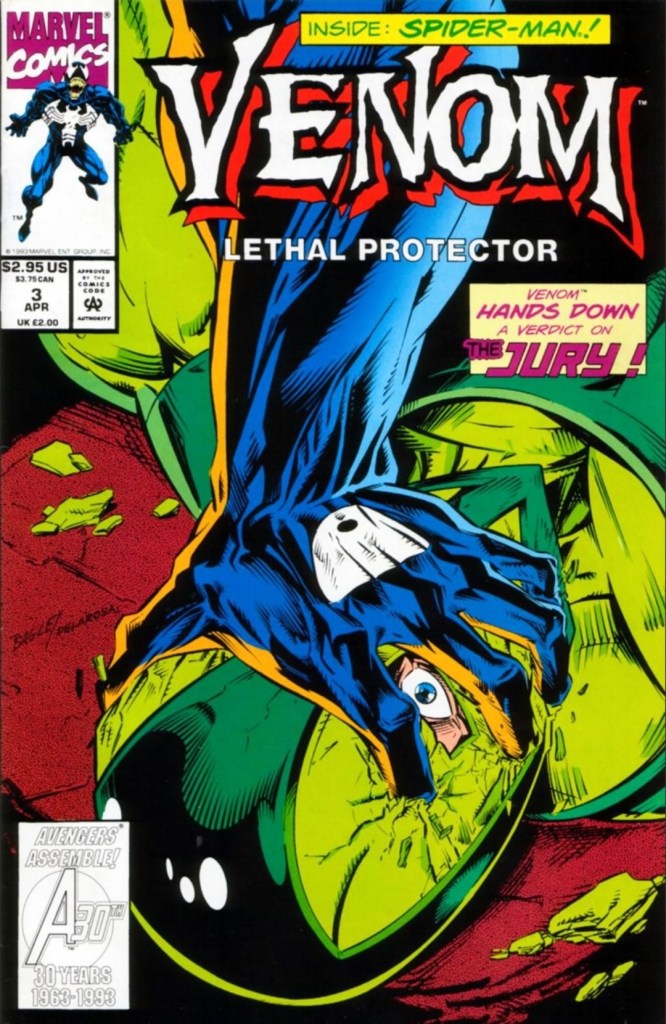
The cover.

Early story

The story begins with Venom suffering from a sonic blast while being restrained by one of the armed members of the group called The Jury. Their leader (who wears a suit and necktie) introduces himself as Orwell Taylor and he addressed Venom as Mr. Brock. It turns out Taylor spent lots of time and resources researching everything about Brock and the alien costume. More shockingly, The Jury’s leader reveals that he lost his son Hugh years ago due to Venom’s arranged killing of him as he escaped from his prison cell in the federal prison called The Vault. Hugh Taylor is the first man Venom killed when he escaped.

Venom responds by say that he and his symbiote did not want to hurt anyone. This provokes Orwell Taylor into anger and he orders The Jury to kill Venom. Due to the lengthy explanations of Orwell Taylor, Venom managed to recover and regain strength which he uses to free himself and throw one Jury member to another causing quick chaos.

After punching another Jury member, Venom then moves out of the alley and away from Taylor and his team…

Quality
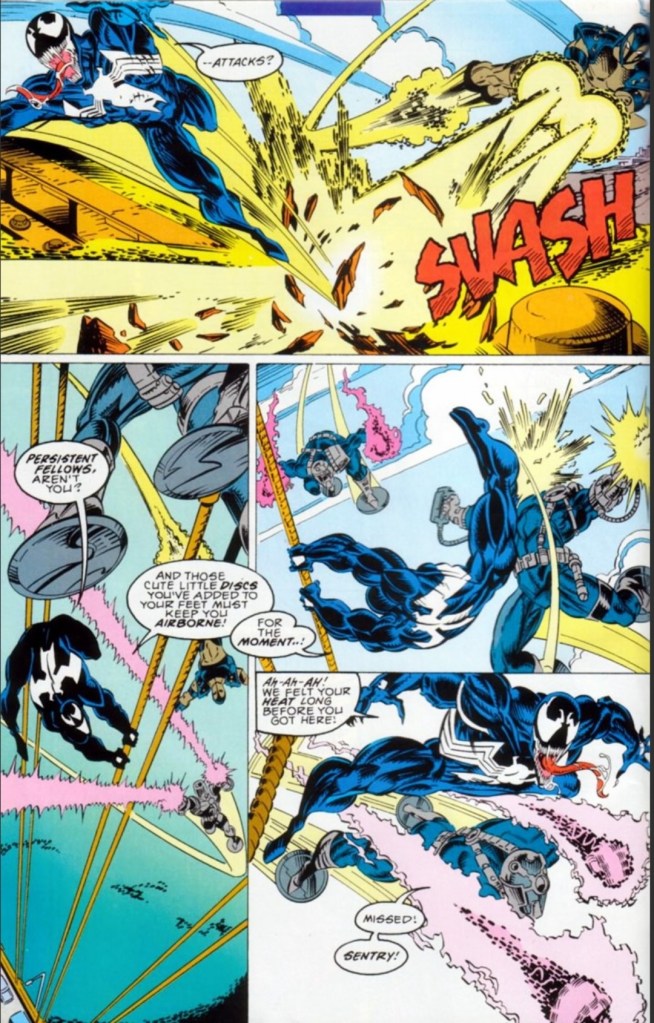
Very clearly, The Jury is a very formidable force of opposition. Their battle with Venom here comes with a lot of spectacle.

In terms of storytelling, this one is another improvement over issue (which itself is an improvement over issue ) as the plot got more interesting and even intriguing. For one thing, I like the fact that David Michelinie recalled Venom’s murderous escape from prison told way back in Amazing Spider-Man #315 (1989) and came up with the establishment of a very angry powerful father who formed the dangerous cybernetic team called The Jury. In a rather symbolic way, this comic book shows how Venom’s past comes back to haunt him and creatively, the battles between Venom and The Jury here are packed with a lot of action and visual dynamism delivered by Mark Bagley. The irony is that The Jury itself is not the main antagonist of this limited series as they are clearly presented to be a recurring force of opposition within Spider-Man’s realm in Marvel Comics’ shared universe of the time.

Still on the plot, the sinister organization hounding the dwellers of the lost city was revealed to be the Treece group whose leader is pursuing something very valuable to feed his greed. Still, even though this is already the third issue, the Treece organization’s presence is very subtle and as the force of opposition towards Venom, they are outclassed by The Jury.

As in the previous issue, Spider-Man got a good share of the spotlight but this one is even more limiting which should delight Venom fanatics who complained about Marvel’s icon overshadowing their guy with the symbiote. Spider-Man serves mainly as a tool for exposition as the creative team showed images from the past of Eddie Brock with his father (whom Spider-Man approached for answers).

The problem here is that showing flashbacks from the past and explaining how Eddie Brock became bitter and sinister as a result of receiving almost no affection from his father ruins the mystery of Venom as a character. During the time of Todd McFarlane drawing Amazing Spider-Man comics and the early Venom tales, the mystery of Eddie Brock’s past added to the intrigue of Venom and his quick rise as the deadliest villain Spider-Man ever faced. I understand that this limited comic book series had Venom as the protagonist who was in high demand among readers of the time but for me the creative team went way too far emphasizing Eddie Brock’s past.

Nothing changes the fact that Eddie Brock aided by the alien costume is a murderer who happens to have previously been a prolific print media journalist whose career got ruined by Spider-Man which in turn led him to a downward spiral and eventually to bonding with the symbiote that once bonded with Peter Parker. The flashbacks were pointless and if there really was an attempt to humanize Eddie Brock and make him sympathetic to readers, the creative team clearly failed.

Conclusion
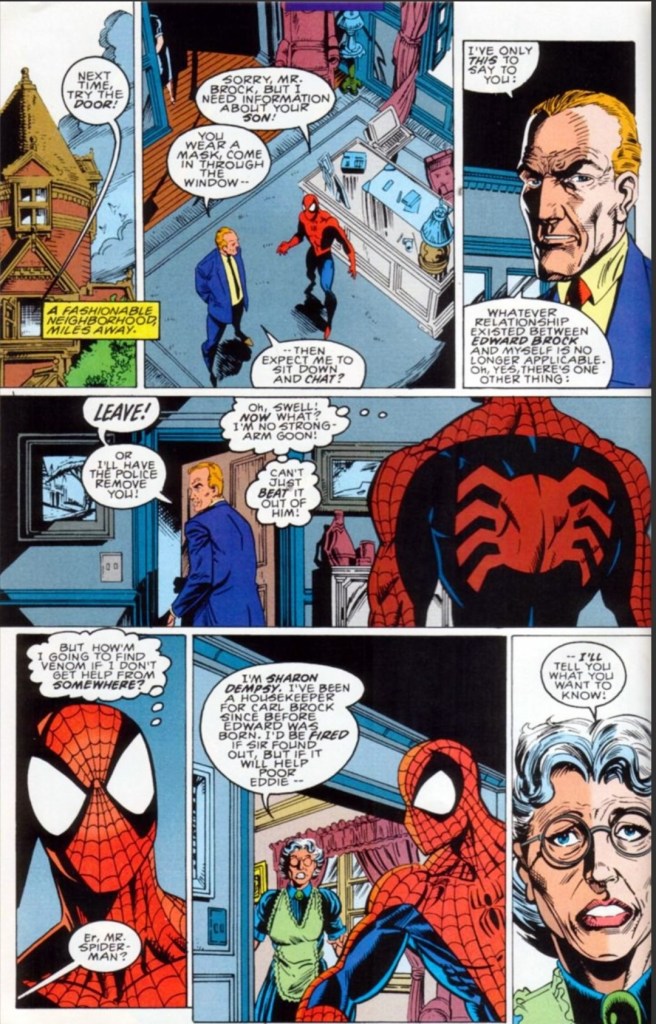
Spider-Man with Eddie Brock’s father in California.

Venom: Lethal Protector (1993) is a mixed bag. Its plot is clearly more intriguing and more interesting to read while there was enough creative space to show The Jury as a powerful force of opposition which is the result of Venom’s murder of Hugh Taylor (read: Amazing Spider-Man #315) while making a prison escape. The spectacle of the battle between Venom and The Jury must be seen! However, the creative team’s move to dramatize Eddie Brock’s past using flashbacks back-fired in my opinion and ultimately they destroyed whatever mystery was left behind Venom. As a protagonist, Venom has no appeal whatsoever and his portrayal here only reminds me that he works best as an antagonist opposite Spider-Man. Venom as a hero for those he perceived to be innocent and helpless remains forced and unconvincing.

Overall, Venom: Lethal Protector (1993) is satisfactory.

+++++

Thank you for reading. If you find this article engaging, please click the like button below, share this article to others and also please consider making a donation to support my publishing. If you are looking for a copywriter to create content for your special project or business, check out my services and my portfolio. Feel free to contact me with a private message. Also please feel free to visit my Facebook page Author Carlo Carrasco and follow me on Twitter at  @HavenorFantasy as well as on Tumblr at https://carlocarrasco.tumblr.com/ and on Instagram at https://www.instagram.com/authorcarlocarrasco

A Look Back at Harbinger #19 (1993)

Disclaimer: This is my original work with details sourced from reading the comic book and doing personal research. Anyone who wants to use this article, in part or in whole, needs to secure first my permission and agree to cite me as the source and author. Let it be known that any unauthorized use of this article will constrain the author to pursue the remedies under R.A. No. 8293, the Revised Penal Code, and/or all applicable legal actions under the laws of the Philippines.

Welcome back superhero enthusiasts, 1990s culture enthusiasts and comic book collectors! Today we go back to the early 1990s and explore a part of the Valiant Comics shared universe through the Harbinger monthly series.

In my previous retro review, the creative team of Fontenot-Simpson told another story that built up Harbinger’s concept some more while introducing yet another new character – Screen – who is not part of the team led by Sting. The story symbolically showed the further growth of the tremendous power of Toyo Harada not only through his control of the Harbinger foundation but also of his connection with the new United States President of the time. 

With those details laid down, here is a look back at Harbinger , published in 1993 by Valiant Comics with a story written by Maurice Fontenot and illustrated by Howard Simpson.

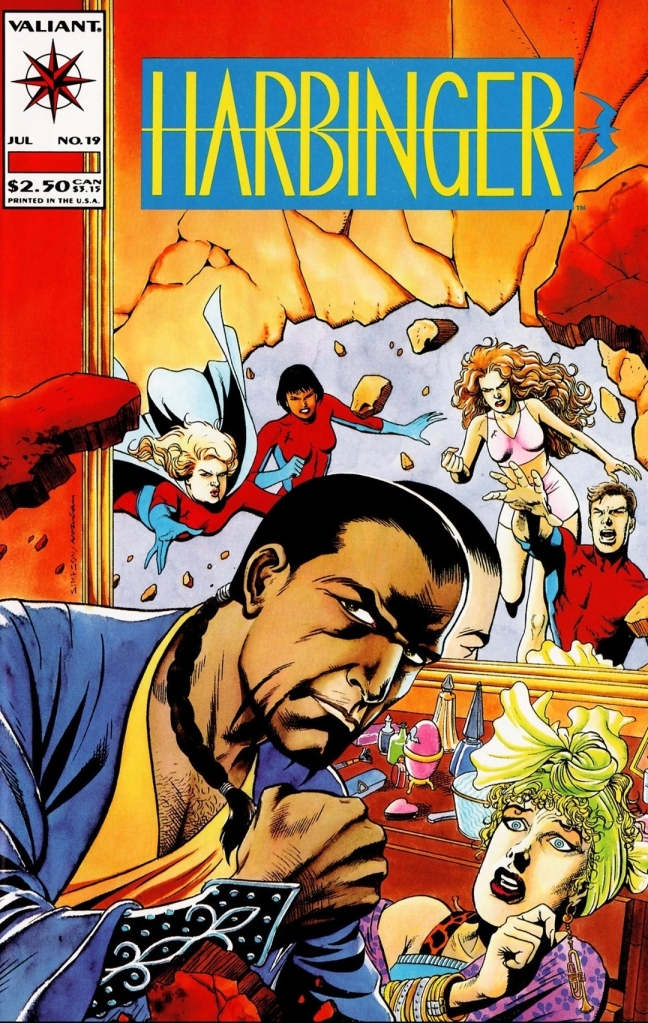
The cover.

Early story

The story begins on the afternoon of January 25, 1993. Inside the New York facility of the Harbinger foundation, a pretty blonde, young lady named Natalie Toynbee – codename: Stunner – gets scanned by the technicians handling the technologies. A technician’s request for Natalie to urinate into a cup reveals that the lady has a huge ego and pride of herself as she reacts negatively. 

Suddenly, the wall near Natalie and the technician got damaged by force unleashed by Sting who is accompanied by Faith, Flamingo and Shatiqua. Their mission is to free Natalie from the clutches of the Harbinger foundation which is a small part of their long-term vision of freeing and recruiting more powered young adults.

After subduing the Harbinger foundation personnel, Sting begins to explain to Natalie the situation and tells her to just trust him. Sting tells her to come with them which only drew more of Natalie’s ego along with skepticism. This reaction makes Faith think Natalie is not worth saving…

Quality

Imagine Iran invading America and causing terror like in this scene. Imagine Joe Biden and the Democrats allowing this to happen to Americans.

While the story was not crafted to follow-up closely on the events of issue #18, this comic book puts Sting and his teammates into a collision course with a new force of evil – the Iranians (note: issue confirms their national identity) who have interests on specific young adults with powers and special abilities. Along the way, the Fontenot-Simpson team introduced a new sinister force in the form of a very manipulative Iranian named Kaliph.

Kaliph’s introduction here is easily the biggest feature of the story and he unsurprisingly overwhelms the debut of Natalie. Kaliph here works in service of his unidentified superiors and as he does his job, he uses his special ability of manipulating people’s minds through sight and sound to gain information, find directions, make them do his orders and gain access into places that he could never have had he been an ordinary person. By the end of the story, I was convinced that Kaliph was created to be an enduring or recurring villain for Sting and his team.

More on the primary characters of this monthly series, Sting and his teammates were portrayed to get more harbingers (powered young adults) to join them and become part of their long-term opposition against Toyo Harada and the Harbinger foundation, even though their own team lacks the resources needed to support themselves. The lack of resources was cleverly highlighted through Natalie’s reactions (related to her big ego) to what Sting’s team has for her to live with. Looking at the bigger picture going back to issue , Sting’s vision of defeating Harada and winning the trust of powered young adults without any solid foundation (specifically resources, connections and security) emphasize his recklessness and false sense of maturity as a team leader.

Conclusion

Kaliph and his companion arrive in America with a sinister plan.

In my view, Harbinger (1993) is a solid change of direction for the monthly series complete with the introduction of a new, strong villain who originated from Iran which by today’s standards is the major force of terrorism in this world. The new villain Kaliph has a creepy aesthetic that other villains in this series lacked. More notably, the story remained consistently very engaging and pulled off some notable surprises which were indeed entertaining.

Overall, Harbinger (1993) is highly recommended!

+++++

Thank you for reading. If you find this article engaging, please click the like button below, share this article to others and also please consider making a donation to support my publishing. If you are looking for a copywriter to create content for your special project or business, check out my services and my portfolio. Feel free to contact me with a private message. Also please feel free to visit my Facebook page Author Carlo Carrasco and follow me on Twitter at  @HavenorFantasy as well as on Tumblr at https://carlocarrasco.tumblr.com/ and on Instagram at https://www.instagram.com/authorcarlocarrasco

A Look Back At Dr. No

Every great movie franchise starts small and as the decades pass by, its place in history will be marked and revisited.

This is my review of the first-ever James Bond movie Dr. No.

Screenshot_20190812-114957_YouTube.jpg
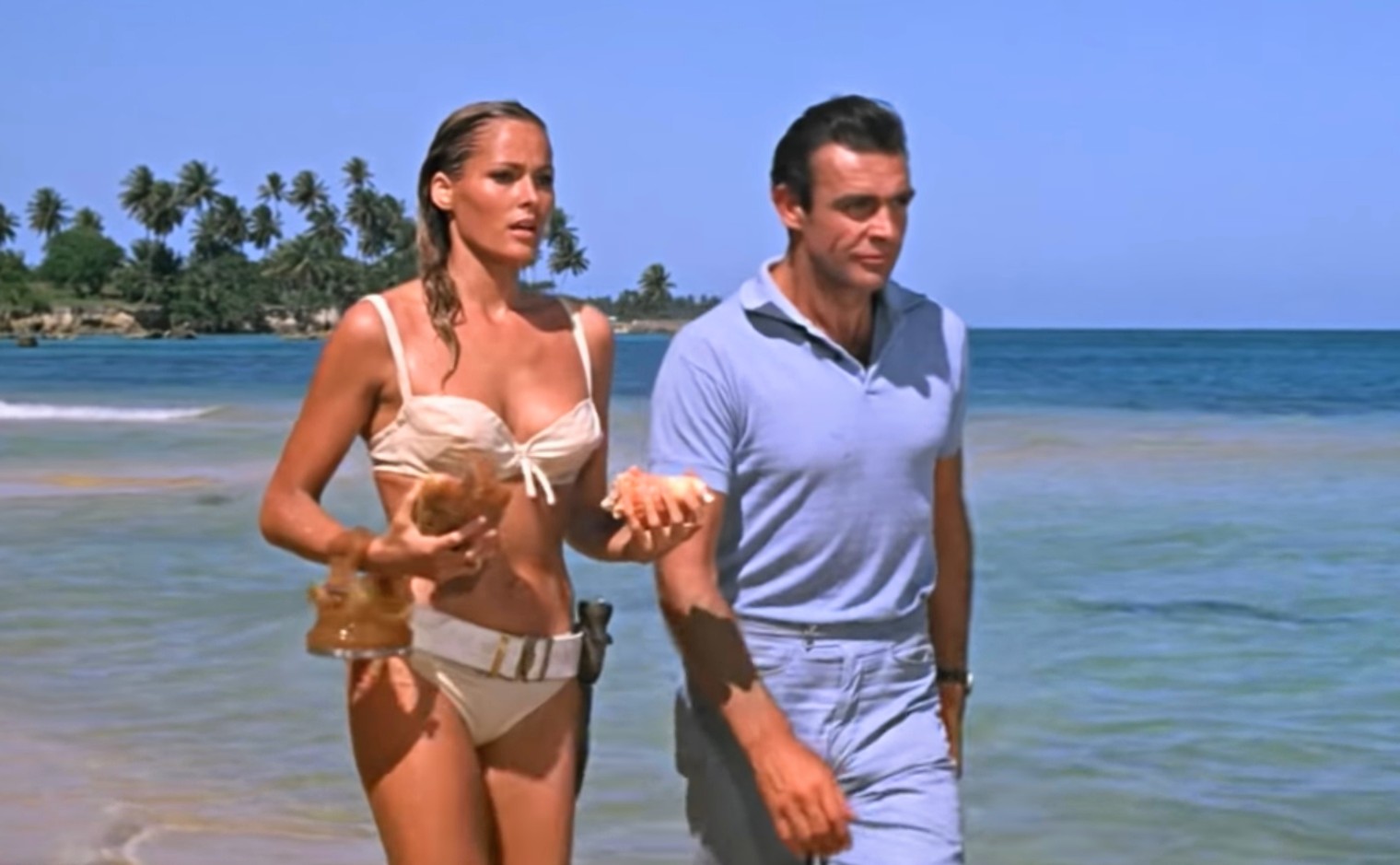
Ursula Andress and Sean Connery as Honey Ryder and James Bond respectively. 

Released in 1962 based on the sixth novel written by James Bond creator Ian Fleming, Dr. No brought Agent 007 to the big screen worldwide and its success led to a series of big moneymaking sequels, merchandise, novels, comic books, video games and other forms of contributions to pop culture. This movie also marked the beginning of Sean Connery’s journey towards becoming a cinematic icon as, arguably, the best cinematic James Bond ever.

The movie begins when British agents in Jamaica get killed off by henchmen who eventually retrieved highly confidential files. In England, the secret service sends Agent 007 to Jamaica to do detective work and he gets armed with a Walter PPK. Once in Jamaica, Bond starts talking to people, gathering clues and traveled to different places to find out who is responsible for killing his fellow British intelligence operatives. If you want to know more, you just have to watch the movie.

If you are a newcomer to the James Bond franchise or if you never saw this movie before, then you have to keep in mind that this very old movie is NOT an action film but rather it is a detective story laced with suspense and some action that follows James Bond performing his mission for Queen and Country.

Chances are, you must have seen many other James Bond movies that are heavy on action, stunts and explosions. As it was the first of the film franchise, Dr. No is nothing like those other movies of Agent 007.

Being a detective story, Dr. No is character-driven and laced with mystery and suspense. To describe it without spoiling the story, the narrative shows Bond searching for answers and as the suspense builds up, something or someone gets revealed which adds to the deepening of the plot. There is some action, stunts and explosions to spice up the movie which were pretty enjoyable for the early 1960s. However the car chase is very outdated and never believable. Naturally, the spectacle is tame by today’s standards but still, this movie is not boring at all for me.

The movie is nicely paced and makes clear what is going on. There is sufficient build-up leading to the next revelation or the next part of the chain of mystery or the next twist. By the time James Bond encounters Dr. No himself well after the 60-minute mark into the movie, I became oriented with both characters as their conflict finally starts. This will work for you if you take time with the movie’s pace and pay close attention to details.

Sean Connery as Agent 007 is charming, cool and cruel. The filmmakers and Ian Fleming himself really oriented the actor on how to portray the literary Bond in cinematic form. Connery’s Bond is charming and the filmmakers make it very believable on-screen that ladies would fall for his charm which in turn would give him the opportunity to advance in his pursuit of accomplishing his goals in the line of duty.

Ursula Andress, who had to be dubbed in post-production due to her accent, caught the world’s attention wearing the bikini on the big screen (in color, no less) as Honey Ryder who came out from the water with her equipment and sea shells. This was a daring scene to show back in the early 1960s. Of course, Honey is not just a pretty face but also a brave lady with a history of adventure and exploring. This makes her believable as a Bond girl who has what it takes to keep up with Agent 007 in the story, even going face to face with Dr. No.

Screenshot_20190812-115032_YouTube.jpg
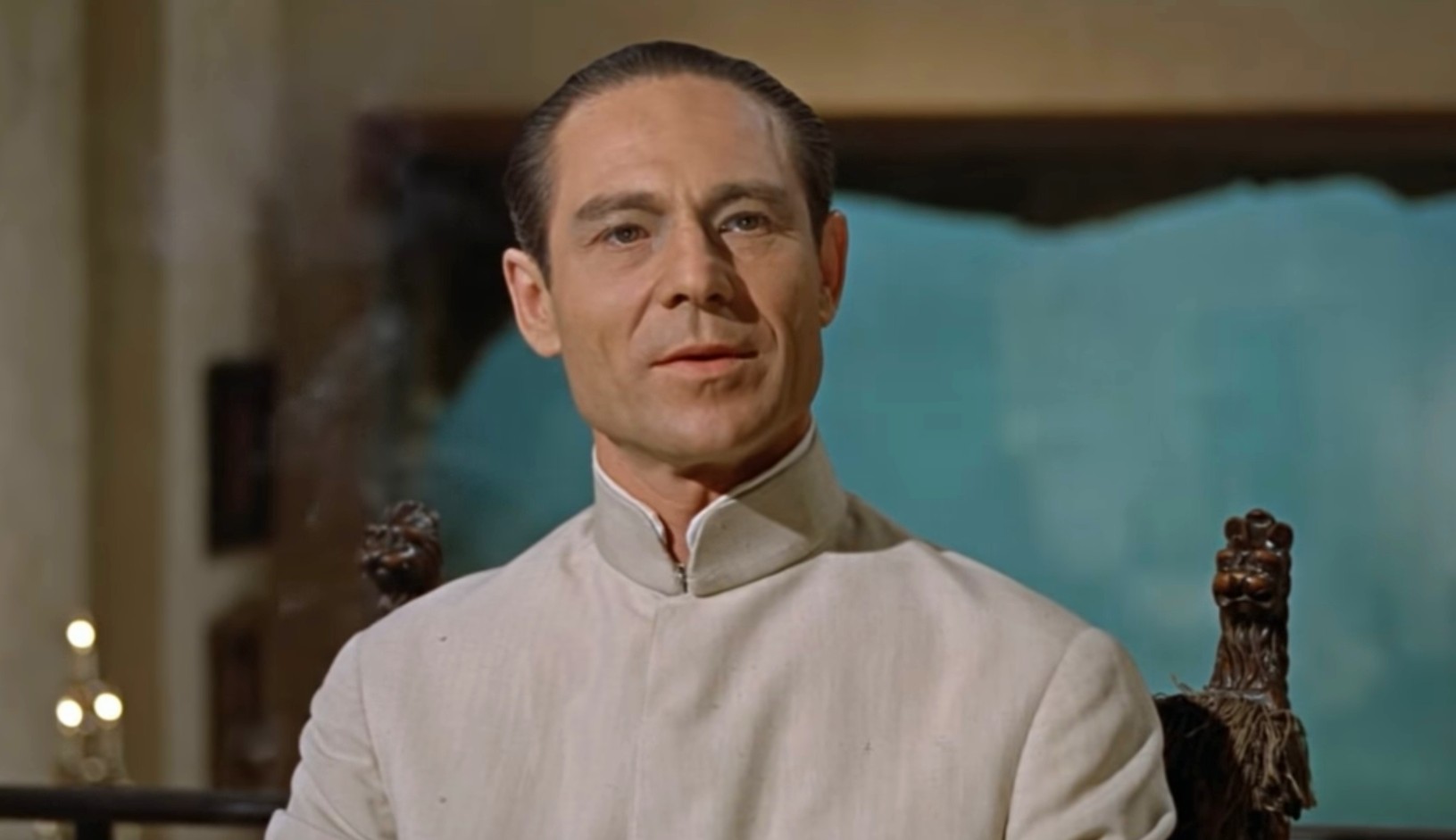
Joseph Wiseman as Dr. No.

Joseph Wiseman‘s performance as Dr. No is subtle and yet he remains creepy as a cinematic villain. When compared to other villains in the James Bond film franchise, he does not do much action but his portrayal as a very powerful sinister human being who controls a loyal group of personnel still makes him a competent franchise villain in by today’s standards. Having seen all the James Bond movies, I find Wiseman’s Dr. No a more engaging villain compared to Col. Moon (the dreadful Die Another Day), Hugo Drax (Moonraker), Kamal Khan (Octopussy), Alec Trevelyan (GoldenEye) and the 21st century Ernst Blofeld (Spectre) to name some.

In terms of production values, Dr. No is a mixed bag. There are some props that looked fake and cheap. The rear projection in the car chase is so fake looking. Ironically, the film shines with the sets designed by Ken Adams. The big room visited by Professor Dent to communicate with Dr. No, the hotel-like lair of the villain (where Honey and Bond are treated like special guests) and the elaborate room of the table meeting with Dr. No all are visually striking.

When it comes to presentation, Dr. No marked the beginning of many things that would later become cinematic traditions – the gun barrel opening, “Bond, James Bond”, the James Bond theme music, the mission meeting between Bond and M. (plus the nice chat between Bond and Moneypenny),  the appearance of Felix Leiter during the mission etc.

The screenplay written by Richard Maibaum, Johanna Harwood and Berkley Mather has quality in it not just with the narrative but also with the dialogue.

I love this exchange of words between Bond and Dr. No.

Dr. No: I’m a member of SPECTRE.

James Bond: SPECTRE?

Dr. No: SPECTRE – Special Executive for Counter Intelligence, Terrorism, Revenge, Extortion. The four great cornerstones of power headed by the greatest brains in the world.

James Bond: Correction – criminal brains.

And there was also this exchange.

Dr. No: The Americans are fools. I offered my services; they refused. So did the East. Now they can both pay for their mistake.

James Bond: World domination. The same old dream. Our asylums are full of people who think they’re Naploeon. Or God.

Overall, Dr. No is a classic movie and it is the kind of film that filmmakers today don’t make anymore because they know people won’t be satisfied without excessive action and spectacle. It is a James Bond flick in the form of a detective story which has a good amount of mystery, suspense and some action.

For sure, people who have gotten used to action-heavy James Bond movies won’t feel engaged with Dr. No. The best way to enjoy this film is to treat it the way it is meant to be – a piece of cinematic history that built the James Bond film franchise in the very first place.


Thank you for reading. If you find this article engaging, please click the like button below and also please consider sharing this article to others. Also my fantasy book The World of Havenor is still available in paperback and e-book format. If you are looking for a copywriter to create content for your special project or business, check out my services and my portfolio. Feel free to contact me as well. Also please feel free to visit my Facebook page Author Carlo Carrasco and follow me at HavenorFantasy@twitter.com