Two foreign tourists – one from China and the other from Vietnam – were intercepted by the Bureau of Immigration (BI) for trying to work illegally in the country, according to a GMA Network news report.
To put things in perspective, posted below is an excerpt from GMA news report. Some parts in boldface…
The Bureau of Immigration intercepted two foreign nationals suspected of attempting to enter the country to work illegally.
According to a statement by the BI on Friday, 20-year-old Chinese national Ding Junda claimed he was visiting a relative in the country for eight days when he arrived at the Ninoy Aquino International Airport Terminal 3 on Sunday.
On Monday, 22-year-old Vietnamese Nguyen Thi Tuyet Trang arrived and said she was going to Tagaytay City for a holiday.
However, the two individuals confessed to working in the country during a secondary inspection, with Ding working as a parcel delivery rider and Nguyen as a nail technician.
Ding was also found to have been sponsored by another Chinese national outside the country.
“They were denied entry after our officers determined that they were likely to become a public charge, as stipulated by the provisions, resulting in their classification as excludable aliens under our immigration laws,” said BI Commissioner Norman Tansingco.
Let me end this piece by asking you readers: What is your reaction to this recent development? Do you think there will be more foreigners who will try to enter the Philippines as tourists only to engage in illegal work locally?
For more South Metro Manila community news and developments, come back here soon. Also say NO to fake news, NO to irresponsible journalism, NO to misinformation, NO to plagiarists, NO to reckless publishers and NO to sinister propaganda when it comes to news and developments. For South Metro Manila community developments, member engagement, commerce and other relevant updates, join the growing South Metro Manila Facebook group at https://www.facebook.com/groups/342183059992673
The Department of Foreign Affairs (DFA) announced that Chinese tourists who intend to secure a temporary visitor’s visa for travel to the Philippines will have to come up with an additional requirement, according to a GMA Network news report.
To put things in perspective, posted below is an excerpt from GMA Network news report. Some parts in boldface…
The Department of Foreign Affairs (DFA) released details on Thursday on the additional requirement for Chinese citizens applying for a temporary visitor’s visa.
The DFA said that Chinese nationals applying for a 9(a) Temporary Visitor’s Visa at Philippine Foreign Service Posts will be required to submit their Chinese Social Insurance Record Certificates.
According to the DFA, the certificates must be registered for at least six months at the time of the visa application.
Those exempted from the visa requirement are Chinese citizens who are currently enrolled in primary, secondary, or college education—who will be required to submit proof of enrollment—and retirees over 55 years old.
Meanwhile, the department said other exceptions will be considered on a case-by-case basis.
“The additional visa requirement is part of the DFA’s continuing efforts to enhance its visa policies and regulations for the safe and efficient entry of foreign visitors,” it said in a statement.
Last month, the DFA announced that the Philippines would tighten its visa requirements for Chinese tourists amid many fraudulent applications received in its embassy and consulates in China.
Foreign Affairs Undersecretary Jesus Domingo said on May 9 that the stricter visa requirements intend to “weed out” the “illegitimate and unsavory” tourists from the legitimate ones.
Several Chinese nationals have reportedly been involved in organized crimes such as human trafficking, prostitution, kidnapping, and fraud.
Let me end this piece by asking you readers: What is your reaction to this recent development? Do you think the new requirement the DFA came up with will reduce the number of Chinese nationals who intend to commit crime while in the Philippines? Considering the recent conflicts between China and the Philippines at sea as well as the high number crimes committed by Chinese nationals in the Philippines, do you think the new requirement is justified? Do you think the new requirement will severely reduce the number of Chinese tourists visiting the country?
The government here in the Philippines are trying to balance the nation’s need of security and the gains from attracting foreign tourists. Specifically speaking, the spotlight is currently on the handling of visa requirements from Chinese tourists as the Bureau of Immigration (BI) made clear the need to help ensure national security, according to a GMA Network news report.
The BI responded to the statement of the Philippine Travel Agencies Association (PTAA) that tighter visa rules for Chinese nationals could harm the nation’s tourism as well as the businesses connected with tourist activities. Take note that criminal/illegal activities involving Chinese nationals happened many times here in the Philippines (click here, here, here, here, here, here, here and here).
To put things in perspective, posted below is an excerpt from the GMA news report. Some parts in boldface…
The Bureau of Immigration (BI) said Sunday that tightening the visa requirements for Chinese tourists would also help the Philippines protect national security, considering the illegal activities involving Chinese nationals.
Interviewed on Super Radyo dzBB, BI spokesperson Dana Sandoval explained that while tourism is very important to the Philippine economy, the government also needs to implement stricter measures to protect public interest.
“We also have to look into the national security issue, the safety of the country. Kung merong mga ilegal na ginagawa [if there are illegal activities], I think it’s also important to have strict measures kung may nakikita na tayo na kakaibang nangyayari [if we see anything different happening] or mga activities that are probably inimical to national security or public interest,” she said.
Sandoval made the remark in reaction to the statement of the Philippine Travel Agencies Association (PTAA) that tighter visa rules for Chinese nationals visiting the Philippines could “discourage tourism and hurt businesses.”
She said that the BI has always been strict in inspecting arriving foreign nationals, particularly those involved in illegal activities.
Several Chinese nationals have reportedly been involved in organized crimes such as human trafficking, prostitution, kidnapping, and fraud. Some of them were also linked illegally working for a Philippine Offshore Gaming Operator (POGO).
This prompted the Department of Foreign Affairs (DFA) to tighten the Philippines’ visa requirements for Chinese tourists amid a high number of fraudulent applications received in its embassy and consulates in China.
The DFA, however, ruled out ongoing tensions with China in disputed areas in the South China Sea as the reason for imposing more stringent visa measures for Chinese visitors.
Sandoval welcomed this development, saying it would add a layer of security in the Bureau of Immigration’s assessment of foreign nationals entering the Philippines.
Let me end this piece by asking you readers: What is your reaction to this recent development? Do you agree with the Philippine Travel Agencies Association (PTAA) that tighter visa rules for Chinese visitors could hurt Philippine tourism? Do you think that Chinese tourists could not behave themselves while they are in the country? Do you want visa rules on all Chinese visitors be tightened for the long-term? Did a Chinese national cause trouble in your local community lately?
As part of its pursuit to attract more foreign tourists and generate higher tourism revenue this year (click here and here), the Philippines is targeting tourists from the United States with the perception that they are heavy spending tourists, according to a Philippine News Agency (PNA) news article.
To put things in perspective, posted below is an excerpt from the PNA news article. Some parts in boldface…
The Philippines targets to attract about 15 percent more inbound visitors from the United States, seeing the “highly valuable” market as a big contributor to the full recovery of the country’s tourism sector.
In 2023, at least 903,299 visitors from the US arrived in the Philippines, generating PHP35 billion in tourism revenue— the highest among the country’s top tourist markets.
“This (receipt) is 215 percent higher than the tourism receipts from South Korea, so this is how important the American market (is). While the arrivals are fewer, the contribution is bigger,” Philippine Tourism Director-Attache in New York Francisco Hilario Lardizabal said over the weekend.
Data from the Department of Tourism (DOT) showed that visitor receipts in 2023 reached PHP482.54 billion, with the US as the top spending market, followed by Australia with PHP17.74 billion, South Korea with PHP16.41 billion, Canada with PHP15.85 billion, China with PHP12.24 billion, and Japan with PHP10.02 billion.
In a briefing with visiting Filipino journalists on April 26, the official said the American market tends to spend more and stay longer in a destination.
In the Philippines, Lardizabal said the majority, or 55 percent of inbound travelers from the US are former Filipino citizens, whose main travel motivation is to visit friends and relatives.
“Filipinos from the US do go around the Philippines and stay longer in the Philippines, and mind you, they also spend a lot. Apart from the money they spend on travel, they sometimes also give out money to their relatives,” he shared.
Presenting the country’s planned promotion efforts for the entire year, Lardizabal is confident the Philippines would achieve 15 percent more of the 2023 arrival figure.
Lardizabal said the DOT was taking a multi-pronged approach to entice the market by forging partnerships, conducting more training for travel agents, joining B2B (business-to-business) travel trade events, and organizing curated familiarization tours.
Emerging trends – Before the pandemic, most US travelers to the Philippines were baby boomers, or those in the age bracket of 60 to 78, and Generation X, or those aged 44 to 59.
Citing a 2022 study, the majority of US travelers “showing interest in the Philippines” now are millennials or those born between 1981 and 1996, Lardizabal said.
“Iyon ang dapat natin bigyan ng pansin (That should be our focus), how do we address the needs and preferences of the millennials,” he said.
Let me end this piece by asking you readers: What is your reaction to this recent development? Do you think the Philippines should do more to attract American tourists?
Recently Muntinlupa City hosted the 2024 edition of the Flavors of NCR food festival at the Filinvest City Central Park in Alabang and I personally witnessed the formal opening ceremony which involved many high-level officials and special guests. A lot of people visited the food festival on April 19 and 20 which added to the credibility of Filinvest City Central Park as a suitable open-air venue for special events.
For the newcomers reading this, Flavors of NCR is a special event presented by the Association of Tourism Officers – NCR which collaborated with the City Government of Muntinlupa for this year’s event. It is a showcase of unique cuisine found in the sixteen cities and one municipality of the National Capital Region (NCR). The local government units (LGUs) that participated include: Caloocan, Las Piñas, Makati, Malabon, Mandaluyong, Manila, Marikina, Muntinlupa, Navotas, Parañaque, Pasay, Pasig, Quezon City, San Juan, Taguig, Valenzuela, and the Municipality of Pateros.
Event launch
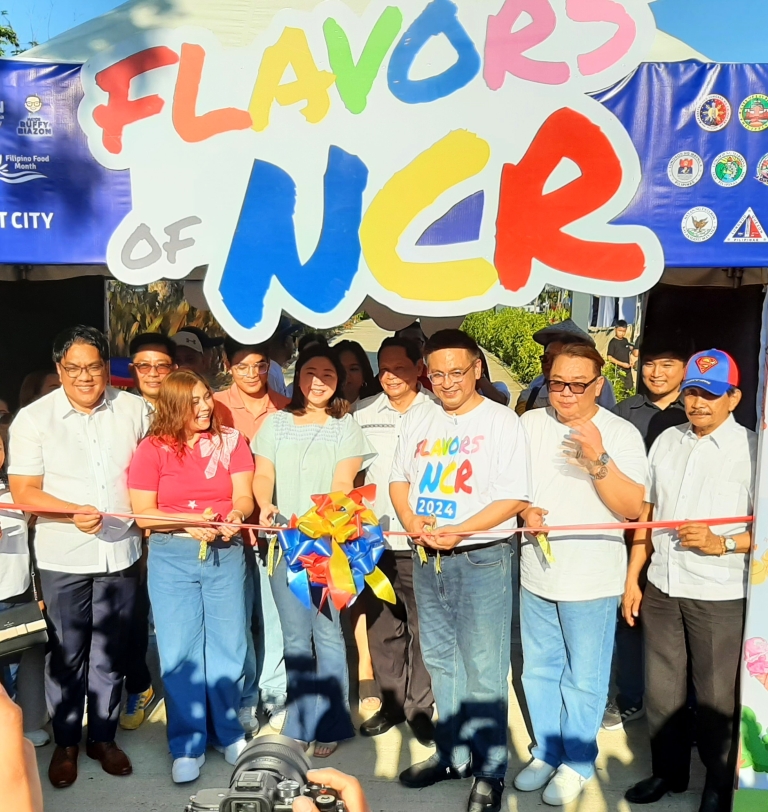
The ribbon cutting led by high officials that include Taguig City Mayor Lani Cayetano (3rd from left), Muntinlupa Mayor Ruffy Biazon (3rd from right) and Department of Tourism-NCR Regional Director Sharlene Zabala-Batin (2nd from left) to name a few.
The opening ceremony of Flavors of NCR 2024 was attended by Muntinlupa City Mayor Ruffy Biazon, Taguig City Mayor Lani Cayetano, Department of Tourism-NCR Regional Director Sharlene Zabala-Batin, Association of Tourism Officers-NCR headed by Manila City Tourism chief Charlie Dungo, and Pasay City chief of staff Peter Eric Pardo. Also present were Muntinlupa Vice Mayor Temy Simundac and Muntinlupa City Council Raul Corro.
“We are delighted to host the Flavors of NCR,” Mayor Biazon stated during his welcome remarks to all the guests. “(We acknowledge) the presence of other cities here so that their products will be showcased and we are proud to have you here.”
Biazon stressed that hosting the Flavors of NCR opens up opportunities for Metro Manila’s LGUs and their respective food-and-beverage stakeholders access to the Calabarzon region composed of Cavite, Laguna, Batangas, Rizal and Quezon with a collective population of over sixteen million people.
It should be noted that the Alabang area of Muntinlupa is a popular destination for Calabarzon residents as well as those from nearby cities who enjoy shopping and recreational activities during the weekend. That being said, Flavors of NCR fits nicely with the weekend vibe at Filinvest City.
After the formal ribbon-cutting was done, Flavors of NCR 2024 officially opened and a lot of people and photographers followed Biazon and the guests visit the different food booths of each city.
Each LGU and their best
I visited and explored the designated areas (also referred to as “booths”) of each LGU during the food festival. Each area had a different style of interiors and layouts of food, drinks and other products being offered to visitors. There were also chairs and tables present for those who need to seat down and eat. Check out my raw YouTube videos plus pictures below…
Native delicacies on display for sale at the Las Piñas City booth.
Burger patties being cooked at the Mandaluyong City area.
Delicious halo-halo from Aling Consuelo Halo-Halo sa Ugbo. This was sold at P100 each.
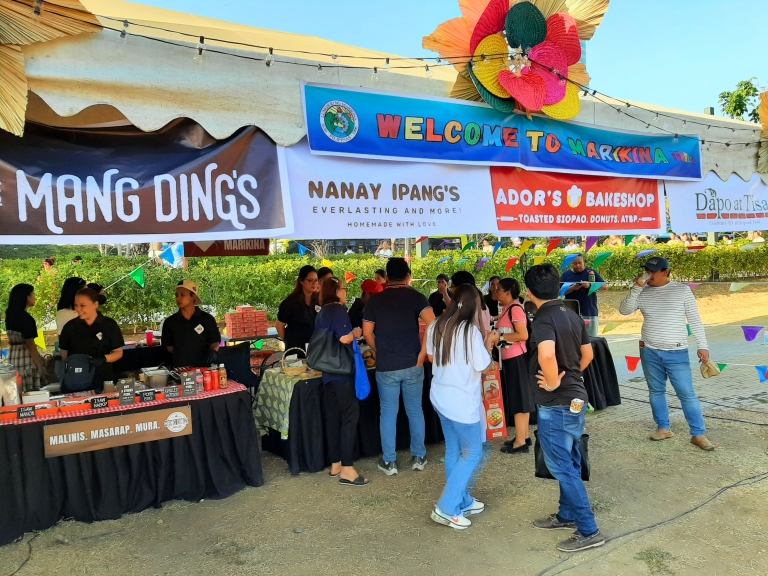
Marikina City had four sellers that attracted customers during the food festival.
Drinks, dessert and other stuff offered to customers at the Las Piñas City booth.
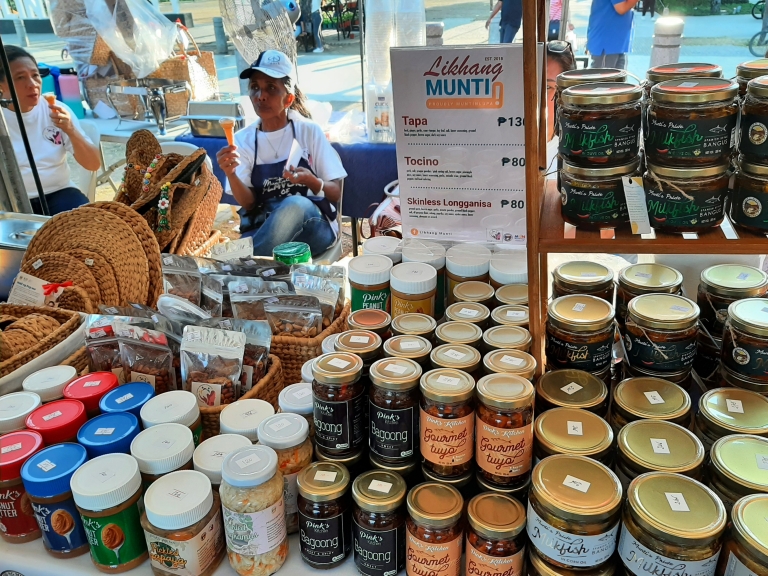
As expected, the variety of food and drinks were really great. Offered to customers were chicken, beef, pork, siomai, barbeque, puto, bibingka, pansit, siopao, fried chicken, roasted pig, pastries, cakes, halo-halo and ice cream to name some. There were also non-food products being sold such as bags and accessories in some booths.
The Muntinlupa City area.
Sea food and other food items being sold at the Parañaque City booth.
Fried chicken being prepared for customers.
The best of Muntinlupa City offered to customers.
Food and bags for sale inside the booth of Malabon City.
It was really nice to see these small businesses represent their locality and offered their best products to visitors at Filinvest City Central Park. Adding zest to the food festival were some performances by different bands from the cities of NCR. There also was a modern dance activity that drew in lots of visitors which added to the customers at the food festival.
Conclusion
The 2024 edition of Flavors of NCR at Filinvest City Central Park was indeed a nice showcase of what each LGU had to offer for those who love food and drinks. In addition, this festival really emphasized unity between the local governments of NCR and it also promoted local tourism. The festival also attracted some residents of Filinvest City’s residential towers (plus others from Ayala Alabang, Palms Pointe Village and other residential communities) and some employees (who worked at offices near the park) whose shifts ended.
In the perspective of tourism, this event really boosted Filinvest City Central Park’s status as a venue for special events or activities. To date, the said park continues to be an attraction for visitors and already it has been used by organizers of sports events and musical events.
This was taken during Saturday night.
The successful staging of Flavors of NCR could inspire food festival organizers to have their events held within Filinvest City in the future.
Let me end this post by asking you readers: Were you able to attend Flavors of NCR at the central park in Filinvest City? If you did, how was your experience? Do you wish to see another food festival to be held at Filinvest City Central Park soon?
For more South Metro Manila community news and developments, come back here soon. Also say NO to fake news, NO to irresponsible journalism, NO to misinformation, NO to plagiarists, NO to reckless publishers and NO to sinister propaganda when it comes to news and developments. For South Metro Manila community developments, member engagements, commerce and other relevant updates, join the growing South Metro Manila Facebook group at https://www.facebook.com/groups/342183059992673
If the newest data about the 1.2 million international tourist arrivals released by the Department of Tourism (DOT) for the period of January 1 to March 5, 2024, is indeed true and accurate, then it looks like achieving the 7.7 million international tourist arrivals target for the Philippines for 2024 is doable. The DOT recently announced that that 1,227,815 international tourist arrivals (which includes both foreign tourists and Filipinos based overseas) were counted during the first 65 days of the year, according to a news article by the Philippine News Agency (PNA).
To put things in perspective, posted below is an excerpt from the PNA news article. Some parts in boldface…
The Philippines is off to a good start in reaching its year-end arrival target after getting 1.2 million foreign visitors in the first two months of 2024 alone, the Department of Tourism (DOT) reported Thursday.
As of March 5, international tourist arrivals to the Philippines have tallied 1,227,815.
Foreign tourist arrivals took the lion’s share with 1,160,129 or 94.49 percent while overseas Filipinos make up the remaining 67,686.
Speaking at the Philippine Pavilion at the Internationale Tourismus-Börse (ITB) 2024 Convention in Germany, Tourism Secretary Christina Garcia Frasco said this is 22.86 percent higher than the 999,390 arrivals received by the country in the same period in 2023.
“I would like to express my profound gratitude first to all our Philippine sellers who continue to champion Philippine tourism. As of today (March 5), the Philippines has received over 1.2 million international visitors, a robust indication of the future of Philippine tourism. Cheers to all the reasons to celebrate and Love the Philippines,” she said.
South Korea remains the country’s top source market for visitors, with 349,956 or 28.50 percent of the total, followed by the United States with 195,603 (15.93 percent), China with 85,876 (6.99 percent), Japan with 73,159 (5.96 percent), and Canada landing in the fifth spot with 50,555 (4.12 percent).
Australia took the sixth spot with 50,488 (4.11 percent), Taiwan with 42,955 (3.50 percent), the United Kingdom with 30,507 (2.48 percent), Singapore with 25,253 (2.06 percent), and Germany with 20,816 (1.70 percent).
In January, the country’s visitor receipts also grew by 4.84 percent to USD652.26 million from the USD622.14 million recorded in the same month last year.
By doing the math, 1,227,815 international tourist arrivals divided by the first 65 days of 2024 is equivalent to 18,889.46 per day. Multiply that by 366 days for 2024 (a leap year), the total would be 6,913,542 which is several hundreds of thousands of international tourist arrivals short of the declared target. The DOT and the rest of tourism industry’s stakeholders still have lots of work to do to ensure that more than enough visitors from overseas will come into the country and add to the nation’s economy. It should be remembered that the Rizal Commercial Banking Corp. (RCBC) and China Banking Corp. found the nation’s Philippine tourism recovery still lacking.
Let me end this piece by asking you readers: What is your reaction to this latest development? Do you think the reforms and initiatives the Department of Tourism (DOT) executed last year are generating positive results right now? Did you notice the lack of Arab nations among the top markets of international visitors the DOT declared? Do you think there is enough momentum and time for the Philippines to be able to attract 7,700,000 international tourist arrivals by the end of the year?
As many of you my readers should know by now, I blogged a lot about tourism in the Philippines, what the Department of Tourism (DOT) has been doing and what the nation has achieved with regards to attracting foreign tourists.
To put things in perspective, posted below is an excerpt from the Philippine News Agency (PNA) news article of September 28, 2023. Some parts in boldface…
The Philippine government on Thursday vowed to promote inclusive travel in its bid to position the country as an LGBTQI+-friendly destination in the region.
During the first Tourism Pride Summit in Makati City, Tourism Secretary Christina Frasco said the Philippines plans to implement programs and initiate government interventions to address the unique challenges that the community faces when traveling.
The summit, she said, is one intervention to spark conversation and give members of the LGBTQIA+ a platform where they can share experiences and suggestions on how the government can make travel enjoyable and safe for them.
“Under the administration of President Ferdinand Marcos Jr., he seeks a tourism industry that is inclusive, where no destination and no stakeholder is left behind in the development of our country,” Frasco said.
“That is why in our effort to reach our hand of collaboration to the farthest reaches of our country, we reach out our hand of collaboration as well to the many sectors that are involved in tourism, especially and including the LGBTQIA+ community,” she added.
Frasco noted that LGBTQIA+ tourism presents vast opportunities for growing the Philippine tourism industry portfolio.
Citing data from the United Nations World Tourism Organization, Frasco said there are an estimated 36 million LGBTQIA+ travelers around the world.
“We recognize the strength of capitalizing on LGBTQIA+ tourism considering that it is a USD200 billion industry that’s only slated to grow at half a trillion dollar industry by 2030,” she said.
Obviously the DOT is determined to attract as many LGBTQIA+ foreign tourists as possible as well as their money so that it could help them reach their financial goals and add to the momentum to make the Philippines a major tourist destination by the year 2028.
If ever a huge influx of foreign tourists who identify themselves as homosexuals/transgender/bisexual/transsexual/intersex/non-binary arrive in the Philippines, there is the potential rise of criminal activities involving the acts of the LGBTQIA+ people in the country. Can they behave themselves? Already there is one local LGBT crime that resulted one death. Can you imagine the possibility of more crime happening as more LGBTQIA+ tourists arrived? Can these people really behave themselves?
I am not just talking about sex tourism but also potential violations such as rape, sexual harassment, sexual assault, theft, scams, molestation, kidnapping, murder and other incidents that LGBTQIA+ tourists could commit here in the Philippines as they know they are favored by the DOT. If these specific foreign tourists could add to crime while touring the country, then the “Love the Philippines” slogan of the DOT could end up having a very dirty reputation plus additional embarrassment for the entire nation.
Let me end this piece by asking you readers: What is your reaction about the DOT’s drive to make the Philippines a more attractive destination for LGBTQIA+ tourists? Do you think the DOT continues to ignore the potential danger that LGBTQIA+ tourists could unleash on Filipinos while they tour the country? Did you encounter a homosexual foreign tourist who committed a crime or victimized a member of your local community? Does the majority of the youth in your local community express themselves as LGBT-friendly or even as LGBT rights activists?
Do you think that the Democrats in America, the Islamo-Leftists and woke activists could be funding LGBTQIA+ people to come to the Philippines for vacationing as well as executing secretive efforts to establish new activists among Filipinos who will blindly fight for LGBT rights in the country?
As far as the chief economists of the Rizal Commercial Banking Corp. (RCBC) and China Banking Corp. are concerned, the recovery of Philippine tourism is still lacking and a lot more needs to be done which includes relying on tourists from China, according to a BusinessWorld news report.
To put things in perspective, posted below is an excerpt from the BusinessWorld news report. Some parts in boldface…
THE RECOVERY of the tourism market lags the rest of the region due to infrastructure constraints and the slow rebound of visitor arrivals from China, analysts said.
Michael L. Ricafort, chief economist of Rizal Commercial Banking Corp., said the Philippines’ tourism performance was lagging even before the pandemic.
“There has been a lot of catching up since the pandemic and also even before the pandemic with other ASEAN or Asian neighboring countries,” Mr. Ricafort said in a Viber message.
“This is largely due to infrastructure constraints that limit the capacity of airports and accommodation and MICE (meetings, incentives, conferences, & exhibitions) facilities to cater to a much larger number of foreign tourists,” he added.
Mr. Ricafort said upgrades are needed to airports, particularly the Ninoy Aquino International Airport (NAIA), which will share future traffic to and from the capital with the Bulacan and Sangley airports.
“There is a need as well as for integrated tour packages that will be cheaper and more convenient to attract more foreign tourists,” he said.
“There is also a need for more mass transport systems such as railways that are integrated into major airports to make it more convenient for local and foreign tourists to travel,” he added.
China Banking Corp. Chief Economist Domini S. Velasquez said slow growth can be attributed to geographical constraints and absence of Chinese tourists.
“The Philippines lags behind its other ASEAN neighbors in terms of tourist arrivals, which can be attributed partly to geographical constraints, as the country cannot be accessed by land,” Ms. Velasquez said in a Viber message.
“However, another factor contributing to the below-target numbers, especially during the pandemic, is the absence of Chinese tourists,” she added.
Before the pandemic, China was the country’s second top source of international arrivals after South Korea. However, China only ranked fifth last year.
South Korea remained the top source of international visitors accounting for 26.41%, followed by the US (16.57%), Japan (5.61%), Australia (4.89%), and China (4.84 %).
“The sluggish growth and high unemployment in China have hindered the phenomenon known as “revenge travel,” wherein Chinese tourists typically exhibit strong travel demand. As a result, the expected influx of Chinese tourists has been limited,” Ms. Velasquez said.
Mr. Ricafort said the Philippines has strong potential in further growing the tourism economy with much room to improve in many elements of the product offering.
“The tourism business is low-hanging fruit that can generate more business, employment, and other economic activities as a major source of growth or a bright spot for the economy,” he said.
Let me end this piece by asking you readers: What is your reaction to this recent development? Do you agree with the analysts’ findings as to why Philippine tourism is still lacking and what should be done to improve it? Do you think the Department of Tourism (DOT) should focus more on attracting tourists from other nations instead of depending so much on China? What do you think are the five biggest problems of Philippine tourism right now? Do you think the DOT should be more active in promoting local film festivals, fashion shows, sports events and food tours to foreigners?
In the 2024 edition of the ASEAN Tourism Awards held recently in Laos, the Philippines won big as three cities and more than twenty stakeholders won honors, according to a Philippine News Agency (PNA) news article.
To put things in perspective, posted below is an excerpt from the PNA news report. Some parts in boldface…
Three cities and 21 tourism stakeholders from the Philippines have been recognized during the 2024 ASEAN Tourism Standard Awards in Vientiane, Laos.
The awarding ceremony was one of the activities in the ASEAN Tourism Forum 2024 which ran from Jan. 22 to 27, the Department of Tourism (DOT) said in a news release on Wednesday.
The cities of Baguio in Benguet, Ilagan in Isabela, and Tabuk in Kalinga were awarded as the ASEAN Clean Tourist City, the Department of Tourism
According to ASEAN Tourism Standards, these are the areas where the flow of visitors and where cultural, natural and/or man-made attractions exist.
Prime Properties Pearl Farm Beach Resort, Club Paradise Palawan, Bohol Beach Club, Seda Nuvali, and The Forest Lodge at Camp John Hay won the ASEAN Green Hotel Award.
This citation is given to hotel industry players whose operations are based on the achievement of sustainable tourism through environment-friendly principles, human resource development, resource consumption reduction, and local community involvement.
About 15 Philippine venues were given the ASEAN Meeting, Incentive, Convention, Exhibition (MICE) Venue Awards granted to physical spaces with quality facilities and impressive services, designed and provided for MICE activities with purposes for meetings, exhibitions, and events.
The major criteria for the awards encompass the standards of physical aspects, venue management, and people working within venues that competitively meet the requirements of MICE travelers. It is divided into three categories: room, exhibition venue, and event venue category.
Properties Bai Hotel Cebu, Clark Marriott Hotel, Hilton Clark Sun Valley Resort, Princesa Garden Island Resort & Spa, Seda Hotel Nuvali won the meeting room category; World Trade Center Metro Manila (Manila Exposition Complex), SMX Convention Center Manila, Cordillera Convention Hall by Baguio Country Club, Isabela Convention Center (ICON), and Iloilo Convention Center won the exhibition hall category; and Palacio del Sur by Marcian Group, Jpark Island Resort & Waterpark Cebu, Infinity Garden by Baguio Country Club, CAP-John Hay Trade and Cultural Center, Princesa Garden Island Resort and Spa by Modern Asia, Inc. were named as the winners for the event venue category.
Meantime, Palawan-based property Daluyon Beach and Mountain Resort was named as a lead partner for “Enchanting Gastronomical Sabang Delights, Beach Forest and Caves” under the ASEAN Sustainable Tourism Awards.
Tourism Secretary Christina Frasco said the winners made not only significant revenue contributions but also employed millions of Filipinos.
“These achievements reflect not only the excellence and dedication that you have put in with the development of tourism but also contribute significantly to the overall advancement and sustainability of the ASEAN tourism industry,” she said.
A total of 192 ASEAN Tourism Standards Awards were given to the member countries.
Let me end this piece by asking you readers: What is your reaction to this recent development? Are you delighted with the many awards the Philippines won at the ASEAN Tourism Awards? If you are running a local business that benefits from the inflow of tourists, does this development encourage you to move your business deeper into the tourism industry? Do you consider the Philippines more competitive with its Southeast Asian neighbors when it comes to tourism?
Recently the immigration officials revealed that citizen of the Czech Republic who arrived at the international airport in Clark, Pampanga, was denied entry as a result of bad behavior and disrespect with regards to registering with the eTravel system online, according to a Manila Bulletin news report.
To put things in perspective, posted below is an excerpt from the Manila Bulletin news report. Some parts in boldface…
Being rude can get you the boot. This is just what happened to Czech tourist Jaroslav Konsel, 55, when he arrived at the Clark International Airport (CIA) in Pampanga last Jan. 3.
Bureau of Immigration (BI) Commissioner Norman Tansingco said immigration officers denied the Czech tourist’s entry into the country for uttering expletives when he was asked to register with the eTravel system online.
“Reports that he taunted and mocked the immigration officers who were politely explaining to him the eTravel requirement is enough ground for him to be excluded and banned from entering the country,” Tansingco said.
He pointed out that Konsel showed disrespect to the country’s laws and persons of authority in refusing to comply with the requirement to fill out the eTravel.
“Registration in the eTravel system is mandatory for all international passengers as it is an electronic travel declaration system which receives and stores information and data about all passengers who enter and exit the country,” the BI said.
Citing reports from BI officials at the CIA, the bureau said that airline and immigration employees attempted to assist Konsel in filling out the form but he angrily rejected.
“BI-CIA officials reported that Konsel immediately became rude and started mouthing foul language when he was told by the BI officer to first fill out the e-travel form online,” it said.
“He allegedly continued to behave in an outraged manner even as he was filling out the eTravel form and even refused to listen or follow instructions from people who were assisting him in the eTravel counter,” it also said.
Let me end this piece by asking you readers: What is your reaction to this recent development? Do you think the immigration officers did the right thing by denying the Czech visitor entry into the country in response to his rude behavior? Do you think the reported incident could cause a new diplomatic problem between the Philippines and the Czech Republic?











 Author Carlo Carrasco