A Look Back at Aerobiz Supersonic

When it comes to playing economic simulation games, I enjoy playing them on the personal computer (PC) using the keyboard and mouse. Back in the mid-1990s, there was one particular economic simulation that I played on the Super Nintendo Entertainment System (Super NES or SNES) and found it to be very enjoyable and easily to play with using the console’s control pad.

That game was Aerobiz Supersonic, a simulation about the airline industry developed and published by Koei for both the Super NES and the Sega Genesis. Here is my look back at this old video game from the 1990s.
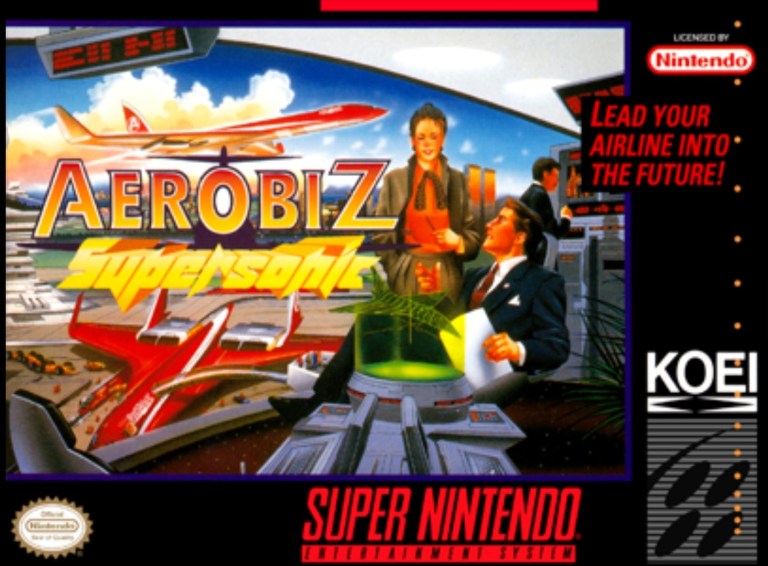
Screenshot_20200222-133557_Photos.jpg
The cover of the Super NES version of the game. Its art and style is really nice to look at.

Concept and Game Design

In the game, you get to play the Chief Executive Officer (CEO) of an airline and your goal is to beat your rivals in the global air travel industry. How to achieve the goal and succeed? There are tasks that need to be accomplished such as buying commercial airplanes (that include such real-life companies like Boeing and Airbus) for use, establishing flight routes, securing slots in airports worldwide, selling tickets and filling up each flight with as many passengers as possible, achieve profitability and finish the game’s imposed time period ranking #1. Adding zest to the game’s challenge is the selection of a certain era of world history that include 1955-1970 (the dawn of jets), 1970-1990 (the Cold War era), 1985-2005 (the present era) and 2000-2020 (the age of continued flight advancement).

Within the game, time passes by means of clicking a certain on-screen button that ends the player’s current turn. Of course, before pressing that, the player has to set things in motion like sending a representative to a certain overseas airport to negotiate and secure slots (which takes months to complete), set the ticket prices, buy a new airplane or two, etc. The game even allows players to micro-manage their airline like adjusting internal spending (salaries) or adjusting the quality of their airplane and services. Also nice is the option offered for players to buy a hotel or resort, a theme park or a travel agency that can bring in additional revenue.
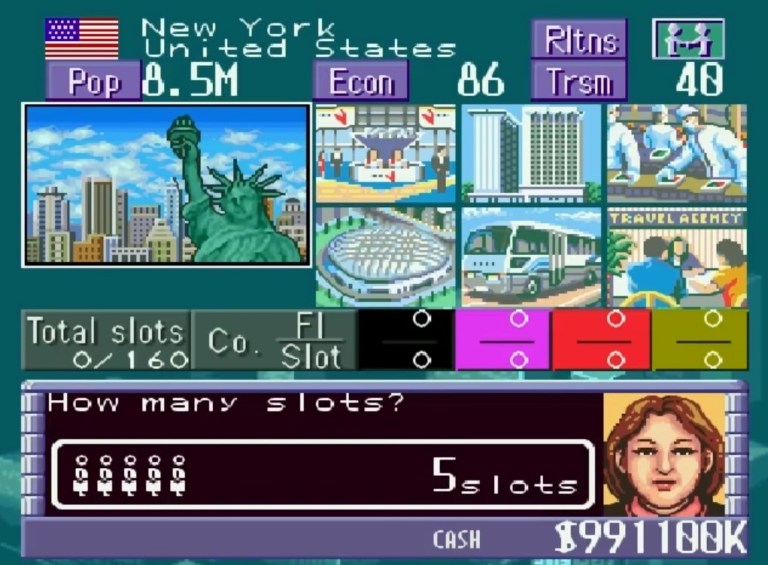
Screenshot_20200222-132447_YouTube.jpg
The airport slots, local businesses, economic and tourism details per city displayed.
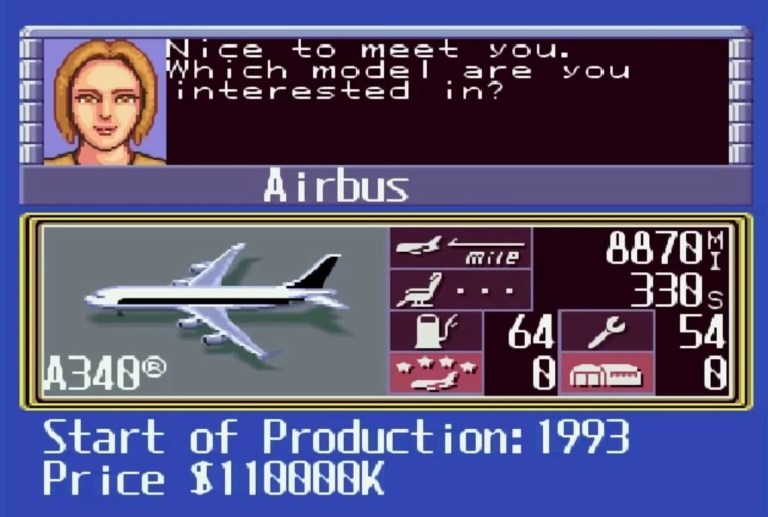
Screenshot_20200222-132508_YouTube.jpg
Visit an airline and choose from one of many models of airplanes to buy.

There are other small details that need paying attention to such as the economy and tourism meters of each city displayed (note: a higher tourism score means the city is more attractive to travelers), the population, etc. Also noteworthy is the current state of relations between your home nation with the nation of the city airport you are trying to establish routes with which can affect your business.

When the turn ends, a series of events will happen showing what happened around the world, how your company fared in the competition during the lapsed time period, and, occasionally, a random event will occur that most likely will affect your business (examples: the Olympics hosted by a city helps draw in additional passengers or the 1970s oil crisis raises the cost of your operation).

Regarding the game’s imposed time period for competing with the artificial intelligence (AI) opponents, the period is twenty in-game years.
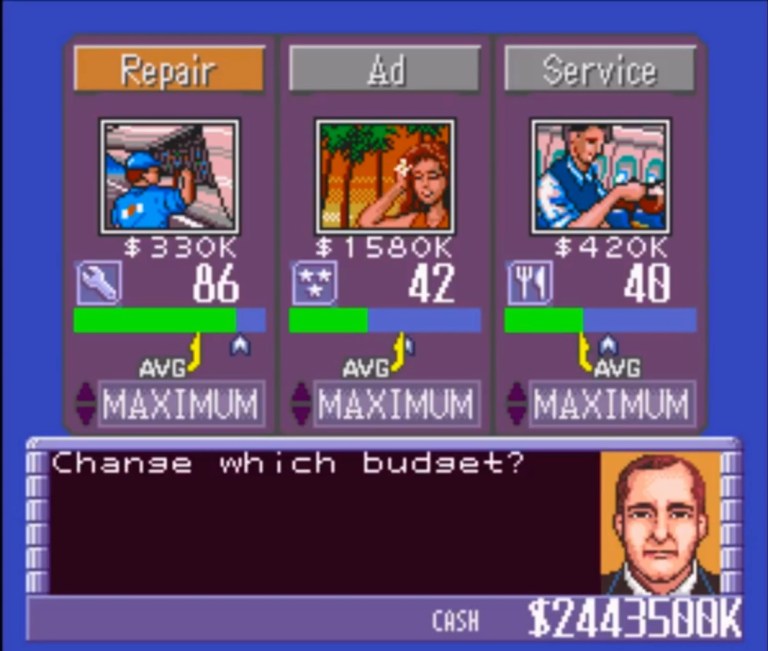
Screenshot_20200214-195600_YouTube.jpg
This is part of micro-managing your business in the game.
Screenshot_20200214-195720_YouTube.jpg
After the end of each turn, news and updates not only about your company but also your competitors are flashed.

Quality

Being used to playing simulation games on PC, I found Aerobiz Supersonic to be very enjoyable, addicting and easy and efficient to play (in terms of controls). Considering the above-mentioned gameplay options (buying an airline, sending a representative, etc.), they are pretty easy to adjust using the Super NES controller although there were a few moments when I accidentally pressed the button putting into motion a different option.

Gameplay aside, this game has a whole lot of charm with its visual presentation. You launch a brand new flight route, the game shows a short animation sequence of the jet taking off. You buy an airplane, you will see a short animation of it entering your facility once it arrives (complete with a visual design reflecting the model). You conduct a board meeting, your company’s officials are present making reports to you and you get a series of choices to make on what to do next. A historical event or a global development occurs, you get to see original art reflecting them (example: a nation joins the EU with people wearing suits and neckties together in a formal ceremony). You make a move to buy slots at an airport overseas, a company official will have his or her face shown talking to you. When looking at the regional map, you see lines connected between cities (highlighting the establish flight route you made) and there are icons of airplanes flying between them.

Screenshot_20200214-195732_YouTube.jpg
Random tourist hot spots get highlighted as you keep playing.

More on the aspect of starting the game, I like the options offered for me to select which city shall serve as my airline headquarters. Among the many cities included, there are cities of my native Philippines namely Manila (the international destination) and the nearby city of Cebu. I still remember how delighted I was to see my native Philippines included in the game, complete with Asian character designs to reflect the company and its region.

Conclusion

Ultimately Aerobiz Supersonic (which was actually a sequel to Aerobiz) is a gem of a console economic simulation released at a time when 2D sprite gaming was still the standard and 3D polygonal gaming was just about to make an impact on the global video game console market. Back then, 2D side-scrolling action/adventure games, sports games and role-playing games (RPGs) were so common on the Super NES and Genesis combined and the idea of enjoying economic simulations on consoles was highly unusual. Aerobiz Supersonic is proof that economic simulations can come with a lot of depth, deliver a good amount of strategy and can be highly playable and enjoyable on consoles.

If you want to enjoy this game, it can be quite difficult to do because you need to acquire an existing copy of the game as well as a fully functioning Super NES or Sega Genesis. As of this writing, there has never been a re-release of Aerobiz Supersonic (note: in line with legitimacy, I will not consider those browser versions or file sharing of ROMs) and it is not even included on Nintendo’s Virtual Console. There’s not even a version made for smartphones.

Now if only the executives at Koei Tecmo Games would consider revisiting Aerobiz Supersonic with today’s consumers in mind.
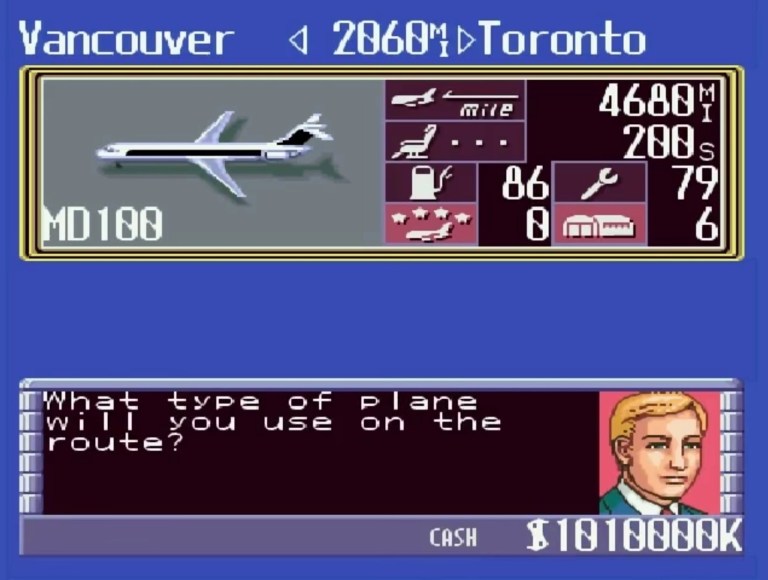
Screenshot_20200222-132429_YouTube.jpg
You can choose what kind of plane, how many planes, how many flights and how much you set the ticket prices whenever you start a new flight route.

Thank you for reading. If you find this article engaging, please click the like button below and also please consider sharing this article to others. Also my fantasy book The World of Havenor is still available in paperback and e-book format. If you are looking for a copywriter to create content for your special project or business, check out my services and my portfolio. Feel free to contact me as well. Also please feel free to visit my Facebook page Author Carlo Carrasco and follow me at HavenorFantasy@twitter.com


A Look Back at Super Star Wars: The Empire Strikes Back

In this age of photo-realistic 3D graphics in video gaming, I sure miss the days when 2D gaming and highly detailed pixel art were the standard. I’m referring to the so-called 16-bit era of the Super NES/SNES (Super Nintendo Entertainment System) back in the 1990s.

In 1991, Super Star Wars was released on the Super NES and it became a big hit with the gamers, the critics and fans. That game was heralded as one of the best video game adaptations of movies.

Naturally, a follow-up to that game was released in 1993 – Super Star Wars: The Empire Strikes Back.

That being said, here is my retro gaming review of Super Star Wars: The Empire Strikes Back.

Screenshot_20200118-222140_YouTube.jpg
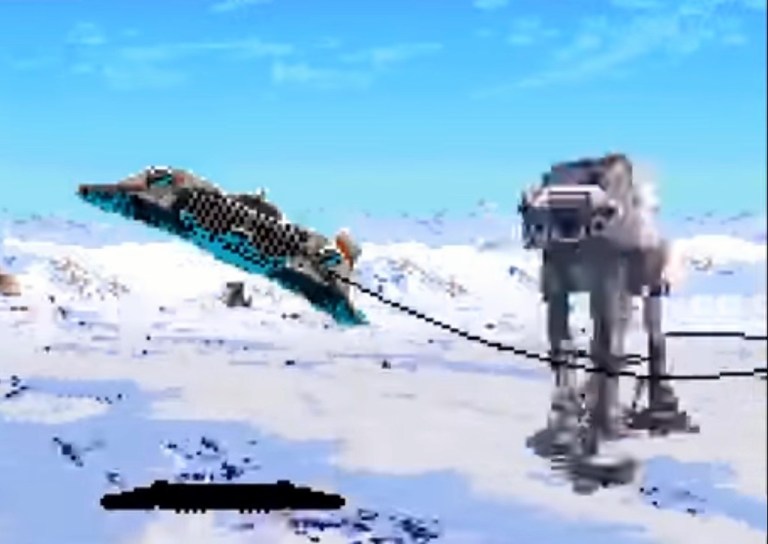
The experience of using a Rebel speeder to bring down an AT-AT walker with the cable remains awesome.

Developed by Sculptured Software and LucasArts and published in America by JVC, this game is based on The Empire Strikes Back which today has been considered to be the greatest Star Wars movie ever. Of course, in order to make a cohesive video game adaptation out of the classic movie, a lot of liberties were taken when it comes to following the story. This was inevitable as the game developers needed a lot of creative freedom to make a cohesive video game.

Early story (and some notable differences from the movie)

Super Star Wars: The Empire Strikes Back begins with Luke Skywalker riding a Tauntaun. Unlike the movie, Luke (controlled by players) visits some places of the wasteland of Hoth, notably caverns and hills fighting several forms of wild life (including wampa beasts), and even some probe droids.

Screenshot_20200118-223405_YouTube.jpg
Luke jumping on to a wampa beast.

Unlike the movie, Luke does not get rescued by Han Solo in the wilderness. Instead he defeats a giant-sized probe droid and a giant-sized wampa beast (as in-game bosses) and make his way back to Echo Base to rejoin the rebels. Upon returning at the base, he finds it filled with Imperial troopers and their machines (where are Luke’s fellow rebels?) and fights his way through to fly a rebel speeder (note: without the movie co-pilot Dak) and proceed in the Battle of Hoth.

image-2.jpg
This never happened in the movie.
image-3.jpg
Luke jumping into a snow speeder without a co-pilot.

Back at Echo Base, Han Solo (player-controlled) has to make his way through a wave of Imperial enemies and machines to meet Princess Leia, secure her and ride away on the Millennium Falcon. The Falcon (player-controlled) enters the asteroid field being attacked gradually by over twenty TIE Fighters. Once all of them have been eliminated, the Falcon jumps into light speed (which contradicts the movie).

Gameplay

Super Star Wars: The Empire Strikes Back is composed mostly of 2D, side-scrolling action sequences in which players control their characters moving from left to right in order to make the game progress. The sequences are filled with lots of action-packed moments mainly due to the MANY enemies challenging the players plus sequences of shooting, jumping and using special weapons (note: the thermal detonator was awesome to use). When it comes to filling up the health meter of your character, defeating enemies result random releases of hearts (symbolizing health) which you need to pick up. Key side-scrolling segments of the game will have players facing off with in-game bosses or enemies that are large, intimidating and have their own health meters for players to reduce to zero.

As typical with most 2D side-scrolling games of the era, this game is really tough and will take gamers some patience and perseverance to complete.

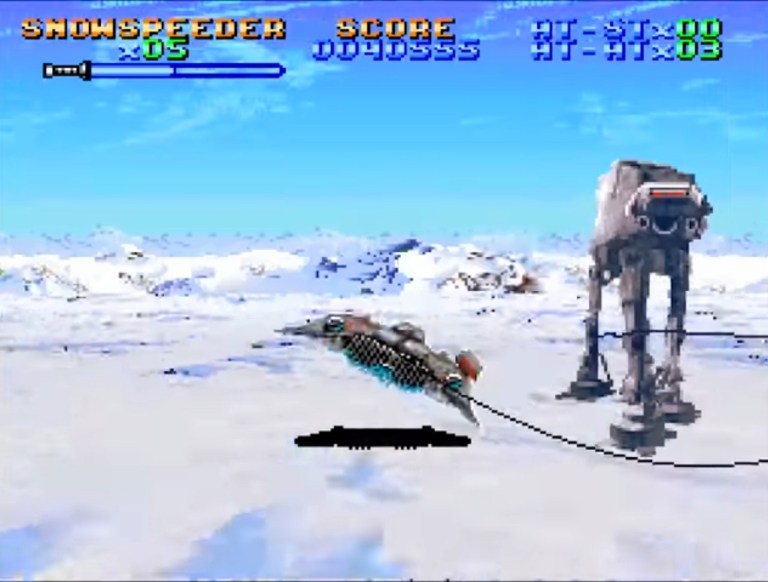
What really stood out in this game are the makeshift 3D segments (made possible by Mode 7) which were pretty extensive and really interactive. The Battle of Hoth in Mode 7 was pretty engaging as players get to fly a rebel speeder over a snowy field complete with lots of Imperial enemies (including the AT-ST walkers and the AT-AT walkers) and each of them is composed of multiple 2D sprites making them look 3D as the speeder moves around. Apart from simply shooting, the interactive sequence of tagging an AT-AT walker with a cable, flying around it and wrapping it with the cable, and then watching it fall to the ground really is an awesome gaming experience which really showed how hard the game developers pushed 2D visuals and pixel art.

Screenshot_20200118-222830_YouTube.jpg
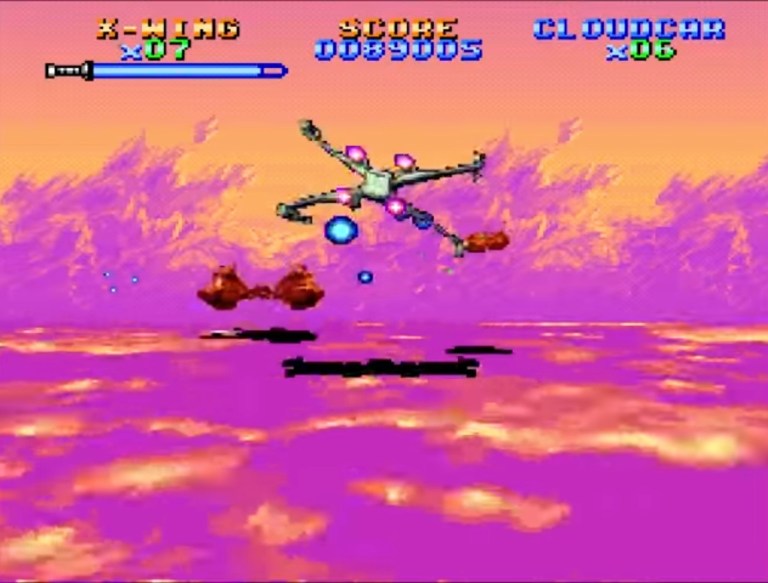
A Mode 7 sequence late in the game had players using an X-Wing fighter.
Screenshot_20200118-222213_YouTube.jpg
The Battle of Hoth was a great and lengthy use of Mode 7.

Apart from the Battle of Hoth, there was also another Mode 7 sequence involving the X-Wing Fighter approaching Cloud City. That particular sequence was noticeably shorter and did not have a standout action sequence as it was limited to the X-Wing Fighter simply shooting Bespin fighters. Another non-2D segment was the Millenium Falcon’s flight through the asteroid field which was done with the cockpit view (first-person view exactly) in which you move a cursor for targeting and moving the ship to. This segment was pretty tough because players were not only required to eliminate more than 20 TIE Fighters but also avoid incoming asteroids and maintaining the Falcon’s energy shields (which serves as a health meter)

Going back to the 2D side-scrolling segments, the use of the lightsaber by Luke remains a lot of fun to do. Not only could he slash bad guys, he could use the lightsaber defensively protecting himself from incoming energy blasts (which get deflected by the lightsaber). On the offense, Luke can jump into the air and spin with the lightsaber turned on making him an aerial slasher over the bad guys.

In keeping with the theme of the movie showing Luke Skywalker learning to be a Jedi, the Dagobah segment in the game has Luke gaining varied Force powers and he also has a separate Force energy meter. The Force powers can be used in subsequent segments of the game and they are quite useful when Luke encounters Darth Vader as the final boss in Cloud City.

The fights with Darth Vader were nicely designed. With creative freedom, the game developers expanded on Darth Vader’s use of the Force to move several pieces of debris and machines towards Luke who has to defend himself from all sides. Fighting Darth Vader with the lightsaber was tricky and for the most part, I had Luke slashing on villain with just enough space between them and many times I had Luke use the lightsaber on him while jumping and spinning in the air. Defeating Vader was a requirement to complete the game.

Screenshot_20200118-222758_YouTube.jpg
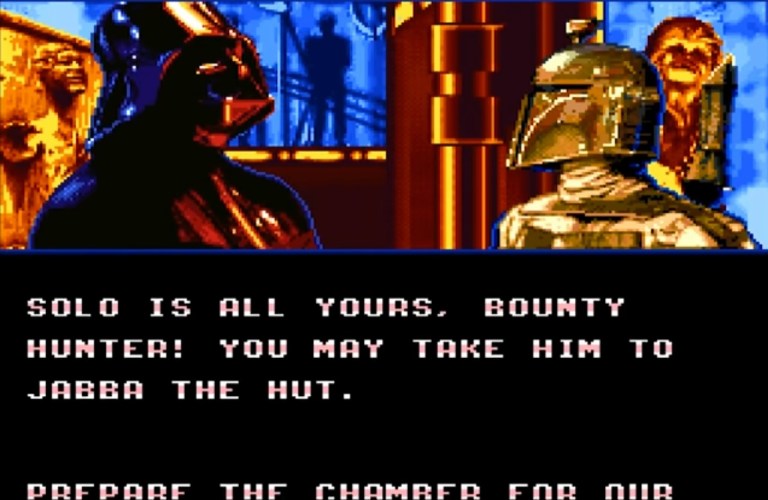
Very nice artwork made for the storytelling cut scenes.

Finally, like in Super Star Wars, players can also play as Han Solo (special attack: grenade throw) and Chewbacca (special attack: offensive spin) but only in specific segments of the game supposedly to keep in line with its story.

Conclusion

Even by today’s standards, Super Star Wars: The Empire Strikes Back is still a high-quality video game that is a lot of fun to play with even though it is tough (a password system is used for in-game progress so that gamers can come back to continue) all throughout. Gameplay aside, the presentation of visuals and audio is also very solid. The sprites for the in-game characters, enemies, machines and animal were detailed to look at while the background art were immersive (like in the movies, Cloud City, Hoth and Dagobah had their distinctive visuals). The Super NES audio chip was greatly used on recreating 16-bit sound from the movies, especially John Williams’ movie scores and lightsaber sound effects.

Take note that this game was released in 1993 which is significant in the sense that people had moved on since the release of the movie Return of the Jedi (1983) and the Star Wars prequel trilogy did not begin until 1999 with Star Wars Episode I: The Phantom Menace. This game was released at a time when 2D gaming was still in strong demand and most gamers did not expect that 3D polygonal graphics would reshape video gaming eventually. In retrospect, the polygon-focused gaming consoles Sega Saturn and the original Sony PlayStation launched in late 1994 or more than a year after Super Star Wars: The Empire Strikes Back.

Screenshot_20200118-223133_YouTube.jpg
The inevitable battle between Luke Skywalker and Darth Vader.

I myself had lots of fond memories playing this game back in the mid-1990s. I simply endured the many challenges of it and ultimately had a lot of enjoyment completing it. I even replayed the game from the start even though I knew how the game presented the ending and key story elements of the movie. I also got to replay The Empire Strikes Back on home video around the time I played this game.

Believe it or not, Super Star Wars: The Empire Strikes Back was the first of the Super Star Wars trilogy on the Super NES that I actually played. After completing it, I borrowed the Super Star Wars cartridge from a friend and later bought a copy of Super Star Wars: Return of the Jedi. I completed those two other games and I can clearly say that Super Star Wars: The Empire Strikes Back remains the best in game design, the best in terms of fun factor and the most memorable of them all.

If you love Star Wars and you want the best 16-bit era video game (note: you’ll need a working Super NES console or Nintendo’s Virtual Console for any Super Star Wars game) experience of it, Super Star Wars: The Empire Strikes Back is highly recommended.


Thank you for reading. If you find this article engaging, please click the like button below and also please consider sharing this article to others. Also my fantasy book The World of Havenor is still available in paperback and e-book format. If you are looking for a copywriter to create content for your special project or business, check out my services and my portfolio. Feel free to contact me as well. Also please feel free to visit my Facebook page Author Carlo Carrasco and follow me at HavenorFantasy@twitter.com