In case you are wondering, Chorus is a science fiction 3D space shooter developed by Deep Silver FISHLABS and published by Deep Silver. You get to play as the female pilot named Nara and you must guide her on a quest to destroy the dark cult that made her. You will get to fly an AI-controlled spaceship called Forsaken and together you will not only travel through the depths of space and engage in battle, but also explore lots of places that will test your abilities to fly and figure which paths to take.
To put things in perspective, posted below is the excerpt from the game’s official announcement published on Xbox.com written by Deep Silver’s Global Community Manager David Robson. Some parts in boldface…
This flight into an asteroid field looks really intriguing and suspenseful.
Chorus is an exciting sci-fi adventure where you play as Nara, an ace pilot with a haunted past, alongside her sentient starfighter, Forsaken, as you unravel their mysterious backstory and join their fight for redemption.
A cinematic single-player experience, Chorus empowers you with devastating weapons and mind-bending abilities, known as the Rites of Power, to fight to free the galaxy from the oppressive cult, the Circle.
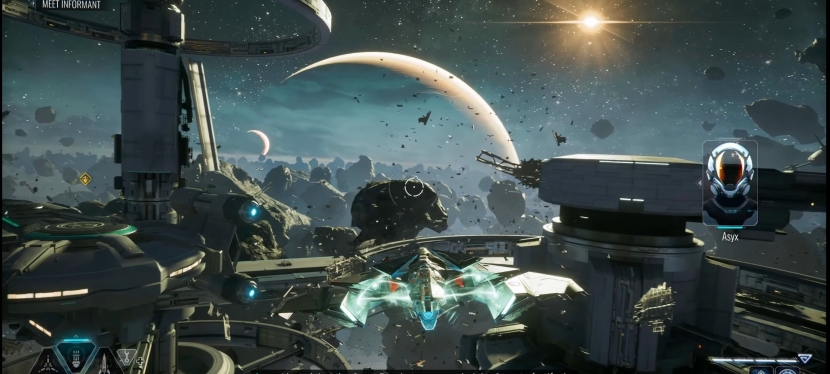
Huge structures like that are just waiting to be explored.
Nara’s journey spans across the galaxy and beyond the boundaries of reality in a dark new universe teeming with mystery and rife with conflict. Explore epic locations, such as sprawling space stations and strange plains of existence beyond our own, and experience thrilling zero-g dogfights; the fast-paced spectacular action evolves the spirit of classic space shooters.
The game is also fully engineered to take advantage of Xbox Series X|S hardware, you can enjoy glorious sci-fi visuals, 4K resolution at 60fps, advanced enemy ship destruction, higher quality volumetrics, and richer environmental effects.
Nothing like communicating with someone while enjoying a magnificent view of space.
Based on the 2020 unveiling video and the most recent video, Chorus sure looks flashy and it is easily the most eye-catching 3D polygonal space shooter of this new console generation. Games of this kind are not too many and if the game turns out to be very good, it could win the approval of game critics and the gamers themselves. I personally am interested with Chorus but also cautious. While its art direction and use of 3D polygons and effects look great, I am concerned that the gameplay might lack variety and end up being repetitive. Will there be many interesting objectives to accomplish within the game apart from the typical fly-search-attack approach seen in many other shooter-type games? Will the story cutscenes be compelling for gamers when it comes to following the story? Will the in-flight communication with other characters be varied and interesting? Will there be a lot of customization options for your spaceship? Will there be options for players to make decisions that would affect the story? We can only find out this December.
Players will be offered options to customize their spaceship.
To its credit, Chorus has a story concept that looks promising on face value and if the game developers could strike a fine balance between storytelling and gameplay to ensure bouts of fun for gamers complete with a good amount of variety, then the game might just be a hit waiting to be realized. As stated in the official announcement above, this game has been made to take advantage of the advanced technologies of the Xbox Series consoles ensuring that gamers will have a truly great looking game on both 1080p and 4K. The version on Xbox Series X is, unsurprisingly, the 4K60 (4K resolution with 60 frames-per-second frame rate) experience gamers will find. Anyone looking forward to Chorus should mark their calendars for December 3, 2021!
Thank you for reading. If you find this article engaging, please click the like button below and also please consider sharing this article to others. If you are looking for a copywriter to create content for your special project or business, check out my services and my portfolio. Feel free to contact me as well. Also please feel free to visit my Facebook page Author Carlo Carrasco and follow me at HavenorFantasy@twitter.com
Disclaimer: This is my original work with details sourced from playing Flashback: The Quest for Identity and doing personal research. Anyone who wants to use this article, in part or in whole, needs to secure first my permission and agree to cite me as the source and author. Let it be known that any unauthorized use of this article will constrain the author to pursue the remedies under R.A. No. 8293, the Revised Penal Code, and/or all applicable legal actions under the laws of the Philippines.
We live in an age in which software exclusivity defines not only the relevance of game consoles but also nature of the entire video game industry right down to the many varied communities of very avid fans (and fanboys).
While the Super Nintendo Entertainment System (SNES or Super NES) and Sega Genesis each had their own exclusive games back in the 1990s, there was one particular game that was made for and released on not just one, not two but rather on more than fifteen different platforms – both consoles and computers – starting with Amiga way back in 1992. That game is none other than Flashback: The Quest for Identity which I first played on our Super NES back in 1994.
The cover of the game box.
For the newcomers reading this, Flashback was a 2D side-scrolling adventure game in the form of a cinematic platformer (note: similar to Prince of Persia and Out of This World) with a strong flavor of science fiction. It was cinematic in the sense that all the in-game animation were rotoscoped resulting unique smoothness combined with hand-drawn backgrounds and the computer-generated cutscenes were used in key parts of the game as the story progressed. Flashback on SNES in America even came with a Marvel Comics-published Flashback comic book and on the rear of the SNES game box were the words “The first CD-ROM game in a cartridge!”
A Flashback remake was released in 2013, followed by a port of the original game released on Sega Dreamcast in 2017, and a remastered version got released for varied platforms in 2018.
I got to play that game at a time when I have not even started playing Final Fantasy II (AKA Final Fantasy IV), Final Fantasy III (AKA Final Fantasy VI) and other great role-playing games (RPGs) of the Super NES. I also remember that Flashback was a nice change of pace for me after playing Super Star Wars: The Empire Strikes Back.
With those details laid down, here is a look back at Flashback: The Quest for Identity, released on Super NES in 1993 by U.S. Gold and developed by Delphine Software International.
The start and options screen.
Early story
The story begins with Conrad running away from two armed persons chasing him. He flies away riding a solo vehicle but those chasing him (riding a huge vehicle) managed to get close and blast his vehicle causing to crash into the forest.
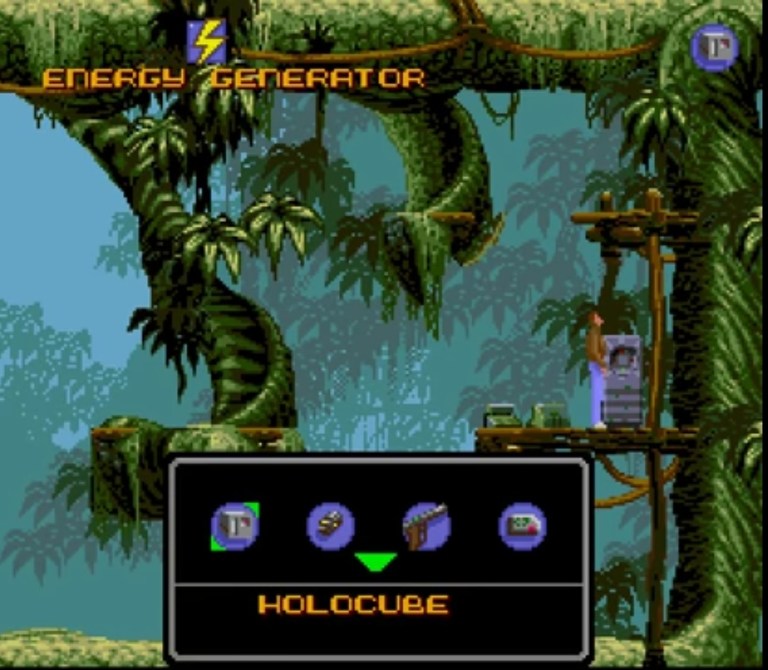
Sometime later, he wakes up and accidentally pushes a mechanical cube to fall down. He climbs down to reach it and activates it. The cube displays a holographic video of himself telling him that he recorded it without remembering it. As Conrad watches, he learns that he must contact a friend named Ian who can explain important things to him.
After viewing the message, Conrad sets off to find his way out of the jungle and somehow get to Ian in New Washington…
Game design and quality
You have to pay close attention to what’s going on, what items do you have and what the in-game prompts tell you.
This game is not your typical fast-paced, action-oriented 2D side-scrolling adventure in which you move from left to right to progress. As it is a cinematic platform game by design complete with very specific controls, players will have to be patient, adaptive and strategic in order to learn how exactly you can control your character, what moves will be executed (and when to execute). For one thing, the very fluid 24 frames-per-second animation on your character limits you in terms of control as timing is required.
To do things properly, you have to execute specific controls. To ascend on a lift, you press Up and the Y button. To do a small jump, have your character stand still and then press Up and Y button. To go down on level (on foot, no lift), stand by the edge of a level then press Down and Y button. To run and hang on to a higher floor automatically, have your character stand still, press Right and Y button, press Y button (once your character moves) and watch him pull it off. With controls like these, the usual 2D platforming approach is out of the question. In my experience, these controls are indeed challenging but never impossible to learn and eventually I got proficient with the controls as I played more.
The in-game animation for the characters are very good and there is also a sensation of weight with your character. Falling straight down from a very high place is a big no-no.
Apart from character controls, you don’t just move Conrad from one screen to the next…you also should do key objectives along the way apart from engaging in action scenes (read: shooting). That being said, you must watch out for icons that appear on screen when your character steps on a particular spot that requires interaction. For example, if you stop by a terminal, an icon will appear serving as a prompt to start the interaction. Another example is when your character steps on the same spot as an item located at which you can pick up once prompted.
More on the action on the screen, you will encounter armed enemies as well as high-tech machines (including floating drones). To overcome them, doing straightforward shooting is not recommended as you have to be strategic before firing a shot. You have to learn how each enemy or machine moves, how much physical space is available right there and how you can maximize your limited time and space to overcome them. In fact, you will also be compelled to take advantage of whatever seconds you have while the enemies’ animation (between moves) take place. There will also be times when you need to have your character armed with the gun before jumping to a lower level where an armed enemy is located and on the lookout. Coming down armed gives you an advantage to shoot first at the enemy who
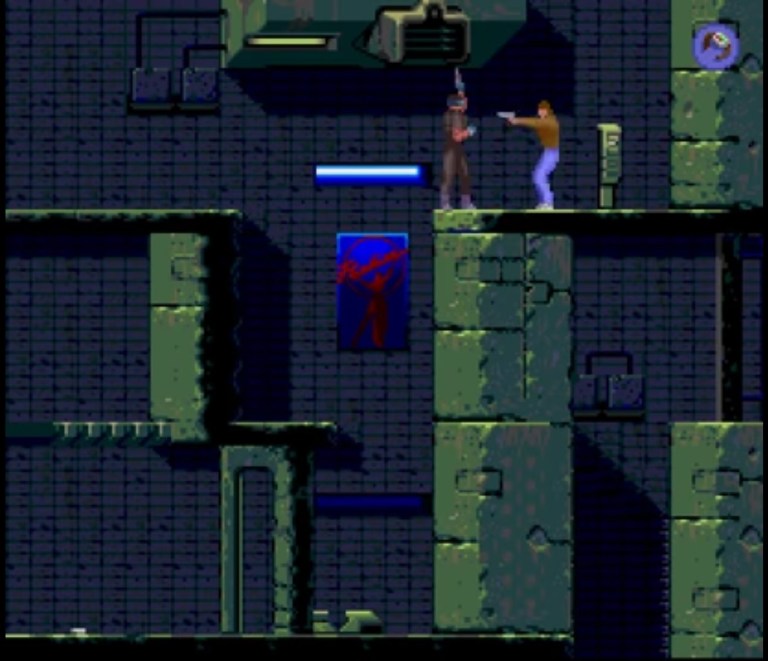
Considering the 24 frames-per-second animation, you will have to time your moves carefully, especially during moments when you face an armed enemy.
Apart from shooting, you can also use grenades which requires opening your inventory to select a grenade and then do your timing and calculation of the distance in order to pull of a successful throw and explosion. You can also throw stones to distract enemies or to apply weight on key platforms in order to open mechanical doors.
With regards to the quality of gameplay, Flashback is enjoyable but only if you get over its rather high learning curve with regards to the controls which themselves serve as the game’s advantage and even as a disadvantage. In addition to being patient and strategic, you will really have to pace yourself, think more and get used to the rather slow pace of the game in relation to its cinematic platformer design. I should state that as you keep progressing, there will be places, or new obstacles or new enemies that will compel you to change your tactics in order to overcome them. Anyone who is used to playing 2D side-scrolling games the fast and easy way might find the high learning curve and pacing of Flashback a turnoff but if they are willing to learn, adjust and pace themselves, only then can this game’s gameplay be really enjoyed.
Cut scenes like this move at a sluggish pace which shows the limitations of the SNES and cartridge technology.
As for the visuals, the obvious highlight here is the 24 FPS animation which is the result of rotoscoping and careful visualizing (note: observe those alien humanoids who morph into moving blobs). The rotoscoped animation, however, would not have been that effective had the quality of the art used for the backgrounds been made of lower quality. I can say that the background artworks here look pretty good even by today’s standards. The standout among them were the background artworks of Morph’s home planet which really looked very alien and creepy at the same time. What hurts this particular version of Flashback is the lackluster (read: choppy) frame rate whenever the computer-generated cinematic cutscenes (obviously they were meant for more powerful PCs) play which, in my experience, took me out of the story. There were also bouts of slowdown during the gameplay, especially when you encounter enough enemies that were animated sophistically.
With regards to narrative, Conrad is literally your avatar to learn, discover and interact with the many elements of the universe he is part of. There is obvious influence that the game makers took from the movie Total Recall as they crafted Conrad to be someone who lost his memory, moves on to regain it and do a lot of things as he realizes his true purpose and what is really at stake. Unlike Total Recall’s protagonist, Conrad himself is not too interesting mainly due to the way the in-game story was structured. Just play as Conrad and do what needs to be done to complete the game.
When it comes to understanding the narrative, you will have to do lots of reading. You will spot and read the short description of the prompts that appear. You’ll also have to read the on-screen text whenever your character talks with someone during the levels of the game. And there are the captions shown during the slow animated cutscenes.
Conclusion
The background artworks during the late stage of the game are great and truly creative with science fiction in mind.
I can clearly say that Flashback: The Quest for Identity on Super NESis fun and engaging mainly to those who are willing to adjust themselves to it. If you don’t have patience, if you are not willing to think while playing, if you cannot pace yourself and if you are not willing to learn all the specific controls of the game, then you should not be playing Flashback. It is a cinematic platformer and that should tell you that you will need to adjust to enjoy it.
Overall, Flashback: The Quest for Identity on SNES is recommended.
+++++
Thank you for reading. If you find this article engaging, please click the like button below and also please consider sharing this article to others. If you are looking for a copywriter to create content for your special project or business, check out my services and my portfolio. Feel free to contact me as well. Also please feel free to visit my Facebook page Author Carlo Carrasco and follow me at HavenorFantasy@twitter.com
Tokyo Game Show is set for September 30 to October 3.
Before you Xbox fans and gamers get too excited, there is a need to control your expectations first as Aaron Greenberg of Team Xbox tweeted: Well since you asked, @tokyo_game_show is a show for our players in Japan and across Asia. Expect regionally relevant updates, but no major reveals or announcements as our game teams are focused on continuing to ship big releases across October, November, and December.
TGS 2021 is also an opportunity for Team Xbox to emphasize what they have to offer gamers of Asia this coming holiday season. While nothing clear has been made, they could show the latest about Halo Infinite with footage of the single-player campaign. They could also show Psychonauts 2 with the accolades it gained, plus some more new footage of Forza Horizon 5, and reveal details of the limited edition Halo Infinite-themed Xbox Series X console for the Japanese market. Xbox Game Pass (XGP) promos and Xbox LIVE updates for Japan are expected.
TGS 2021 could also be the ideal time for Team Xbox to finalize and announce a precise release date of CrossfireX which has been scheduled for a 2021 release. There are only a few months left before the year ends and I believe that the Tokyo Game Show is the ideal time to announce a solid release date with a huge online audience present.
More on Japanese-related gaming, I can only wish that Rabbit & Bear Studios head Yoshitaka Murayama will make an appearance during the Xbox TGS 2021 livestream and give updates about the developments about their two games Eiyuden Chronicle: Rising and Eiyuden Chronicle: Hundred Heroes. Previously, it has been announced that those two games will be released on Xbox Game Pass. Eiyuden Chronicle: Rising and Eiyuden Chronicle: Hundred Heroes will be released in 2022 and 2023 respectively.
There is also Tango Gameworks, a Japan-based game studio owned by Bethesda and Xbox. I wish to see some updates from them for the Xbox livestream, especially when it come to future games.
In ending this piece, here are some Xbox-related videos for your enjoyment.
+++++
Thank you for reading. If you find this article engaging, please click the like button below and also please consider sharing this article to others. If you are looking for a copywriter to create content for your special project or business, check out my services and my portfolio. Feel free to contact me as well. Also please feel free to visit my Facebook page Author Carlo Carrasco and follow me at HavenorFantasy@twitter.com







 Author Carlo Carrasco