

Disclaimer: This is my original work with details sourced from reading the comic book and doing personal research. Anyone who wants to use this article, in part or in whole, needs to secure first my permission and agree to cite me as the source and author. Let it be known that any unauthorized use of this article will constrain the author to pursue the remedies under R.A. No. 8293, the Revised Penal Code, and/or all applicable legal actions under the laws of the Philippines.
Welcome back, superhero fans, 1990s arts and culture enthusiasts, Street Fighter fans, retro gamers, Malibu Comics enthusiasts and comic book collectors! Today we go back to the year 1993 to examine the official comic book adaptation of the wildly popular video game Street Fighter II.
While the original Street Fighter game of 1987 did not achieve huge success in the arcades and on consoles, it literally started the ball rolling for Capcom as the game itself influence other arcade game developers to focus more on making beat-them-up games and the use of special moves appealed to others. Capcom went on to release Street Fighter II in the arcades and it came with a dedicated fighting game design that strongly lured in gamers to play it in huge numbers. After selling 200,000 arcade cabinets, SFII went on to become a huge seller on game consoles. Capcom even went on to produce new versions of the game – popularly referred to as upgrades – culminating with Super Street Fighter II Turbo in 1994.
As Street Fighter II kept on attracting countless players into the arcades worldwide, Capcom approached Malibu Comics (publisher of the Ultraverse).
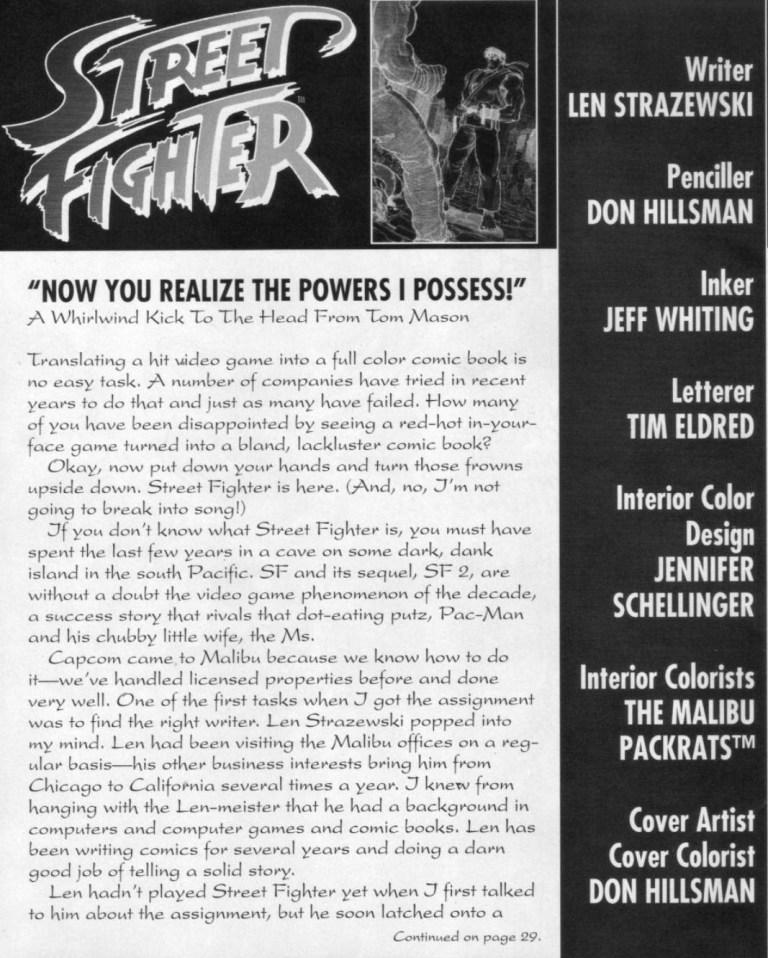
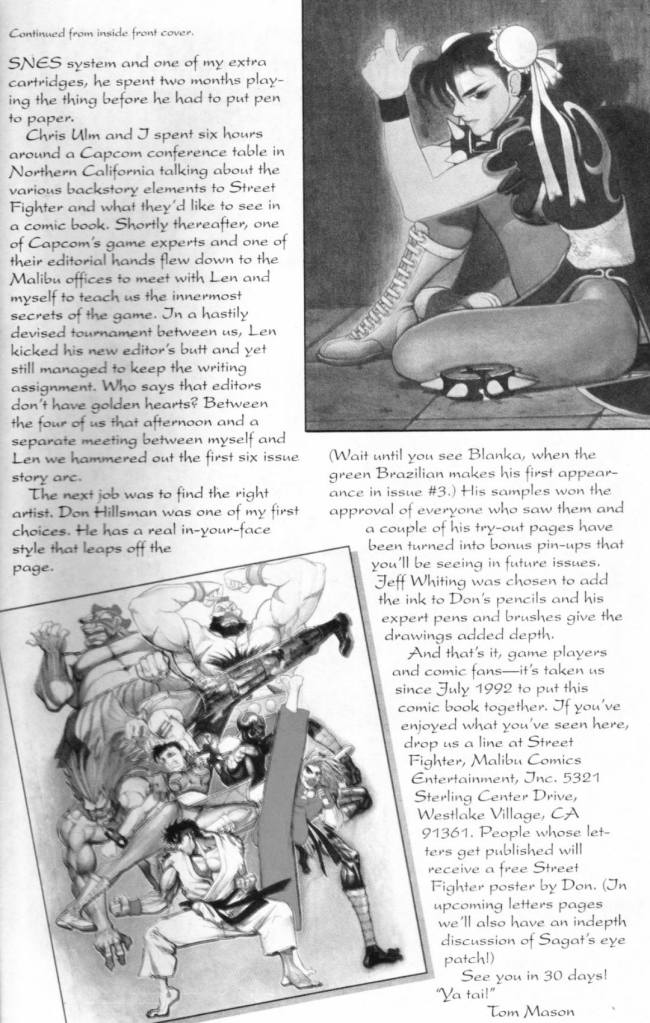
“Capcom came to Malibu because we know how to do it—we’ve handled licensed properties before and done very well,” said Tom Mason in the opening message of the first issue of the Street Fighter comic book adaptation.
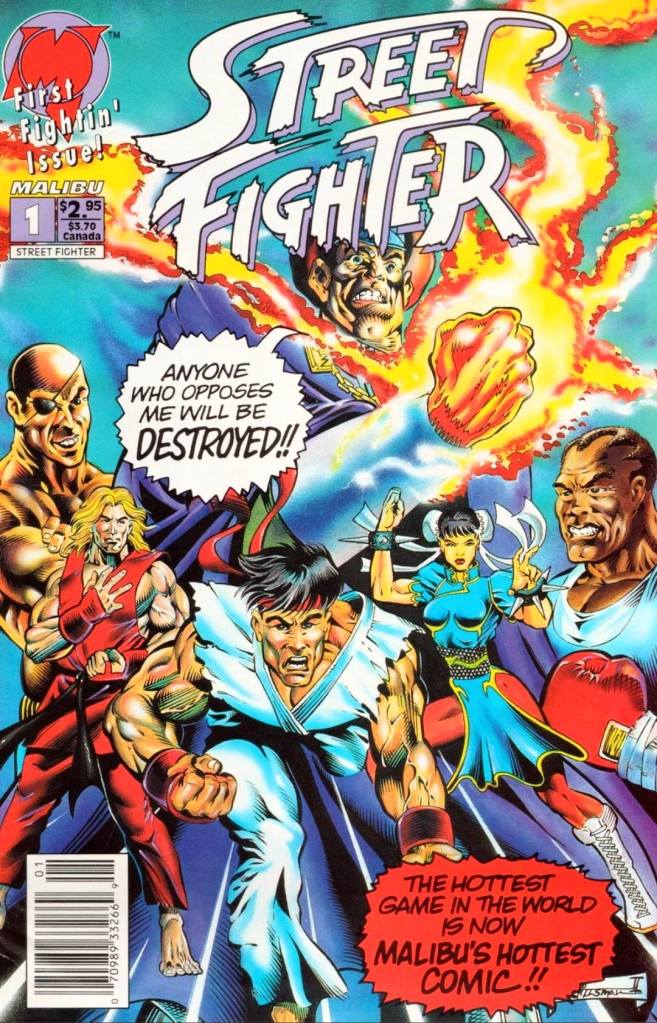
With those details laid down, here is a look back at Street Fighter 1, published by Malibu Comics in 1993 with a story written by the late Len Strazewski and drawn by Don Hillsman. This was the first issue of a planned mini-series.
Early story
The story begins some time in the past when Ryu permanently scars Sagat on the chest with his Dragon Punch during street fight in front of many. Enraged, Sagat tries hard to retaliate against Ryu who happens to be the champion among street fighters. The Japanese fighter hits the tall Thai kickboxer with a barrage of kicks.
The past fight was played on home video and viewed by Sagat and Balrog. Embarrassed by the video, Sagat destroys the TV and asked his companion why must he be humiliated. After Balrog tells him not to talk that tone with their superior Bison, Sagat hits the American boxer. As the fight between the two intensifies, Bison arrives and stops the violence. He tells Sagat that he is an embarrassment to his organization.
Bison reminds them that he took them into his criminal network and still have not redeemed themselves in front of him. He tells the two that they must beat Ryu and regain the street fighter championship.
As Balrog and Sagat express difficulty in finding and fighting Ryu, Bison tells them the Japanese fighter’s friends are Chun Li and Ken…
Quality
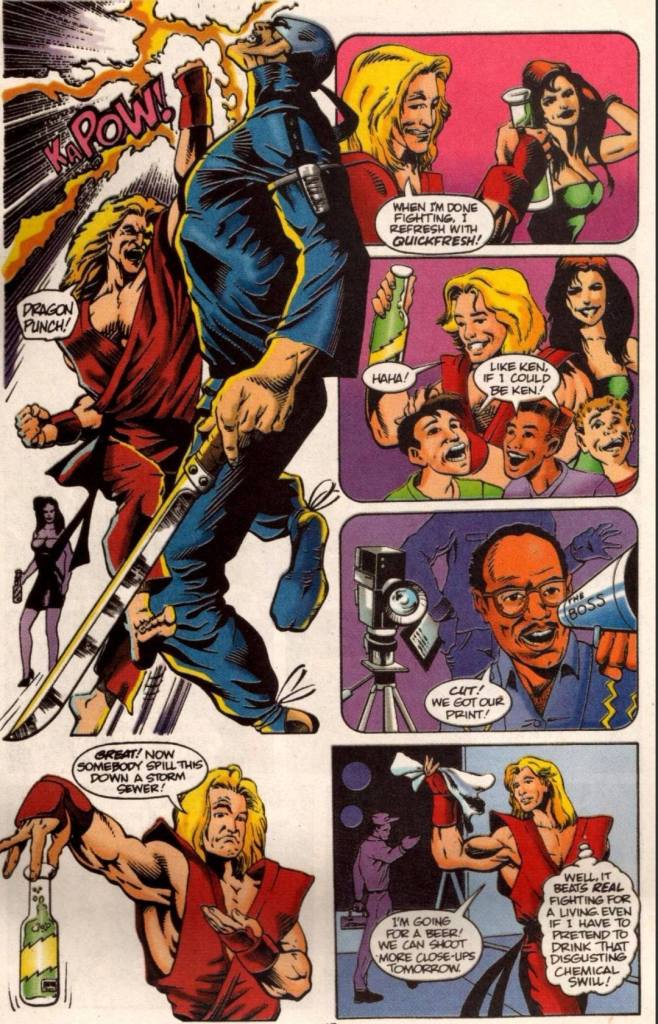
Back in 1993, I even contemplated buying a copy of this comic book locally when it was brand new. I’m glad I chose not to buy it back then as this one has bad quality in its presentation from start to finish. Dedicated Street Fighter II fans should be warned.
For starters, the storytelling is not faithful to the lore of Street Fighter II even though the creators derived key elements of characters from the game itself. That said, it looks like liberties were taken in order to form a narrative that can be told in comic book format.
Chun Li here is correctly described as an agent of Interpol and is motivated by revenge over the loss of her father who was killed by M. Bison. And yet, she is portrayed here as having a romantic relationship with Ryu and has been training with him along with Ken in the past. The romantic relationship between the two never existed in the popular video game and it is established in Street Fighter II lore that Chun Li came from a different martial arts background while Ken and Ryu trained together under the same master.
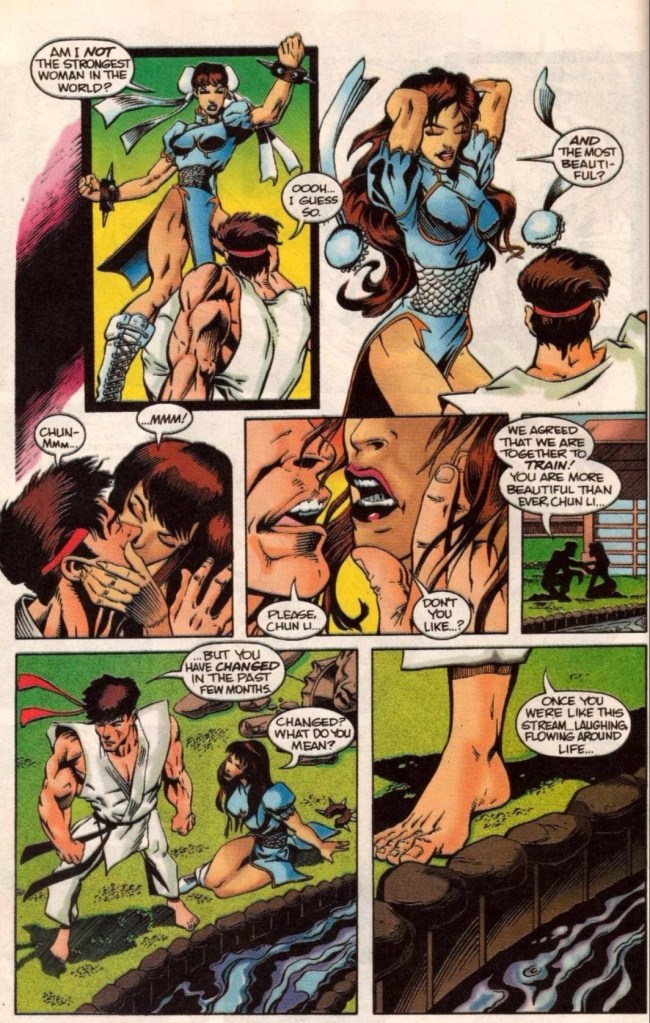
Ryu in this comic book is the defending street fighter champion (reflecting the canonical story of Street Fighter and Street Fighter II) who is responsible for the huge scar on Sagat’s chest. While Ryu is the wandering warrior who travels around the world with only a duffel bag as he seeks the true way of the fighter, in this adaptation he is a reigning champion who starts having doubts when Chun Li lectures him over his devotion to fighting as life changes for others around him.
While the liberties are notable and could be insulting to dedicated Street Fighter II fans, the story of this comic book is surprisingly readable. As Ryu is the target of Bison and his criminal network, it made sense for dangerous pawns Sagat and Balrog to go after Ken to get to the Japanese fighter. There definitely is a plot here and if readers can ignore the actual lore of Street Fighter II, it can be followed and the classic concept of good versus evil will be realized.
As for the art, the work done by Don Hillsman is lackluster. While he excelled in making Balrog look scary early in the story, his visual takes on the other Street Fighter II characters range from bad to passable. Ken, Ryu, Sagat, Bison, Vega and Chun Li all have that rough look on their faces and bodies. Hillsman even tried to emulate special moves from the game but ended up looking sub-par. Lackluster artworks like these only add to the perception of the fans and other people obsessed with Japanese culture and the arts that Western illustrators should not draw Street Fighter characters.
Conclusion
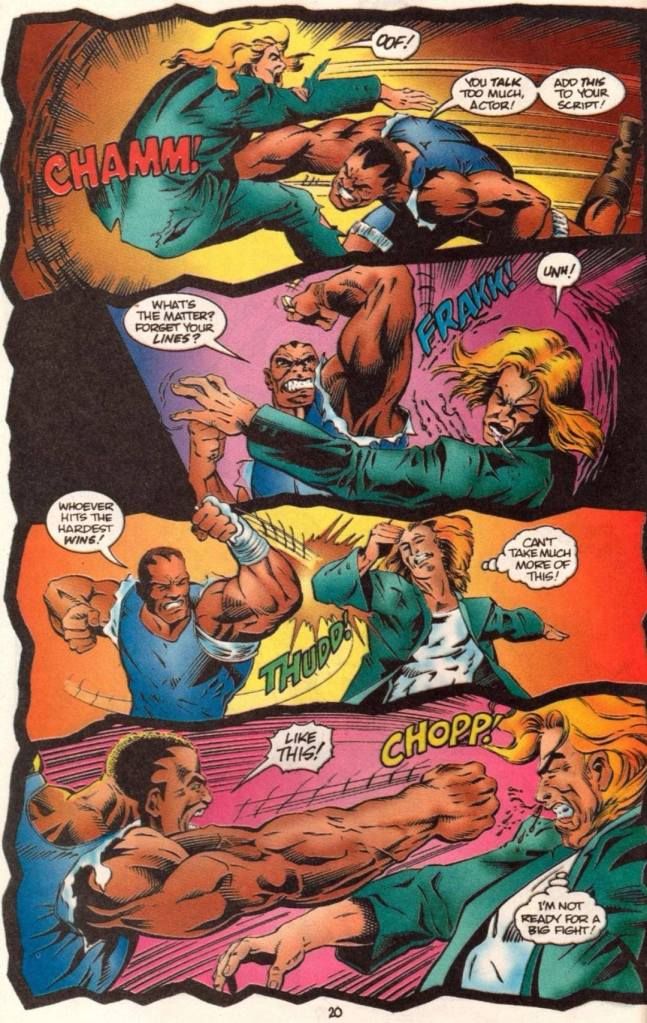
I am glad that I never bought Street Fighter #1 (1993) brand new decades ago. Its quality is really bad and clearly it has not aged well. Street Fighter fans – especially those obsessed with Street Fighter II games – should look elsewhere to enjoy the tale and concepts of Street Fighter II. This comic book from Malibu Comics is a creative failure and was the start of the eventual collapse of the publishing deal made with Capcom. Can you just imagine the shock the Capcom executives had when they first read this comic book? Ultimately, this comic book adaption was creative catastrophe which is a shame because Malibu Comics had a good record of licensed projects and the late Strazewski (died on April 27, 2026) was one of the finest writers and creators on the Ultraverse line of comic books.
Overall, Street Fighter #1 (1993) should be avoided.
+++++
Thank you for reading. If you find this article engaging, please click the like button below and also please consider sharing this article to others. If you are looking for a copywriter to create content for your special project or business, check out my services and my portfolio. If you want to support my website, please consider making a donation. Feel free to contact me with a private message. Also please feel free to visit my Facebook page Author Carlo Carrasco and follow me on Twitter at @CarloCarrascoPH as well as on Tumblr at https://carlocarrasco.tumblr.com/ and on Instagram at https://www.instagram.com/authorcarlocarrasco/.

