Recently at Malacañang Palace, the ambitious P170.6 billion agreement to rehabilitate and modernize the Ninoy Aquino International Airport (NAIA) was formally signed in the presence of President Ferdinand “Bongbong” Marcos Jr., House Speaker Martin Romualdez and Executive Secretary Lucas Bersamin which symbolically starts the public-private partnership, according to a Philippine News Agency (PNA) news article.
To put things in perspective, posted below is an excerpt from the PNA news article. Some parts in boldface…
The PHP170.6-billion Public-Private Partnership (PPP) agreement for the rehabilitation of the Ninoy Aquino International Airport (NAIA) is expected to herald economic growth through better collaborations with both local and foreign investors, Transportation Secretary Jaime Bautista said Monday.
At the signing of the concession deal between the Department of Transportation (DOTr) and the New NAIA Infra Corp. (NNIC) in Malacañang, Bautista said the PPP project would “open floodgates” of opportunities from investments, business, tourism, and employment.
“We welcome this development for the NAIA PPP Project as this will not only generate revenue for the government but it will also create opportunities for Filipinos. With a modernized NAIA, we are elevating the airport’s facilities and services to international standards,” he said.
The agreement, Bautista said, would send signal to the international business community about the viability of government infrastructure projects.
“This radical transformation comes at no small price Substantial investments in infrastructure and technology will necessitate collaborations with local and foreign partners,” he added.
San Miguel Corporation president and chief executive officer Ramon Ang, for his part, said the NNIC would not only rehabilitate but also improve the airport’s functionality and “establish a new standard in serving excellence.”
“Together with our partner, Incheon, we have assembled a team of experts, focused on implementing immediate improvement, and help us achieve our long-term goal for NAIA,” Ang said.
President Ferdinand R. Marcos who witnessed the signing described the pact as an “investment in our future.”
“This undertaking is not just about revenues that will be remitted to treasury alone, but resources invested in the airport,” Marcos said.
The agreement, signed by Bautista, Ang and Manila International Airport Authority (MIAA) General Manager Eric Ines, covers 15 years with an option for a 10-year extension.
Let me end this piece by asking you readers: What is your reaction about this recent development? Do you think this new public private partnership will succeed with achieving its goals of modernizing the NAIA, creating new jobs and attract both new investments and a higher number of foreign visitors in the years in the come?
For more South Metro Manila community news and developments, come back here soon. Also say NO to fake news, NO to irresponsible journalism, NO to misinformation, NO to plagiarists, NO to reckless publishers and NO to sinister propaganda when it comes to news and developments. For South Metro Manila community developments, member engagements, commerce and other relevant updates, join the growing South Metro Manila Facebook group at https://www.facebook.com/groups/342183059992673
To put things into perspective, posted below is an excerpt from the PNA story pertaining to investments. Some parts in boldface…
President Ferdinand R. Marcos Jr. on Friday (Manila time) expressed elation over the signing of the much-awaited “123 Agreement” on nuclear cooperation between the governments of the Philippines and the United States.
This was after Energy Secretary Raphael Lotilla and US Secretary of State Antony Blinken signed the nuclear cooperation agreement that will facilitate the collaboration between the two countries on technical exchanges, scientific research, and initiatives to ensure the safe operation of nuclear power installations.
The agreement was signed on the sidelines of Marcos’ participation in the Asia-Pacific Economic Cooperation (APEC) Summit in San Francisco, California.
“I am most pleased to be here today to join you this afternoon to witness another milestone towards a more energy-secure and green Philippines,” Marcos said, noting that the move was in line with his plans to ensure an “affordable, reliable, and sustainable energy supply” for the Philippines.
Marcos expressed optimism that the signing of the nuclear deal would encourage more foreign investors to pursue nuclear power projects in the Philippines.
The nuclear power cooperation, he said, would enable the country to meet its growing energy demands and provide a “more investor- and consumer-friendly environment.”
“The signing of the Philippines – United States Agreement for Cooperation Concerning Peaceful Uses of Nuclear Energy or the 123 Agreement is the first major step in this major regard, taking our cooperation on capacity-building further and actually opening the doors for US companies to invest and participate in nuclear power projects in the country,” Marcos said.
The 123 Agreement will establish a legal framework that allows the export of nuclear fuel, reactors, equipment, and special nuclear material from the US to the Philippines.
The agreement will allow the Philippines to use US nuclear technology, not for war, but for energy security and climate goals.
The President noted that apart from the 123 nuclear deal, Meralco and Ultra Safe Nuclear Corp. also signed a cooperation agreement to undertake a Pre-Feasibility Study on Micro-Modular Reactors (MMRs) to explore clean and sustainable energy options in the country.
Under the agreement, a feasibility study will be conducted for the potential deployment of MMRs to Meralco sites to enforce the sustainable energy agenda and provide affordable and dependable access to power, particularly to the underserved and off-grid areas for economic empowerment.
“I know our companies are eager to advance discussions on potential projects. Just yesterday, the MOU (memorandum of understanding) between Meralco and Ultra Safe Nuclear Cooperation was also presented to me. So, I believe congratulations are in order for the work of our respective negotiating teams, especially to the team from the United States,” Marcos said.
“I look forward to seeing this agreement in action in the years to come. Nuclear energy is one area where we can show that the Philippines-US alliance and partnership truly works, for our peoples, our economies, and the environment.”
For the PNA story pertaining to energy and modular reactors, below is the excerpt. Some parts in boldface…
The historic nuclear cooperation deal between the United States and Philippines would allow the Philippines to secure US-developed nuclear technologies, including small modular reactors.
Manila and Washington D.C. signed the civil nuclear cooperation deal, commonly known as a 123 Agreement, at the Asia-Pacific Economic Cooperation (APEC) Summit in San Francisco on Nov. 16 (US time).
The agreement will facilitate and enhance cooperation on clean energy security and strengthen the two nations’ alliance, the US State Department said.
“With access to US material and equipment, the US and the Philippines will be able to work together to deploy advanced new technologies, including small modular reactors, to support climate goals as well as critical energy security and baseload power needs within the Philippines,” it said.
The signing marks the successful culmination of the negotiation process launched by Vice President Kamala Harris during her trip to the Philippines in November 2022.
The deal, the State Department said, also spells out limitations on enriching, reprocessing, and transferring specific items without the other party’s consent.
“This agreement lays out a comprehensive framework for peaceful nuclear cooperation between the Philippines and United States based on a mutual commitment to nuclear nonproliferation and is required by US law to allow for the transfer of nuclear equipment and material for peaceful uses,” it said.
The name 123 Agreement is derived from Section 123 of the US Atomic Energy Act, which requires the US to have an agreement with a country before it can conduct nuclear export.
Section 123 establishes nine nonproliferation criteria that 123 Agreements must include and signatories must uphold.
Oregon-based NuScale is known for developing a small nuclear power system, described as safe, modular and scalable.
Let me end this piece by asking you readers: What do you think about these recent developments? Can you imagine what a nuclear-powered Philippines would be like in the years to come? Are there still people in your local community who are afraid of anything related to nuclear power? Do you admire the efforts of the Marcos administration when it comes to modernizing the Philippines with nuclear technology and power?
For decades now, I have been living in Alabang and I witnessed how much Muntinlupa City modernized along the way. Bordering Barangay Ayala Alabang is Filinvest City (formerly called Filinvest Corporate City) which itself is home to several business or facilities such as the Filinvest Tent, Commercenter, Acacia Hotel Manila, Crimson Hotel, Westgate and, of course, the wildly popular place to be in – Festival Mall.
For the newcomers reading this, Festival Mall opened in May 1998 with its initial name Festival Supermall. Way back then, out of pure curiosity, I entered the mall for the first-time ever during its soft opening on May 1, 1998 (Labor Day here in the Philippines) as I was already looking for a new place and new discoveries at a time when I got tired of Alabang Town Center (ATC).
Being very new back then, Festival Mall’s presence of retailers or tenants was not yet dynamic as there were still businesses inside that could not open in time for the mall’s opening. I do remember walking down seeing lots of vacant retail spots covered with signs such as “opening soon”, “coming soon” and the like. Back in those days, the Philippine economy and society itself were dampened by the 1997 Asian Financial Crisis.
As the months passed by, more businesses opened and Festival Mall’s early attractions include the X-Site Amusement Center (which already had the indoor roller coaster) and, of course, the brand new cinemas which had several screens operating at a very spacious area on the top floor. I still remember seeing lots of people lining up for tickets and seats to watch Armageddon which ended up as the highest grossing movie of the world in 1998.
Indeed, for more than a decade, Festival Mall’s original cinemas became a favorite destination of mine to watch movies in Alabang and I definitely was not alone. I also remember the times when the said cinemas attracted a whole lot of moviegoers when the annual Metro Manila Film Festival’s (MMFF) opening day (every December 25) happened resulting in long lines. Watch the YouTube videos below…
As you can see in the above videos, Festival Mall’s original cinemas was a hot spot for moviegoers. It should be noted that the mall is strategically located in close proximity to the Alabang Viaduct and the South Luzon Expressway (SLEX) which ensures visibility to motorists and accessibility to commuters on a daily basis. The old cinemas were also a hot spot for a variety of small businesses selling different kinds of food and drinks to moviegoers and others who just passed by.
Festival Mall at 25
This past May, Festival Mall turned 25 and its anniversary was highlighted with special events as well and publicity through the media. There were these Festival Mall 25th anniversary feature articles that got published in different newspapers almost simultaneously. In the commemorative article that got published in the Manila Bulletin, President and CEO of Filinvest Development Corporation Josephine Gotianun Yap was quoted which goes as follows in the excerpt below. Some parts in boldface…
“We would not be where we are today without the unwavering support of our customers, merchants, suppliers, and employees who have journeyed with us through the years. It is humbling to think that when we first opened the mall, we only had 30 stores and no anchor supermarket. But thousands of visitors came on our first day, attracted by our amusement centers, cinemas, and food court. And now the mall has 800 tenants and eight leading anchor stores. We value our collaboration with major retailers, which has enabled us to bring together SaveMore, Ace Hardware, Robinson’s Department Store, Handyman, Shopwise, H&M, Decathlon, and Landmark all under one roof. As we build on its strong foundations for the future, we see Festival Mall continuing to serve as a place where time stops for making memories with family and friends,”
As seen above, the Filinvest Development Corporation executive clearly referred to the original cinemas which was one of the early attractions of Festival Mall way back in 1998. As mentioned earlier, Festival Mall today has more modern cinemas located at the expanded area on the same floor but several meters away from the original cinemas. So how does Festival Mall’s original cinemas look like nowadays? Watch the video below…
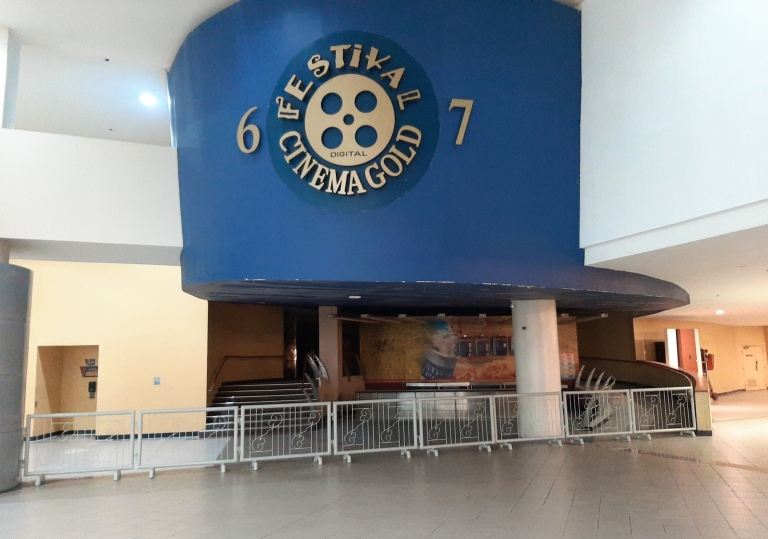
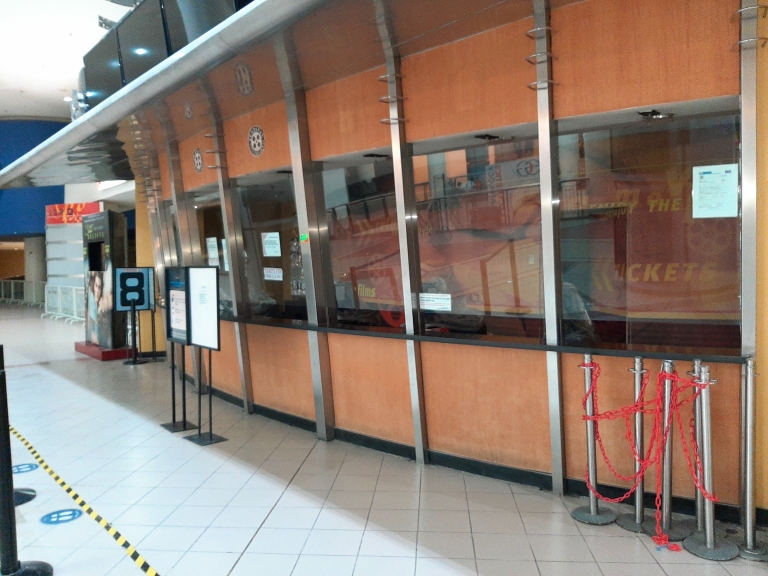
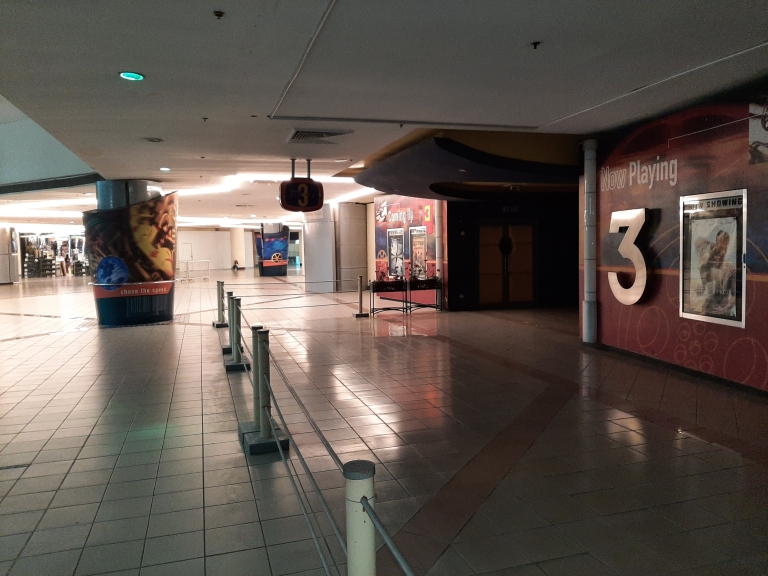
Yes, indeed the mall’s original cinemas have turned depressing. There are much less customers who pass by the area and many of the businesses that operated within have closed down! As I personally found out, Festival Mall is still using a few screens at the old cinemas for moviegoers while leaving the many others closed and left in the dark. If you think about it carefully, what does the mall management have in mind with regards to all of those cinema seats, sound systems, projectors, screens and other pieces of equipment inside each and every closed screen of the original cinemas?
A closed screen at one end of the original cinemas of Festival Mall. Just imagine what is left of all the hardware (examples: projectors and speakers) and seats inside.
This was a premium place to watch movies at. It had more comfortable seats and better equipment that made the cinematic experience more immersive. It was here where I saw 2001’s Final Fantasy: The Spirits Within.
This is where I used to buy movie tickets for many years. For some time now, the selling of movie tickets here has stopped. To buy tickets, you have to go to the modern cinemas of the mall several meters away by foot at the same floor.
Apart from seeing more of the screens of the original cinemas closed down, the number of small-time businesses that sold different kinds of food and drinks are also gone which is depressing. Those businesses offered moviegoers different choices of what to eat or drink apart from the usual popcorn and drinks sold by the cinema’s concessionaires. I do remember a certain business joint that sold really good coffee (both hot and cold) that is also affordable.
There used to be different kinds of small business joints that sold a variety of food and drinks located on the floor spots at the original cinemas area. Those businesses have since closed down and left.
I remember the times I bought popcorn and drinks at this place before watching a movie. Now there are no food, no drinks and no people selling to customers anymore.
With the way things are right now, walking through the original cinemas area of Festival Mall is lonely and depressing to do. The area is almost lifeless and it easily is the saddest place inside the mall which itself has become a major attraction for shoppers and families. I can only wonder if Festival Mall’s management has any plan to revive the original cinemas area. Will they someday renovate at least a few of the screens and install brand new seats and other equipment to accommodate more moviegoers? Do they plan to attract new businesses to occupy the vacant commercial spaces and floor spaces near the old cinemas?
It would be nice to know if Festival Mall’s management or Filinvest itself has any plan to revive commerce at the original cinemas area which is now the saddest and loneliest part of the mall.
To be very clear with you all reading this, I never worked for a shopping mall nor have I ever worked in the movie theater business. I am a long-time resident of Alabang who often visits Festival Mall for purchasing needed items, dining and availing of services. Watching movies at Festival Mall used to be a big reason for me to spend time at the mall. I know for a fact that operating movie theaters is difficult and attracting people to watch movies on the big screen is tougher because of streaming. It does not help that the COVID-19 pandemic convinced people that watching new movies at home via streaming is the new standard which also made them think that movie theaters are unnecessary.
As a movie enthusiast, I can say out loud that watching a movie inside the cinema is still the best and most definitive way to enjoy watching. The movie theater experience can never be matched by streaming nor could the biggest HDTV at home could ever come close to the size and visual impact of a cinema screen. That being said, I can only hope that Festival Mall could someday revive the movie experience and commerce at their original cinemas area. They already have the modern cinemas at the expanded area but those are only 4 screens.
If you are living here in South Metro Manila and you have been to Festival Mall several times before, what do you think the mall management should do about their old cinemas? Is Festival Mall your favorite place to watch movies in? Do you think that hosting multiple film festivals – both foreign and domestic – each year would justify renovating the old cinemas of the mall?
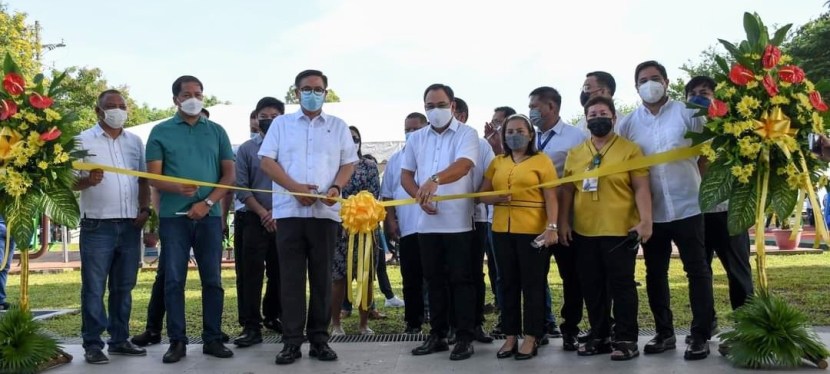
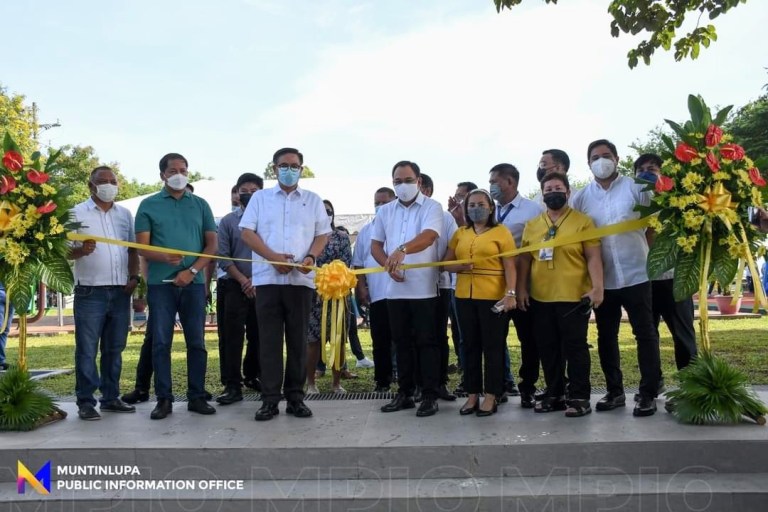
In the progressive city of Muntinlupa, a special project referred to as the Urban Green Space and Recreational Park located at the Bayanan Baywalk was jointly inaugurated today by Mayor Ruffy Biazon and Metropolitan Manila Development Authority (MMDA) Chairman Usec. Carlo Dimayuga III and witnessed by several guests and stakeholders, according to the City Government’s announcement.
A joint inauguration by the City Government of Muntinlupa and the MMDA symbolically led by Mayor Ruffy Biazon and Chairman Usec. Carlo Dimayuga III. (source – Muntinlupa PIO)
The project was from both the City Government and the MMDA done in accordance to the “I ♡ Metro Manila (MM)” advocacy where the agency is in contact with various local government units in the National Capital Region for the Adopt -a-Park Project.
Also in accordance to the Urban Re-Greening and Renewal Program of the agency, the new project is the initiative to raise environmental awareness and encourage inclusive and participatory planning among stakeholders to address urban decay through the creation of green public parks and Metro revitalization Manila ecosystem against rapid urbanization.
Mayor Biazon announced that the establishment of the park is part of the 7K Agenda central to his administration. The said agenda consists of Kabuhayan (livelihood), Kalusugan (health), Karunungan (knowledge or education), Kaunlaran (progress), Kapayapaan/Kaayusan (peace and order), Katarungan (justice) and Kalikasan (environment).
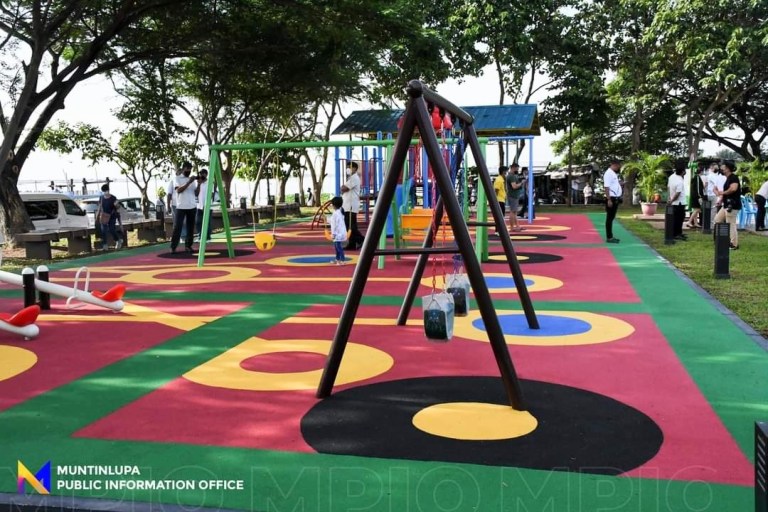
The new park is now accessible to the public. There, visitors will find newly planted grass, bollard lights, seats, ramps for persons with disabilities (PWDs), exercise areas, and a colorful playground for children to enjoy.
A very modern looking playground. (source – Muntinlupa PIO)
Present during the inauguration ceremony were Councilor Jedi Presnedi, City Engr. Dynadelle Aranda, EnP. Alvin Veron, Acting Head of the City Planning & Development Office, Arch. Don Causapin, head of the City Architect’s Office, Mr. Lorna Misa, head of the Environmental Sanitation Center, Mr. Herminio Dela Cruz, head of the Lake Management Office, Barangay Captain Ador San Pedro of Bayanan and barangay members Kagawad Johnson San Pedro, Kagawad Jojo Solema, Kagawad Ronnie Viconia, and Kagawad Buboy Soliveres. Also present at the was Barangay Administrator Engr. Vic Orellana and Barangay Treasurer Engr. Athan Gutierrez.
Let me end this piece by asking you readers: If you are a Muntinlupa City resident, what is your reaction to this recent development? Do you find this special project very helpful to the city? Do you plan to visit the Urban Green Space and Recreational Park soon?
For more South Metro Manila community news and developments, come back here soon. Also say NO to fake news, NO to irresponsible journalism, NO to misinformation, NO to plagiarists, NO to reckless publishers and NO to sinister propaganda when it comes to news and developments. For South Metro Manila community developments, member engagements, commerce and other relevant updates, join the growing South Metro Manila Facebook group at https://www.facebook.com/groups/342183059992673








 Author Carlo Carrasco