A Look Back at Wonder Woman #24 (1989)

Disclaimer: This is my original work with details sourced from reading the comic book and doing personal research. Anyone who wants to use this article, in part or in whole, needs to secure first my permission and agree to cite me as the source and author. Let it be known that any unauthorized use of this article will constrain the author to pursue the remedies under R.A. No. 8293, the Revised Penal Code, and/or all applicable legal actions under the laws of the Philippines.

Welcome back, superheo enthusiasts, 1980s arts and culture enthusiasts, DC Comics fans and comic book collectors! Today we go back to the late 1980s to explore a part of the DC Comics shared universe through a tale of the Queen of Superheroes herself…Wonder Woman!

In my previous retro review, Wonder Woman’s spiritual superior Hermes makes his presence felt on Earth as she continues her interaction with members of the local society. Unsurprisingly, a great disturbance happens with the people as they let their guard down after witnessing something supernatural. This made things more complicated with Wonder Woman who has been trying her best doing her duty as Themyscira’s representative while maintain the personal relationships she established with certain mortals. And then something wrong happened with Hermes.

With those details laid down, here is a look back at Wonder Woman #24, published by DC Comics in 1989 with a story written and drawn by the late George Perez.
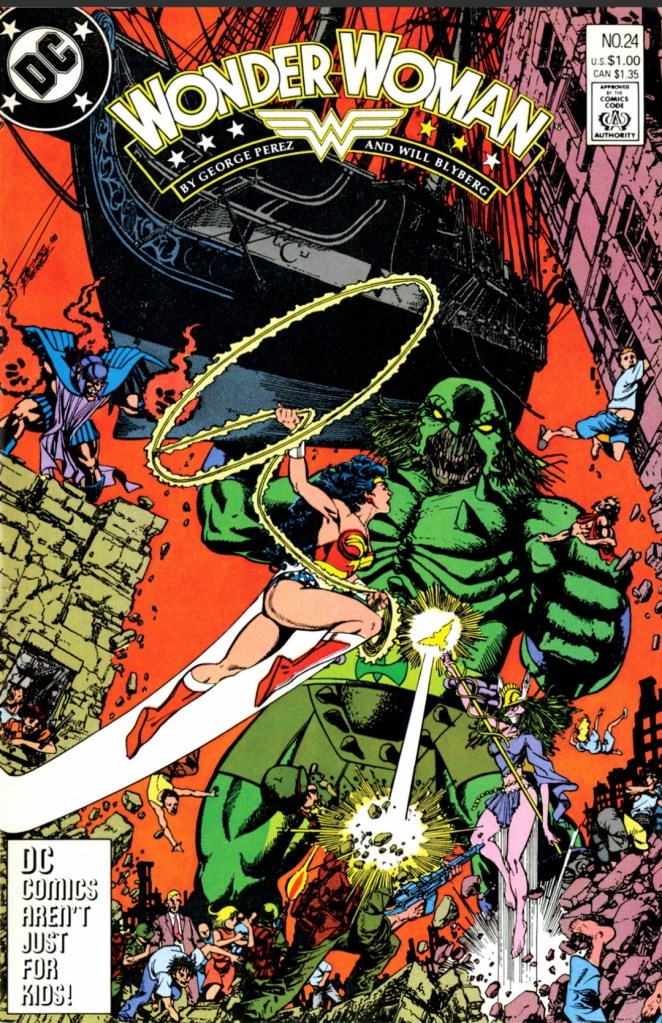
The cover.

Early story

The story begins Vanessa Kapatelis at home watching news on TV about the strange attack on Hermes. In the city of Boston, two police officers find a man sitting with junk at a wall who cannot help but be very scared of something. The man points to a certain building very nearby.

Beneath the foundation of the building, the earth rumbles with very eerie sounds. The gorgon Euryale and Ares’ son Phobos are on top of a pit and below them is Ixion, the first mass murderer to have ever walked the earth. It turns out, Ixion has long been chained to a large wheel that not only restrained him but also tortured him. The generations of torture disfigured Ixion as well. Hermes, who was defeated very recently, cannot help but be shocked at the sight of Ixion whom he left imprisoned in another place. Phobos tells Hermes he could thank his foolish Olympians as they were so busy with the cosmic migration, it paved the way for him (Phobos) to sneak into Hades and pull out Ixion.

It turns out, it was Hermes who forged the unbreakable chains holding Ixion and only he could break it. Euryale, who wears Hermes’ mystical hat, mocks Hermes. Phobos reveals that he has Hermes’ caduceus all to himself and then uses it to capture and harness energy which he uses to free Ixion.

Suddenly, the building crumbles and Ixion emerges with Hermes caught firmly by his oversized hand. The rise of Ixion terrifies the people of Boston…

Quality
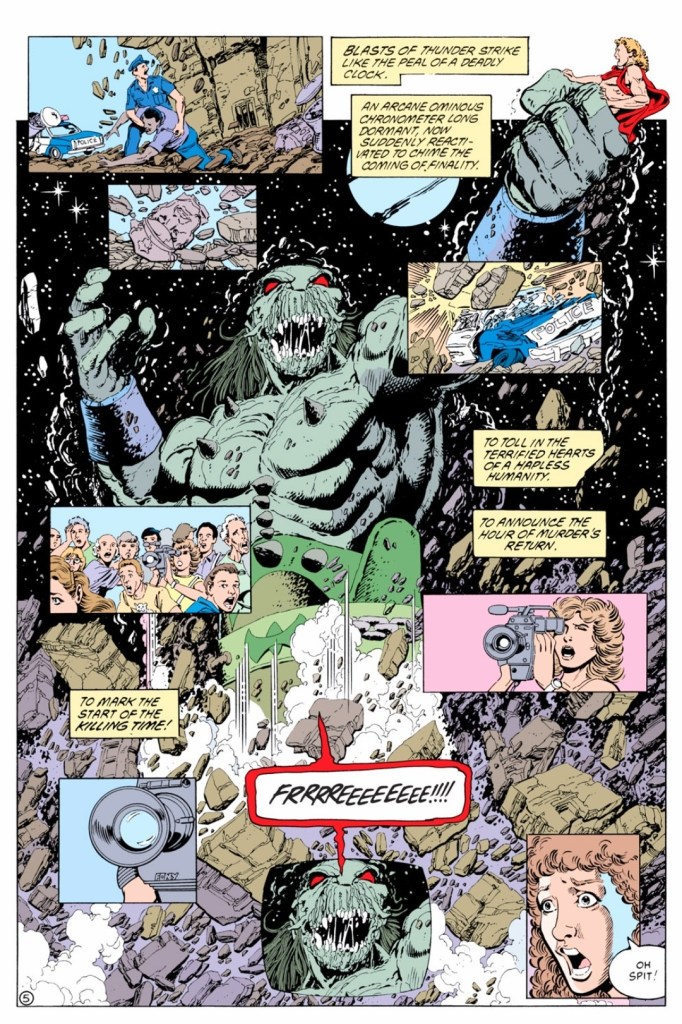
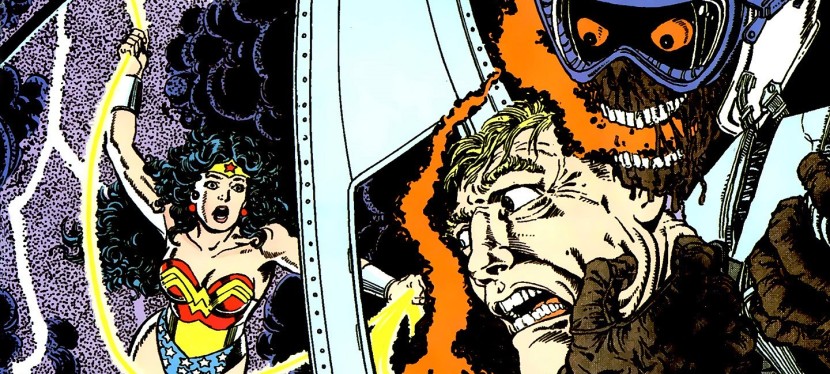
Look at how intimidating Ixion is while Hermes is so helpless and pathetic.

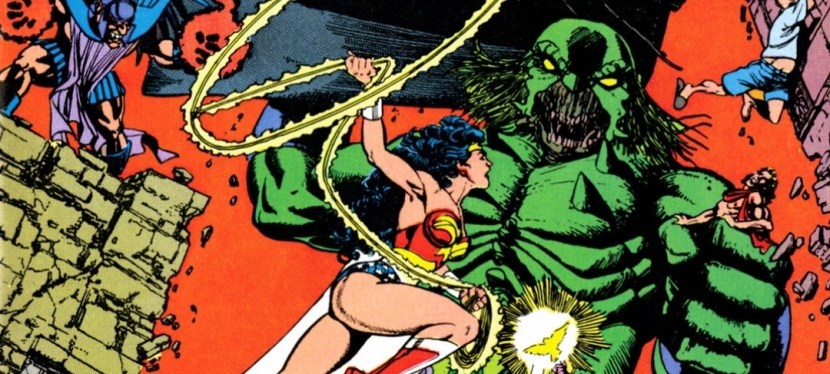
Wow! This is one epic Wonder Woman tale that has a nice blend of fantasy, action and 1980s American culture. The stakes within this comic book are so high as a result of the disaster caused by Ixion who really put many people’s lives in danger. Ironically, the huge scale of disaster did not attract the assistance of other superheroes within the shared comic book universe of DC and this only made Wonder Woman’s involvement more significant. Not only would you see Wonder Woman really struggle with fighting Ixion, you will also see her struggle emotionally and logically when she deals with the helplessness of her superior Hermes (who is rather pathetic here and he really looks like a reject from Olympus) and facing the raging evil of Phobos while trying to prevent any further loss of life. By the way, Ixion here is more than just being one large monster for Wonder Woman to face off with.

While this is indeed a tale heavily loaded with action, the script by Perez sheds light on key themes that are indeed worth thinking over. For one thing, how should Wonder Woman handle herself upon realizing her lord Hermes becomes vulnerable and unworthy of godly authority? How should people deal with idolatry (which is foolish and unholy) when they realize a mythical figure like Hermes is so helpless not so long after he convinced them with his amazing display of the supernatural? More on relationships between mortals and powerful beings, how can an ordinary human like Julia Kapatelis really maintain a sisterly bond with Wonder Woman whose powers and responsibilities are so tremendous and are beyond the reach of humanity? There definitely is something engaging to reflect over in this comic book and the richness behind the writing (as opposed to the visual spectacle) is undeniable.

Themes aside, Perez also crafted very rich dialogue which is very evident near the end of the story. I won’t say which characters engaged in the rich conversation but I assure you it is worth getting this comic book for. The said conversation is not only philosophical but also marks another step in the development of the characters involved. 

Conclusion
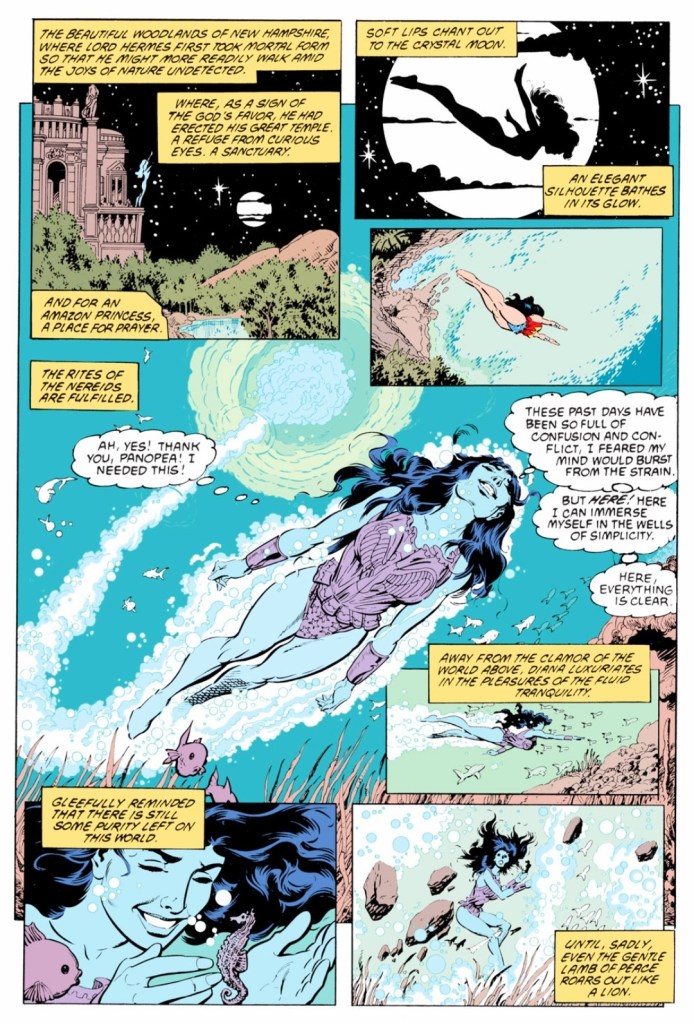
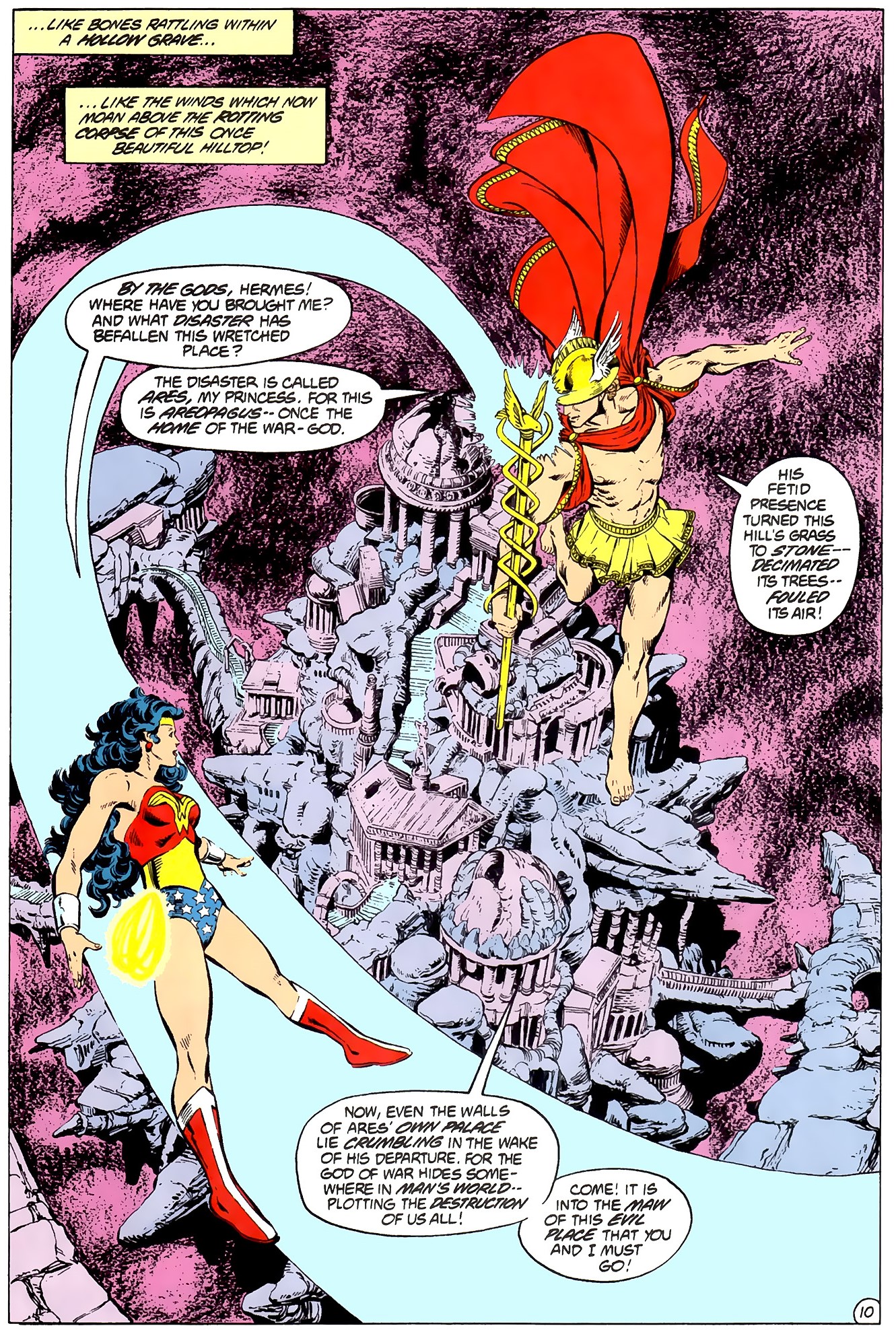
Wonder Woman unwinding.

Wonder Woman #24 (1989) is indeed a great Wonder Woman tale and it is a significant improvement over issues #22 and with regards to storytelling, conflict and characterization. This comic book is a lively reminder about how great George Perez proved to be when it comes to writing. It has lots of superhero spectacle to keep readers entertained but ultimately it is Perez’s writing that made this one a great read. It certainly has aged well and by the time you read this particular comic book, you will really miss the late Perez. Lastly, this Wonder Woman tale should serve as a lively reminder to you all that Zeus, Hermes, Aphrodite and all those so-called gods are all false and you should never fall into worshiping them. You engage in idolatry, and you will go to hell. There is only one true God and He has a Son named Jesus who redeemed humanity, established a living covenant with the faithful, died on the cross, overcame death, met with the faithful again and ascended to Heaven with a promise to return.

Overall, Wonder Woman #24 (1989) is highly recommended!

+++++

Thank you for reading. If you find this article engaging, please click the like button below and also please consider sharing this article to others. If you are looking for a copywriter to create content for your special project or business, check out my services and my portfolio. If you want to support my website, please consider making a donation. Feel free to contact me with a private message. Also please feel free to visit my Facebook page Author Carlo Carrasco and follow me on Twitter at  @HavenorFantasy as well as on Tumblr at https://carlocarrasco.tumblr.com/ and on Instagram at https://www.instagram.com/authorcarlocarrasco/.
A Look Back at Wonder Woman #19 (1988)

Disclaimer: This is my original work with details sourced from reading the comic book and doing personal research. Anyone who wants to use this article, in part or in whole, needs to secure first my permission and agree to cite me as the source and author. Let it be known that any unauthorized use of this article will constrain the author to pursue the remedies under R.A. No. 8293, the Revised Penal Code, and/or all applicable legal actions under the laws of the Philippines.

Welcome back, superhero enthusiasts, comic book collectors and fans of DC Comics! Today is the first day of March of 2021. Do you know what that means? It means that Wonder Woman 1984’s scheduled release on DVD, Blu-ray and 4K Blu-ray is just 29 days away! Even though I still have not seen the movie (which as of this writing has not been released in movie theaters here in the Philippines) and even though social media showed that WW fans are divided over it, I still went ahead ordering the 4K Blu-ray combo online. Just today, the online retailer gave me an important update as to when the 4K Blu-ray combo will arrive.

Personally, I’m excited to watch Gal Gadot play the Queen of Superheroes again and her performance in the 2017 Wonder Woman movie is phenomenal and captures the essence of the icon! I am also interested to see how director Patty Jenkins handled the storytelling as she herself co-wrote the screenplay.

More on Wonder Woman, I should say that I really love the way she was redefined by George Perez and Len Wein in the post-Crisis era of DC Comics. Today, we will find out what happens next to her during her time in Greece in this look back at Wonder Woman , published in 1988 by DC Comics with a story written and drawn by George Perez (with Frank McLaughlin on the finishes).

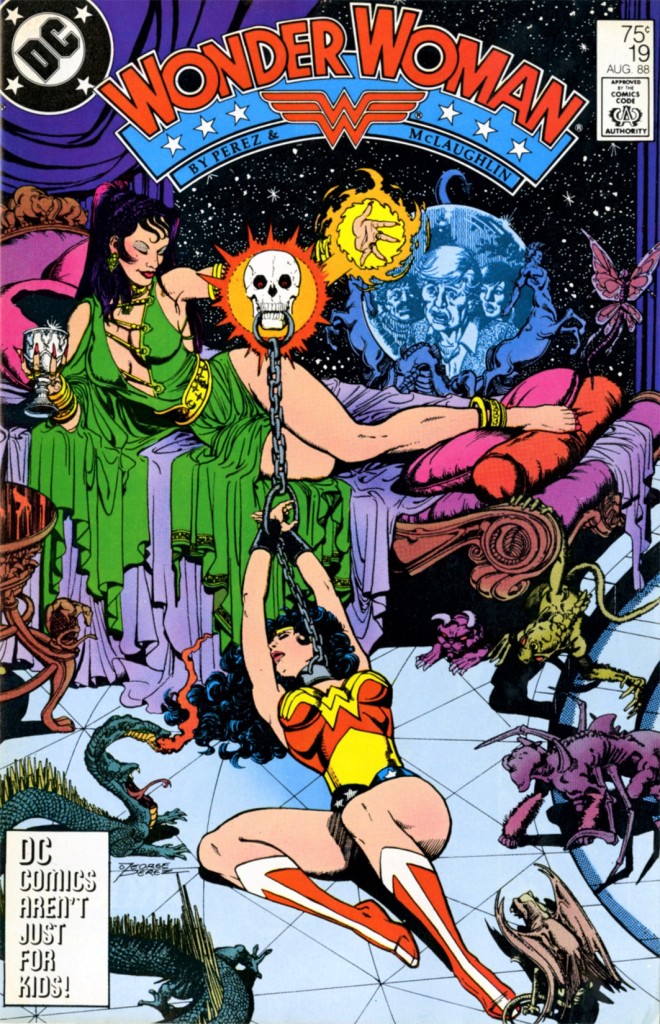
The cover.

Early story

The story begins with a short look back at the end of issue #18 which saw Wonder Woman fighting several monsters that surrounded her. Suddenly a powerful blast hits her and knocks her out.

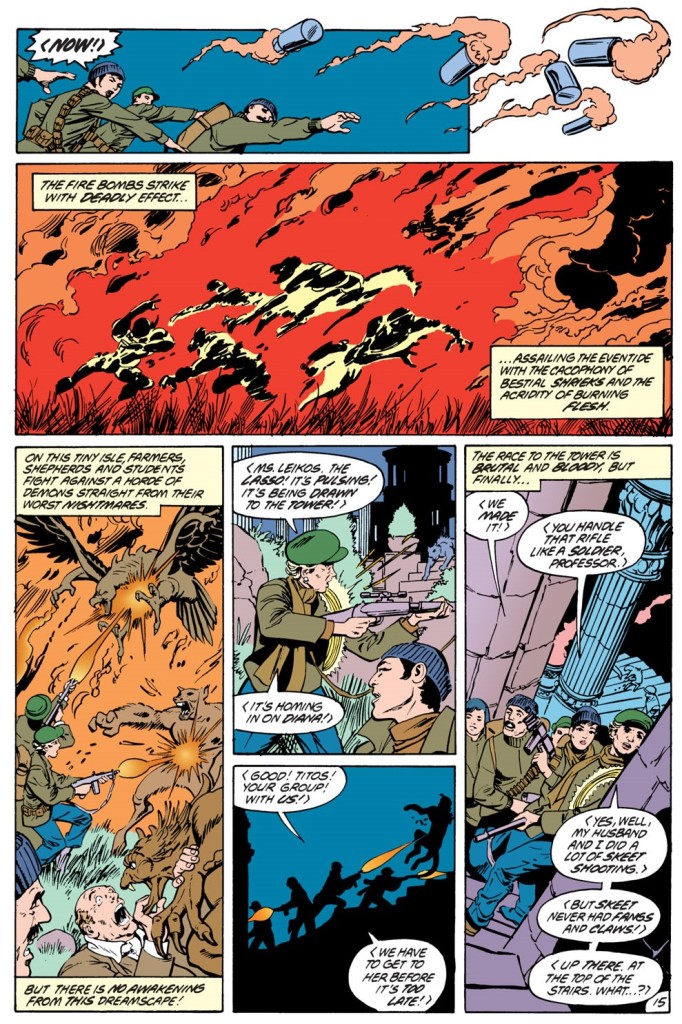
Vanessa, who survived thanks to Wonder Woman’s help, is found by her mom Julie who was accompanied by several armed Greeks. Vanessa states that the scroll she got from her uncle Stavros seemed to attract the monsters which drew a response from local rebel Katina Leikos who belongs to a group that oppose the fabled witch on the nearby island. She states that if they don’t stop the witch, she will destroy princess Diana/Wonder Woman.

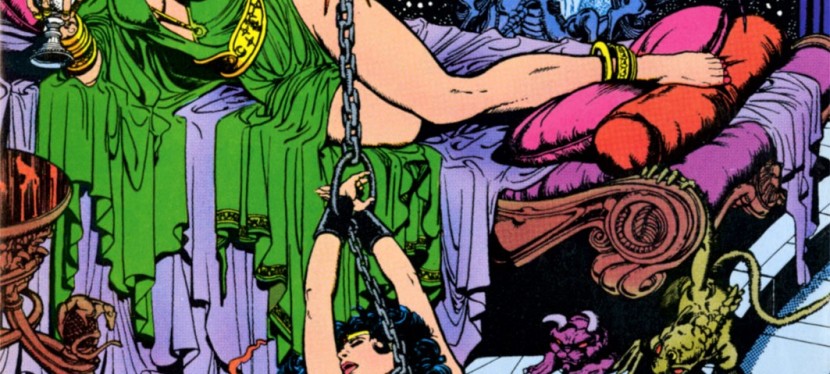
Inside the old structure on the said island, Wonder Woman wakes up finding herself on the floor chained by the neck and wrists. Located very near her is Circe, the enchantress who is the daughter of Hyperion and Perseis. The enchantress tells Wonder Woman that it is her destiny to execute her…

Quality

Julia Kapatelis is more involved with the action and mission.

Of all the comic books that I’ve reviewed so far on this particular monthly series in the post-Crisis era, this one is easily the darkest and most grim Wonder Woman story. It also has the heaviest emphasis on monsters and sorcery, complete with sinister rituals and connections to Greek mythology.

As expected, the story here further develops Wonder Woman and her place in man’s world but with emphasis on destiny and legacies. In this case, destiny related to the shared history between Wonder Woman’s fellow Amazons and Circe (who is DC Comics’ own take on the false Greek goddess) which puts the superhero icon in a rather complex situation. For Circe, Wonder Woman’s innocence means nothing because destiny and hatred matter a lot more. The way George Perez wrote, Circe in this particular issue proved to be more menacing than Ares and is also the most sinister villain of Wonder Woman’s.

More on this comic book, I can declare that it is right here where you will get to see the Queen of Superheroes in her most vulnerable and most helpless state yet. For several pages, you will see Wonder Woman struggle not only against Circe and her monsters, but also with the revelations of history. You will also get to see Wonder Woman’s emotional limits pushed.

Regarding the supporting cast, I really enjoyed seeing Julie Kapatelis really putting her academic skills and expertise to great use as well as getting involved in the action. With her Greek heritage and connections with the locals clearly defined, Julie got a good amount of the spotlight among the characters and nicely contributed to the story. I also love the part when Julie said that Diana (Wonder Woman) is like a daughter to her which really emphasize the bond of love and trust between them.

Conclusion

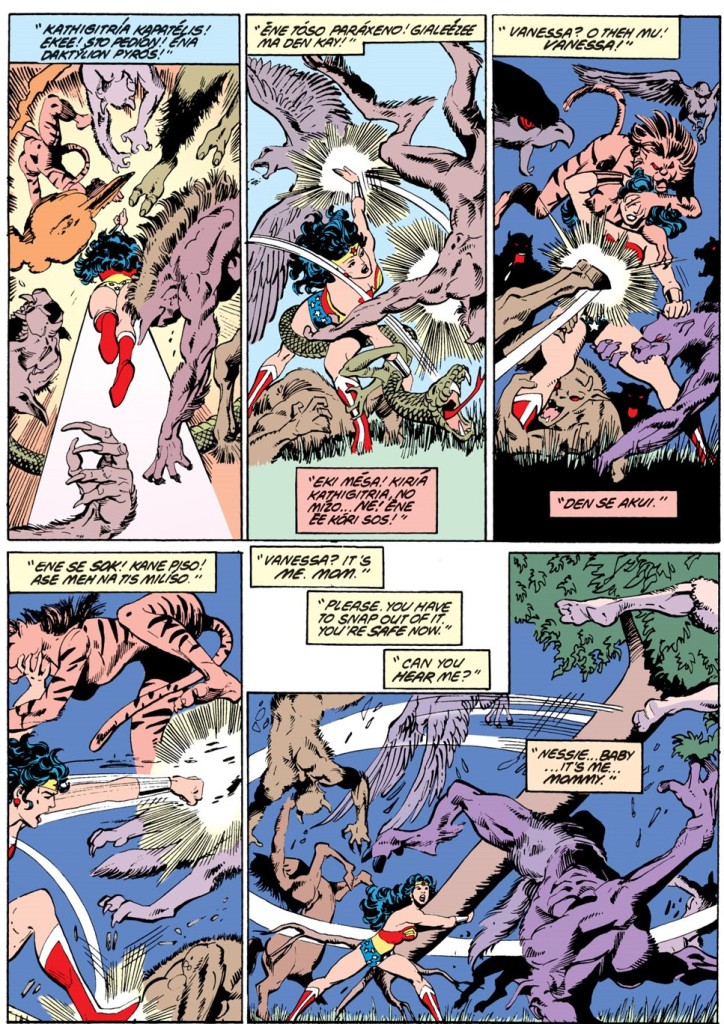
Wonder Woman bravely fights the monsters of Circe.

As far as the visit in Greece goes, Wonder Woman (1988) really ramped up the stakes with Circe’s evil presence emphasized a lot while having Wonder Woman in a vulnerable state which added to her character development in this particular monthly series. It is indeed a very well written tale by Perez who proved to be capable of pushing the boundaries while redefining Wonder Woman in the post-Crisis era. Apart from being the most sinister villain in this monthly series so far, Circe is the complete opposite of Wonder Woman.

If you are seriously planning to buy an existing hard copy of Wonder Woman (1988), be aware that as of this writing, MileHighComics.com shows that the near-mint copy of the regular edition costs $42 while the near-mint copy of the newsstand edition costs $44.

Overall, Wonder Woman (1988) is highly recommended!

+++++

Thank you for reading. If you find this article engaging, please click the like button below and also please consider sharing this article to others. If you are looking for a copywriter to create content for your special project or business, check out my services and my portfolio. Feel free to contact me as well. Also please feel free to visit my Facebook page Author Carlo Carrasco and follow me at HavenorFantasy@twitter.com

A Look Back at Wonder Woman #1 (1987)

Disclaimer: This is my original work with details sourced from reading the comic book and doing personal research. Anyone who wants to use this article, in part or in whole, needs to secure first my permission and agree to cite me as the source and author. Let it be known that any unauthorized use of this article will constrain the author to pursue the remedies under R.A. No. 8293, the Revised Penal Code, and/or all applicable legal actions under the laws of the Philippines.

Hey Wonder Woman and superhero fans! By now, many of you are aware that I wrote and published several retro comic book reviews about the Post-Crisis Wonder Woman specifically the comic books that involved the legendary George Perez, Greg Potter and the late Len Wein. For today, I’ll be reviewing Wonder Woman (1987), the landmark comic book that marked the start of what was back then the new age of greatness of Wonder Woman, the Queen of all Superheroes!

Before starting my review, let’s take a short look back at the publishing history with the online research I did.

In the mid-1980s, DC Comics published the maxi-series Crisis on Infinite Earths to not only celebrate their 50th anniversary but also to conclude what was the original multi-verse (multiple universes) of the publisher. Written by Marv Wolfman and drawn by George Perez, Crisis on Infinte Earths became critically acclaimed and a major seller as the saga saw the deaths of hundreds of characters, destruction of worlds and ultimately paved the way for DC Comics to reboot their superhero universe entirely.

And then the post-Crisis era of DC Comics happened. After Superman and Batman were successfully reintroduced, the Queen of all Superheroes herself – Wonder Woman – was up for a relaunch.

While detailed descriptions about what happened behind the scenes at DC Comics regarding the Wonder Woman reboot have been published, writer Greg Potter himself made some clarifications to set the record straight. For all of you readers and Wonder Woman fans, posted below is Potter’s clarification published with his permission.


The ideas for the rebooted Wonder Woman did not start with brainstorming between Janice Race and me. Having recently finished my Jemm Son of Saturn series, I was approached at a comic con in Chicago by Dick Giordano. He asked if I would like to submit a proposal for a rebooted Wonder Woman series. I sent him my ideas and he approved them. Dick then assigned Janice to the book (she had been my editor on Jemm) and I began writing the script for issue number one. It was after that that George walked into Janice’s office and offered his services as illustrator with a proviso that he also had a hand in plotting the stories.

Janice accepted and George and I subsequently met in her office to discuss our working relationship going forward. George and I agreed that the focus of the character would be her identity as an Amazon who’d lived in the Ancient Greek tradition and knew little about the outside world. I knew a great deal about Greek mythology but George knew even more. He supplied me with a book on the Greek gods that was extremely helpful in writing the first book. I in turn supplied him with many photos of Boston (I once had lived there) which he used in his artwork to make the backgrounds authentic.

It was a wonderful collaboration and made for a great introduction to the new Diana.


Eventually George Perez got involved in the creative process at DC. The famed illustrator and Potter worked closely on reintroducing Wonder Woman with an established identity and a rich cultural background. Indeed, something special transpired before the first issue got published.

“That was the background of the Wonder Woman character, which I felt was also the thing that made her unique as a character, and I thought that it had been downplayed in order to make her more of a standard superhero,” Perez stated.

Perez and Potter were co-writers. Perez himself conducted research on mythology which served as the foundation of the fantasy element of the planed post-Crisis Wonder Woman monthly series. This involved portrayals of deities of Olympus whose acts affect the Amazons living in the flesh. Apart from the fantasy and mythology, Perez implemented some key elements (specifically involving feminism and humanism) thanks to his discussion with Wonder Woman editor Karen Berger.

“A lot of research went into this first issue, and my bookshelves are full of reference material on mythology, Greek hairstyles, armor, clothing and even attitudes of the time. Some compromises were made where different references contradicted each other, but no decision was made without thought. We all have fallen in love with this project and want everyone to share in our excitement,” Perez wrote in the introduction in Wonder Woman (1987).

Now that the history lesson is over, we can now all take a look back at Wonder Woman , published in 1987 by DC Comics with a story co-written by Greg Potter and George Perez. The art was done by Perez supported by the ink work of Bruce Patterson.

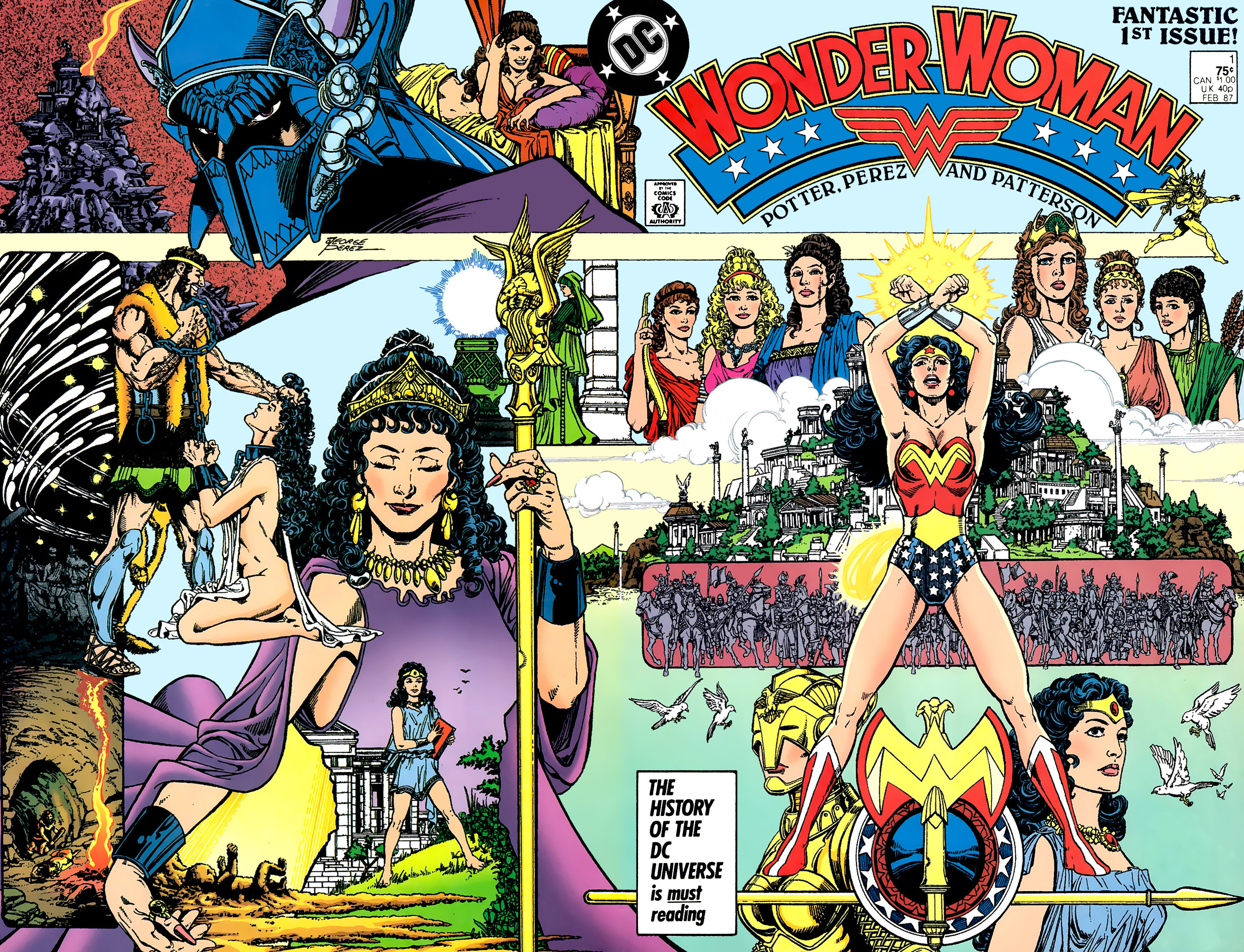
Cover
A very magnificent looking cover by George Perez.

Early story

The story begins in the distant past of 30,000 B.C. Inside a cave, a man hits a pregnant woman’s head with his club instantly killing her and the unborn child.

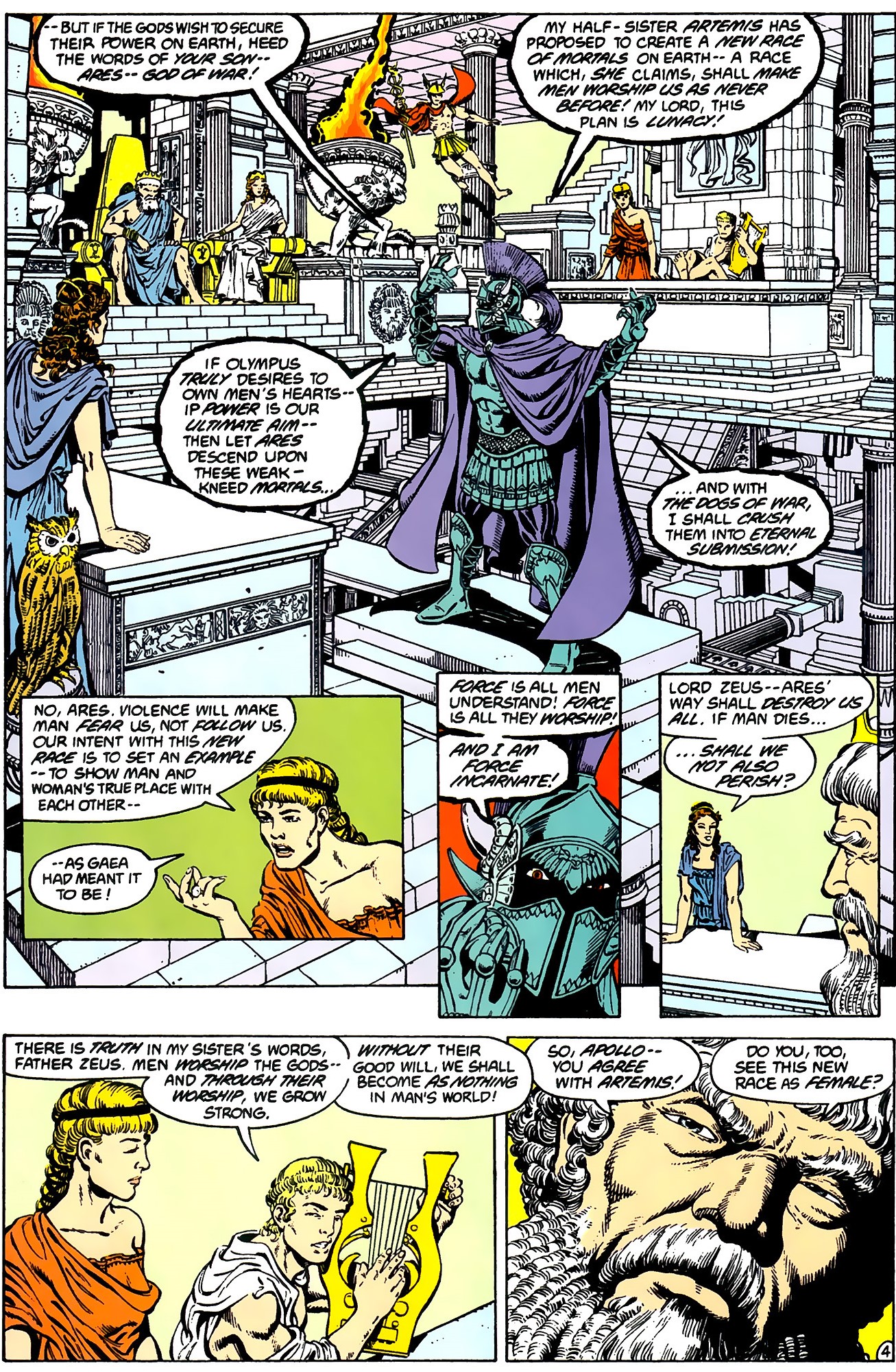
In 1,200 B.C. at Mount Olympus, the god of war Ares tells his father Zeus (with the presence of other deities watching) that if Olympus truly desires to own the hearts of men and gain power, they should let him descend upon mortals. Ares views the mortals as weak and stressed that he could crush them all into eternal submission.

But Artemis (Ares’ half-sister), whose plan to create a new race of mortals on Earth was vehemently opposed by the god of war, responded by stressing that violence will make men fear them and not follow them. She stressed that the intention behind the plan was to set an example by showing man and woman’s true place with each other. The new race of mortals was planned to be female. Zeus, who is aware of the plan, leaves and tells the others to settle the plan among themselves. For his part, Ares leaves Olympus laughing.

With the many souls stuck in limbo for generations available to them, the deities Aphrodite, Artemis, Athena, Hestia and Demeter create the Amazons who appeared with adult bodies. The first to come out among them all was Hippolyte, the mother of Diana/Wonder Woman. In the presence of the many Amazons, Hippolyte was declared queen by the deities…

Quality

27
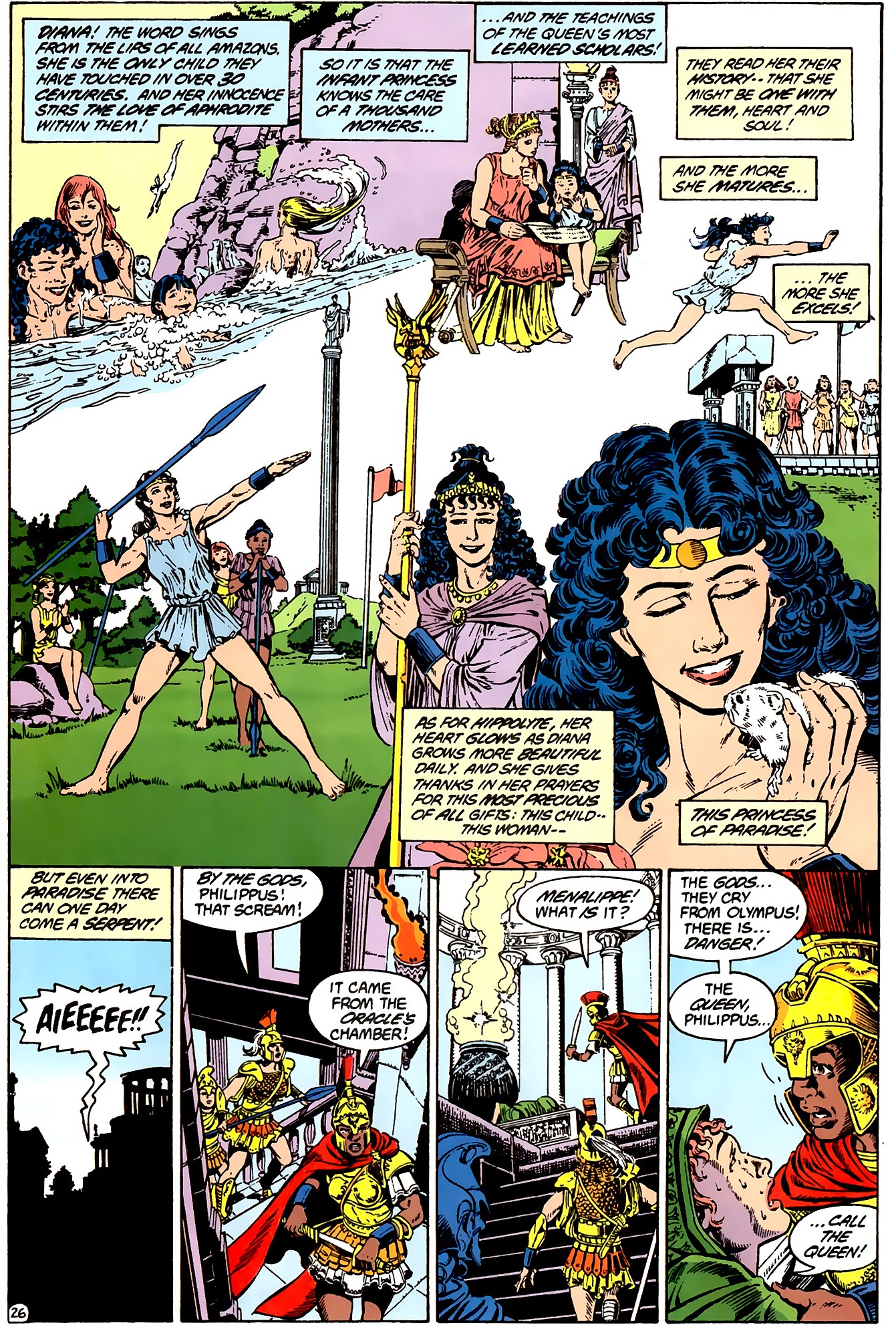
Diana was the only child to grow up with the Amazons.

When it comes to quality of storytelling, art, characterization and spectacle, Wonder Woman is unquestionably an excellent comic book even by today’s standards! For the story, Greg Potter and George Perez crafted an epic fantasy tale retelling the origin of not only Wonder Woman but also of the Amazons complete with a very inspired portrayal of the deities of Olympus who actions and decisions affect the mortals. I should mention here that the portrayal of the mother-and-daughter relationship between Queen Hippolyte and Princess Diana really was compelling to see. Not only that, there were also elements of gender conflict, intrigue and worship portrayed.

It is clear that Perez really studied mythology and Greek culture to create a story that is still believable when it comes to emphasizing Wonder Woman for what was back then the modern readers of 1987 from the superhero geeks to long-time Wonder Woman fans and to girls and women in general. More than that, this story is timeless and clearly it is an illustrated literature classic on its own right.

24
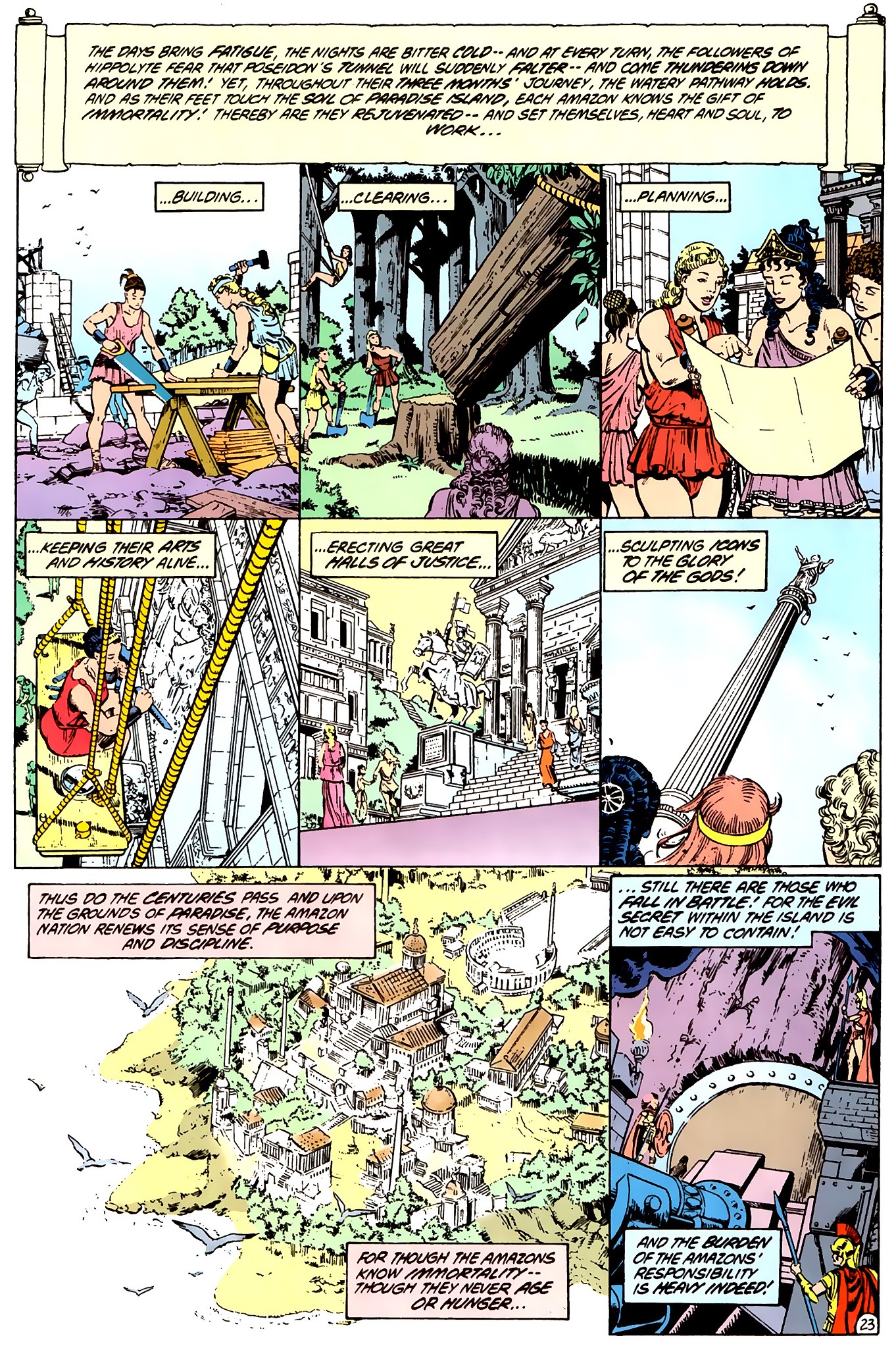
This is how the Amazons built their society in Themyscira.

The comic book has over thirty pages of story and art, with the pace ranging from medium to fast. As such, it managed to completely tell the stories of the Amazons and Princess Diana in just one comic book. By the time I finished this comic book, I got enlightened about the background of the Amazons and Wonder Woman herself.

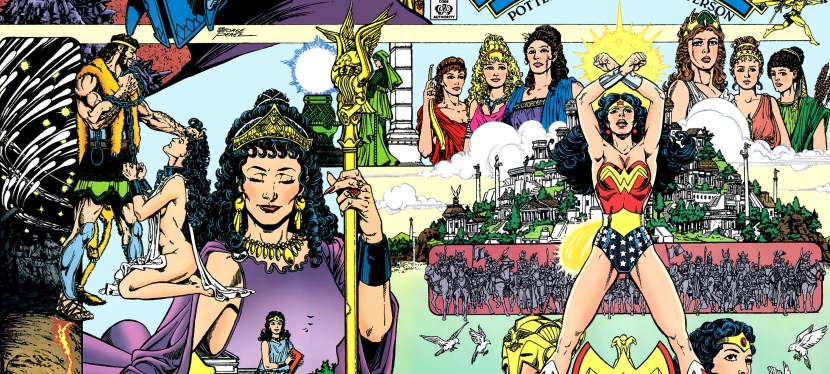
When it comes to the art, each and every page of Wonder Woman is very beautifully drawn by George Perez. His research on Greek culture and mythology is nicely reflected in his drawings. Just look at how he visualizes Olympus, the armor worn by soldiers, the clothes, the hairstyles, the coliseum, the architecture and more complete with a good amount of details visualized. The final page Perez drew remains very stunning, inspiring and heroic!

Conclusion

5
The deities of Olympus.

There is no doubt in my mind that Wonder Woman of 1987 is truly one of the greatest superhero comic books ever published. The creative team succeeded in not only reintroducing Wonder Woman, her people and their part in the post-Crisis DC Comics universe, they also succeeded in modernizing them as well as dramatizing their origins altogether within the 32 pages of this comic book.

While it is a fact that a lot of people nowadays are highly familiar with the cinematic Wonder Woman (memorably played by Gal Gadot), for me the post-Crisis version of the Queen of Superheroes remains the definitive version and I can only wish that director Patty Jenkins would adapt more elements from this. It should be noted that this particular rebooted Wonder Woman is believable and can be taken more seriously among all superheroes.

If you are seriously planning to buy an existing hard copy of Wonder Woman (1987), be aware that as of this writing, MileHighComics.com shows that the near-mint copy of the regular edition costs $51. The near-mint copies of the newsstand edition and the edition without a month printed cost$102 and $153 respectively.

Overall, Wonder Woman (1987) is highly recommended! 


Thank you for reading. If you find this article engaging, please click the like button below and also please consider sharing this article to others. If you are looking for a copywriter to create content for your special project or business, check out my services and my portfolio. Feel free to contact me as well. Also please feel free to visit my Facebook page Author Carlo Carrasco and follow me at HavenorFantasy@twitter.com

A Look Back at Wonder Woman #2 (1987)

Disclaimer: This is my original work with details sourced from reading the comic book and doing personal research. Anyone who wants to use this article, in part or in whole, needs to secure first my permission and agree to cite me as the source and author. Let it be known that any unauthorized use of this article will constrain the author to pursue the remedies under R.A. No. 8293, the Revised Penal Code, and/or all applicable legal actions under the laws of the Philippines.

After the end of publishing their landmark maxi-series Crisis on Infinite Earths, DC Comics gained an all-new slate to literally fill up by rebooting their entire superhero comics universe. They started the new universe (now referred to as the Post-Crisis Universe) with Superman, Batman and some others.

Then in late 1986, DC Comics reintroduced the post-Crisis version of Wonder Woman creatively led by the legendary George Perez (who was assisted by writer Greg Potter) with the release of the comic book Wonder Woman (cover dated February 1987). That particular comic book retold (in great detail with Greek mythology) the origin of the Amazons who were reincarnated women (the souls of which came from women whose deaths were caused by men). The Amazons and Hippolyta (Hippolyte in this comic book) eventually got betrayed by Heracles and his men leading to a period of tremendous hardship. Beatings were obvious and rape was implied.

After getting freed, they are sent to the island of Themyscira. It was there when Hippolyta learned that she died previously as a pregnant woman. Using the clay of the island, the Amazons’ queen formed an infant girl. Then after communicating with the midwives in the spiritual realm, the soul of Hippolyta’ unborn daughter arrived into the clay child. This marked the birth of Princess Diana who would become Wonder Woman. For the newcomers reading this, Diana is the only Amazon who grew up from child to adult in Themyscira.

Right here is my retro comic book review of Wonder Woman published in 1987 by DC Comics with the story done by George Perez and Greg Potter. The art was done by Perez.

Cover
Cover drawn by George Perez. 

Early story

The story begins in man’s world, at an American military base. Colonel Steve Trevor meets with his superior General Kohler who tells him that he has been chosen for a special mission which involves the use a new, modified fighter plane. Steve reacted that the coordinated provided lead to nothing out there. The general instructs him to shut his mouth and do what he was ordered to do.

In Themyscira, Princess Diana is set to start her first-ever mission as Wonder Woman. Her mission pits her against a god gone mad, and her mother Hippolyta and the Amazons are deeply concerned. Suddenly, the Lasso of Truth from Olympus arrives which Diana picks up. Immediately after that, the messenger of the gods Hermes arrives marking the first time in centuries that any Amazon saw him.

45

After a brief talk, Diana travels away with Hermes who could only guide her. They disappeared suddenly surprising the Amazons and Hippolyta who was not given an opportunity to bid farewell to her daughter.

Quality

As expected, Wonder Woman has great qualities with regards to storytelling, characterization and artwork. With Greg Potter assisting George Perez, this comic book told not one but three story arcs each with a good amount of details and, amazingly, such stories were told rather efficiently complete with very believable dialogue. I’m talking about impressive writings and descriptions of the characters, apart from Wonder Woman herself, that include the Amazons, the gods and goddesses of Olympus and the American military.

The story also comes with a very nice touch of discovery which readers can easily relate with through Wonder Woman. As Diana develops and learns more, the reader gets connected with her even more. This is the Queen of Superheroes I’m talking about and the writing is truly excellent.

At the same time, continuing with what was first presented in Wonder Woman , this comic book also explores how much of a threat Ares (god of war) truly is not only to Wonder Woman and her Amazons but also on people in man’s world. The build-up of the tension is really nice and the pay-off is worth it.

Unsurprisingly, this comic book has great looking art. It’s done by George Perez after all supported with ink work by Bruce Patterson. Perez knows how to dramatize characters, pull of amazing shots of action and other forms of spectacle, and most of all, illustrate the very visual elements of Greek mythology complete with other visual concepts of the fantasy genre.

Conclusion

As it is clear it is not the launch issue of its monthly series, Wonder Woman is still very significant as it marks the first-ever mission of Wonder Woman in the post-Crisis universe of DC Comics and also her first encounter with a modernized (for the 1980s specifically) Steve Trevor. Remember the first time Diana and Steve met in 2017 Wonder Woman movie? Remember how Wonder Woman reacted to see a mortal man for the first time ever as played by Gal Gadot and Chris Pine on the big screen? You will see some common elements between the film and this comic book about the two characters. Even the Amazons’ reaction to Steve alone makes this comic book worth reading and it should encourage readers to go back to first issue to understand the details about the Amazons’ culture and mindset.

10
Heavy inspiration about Greek mythology, culture and arts is evident not only in the artwork by Perez but also on the script itself.

If you are seriously considering acquiring an existing copy of Wonder Woman , be aware that according to MileHighComics.com as of this writing, a near-mint copy of the regular edition costs $24, while a near-mint copy of the newsstand edition costs $49. As for the other edition that does not have a month printed on the cover, a near-mint copy costs $77.

Overall, Wonder Woman (1987) is highly recommended!


Thank you for reading. If you find this article engaging, please click the like button below and also please consider sharing this article to others. If you are looking for a copywriter to create content for your special project or business, check out my services and my portfolio. Feel free to contact me as well. Also please feel free to visit my Facebook page Author Carlo Carrasco and follow me at HavenorFantasy@twitter.com