A Look Back at Amazing Spider-Man #258 (1984)

Welcome back superhero enthusiasts, 1980s arts and culture enthusiasts, Marvel Comics fans and comic book collectors! Today we go back to the year 1984 to examine a small part of the Marvel Comics universe through a tale of the Amazing Spider-Man monthly series.

In my previous retro review, Puma had encountered Spider-Man not once but twice. During the first encounter, Black Cat got in the way to defend her beloved webslinger. A short time later, Mary Jane Watson gets involved unexpectedly and the story ended with something that struck Peter Parker very deep inside.

With those details laid down, here is a look back at Amazing Spider-Man , published in 1984 by Marvel Comics with a story written by Tom DeFalco and drawn by Ron Frenz.
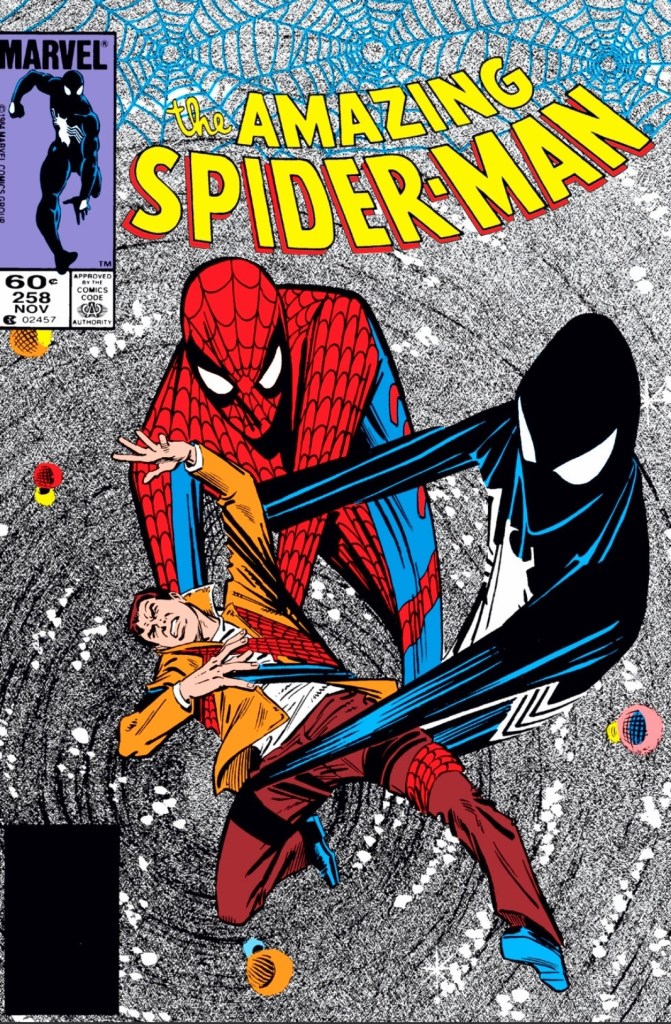
The cover.

Early story

The story begins inside Peter Parker’s apartment in New York City. He is struggling deep inside as he is shocked by Mary Jane’s revelation that she knows he and Spider-Man are one and the same person. She tells him that she knew his secret for years. Peter then begins to think that this is all Puma’s fault.

As Mary Jane begins to leave, Peter tries to talk with her. She tells him that he will deny everything and that she cares about him. She added that knowing his secret identity is why she originally left New York. She had to get away from him (and Spider-Man).

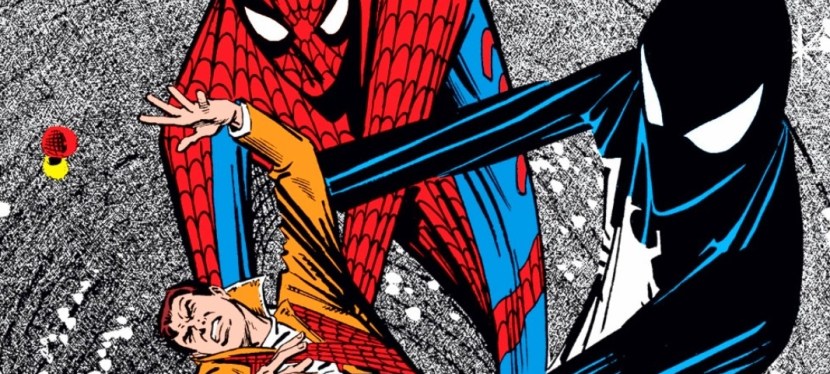
Suddenly, Black Cat arrives through the window. Her presence causes Mary Jane to realize something about them…

Quality

Very clearly the alien costume has its own intelligence and is the main reason why Peter Parker remained exhausted and sleeping too long.

I really like the writing of this comic book. Tom DeFalco showed strong consistency with developing the newcomer (and a formidable foe) Puma and his rivalry with Spider-Man, while also leaving sufficient room to develop Peter Parker who is now in deeper stress dealing with the complexities of his connections with Mary Jane and Black Cat.

What is most notable about the plot is the finally crafted resolution to Peter Parker’s use of the alien costume (the symbiote from Secret Wars that would later bond with Eddie Brock to form the murderous Venom) by having the Reed Richards and Johnny Storm of the Fantastic Four involved in a captivating manner. I won’t reveal what happened but I can assure you readers that this particular plot element alone makes this comic book very worthy of your time and attention. That being said, Spider-Man’s saga took a serious turn from here.

As with the previous issues, Ron Frenz’s fine art really brought DeFalco’s script into life here and this includes Spider-Man’s crossover with the mentioned Fantastic Four members, dynamic shots of the webslinger and fine dramatic expressions on characters’ faces.

Conclusion

With Black Cat and Mary Jane both present with Peter Parker, the tension and uncertainty grew only stronger.

Amazing Spider-Man (1984) is yet another great read from the DeFalco-Frenz duo. The stakes were raised higher and the pay-offs were really solid in this comic book. As mentioned earlier, this story marked the resolution of Spider-Man’s bond with the alien costume, and also paved a new path for future tales of the webslinger. Spider-Man’s crossover with Reed Richards and the Human Torch (which lasted several pages) is easily one of most crucial scenes of entire Marvel Comics stories of the year 1984 and its significance would be realized in relation to the origin and further tales of Venom.

Overall, Amazing Spider-Man (1984) is highly recommended.

+++++

Thank you for reading. If you find this article engaging, please click the like button below, share this article to others and also please consider making a donation to support my publishing. If you are looking for a copywriter to create content for your special project or business, check out my services and my portfolio. Feel free to contact me with a private message. Also please feel free to visit my Facebook page Author Carlo Carrasco and follow me on Twitter at  @HavenorFantasy as well as on Tumblr at https://carlocarrasco.tumblr.com/ and on Instagram at https://www.instagram.com/authorcarlocarrasco
A Look Back at What If #17 (1990)

Disclaimer: This is my original work with details sourced from reading the comic book and doing personal research. Anyone who wants to use this article, in part or in whole, needs to secure first my permission and agree to cite me as the source and author. Let it be known that any unauthorized use of this article will constrain the author to pursue the remedies under R.A. No. 8293, the Revised Penal Code, and/or all applicable legal actions under the laws of the Philippines.

Welcome back superhero enthusiasts, 1990s arts and culture enthusiasts, Marvel Comics fans and comic book collectors! Today we go back to the year 1993 and explore a part of Marvel Comics’ universe through the reimagined tales emphasized in the What If monthly series.

Several years ago, I bought myself a trade paperback collection of the 1987 Spider-Man storyline Kraven’s Last Hunt written by J. M. DeMatteis and drawn by Mike Zeck. That particular storyline was very notable not just for its dark approach to storytelling and visualization, but it also explores what would happen had Spider-Man been defeated and someone very obsessed took his place and go on a rampage disguised as Spider-Man. The storyline also explored how Kraven perceived Spider-Man without ever knowing the defining traits of the man behind the mask – Peter Parker. Eventually, Marvel Comic went on to revisit Kraven’s Last Hunt and explored what would happen had Kraven actually killed Spider-Man through their What If? monthly comic book series.

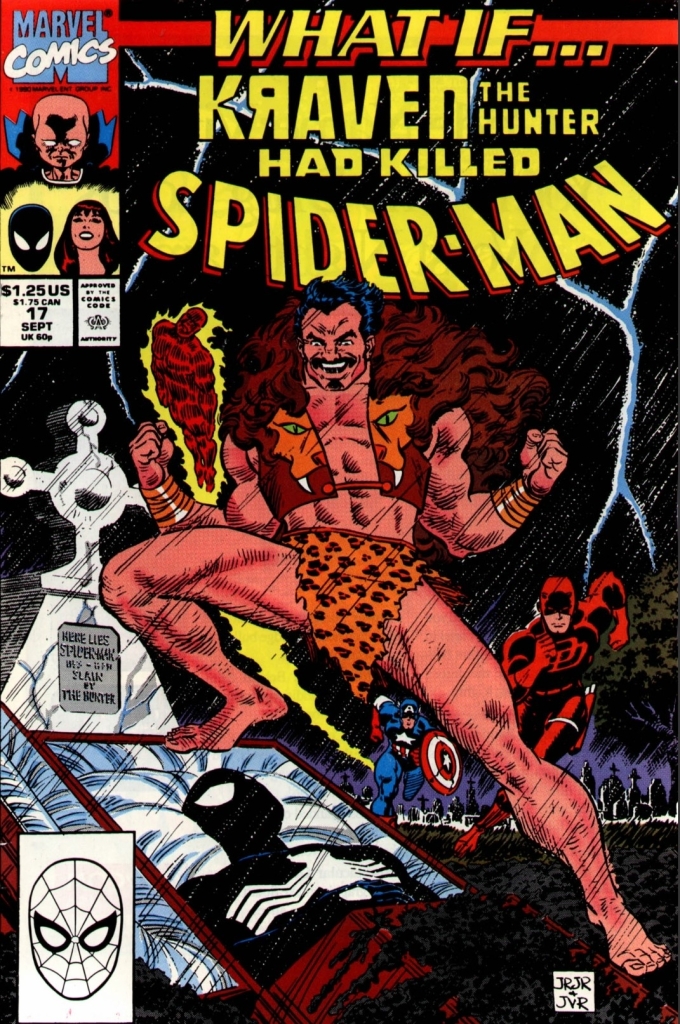
With those details laid down, here is a look back at What If , published in 1990 by Marvel Comics with a story written and drawn by Richard Howell.

The cover.

Early story

The story begins with the Watcher revisiting key moments from the Kraven’s Last Hunt storyline. History then takes a turn towards the unexplored when Kraven, armed with a gun, shoots and kills Spider-Man. As the dead webslinger lies in a coffin, Kraven celebrates his victory with a lot of passion believing that he struck back at what he perceives to be the meaninglessness of the world. Kraven is quite mad as he equates spiders with Spider-Man as well as the decline of civilization.

After fearlessly and grotesquely eating spiders, Kraven wears a black body tight costume that looks almost the same as that of Spider-Man’s. While he is victorious, Kraven is not satisfied and he becomes obsessed by becoming Spider-Man and prove himself superior to him. He then moves into the city whose people are familiar with Spider-Man and also are unprepared with who is coming to them.

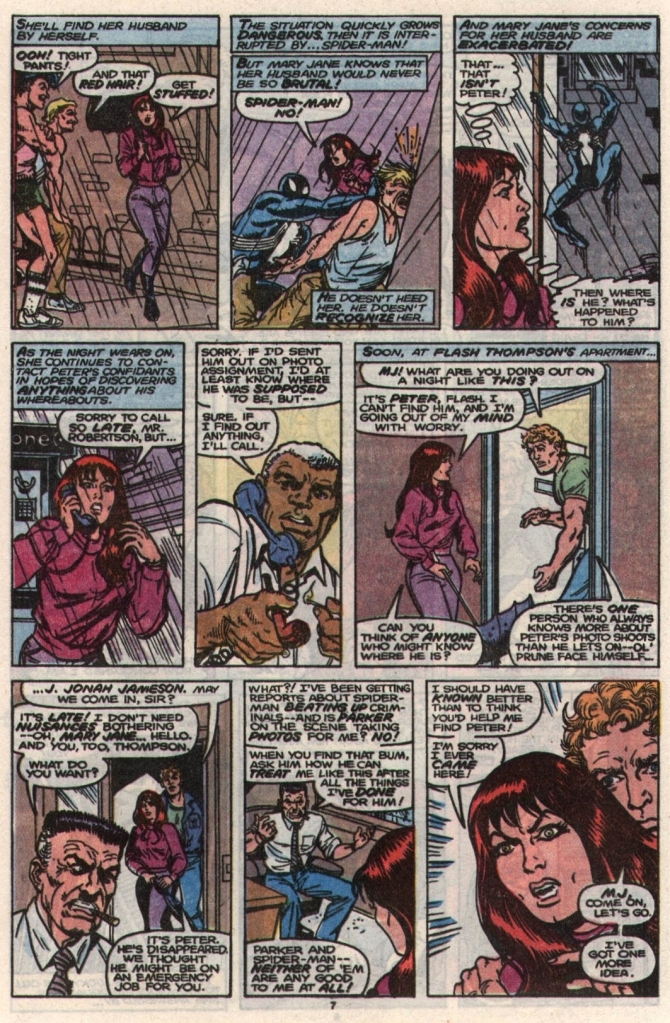
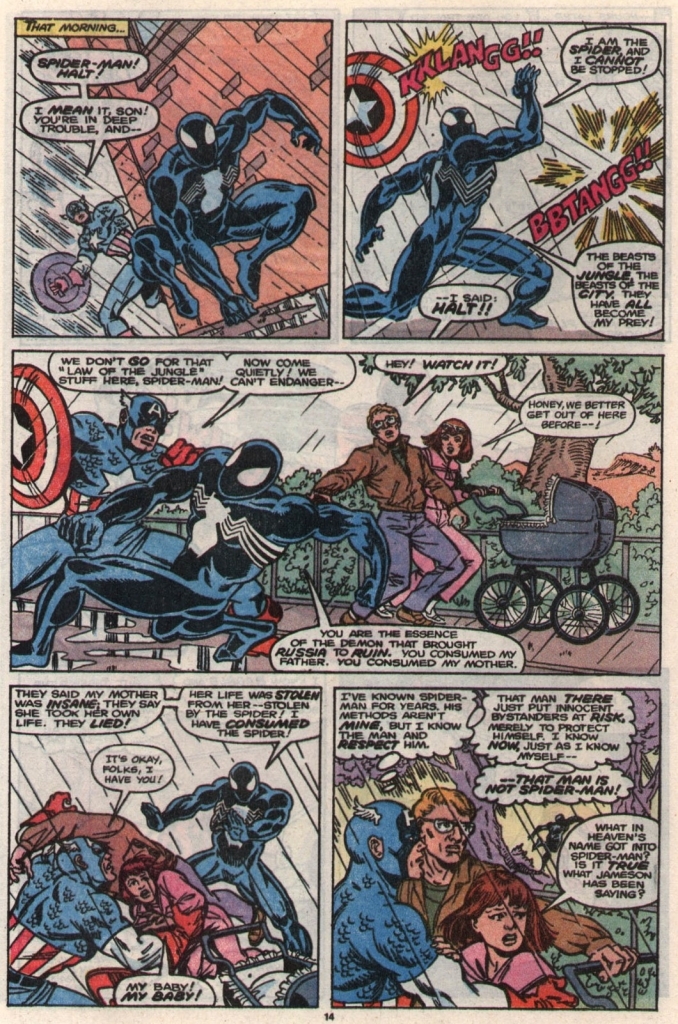
In an apartment, Spider-Man’s wife Mary Jane Parker is alone and worried. As she does not know that her beloved Peter Parker has been killed, she cannot help but agonize over the strain of his double-life as a civilian and as a superhero. Determined to find Peter, she walks out during the rainy night and is spotted by two men focused on her.

Suddenly the new Spider-Man (Kraven) appears and in an apparent effort to help Mary Jane, he grabs one of the men and brutally pushes the man’s head on to a nearby wall. As Kraven does not recognize Mary Jane, the wife realizes that the Spider-Man she just saw is definitely not her husband. This only makes her wonder again where he is and what happened to him. She then starts calling others for help…

Quality

In addition to being ruthless, Kraven disguised as Spider-Man resembles Venom.

I’ll start with the visuals. This comic book took a serious effort to come close to capturing the look and visual tone of the Kraven’s Last Hunt storyline which I enjoyed. Richard Howell visualized the characters, the situations and details properly and there was not a single moment when the visuals overwhelmed the narrative. Howell’s artistic take on the characters is simplistic but they remain recognizable which is a plus. The superhero spectacle was presented with a clear and clean approach, and there were a few key moments of action that got highlighted with some dynamism.

As for the story itself, what I found surprising and also pleasant here was the presentation of Mary Jane Parker as the main character instead of Kraven. This makes sense as Kraven himself was the major attraction of the Kraven’s Last Hunt storyline while Spider-Man was out of commission. In the context of this What If story, it only made sense to have Mary Jane as the central figure. Going back to Kraven, Howell captured the essence of the character well when compared to his version in Kraven’s Last Hunt.

In terms of plotting, telling the story through the viewpoint and actions of the superhero’s concerned wife really works well. Without spoiling the plot, you will see Mary Jane get involved with three notable superheroes – including the iconic Captain America – and even with other notable Spider-Man supporting characters such as Flash Thompson and the irresponsible print media figure J. Jonah Jameson. Interactions aside, the plot works sufficiently as a couple of series of events take place before the big confrontation with Kraven (as the new Spider-Man). By the end of it all, I can say that the story is entertaining, engaging and intriguing to read.

Conclusion

Mary Jane Parker goes out in pursuit of her husband Peter Parker/Spider-Man who happens to be dead already at this particular point of the story.

I can say that What If (1990) is pretty captivating read and it is a worthy literary companion to Kraven’s Last Hunt. Of course, to really enjoy this alternative tale cleverly told by Howell, you must read Kraven’s Last Hunt first. Otherwise, you would not feel the impact of this comic book very much. I also liked how the death of Spider-Man (note: Spider-Man got killed in another What If tale that itself is worth reading) impacts Mary Jane, how it impacts the superheroes who know him, and most notably how it impacts the fragile relationship between society and superheroes. Lastly, this comic book has one of the more significant portrayals of Spider-Man’s most beloved woman. This is indeed a great story.

Overall, What If (1990) is highly recommended!

+++++

Thank you for reading. If you find this article engaging, please click the like button below, share this article to others and also please consider making a donation to support my publishing. If you are looking for a copywriter to create content for your special project or business, check out my services and my portfolio. Feel free to contact me with a private message. Also please feel free to visit my Facebook page Author Carlo Carrasco and follow me on Twitter at  @HavenorFantasy as well as on Tumblr at https://carlocarrasco.tumblr.com/ and on Instagram at https://www.instagram.com/authorcarlocarrasco
A Look Back At Fantastic Four #375 (1993)

When it comes to cinema, Marvel’s Fantastic Four has yet to achieve greatness commercially and critically. Already four movies were made and the last one released in 2015 was so terrible, I felt that the Fantastic Four brand suffered.

Truly the best way to enjoy the stories of Fantastic Four is in the comic books with a long bridge connecting to its past. Through the decades no doubt. Like any other comic book series, Fantastic Four had its high points, low points as well the unusual or intriguing stuff.

Today we take a close look at Fantastic Four .

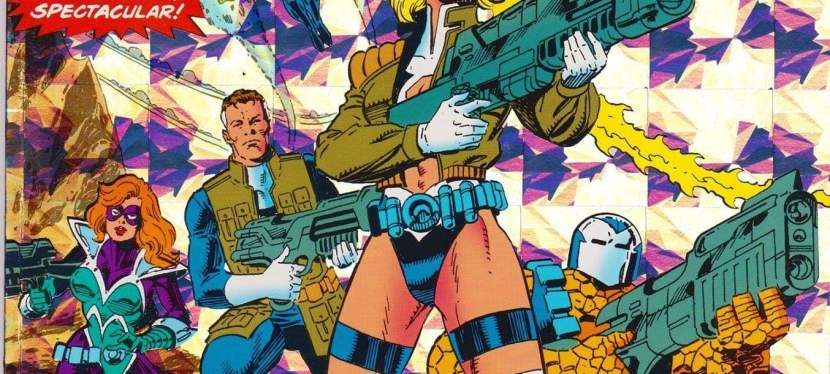
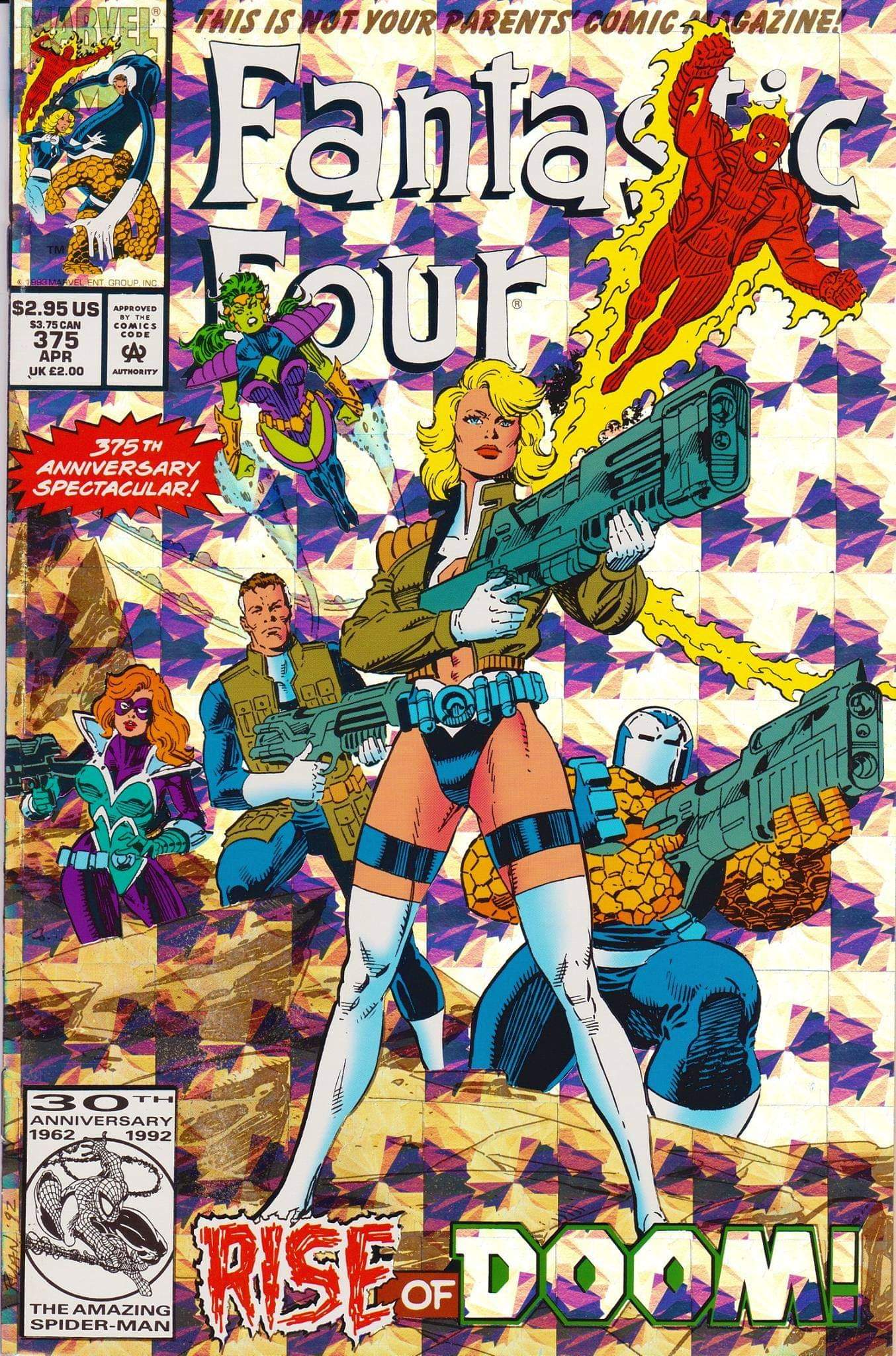
Released in 1993 by Marvel Comics at a prize of $2.95, Fantastic Four came with a foil cover which shines under direct light. The gimmick cover, which was part of the trend of the 1990s, had that “Bling!” visual effect when the brightest light is used on it.

Written by Tom DeFalco and drawn by Paul Ryan, the comic book follows the Fantastic Four with Lyja and Sharon who find themselves suddenly transported into space inside a facility with Uatu, the Watcher. They learned from Uata that their mortal enemy Doctor Doom usurped the power of a renegade Watcher called Aron. Uatu expressed that Doom has grown into a greater threat.

The Fantastic Four and their companions split up in an attempt to find Doom before it is too late.

Storywise, the splitting of the protagonists allowed some notable character development moments to happen. I liked the scene wherein Sharon tries to comfort Ben (The Thing) whose solid face got damaged by Wolverine during a very recent encounter (told in Fantastic Four ) which makes him vulnerable to excruciating pain when he gets hit on the soft spots. Johnny Storm meanwhile deals with the Skrull woman Lyja whom he has a conflict with. And then there is Reed Richards with wife Sue struggling with some issues as they work together.

Sue said to Richard: I can’t believe that you allowed the Watcher to buffalo you into fighting his battle especially since Johnny is still wanted by the police back on Earth!

When they finally confront Doom, there was this division between them.

Richard: Susan! We must protect the optimizer at all costs!

Sue: Then you guard it! If he’s hurt my brother, Doom is mine!

When it comes to quality, the story can be hard to grasp if you missed out on the previous issues. This was because the conflicts between the characters clearly started from some time back. Also it was interesting to see the Inhumans in the mix.

On spectacle, there is a lot of action to satisfy readers. As this was released in 1993, the 1990s superhero trends were unsurprisingly present such as those large futuristic guns and excess pouches/pockets. While they do make sense in the context of the story, the use of guns by key members of the Fantastic Four (which is reflective of the decade of the comic book’s release) can be alienating to any Fantastic Four fan who has gotten used to seeing the team NOT using such weapons.

Artist Paul Ryan, for the most part, delivered serviceable visuals and clearly tried his best to add impact on the action scenes.

Overall, Fantastic Four delivers some temporary fun. Is it a very memorable Fantastic Four story? Absolutely not. Is it a must-read or a must-buy for new comic book collectors? Not really. In my opinion, the most engaging feature of the comic book is just its shiny cover. Once readers get past the cover and immerse themselves into the story, they won’t got much value in return other than temporary fun.

FB_IMG_1554473010319.jpg
The cover with the “Bling!” visual effect under bright light!

 If you find Fantastic Four at a bargain bin for less than $1, then it would be a good purchase. Don’t pay any higher than $1 for it.


Thank you for reading. If you find this article engaging, please click the like button below and also please consider sharing this article to others. Also my fantasy book The World of Havenor is still available in paperback and e-book format. If you are looking for a copywriter to create content for your special project or business, check out my services and my portfolio. Feel free to contact me as well. Also please feel free to visit my Facebook page Author Carlo Carrasco and follow me at HavenorFantasy@twitter.com