

Welcome back Xbox fans, geeks, retro gaming fans and other gamers!
If you are disappointed with modern console gaming and if you don’t like what the game makers are doing, retro gaming will restore the fun and help you forget about the disappointment.
When I was a very young boy, I saw Cloak & Dagger on home video. The movie – starring Henry Thomas and Dabney Coleman – was a thriller laced with Cold War elements, espionage and video gaming. In fact, the video game giant of the time – Atari – was involved in the movie production and their arcade game Cloak & Dagger appeared in the form of a fictional Atari 5200 game. Each time I saw the gameplay footage while watching the movie (read my retro review by clicking here), I was thrilled and always wanted to play it.
Finally, in 2024, I was able to play Cloak & Dagger on my Xbox Series X after purchasing the physical copy of Atari 50: The Anniversary Celebration. Since then, I’ve been replaying Cloak & Dagger a lot in the comfort home and it sure is challenging and fun.
To be clear, this is not a retro game review of Cloak & Dagger. Rather, it is a nostalgic close look at the Atari video game that happened to be featured in the 1984 movie which in turn was released on 4K Blu-ray in 2022. Combine that with the Atari 50 release also in 2022, the Cloak & Dagger game made a comeback in the retro gaming radars of many while also becoming available to play with on modern consoles and Windows PC.
Game design and gameplay
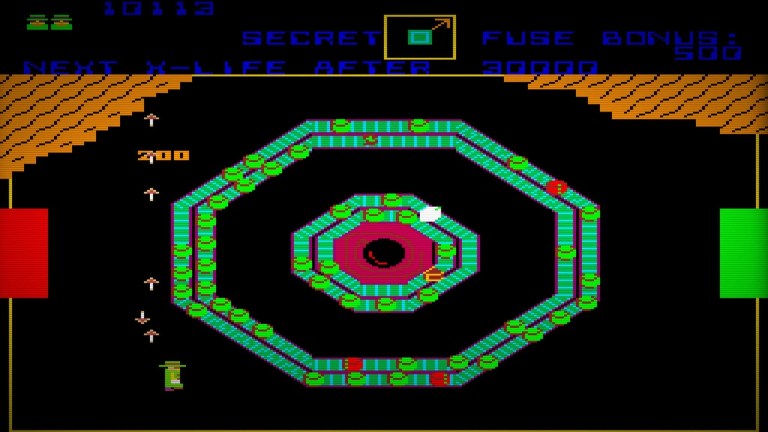
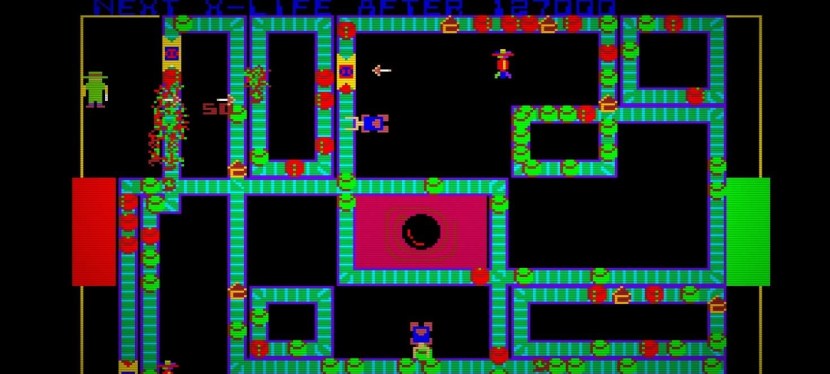
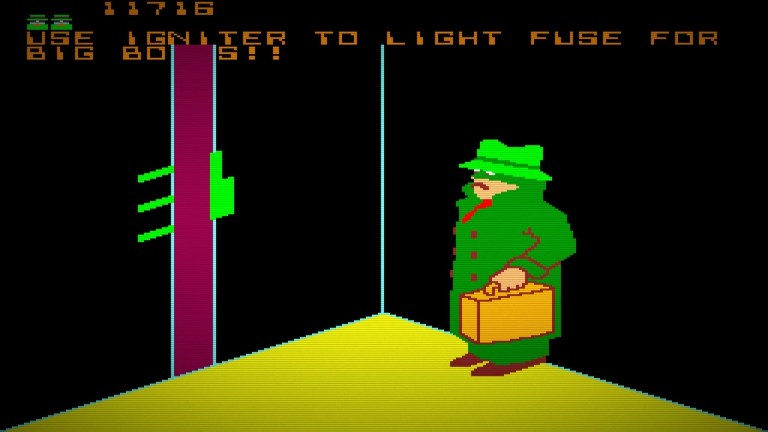
Developed by Atari for the arcade, Cloak & Dagger is a 2D multi-directional shooter in which you play Agent X (who appears wearing a hat, a mask and a coat) whose mission is to infiltrate the massive base of an enemy that goes very deep underground (33 levels/floors).
Each level the player enters require surviving obstacles and defeating (or avoiding) the enemies (robot guards are the most common opposition while the crawling eye occasionally appears) and then move to the other side of the level in order to get into another elevator to keep on descending. The ultimate goal is to reach the final level below to recover top secret plans from Dr. Boom (the main villain and the one responsible for stealing the said plans), destroy his underground bomb factory (which explains the existence of oversized bombs and many explosives on conveyor belts) and get out.
As registering high scores was the trend of video gaming back then, players will be rewarded with shooting at the enemies (example: robot guards are worth 50 points each when asleep or 200 points when awake, while the main villain Dr. Boom is worth 50,000 points) as well as interacting with in-game items such as the unarmed explosives (10 points when shot but worth 100 when collected), armed explosives (50 points each when destroyed) and mystery boxes (worth 200 to 1,800 points plus random effects on the player such as extra life, improved speed and even extra life). For every 30,000 points scored, the player will be granted an extra life. In many levels are gigantic bombs that players can ignite using the Fuse button for extra points.
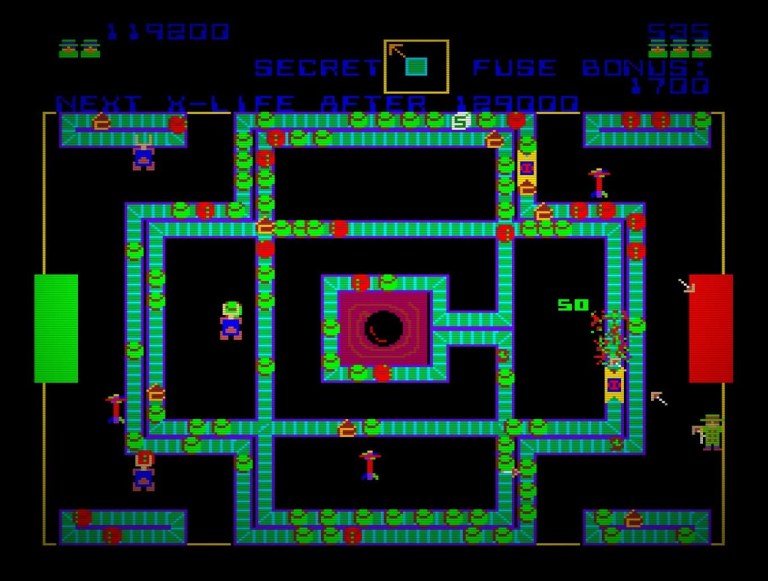
Other items players can collect are the extra boxes (resulting in extra life) and the secret maps (which partially reveal safe paths through each fourth level).
When it comes to the controls, Cloak & Dagger has a dual joystick (twin sticks) setup similar to Robotron 2084 and Smash T.V. (read my retrospective look at it by clicking here). One joystick allows players to move Agent X around while the other allows shooting projectiles (using Agent X’s weapon) at any direction. The fuse action (for igniting the oversized bombs in the enemy lair) is done by simply pressing a button. As I am playing this game on Xbox Series X, the game’s controls functioned well on the Xbox controller. Both precision and response of the game are sharp with the Xbox controller.
When it comes to the enjoyment and overall value of Cloak & Dagger, I can say that it is indeed more challenging and more chaotic when compared to the more notable twin stick games Robotron 2084 and Smash T.V. For one thing, each level has different layouts complete with obstacles or hazards plus enemies that will certainly challenge players. Many levels have conveyor belts moving unarmed explosives, armed explosives (which you must avoid touching because you will die upon direct contact) and items around which form obstacles when it comes to shooting robot guards on the other side (note: you can use the obstacles defensively when the robot guards fire at you).
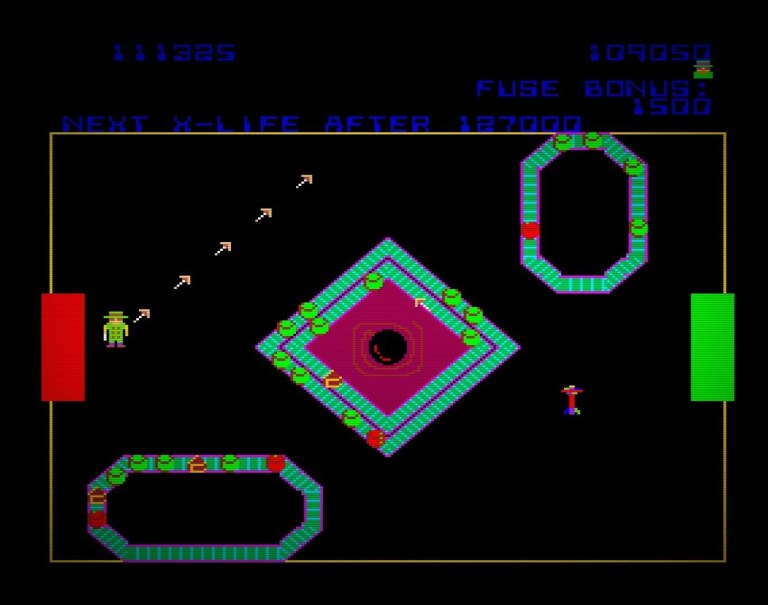
Apart from the robot guards and the crawling eye, there are also forklifts which don’t attack you but their solid exterior will deflect any projectile you fire at them and send them back to your direction.
To be clear, you are not required to destroy all the robot guards (or the huge crawling eye enemies) in each level. You can simply try to avoid obstacles and enemies to make it to the next elevator to keep on descending although doing so means scoring much lesser points. Picking up items will add points and randomly alter your character’s capabilities (by picking up mystery boxes).
Adding pressure to you on each level is the giant bomb located in the middle which you can ignite using the fuse action. Once ignited, you only have a few seconds left to make it to the next elevator as the giant bomb will explode and spread fire throughout the whole level. Igniting the said thing will grant you a lot of points provided you survive and made it to the elevator going down.
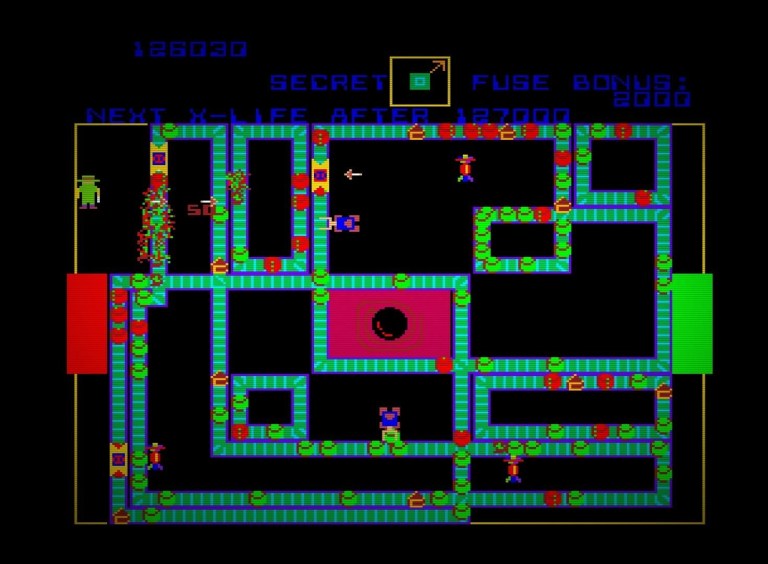
Cloak & Dagger is indeed a fun game but the opposition, the obstacles, time limit (indicated by the giant bomb) and chaotic turn of events make it more challenging than Midway’s two notable twin stick shooters. The game would have been more forgiving and more playable if only it did not have the one-hit-death embedded on it. Considering the challenges each level has and the many levels players have to go through, it would have made more sense to have Agent X have a life bar/health meter/shield and be able to absorb some enemy projectiles (before dying).
Of course, the game was never designed to be like that and the one-hit-death is also found in Robotron 2084 and Smash T.V. That being said, if you played Cloak & Dagger with a high level of success and completed everything without losing all your lives, then you would be a great achiever.
Pop culture significance
It has been reported that Cloak & Dagger – which was released as an arcade kit for machines that ran Robotron 2084, Joust, Defender and Stargate – did not have a big presence in the arcades in America. The 1984 movie dramatically increased public awareness of it.

When Cloak & Dagger was still in game development (created and led by Russell Dawe) under the title “Agent X”, Atari and certain movie producers became aware of each other’s projects and decided to work together. The deal made business sense as Atari could benefit from reaching a mainstream audience through the cinemas while the movie producers joined in the 1980s Hollywood trend of movies that featured powerful computers, software and artificial intelligence as seen in WarGames (1983), Superman III (1983), and The Terminator (1984).
Much to the credit of the filmmakers, the presence of the game actually added good value to the plot. The film’s concept of the Cloak & Dagger game becoming a very wanted object (plot device actually) resulting in chases, intense action scenes and suspense turned out to be very believable as well. It should be noted that director Richard Franklin took inspiration from Alfred Hitchcock which gave the film a unique touch on the suspense and shock scenes. Check out the movie clip below…
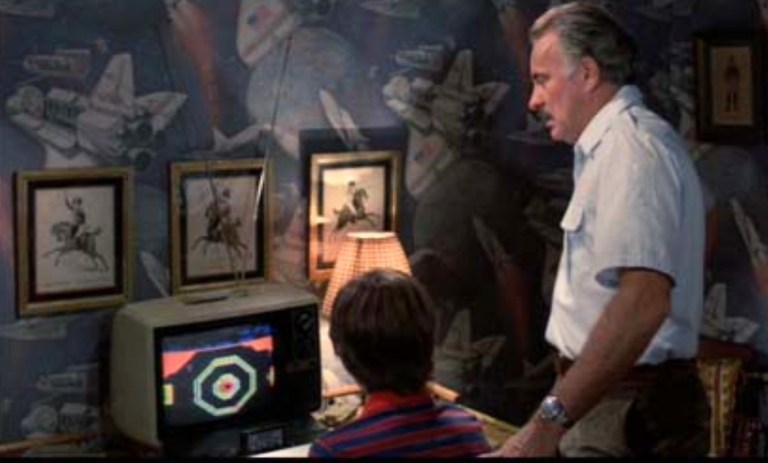
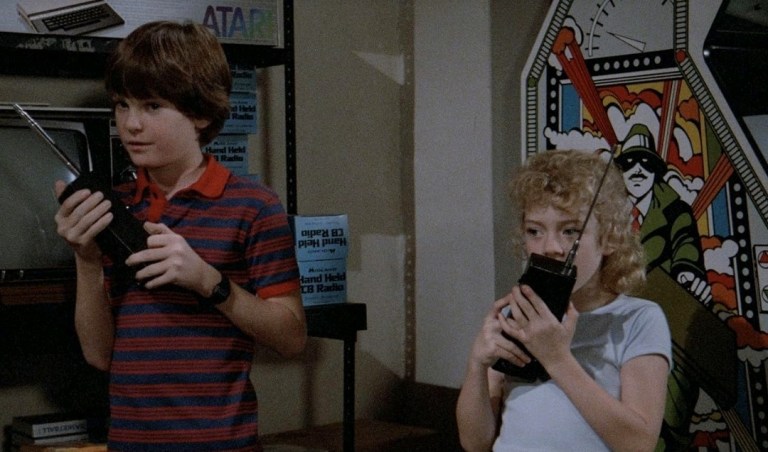
When it comes to the Cloak & Dagger game appearing within the movie of 1984, you will see how the filmmakers and Atari cleverly created the illusion of the game operating on the Atari 5200 console by showing not only video game footage, but also having Henry Thomas acting like he’s playing it using the Atari 5200 controller (which has an analog joystick and buttons on one side). When I was a young boy watching the movie, I found the game footage very entertaining and wanted to play it.
If you are an Xbox gamer who intends to play Cloak & Dagger now, buy the Atari 50 collection in digital format by clicking https://www.xbox.com/en-US/games/store/atari-50-the-anniversary-celebration/9N3TFDSQ531T
+++++
Thank you for reading. If you find this article engaging, please click the like button below, share this article to others and also please consider making a donation to support my publishing. If you are looking for a copywriter to create content for your special project or business, check out my services and my portfolio. Feel free to contact me with a private message. Also please feel free to visit my Facebook page Author Carlo Carrasco and follow me on Twitter at @HavenorFantasy as well as on Tumblr at https://carlocarrasco.tumblr.com/ and on Instagram athttps://www.instagram.com/authorcarlocarrasco
 Author Carlo Carrasco