Welcome back fellow geeks, Blu-ray collectors and movie buffs!
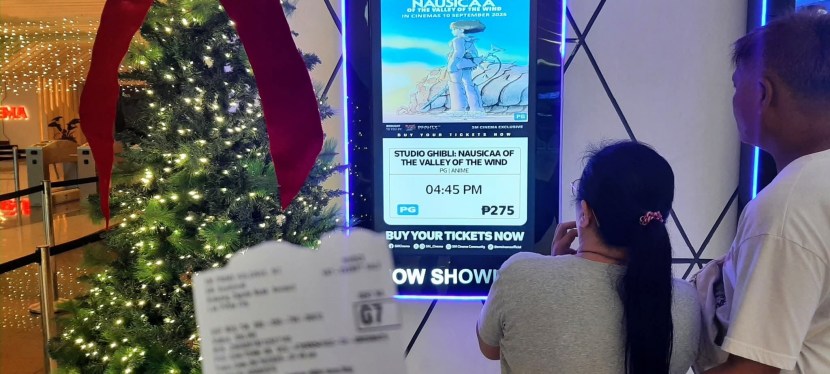
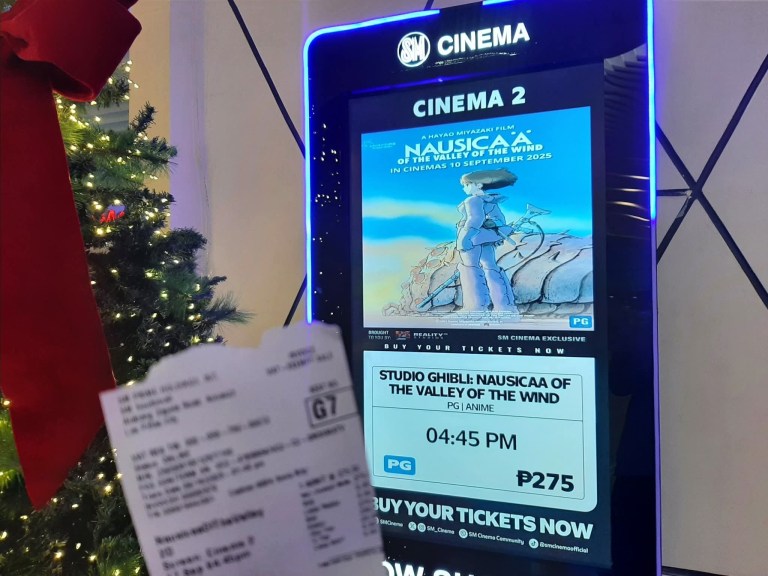
I finally did it! After having seen it many times on home video, cable TV, local TV and DVD, I finally viewed Nausicaä of the Valley of the Wind inside the local cinema here in the Philippines. I saw it on September 17 at SM Cinema inside SM Southmall in Las Piñas City. This was also the first time in two years since I last saw any movie inside the cinema (I last saw Sound of Freedom).
An old movie poster of Nausicaä Of The Valley Of The Wind.
For the newcomers reading this, Nausicaä Of The Valley Of The Wind was part of the Studio Ghibli Fest 2025 which was exclusive to SM Cinema (the largest cinema chain in the country). While the said fest ended on September 16, there were still screenings of Studio Ghibli anime feature films shown in SM Cinema branches from September 17 to 23.
I paid P275 (US$4.72 according to the foreign exchange as of this writing) for my SM Cinema ticket and it includes a free drink. I entered the cinema carrying my ticket, drink and popcorn feeling excited and nostalgic to see Nausicaä Of The Valley Of The Wind on the big screen for the first time ever. What was shown was the English-subtitled version with Japanese voiceovers (Sumi Shimamoto as Nausicaä, Gorô Naya as Yupa, Yoshiko Sakakibara as Kushana, Yôji Matsuda as Asbel, and more)
We were only seven people inside the cinema and there were lots of vacant seats beside, behind and in front of me. I was sitting very comfortably waiting for the screening to begin. At the same time, nobody had a noisy smartphone during the screening. As for me, I deliberately turned my smartphone off to ensure no communication-related distractions would happen.
Eventually Nausicaä Of The Valley Of The Wind finally started playing on the big screen. After the short animated opening scene, the music by Joe Hisaishi started playing as the opening credits went on. At that moment, I was immersed into Hayao Miyazaki’s anime classic immediately and I knew I made the right decision to see it inside the theater.
As the film went on, I adjusted myself to reading the subtitles while maintaining focus on the plot as well as the development of characters. Visually, the film turned out to be really spectacular on the big screen even though it had no computer-generated images at all (note: it is purely hand-drawn animation that was done with so much hard work by Miyazaki and the animators). With the higher resolution on the big screen, I saw a lot more tiny visual details here and there and the facial expressions of the characters became more lively than before. Very clearly, Nausicaä Of The Valley Of The Wind is meant to be seen in the movie theater.
The sense of visual scale in scenes like this one is best viewed on the big screen in the movie theater. (photo source – IMDB.com)
There is nothing like exploring a very polluted forest filled with huge, mutated insects. (photo source – IMDB.com)
After about two hours – the end credits includes animated scenes showing what happened after the climax – of watching, I left the cinema feeling very satisfied and entertained even though I saw Miyazaki’s 1984 masterpiece many times over the decades. The fact that the English-subtitled version was shown gave me an idea of what Japanese moviegoers saw inside their cinemas in 1984, and I can say that the Japanese voiceovers were engaging to listen to. The big screen experience alone made watching Nausicaä Of The Valley Of The Wind worth it.
That being said, I want to express out loud to local movie theater operators reading this to consider showing more of the classic anime feature films as well as classic motion pictures during film festivals or special theatrical events. Personally, I want to see Casablanca, Macross: Do You Remember Love?, Metropolis (2001), Tron, Total Recall (1990) and Akira in the local cinemas.
I am very glad to have seen the 1984 classic anime movie inside the movie theater.
Going back to Nausicaä Of The Valley Of The Wind, I am very glad to have seen inside the cinema and if ever your local cinema will have it screened, I encourage you to go for it. There is absolutely no way that that the screens of your smartphone, your tablet, your PC monitor and your high-definition TV could match the grand visuals of Miyazaki’s film on the cinema’s big screen. Truly the cinema is better than streaming.
If you wish to join a group of movie enthusiasts and talk about cinema, cinematic trends, Blu-ray releases and more relevant stuff, visit the Movie Fans Worldwide Facebook group at https://www.facebook.com/groups/322857711779576
For more South Metro Manila community news and developments, come back here soon. Also say NO to fake news, NO to irresponsible journalism, NO to misinformation, NO to plagiarists, NO to reckless publishers and NO to sinister propaganda when it comes to news and developments. For South Metro Manila community developments, member engagement, commerce and other relevant updates, join the growing South Metro Manila Facebook group at https://www.facebook.com/groups/342183059992673
Welcome back fellow geeks, Blu-ray collectors and movie buffs!
When it comes to watching movies – both old and new – the best place for me is still the movie theater. The very large screen, high-tech sound systems and comfortable seats of the cinema all make the theater viewing experience very immersive which streaming apps and the home theater setup could never match. The cinema experience is always better than streaming.
That being said, it is disappointing for me – as a resident of Muntinlupa City here in the Philippines – that local theaters in Alabang had to close down. The original cinemas of Festival Mall, which first opened in 1998 and grew from six to ten screens, are no more. Before they were all closed down, those cinemas had deteriorated over time and I still remember how bad the projection in one of their premium cinemas was when I saw Star Trek Into Darkness in 2013. It was like I was watching a VHS copy of the movie on their screen. It was that bad!
This year, the 4-screen cinemas of Commercenter in Filinvest City had closed down (refer to my past blog posts by clicking here and here) and it is very unfortunate not just for me but also for others who enjoyed watching movies at that mall. In my experience, Commercenter was my favorite local place to watch movies at and the cinema operators were consistent with maintaining each screen, the comfortable chairs and the sound systems. At the same time, it was pretty convenient for me to park the car in the basement parking (really spacious), climb up to the cinemas at the 2nd floor (ticket counter and snacks counter were beside each other), enjoy a movie, and visit a local store or a restaurant within the mall after leaving the cinema.
With the closure of Festival Mall’s original cinemas and Commercenter cinemas, that is a combined loss of ten screens along with the many seats and equipment combined. Along the way, many people who worked directly in those lost cinemas either became unemployed or got re-assigned to a new task within the local establishment. Sadly, not too many people here in the Philippines are talking about the jobs lost with the closure of cinemas.
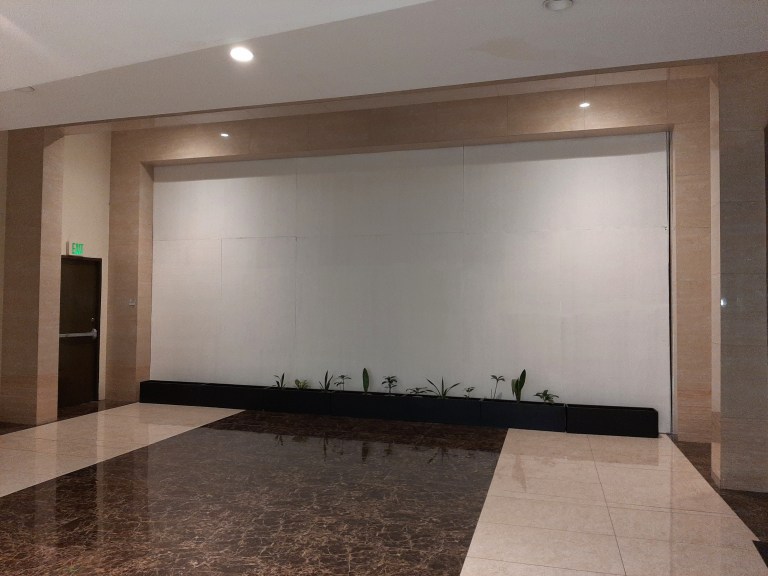
Cinemas of Commercenter have been closed down since March 15, 2025.
This brings me to my next point – BusinessWorld published an article exploring the current struggle of Philippine cinemas in what is now the post-pandemic era. For the newcomers reading this, the Philippines economy has been growing strongly year-by-year after the COVID-19 period ended but the nation’s cinema industry is still struggling in terms of sales and attracting paying customers. The Filipinos’ love for streaming is huge factor but there are also other reasons why not enough moviegoers are supporting cinemas.
To put things in perspective, posted below is an excerpt from the BusinessWorld article. Some parts in boldface…
KAREN LUSTAÑAS, 30, tries to watch a movie in the Philippine capital at least once a month, if the budget allows it.
“I try to save time and money for films that I really want to see,” she told BusinessWorld in a Facebook Messenger chat. “I can barely afford it, but if I’m a fan of the director or actors, I really have to watch it.”
“Otherwise, I’ll just watch it on a streaming platform,” she added.
As good as the movie industry is in imagining alternate realities, it didn’t see this one coming. Five years after the coronavirus disease 2019 (COVID-19) decimated the box office here and all over the world, movies are still struggling to come back.
Philippine gross movie ticket sales fell 3.7% year on year to $45.5 million (P2.5 billion) last year, a far cry from the $144.5 million posted in 2019, before the pandemic hit, according to US-based box office revenue tracker Box Office Mojo. In 2020, gross sales plunged 95% to $7.7 million.
Global cinema ticket sales fell 8.8% last year to €28 billion (P1.8 trillion) from 2023, the first annual drop since COVID-19, the European Audiovisual Observatory (EAO) said last month.
Regular movie ticket prices cost P300 to P400 in Metro Manila, or about half the daily minimum wage. On the other hand, the basic monthly subscription to streaming platforms like Netflix, Max (HBO) and Disney+ costs P150 to P250, and the titles are virtually endless.
“If you think about it, it’s really worth it and more practical to go with Netflix,” Ms. Lustañas, a freelancer, said.
The annual Metro Manila Film Festival (MMFF) grossed P800 million last year, hitting the target but failing to top 2023’s record P1 billion despite a week-long extension.
The pandemic forced people to watch movies at home, aiding streaming services like Netflix, whose revenue grew 14% annually to more than $39 billion last year from 2019, according to computations by BusinessWorld using data from the company’s website. Netflix subscribers also doubled to about 300 million over the five-year period.
Since 2020, local box office hits have been few and far between. The latest was Star Cinema’s My Love Will Make You Disappear starring Kim Chiu and Paulo Avelino, grossing P12 million on its opening day in March.
“Today, going to the cinema is a more intentional experience, rooted not just in the movie being shown but in the overall ambiance that brings the film to life,” Hamm E. Katipunan, Ayala Malls’ Asset Management head, said in an e-mailed reply to questions.
“It’s not just about waiting for blockbusters to hit streaming sites; Filipinos appreciate the good feeling of watching movies that are truly worth experiencing on the big screen,” he added.
While cinemas run by Ayala Malls, SM Supermalls and other mall chains have diversified their offerings, a pattern has emerged in the top-grossing Filipino films that have drawn people to cinemas.
GMA Pictures and Star Cinema’s co-production Hello, Love, Again starring Alden Richards and Kathryn Bernardo set the record for the highest opening day gross for a local film with P85 million in November, surpassing the P75-million gross from The Super Parental Guardians in 2016.
‘FORMULAIC STORIES’ – It shows that Filipinos watch a movie mainly because of its main cast, Film Development Council of the Philippines (FDCP) Chairman Jose Javier Reyes told a news briefing in March, citing a council-funded study involving 800 respondents.
“They can’t afford to go regularly to the movies anymore,” he said. “The biggest blow is that people don’t repeat screenings. They just wait for it to go on streaming platforms.”
The study, done in 2024 in collaboration with De La Salle University to explore the evolving habits, preferences and challenges shaping the local film industry, found that Filipinos from the A, B, and a small part of the C socioeconomic classes regularly watch movies.
The study, which will be released in July as part of the launch of FDCP’s Philippine Film Industry Roadmap, also found that streaming services have become the primary platform for 67% of Filipinos.
Only 21% still frequent cinemas, with many complaining about repetitive movie themes and high ticket prices.
Though stars are still the main movie drawer, the study also found that Filipinos are “sick of formulaic stories,” Mr. Reyes said. He added that the roadmap, mandated by the government, would shed light on how to better support the industry.
In October last year, President Ferdinand R. Marcos, Jr. placed the Film Academy of the Philippines under the Department of Trade and Industry (DTI) to boost Filipino film development.
Trade Secretary Ma. Cristina A. Roque earlier said the budget for the film industry would increase next year as part of the roadmap. She noted that other countries have been using movies and the creative industry to boost tourism and trade.
Mr. Reyes said movie outfits should improve the quality of their films to boost their success overseas. “In the Philippines, star power is important, but the moment you cross borders, there’s a market for people who are more interested in the material itself,” he pointed out.
Rico V. Gonzales, head of distribution at Warner Bros. Pictures Philippines, said the company supports the local industry by distributing two to three Filipino movies yearly, along with the usual foreign releases from Warner Bros. and Universal Pictures.
“It’s part of the goodwill of the company to help local producers who don’t have a distribution arm, compared with the likes of Star Cinema and GMA Pictures, which have the power to do it themselves,” he said.
The current state of the cinema industry of the Philippines is disappointing and the future looks uncertain as of this writing. While a lot of my fellow Filipinos chose streaming to watch movies in the comfort of their home, I prefer watching movies on Blu-ray and 4K Blu-ray disc format. The most phenomenal 4K Blu-ray experiences I had was Top Gun: Maverick and that movie never failed to amaze me each time I saw it using my 4K Blu-ray disc player. I also enjoyed watching my 4K Blu-ray copies of Casablanca, Interstellar, Total Recall (1990), and Star Trek: First Contact.
Going back to the state of cinema here in the Philippines, I did not watch a single movie in the cinema in 2024. In fact, the last time I saw a movie on the big screen locally was Sound of Freedom in 2023 (read my review by clicking here). This is because the new movies that were released in 2024 did not interest me at all and the fact that a lot of new Hollywood movies had woke garbage in them turned me off. Not only that, there were times when news movies from overseas were not even released in Philippine cinemas at all such as Jesus Revolution (note: I had to buy the movie on Blu-ray just to watch it).
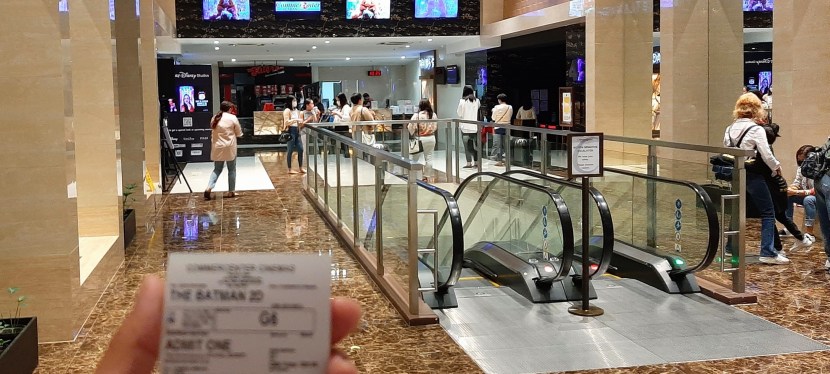
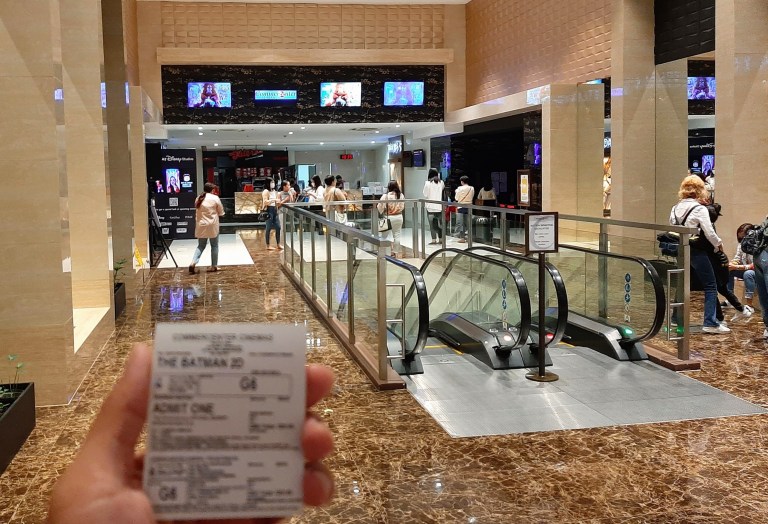
I saw The Batman at Commercenter’s cinema on March 2022.
As of this writing, the direction of the entire cinema industry of the Philippines remains uncertain and so far there were no real breakthroughs that happened. That being said, I still remember when in 2015, there were long lines of moviegoers at Commercenter waiting to enter the cinemas to watch Jurassic World. Such a memory won’t be repeated here in Alabang and without its cinemas, Commercenter’s value as a place for fun has gone way down.





 Author Carlo Carrasco