Fuel giant Petron confirmed that it has almost 2.5 million barrels of crude oil from Russia, according to news report by GMA News. The acquisition has been perceived by many as crucial as the Philippines is struggling with very expensive fuel.
To put things in perspective, posted below is an excerpt the GMA News report. Some parts in boldface…
Petron Corp. on Monday confirmed the procurement of 2.48 million barrels of crude oil from Russia to augment its inventory until June, as the country’s supply reaches what it described as a “precarious” level amid the ongoing conflict in the Middle East.
The listed fuel retailer, which holds a 30% share of the Philippine market and operates the country’s only oil refinery, said it closely coordinated with the Departments of Energy (DOE) and Finance (DOF) on the purchase after both agencies called on local companies to secure alternative sources of crude and finished products.
“The corporation wishes to emphasize that the procurement of Russian crude oil is not part of its business-as-usual sourcing strategy,” Petron said in a regulatory filing.
“The purchases were undertaken strictly out of extreme necessity, as an extraordinary emergency measure in response to unprecedented geopolitical and supply chain disruptions, and only after exhausting all commercially and operationally viable alternatives,” it added.
Petron said it also received confirmation from the Bangko Sentral ng Pilipinas (BSP) that there is no prohibition under Philippine law on sourcing foreign currency for import and trade transactions, clearing the way for the importation of Russian crude oil.
The corporation said that if the current crisis persists and alternative crude sources remain unavailable or insufficient, it may again be compelled to consider purchasing Russian crude oil to augment the national fuel supply.
It added that this would help directly mitigate the adverse consequences arising from the absence of a stable and reliable source of crude.
Let me end this post by asking you readers: What is your reaction to this recent development? Does Petron’s procurement of 2.48 million barrels of Russian crude oil make you feel relieved when it comes to the overall supply of fuel in the Philippines?
Since February 28, the Islamic terrorist regime of Iran has been heavily decimated by the joint US-Israel military operations. To date, almost all of Iran’s senior leadership were eliminated, their navy and air force have been devastated, their military/industrial/government sites have been struck, and their new so-called supreme leader could not even show himself physically to his people. While it is still able to launch missiles at different states in the Middle East, Iran has been weakened dramatically and its wicked regime is clearly down on its knees.
Since the beginning, it was made clear that the joint operations were to bring down the Islamic terrorist regime, disarm it and pave the way for the oppressed Iranians to take their country back. The Trump administration made it clear the operations won’t be a “forever war” nor would it follow what the administration of past US President George W. Bush did during and after the invasion of Iraq. US President Trump just delivered a primetime speech to give the public a clear view about the direction America is taking right now regarding the weakened Iran. Beyond the fighting, what happened has been shaping the future of the Middle East as we know it.
To begin with, posted below is the primetime speech of President Trump. Watch it entirely and pay attention closely.
To put things in perspective, posted below is are details from Trump’s speech via the White House announcement. Some parts in boldface…
Here are the top moments from the address:
“As we speak this evening, it has been just one month since the United States military began Operation Epic Fury targeting the world’s number one state sponsor of terror, Iran. In these past four weeks, our Armed Forces have delivered swift, decisive, overwhelming victories on the battlefield — victories like few people have ever seen before. Tonight, Iran’s navy is GONE. Their air force is in ruins. Their leaders, most of them — the terrorist regime they led — are now dead. Their command and control of the Islamic Revolutionary Guard Core is being decimated as we speak. Their ability to launch missiles and drones is dramatically curtailed and their weapons, factories, and rocket launchers are being blown to pieces — very few of them left. Never in the history of warfare has an enemy suffered such clear and devastating large-scale losses in a matter of weeks.” (Watch)
“From the very first day I announced my campaign for President in 2015, I have vowed that I would never allow Iran to have a nuclear weapon. This fanatical regime has been chanting ‘Death to America, ‘Death to Israel,’ for 47 years. Their proxies were behind the murder of 241 Americans in the Marine Barracks bombing in Beirut, the slaughter of hundreds of our servicemembers with roadside bombs, they were involved in the attack on the U.S.S. Cole, and they’ve carried out countless other heinous acts… For these terrorists to have nuclear weapons would be an intolerable threat. The most violent and thuggish regime on earth would be free to carry out their campaigns of terror, coercion, conquest, and mass murder from behind a nuclear shield. I will never let that happen.” (Watch)
“I did many things during my two terms in office to stop the quest for nuclear weapons by Iran… First, and perhaps most importantly, I killed General Qasem Soleimani in my first term… And then, very importantly, I terminated Barack Hussein Obama’s Iran Nuclear Deal… Essentially, I did what no other President was willing to do. They made mistakes and I am correcting them.” (Watch)
“My first preference was always the path of diplomacy — yet, the regime continued their relentless quest for nuclear weapons and rejected every attempt at an agreement. For this reason, in June, I ordered a strike on Iran’s key nuclear facilities in Operation Midnight Hammer… The regime then sought to rebuild their nuclear program at a totally different location, making clear they had no intention of abandoning their pursuit of nuclear weapons… For years, everyone has said that Iran cannot have nuclear weapons — but in the end, those are just words if you’re not willing to take action when the time comes.” (Watch)
“As I stated in my announcement of Operation Epic Fury, our objectives are very simple and clear. We are systematically dismantling the regime’s ability to threaten America or project power outside their borders… Our Armed Forces have been extraordinary. There’s ever been anything like it militarily — everyone is talking about it — and tonight, I am pleased to say that these core strategic objectives are nearing completion. As we celebrate this progress, we think especially of the 13 American warriors who have laid down their lives in this fight to prevent our children from ever having to face a nuclear Iran… Now, we must honor them by completing the mission for which they gave their lives.” (Watch)
“Many Americans have been concerned to see the recent rise in gasoline prices here at home… This short-term increase has been entirely the result of the Iranian regime launching deranged terror attacks against commercial oil tankers and neighboring countries that have nothing to do with the conflict. This is yet more proof that Iran can never be trusted with nuclear weapons. They will use them and they will use them quickly. It would lead to decades of extortion, economic pain, and instability worse than we can ever imagine. The United States has never been better prepared economically to confront this threat.” (Watch)
“To those countries that can’t get fuel — many of which refused to get involved in the decapitation of Iran, we had to do it ourselves — I have a suggestion. Number one, buy oil from the United States of America; we have plenty. We have so much. And Number two, build up some delayed courage… Go to the Strait and just take it. Protect it. Use it for yourselves. Iran has been essentially decimated. The hard part is done.” (Watch)
“I have made clear from the beginning of Operation Epic Fury that we will continue until our objectives are fully achieved. Thanks to the progress we’ve made, I can say tonight that we are on track to complete all of America’s military objectives shortly — very shortly. We are going to hit them extremely hard over the next two to three weeks. We are going to bring them back to the stone ages where they belong. In the meantime, discussions are ongoing… We have all the cards; they have none.” (Watch)
Let me end this piece by asking you readers: What is your reaction to this development? Which part of Trump’s speech did you find the most compelling or most interesting? Can you imagine the Middle East being free from the armed threat of Iran? Do you think the Islamic terrorist regime of Iran will get penalized by Saudi Arabia, Qatar, Kuwait, the United Arab Emirates (UAE) and other states for the Iranian missiles and drones that hit them? Do you feel confident that the price of oil will go down this month?
With a lot of economic disruptions connected with the conflicts in the Middle East, the Philippine Peso has been exposed as one of the most vulnerable currencies of Asia and already the nation is struggling with spiked fuel prices and rising inflation, according to a business news report by the Manila Bulletin.
To put things in perspective, posted below is an excerpt from the announcement by the Manila Bulletin. Some parts in boldface…
Singapore-based DBS Bank Ltd stated that the Philippine peso is emerging as one of Asia’s most vulnerable currencies as deepening global oil crisis exposes the nation’s heavy reliance on imported energy and the lack of government subsidies.
DBS wrote in a commentary published last Friday that the peso is expected to underperform in the foreign exchange (forex) market alongside the Indian rupee, which recently hit a record low against the United States (US) dollar. The peso also plummeted to another all-time low last Friday, finishing at P60.55 per dollar.
Like India, the Philippines is grappling with vulnerabilities from oil price shocks, which have led the peso to reach a new all-time low, according to DBS senior forex strategist Philip Wee and forex and credit strategist Chang Wei Liang.
“Similarly, the peso remains highly vulnerable,” Wee and Liang said. Last Friday, the peso breached the 60.5 level as geopolitical tensions in the Middle East intensified, and the central bank stood firm in its view that there is no immediate need to defend the currency.
Wee and Liang said the Philippines stands as “most exposed to oil price pass-through due to zero subsidies and a 90 percent energy reliance on Gulf energy.”
Japanese financial giant MUFG Bank Ltd. and think tank Capital Economics also emphasized the Philippines’ high exposure to external market volatility, which is hurting the peso amid investors’ risk-off sentiment.
MUFG analysts said the peso is among the “weakest performers in the region” last week, declining by a total of 4.9 percent since the Israel-Iran conflict flare-up. It was surpassed only by the Thai baht, which has dropped 5.9 percent month-to-date.
Following the peso are the declines in the South Korean won (4.7 percent), Indian rupee (4.1 percent), and Malaysian ringgit (three percent). Meanwhile, the Vietnamese dong and Chinese yuan have been the most resilient currencies, with only around a one percent decline each.
DBS said that the Bangko Sentral ng Pilipinas (BSP) is facing a dilemma: it must contain skyrocketing consumer prices while defending the peso amid extreme vulnerability to the worsening energy crisis, with the impacts more pronounced in heavy oil-importing economies.
Citing metrics from an Institute of International Finance (IIF) study, Wee and Liang labeled the currencies of the Philippines, South Korea, and Malaysia as “somewhat vulnerable” to oil price spikes stemming from the Middle East war.
Such metrics include direct trade exposure to oil imports, the growth impact of oil usage intensity, and vulnerability to agricultural and fertilizer supply shocks.
DBS assessed India, Thailand, and Vietnam as the most vulnerable to oil market shocks, while China and Indonesia are the least sensitive.
Despite the peso’s recent weakness, DBS projects the local currency to rebound toward 57.8 per dollar by the end of 2026. However, the pair is also seen climbing back to 59.9 by late 2027 and remaining within the 59 level through 2030.
Let me end this post by asking you readers: What is your reaction to this recent development? Do you think the government of the Philippines and its economic managers will be able to execute moves to prevent strengthen the Peso ensuring economic growth?
As the Islamic terrorist regime of Iran made passage through the Strait of Hormuz tremendously difficult, tremendous economic disruptions connected with oil shipments negatively impacted economies around the world. For Israeli Prime Minister Benjamin Netanyahu, the only long-term solution to the Hormuz crisis is the rerouting of pipes westward across Saudi Arabia to the Red Sea and the Mediterranean, according to a news report by The Jerusalem Post.
To put things in perspective, posted below is an excerpt from the news report of The Jerusalem Post. Some parts in boldface…
Prime Minister Benjamin Netanyahu on Monday said that a long-term solution to the crisis in the Strait of Hormuz would include the construction of pipelines that would carry the Gulf state’s oil and gas to the Mediterranean.
“Long-term solutions include rerouting energy pipelines westward, across Saudi Arabia to the Red Sea and Mediterranean, bypassing Iran’s geographic choke point,” Netanyahu explained in an interview with conservative US media outlet Newsmax.
Currently, the Strait is one of the main chokepoints in the energy market, with 20% of global oil exports passing through it.
While Saudi Arabia, the United Arab Emirates, and Oman have territorial waters in the Strait, the presence of Iran on the other side of Hormuz has made it vulnerable, with the Islamic regime having the capabilities of threatening global energy markets by attacking ships that go through the Strait.
This has been Iran’s main strategy during the current war, alongside its missile attacks towards Israel and the Gulf States. Netanyahu noted that, while a military solution might offer short-term stability, a deal that eliminates the strategic importance of the Strait might be the best route long-term.
‘Beyond halfway point’: Netanyahu avoids giving precise end date to war – Netanyahu also said in the interview with Newsmax that the war with Iran is “beyond its halfway point,” although he avoided giving a precise end date for the war.
“We’re beyond the halfway point in terms of mission success,” Netanyahu said, adding that the IDF’s current focus is on destroying the remaining nuclear capabilities of the Iranian regime.
“We’ve already degraded their missile capabilities, destroyed factories, and eliminated key nuclear scientists,” he explained, warning that Iran is “pursuing nuclear weapons and the means to deliver them to American cities. That’s what this war is about, preventing that outcome.”
Netanyahu also pointed out that the regime was able to attack the Diego Garcia base in the Indian Ocean, with this being Iran’s longest strike and a demonstration that their missiles could reach almost any country in the region, including most of Europe.
“It wasn’t an intercontinental missile, but it’s getting there, about 4,000 km. That puts much of Europe within range,” Netanyahu pointed out.
Let me end this piece by asking you readers: What is your reaction to this development? Do you agree with Prime Minister Netanyahu about rerouting pipes westward to the Mediterranean as the main solution to the choke point of the Strait of Hormuz?
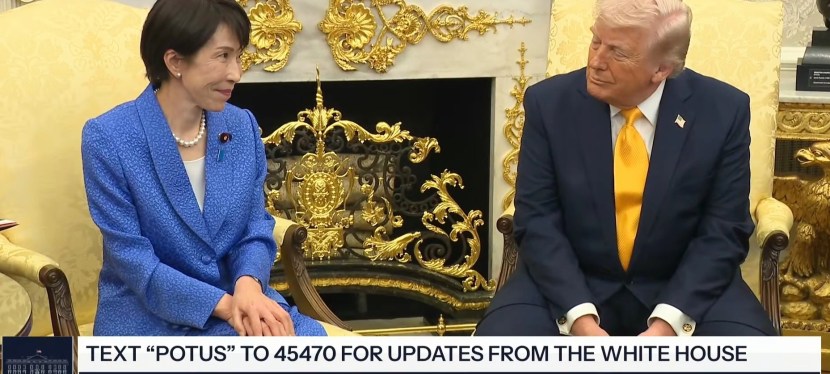
Japanese Prime Minister Takaichi Sanae visited Washington for the first time as the head of her nation and met with US President Donald Trump at the White House where they discussed very important matters in front of the media and officials, according to a news report by Kyodo News. Takaichi also praised the President for his peace efforts.
To put things in perspective, posted below is an excerpt from the news report of Kyodo News Some parts in boldface…
Prime Minister Sanae Takaichi told U.S. President Donald Trump on Thursday that Japan is ready to contribute to the safety of the Strait of Hormuz as the U.S.-Israeli war on Iran intensifies, while explaining Tokyo’s legal constraints on sending ships from its defense forces to the region.
Takaichi told reporters after her meeting at the White House with Trump that she told the U.S. leader “in detail what Japan can do and cannot do” from a legal perspective under the country’s war-renouncing Constitution.
Trump, for his part, reiterated his expectation that Japan would be engaged, while saying during the part of their talks open to media that he believes Japan has been “stepping up to the plate” in recent days over the Iran war, “unlike NATO.”
The U.S. leader has made public his dissatisfaction with Washington’s allies, including Tokyo and members of the trans-Atlantic alliance, over their reluctance to pitch in to help secure the Hormuz strait, a vital waterway for global oil transportation now largely blocked by Iran.
“I expect Japan to step up, because, you know, we have that kind of relationship,” he said. “We have 45,000 soldiers in Japan. We have, we spend a lot of money on Japan…so I expect, I’m not surprised that they would step up.“
Noting also that more than 90 percent of Japan’s crude oil imports normally pass through the strait, Trump said Japan has a “big reason” to do more.
In affirming Japan-U.S. collaboration on expanding U.S. energy production, Takaichi said she proposed to Trump a joint oil-reserve project to ease supply concerns driven by the Middle East conflict.
At the talks, Takaichi praised Trump’s “peace” efforts, expressing readiness to assist by reaching out to other countries. “Donald is the only person who can bring peace and prosperity across the world,” she said.
Takaichi emphasized that the prospect of Iran developing nuclear weapons is unacceptable. Trump alluded earlier to Iran’s nuclear program to explain the U.S. decision to launch its military campaign against the country.
Facing an increasingly assertive China, Takaichi also reminded Trump that the security environment remains severe in the Indo-Pacific, at a time when reports have emerged that some U.S. military assets are being moved from the region to the Middle East.
The two leaders “committed to peace and stability across the Taiwan Strait as an indispensable element of regional security and global prosperity” and “opposed any attempts to unilaterally change the status quo, including by force or coercion,” the White House said in a press release without naming China.
They confirmed that their nations oppose measures threatening critical mineral supplies such as export controls, senior Japanese government officials told reporters, apparently referring to Beijing’s tighter regulations on rare earths exports.
They agreed to advance broad defense cooperation, including joint missile development and production, and promote a free and open Indo-Pacific, according to Takaichi. The White House said the production of the interceptor Standard Missile-3 Block 2A in Japan will be quadrupled.
“We were able to affirm many concrete forms of cooperation that will further enhance the quality of our alliance in wide-ranging fields,” Takaichi said, adding that she and Trump are aiming to elevate bilateral ties to “a higher level” together.
Trump welcomed Japan buying “a lot of” U.S. military equipment. He further stressed that he has a “very fine relationship” with Takaichi, describing her as “a very special person” who is doing a “fantastic job.”
The U.S. side did not bring up fresh demands for Japan to spend more on its defense, the officials said.
Takaichi’s main goals in her first trip to the United States since taking office in October were to strengthen the personal trust in her ties with Trump and reaffirm the U.S. security commitment to the Indo-Pacific region as China’s influence grows.
The meeting came amid increasing concerns within Japan that the U.S. focus in terms of policy and military assets could shift from the Indo-Pacific to the Middle East if the U.S.-Israeli war with Iran drags on, a development that would work in China’s favor.
The U.S. military has reportedly begun relocating the amphibious assault ship Tripoli and over 2,000 Marines from their bases in southwestern and southern Japan to the Middle East.
Takaichi got off to a positive start in building personal ties with Trump when they met in person for the first time in October in Tokyo, shortly after she became Japan’s first female prime minister.
Since the outbreak of the Middle East conflict, Tokyo has sought to strike a delicate balance between maintaining its strong alliance with Washington and its friendly relations with Tehran.
For more insight about the Trump-Takaichi meeting, watch the videos below.
Let me end this piece by asking you readers: What is your reaction to this development? What is your impression about the many matters and announcements that happened during the Trump-Takaichi meeting at the White House? Were you surprised when it was announced that US allies Japan, Italy, England, Netherlands, Germany, and France jointly agreed to secure the Strait of Hormuz in response to Trump’s demand? With Japan having a close relationship with Trump’s America now, do you think Communist China and North Korea will feel intimidated at their side of the Pacific?
To put things in perspective, posted below is an excerpt from the news report of Kyodo News Some parts in boldface…
Prime Minister Sanae Takaichi is considering expressing Japan’s desire to cooperate on the U.S. “Golden Dome” next-generation missile defense system at her upcoming meeting with President Donald Trump, Japanese government sources said Tuesday.
The envisaged missile defense collaboration is among the expected agreements, covering various areas from the long-standing Japan-U.S. alliance to the fields of economic security and cutting-edge technology, at the summit slated for Thursday in Washington, the sources said.
Revealed by Trump in May, the Golden Dome scheme is intended to detect and destroy hypersonic missiles, which can fly at above five times the speed of sound, in outer space in mid-flight. The total costs are estimated at $175 billion.
The trajectories of hypersonic weapons are irregular and low-altitude, making them difficult to shoot down or track by radar. China, North Korea and Russia have been aggressively pursuing such arms.
In August 2023, Tokyo and Washington agreed to develop a new type of missile to intercept hypersonic weapons, with the goal of completing it by the 2030s. It is intended that Aegis destroyers of the U.S. Navy and the Japan Maritime Self-Defense Force will be equipped with the missile.
To enhance the missile defense system’s detecting and tracking capabilities, the U.S. military has been building a “satellite constellation” system that allows it to capture incoming missiles with high accuracy by linking multiple small satellites.
Japan’s Defense Ministry, which has also been conducting research on technologies necessary for detecting projectiles from outer space, is eyeing information sharing with the United States, the sources said.
During the summit talks, which will take place amid the Middle East conflict following U.S. and Israeli attacks on Iran, Takaichi also plans to ask Trump about purchasing crude oil produced from Alaska, according to the sources.
Japan, which relies heavily on the Middle East for its crude oil imports, has once again had its energy vulnerability exposed in the wake of the war in the region, with the effective closure of the Strait of Hormuz disrupting oil flows.
Takaichi and Trump, meanwhile, are expected to agree on a $100 million joint project in shipbuilding, a sector both countries are keen on enhancing amid dominance by Chinese makers.
Let me end this piece by asking you readers: What is your reaction to this development? Do you think the US-Japan summit this week will result in big breakthroughs with regards to defense, economics and energy? What do you hope to see happen after President Trump and Prime Minister Takaichi meet in Washington? Do you think the Golden Dome missile defense project will be fully realized and operational in the years to come?
As expected, Japan officially started releasing yesterday its oil reserves to stabilize the distribution of petroleum products and to ensure a good supply as the war against the Islamic terrorist regime of Iran continues, according to a Kyodo News report.
To put things in perspective, posted below is an excerpt from the news report of Kyodo News Some parts in boldface…
Japan began to release oil from its reserves Monday to alleviate supply concerns that have grown amid the U.S.-Israel war with Iran and stabilize the distribution of petroleum products, taking the step ahead of a planned International Energy Agency-led move.
In its first oil release since 2022, when it joined an IEA coordinated effort following Russia’s full-scale invasion of Ukraine, Japan is initially freeing up 15 days’ worth of reserves held by the private sector, with a month’s worth of state-held oil to follow.
Chief Cabinet Secretary Minoru Kihara said the release was decided as Japan’s crude oil imports are expected to decrease significantly from late March onwards due to the effective closure of the Strait of Hormuz, which many tankers traverse.
“We plan to make efforts so that (the released oil) will circulate in the market smoothly,” he said, adding the government will “continue to take every possible step to ensure the stable supply of energy, through international coordination and without ruling out any options.”
The IEA said Sunday the planned coordinated release of oil by its 32 member countries, including Japan, will “soon start.”
It said last week that the countries will make 400 million barrels of oil available to the market in response to the disruptions resulting from the Middle East conflict.
Crude oil futures have been surging amid growing prospects of a prolonged conflict, with the benchmark West Texas Intermediate crude oil futures contract briefly topping $100 per barrel again in New York on Sunday, after a similar spike a week earlier.
The Japanese government will reduce the mandatory 70-day reserve requirement for oil refiners and trading companies under Japan’s oil stockpiling law to 55 days’ worth, allowing them to draw down their existing stocks for use.
Last Wednesday, Prime Minister Sanae Takaichi announced the government’s plans to release about 80 million barrels of oil, the largest ever, equivalent to 45 days’ worth of domestic consumption and 1.8 times the amount released after the massive earthquake and tsunami in 2011 that devastated Japan’s northeast.
Preparations are under way to sell oil in government-held reserves to wholesalers.
As of the end of 2025, Japan held reserves of approximately 470 million barrels of oil, equivalent to 254 days of domestic consumption, of which 146 days’ worth were government-owned, 101 days held by the private sector, and the remainder jointly stored by oil-producing countries.
Let me end this piece by asking you readers: What is your reaction to this development? Do you think newly released oil reserves will stabilize the Japanese market for petroleum products? Do you think the joint Israel-US campaign against the Islamic terrorist regime of Iran will ultimately cause the enemy to surrender this month?
As many countries around the world are already struggling with the economic disruptions and the spike in oil prices as a result of the ongoing chaos in the Middle East, Japan has decided to release its own oil reserves and it could happen as early as Monday (March 16), according to a news report by Kyodo News.
To put things in perspective, posted below is an excerpt from the news report of Kyodo News Some parts in boldface…
Japan will begin drawing down its oil reserves as early as next Monday to deal with a possible sharp rise in gasoline and other petroleum product prices amid the Middle East conflict, Prime Minister Sanae Takaichi said.
Takaichi told reporters on Wednesday that Japan will release 15 days’ worth of reserves held by the private sector and then one month’s worth of government-held oil without waiting for a decision coordinated by the International Energy Agency.
It will be the first time Japan has released its government oil reserves individually, not in an internationally coordinated way, since the stockpiling of oil began in 1978.
Japan’s dependency on the Middle East for crude oil is “prominently high” compared with other countries and imports are expected to “significantly drop late this month or later,” necessitating measures to prevent a disruption to the supply of gasoline and other petroleum items, Takaichi said.
Citing the possibility that the average price of domestic retail gasoline could surpass 200 yen ($1.26) per liter, Takaichi also said she aims to keep the price at around 170 yen by utilizing a government fund.
The price of gasoline hit as low as 154.70 yen in mid-January but rose to 161.80 yen per liter as of Monday, according to industry ministry data.
“We will flexibly review the support measures to ensure continuous relief for the public even if the (Middle Eastern) situation is prolonged,” Takaichi said.
Japan imports more than 90 percent of its oil from the Middle East, making it highly vulnerable to the effective closure of the Strait of Hormuz, which has prevented the transportation of oil and gas from suppliers in the Persian Gulf, after the U.S. and Israel attacked Iran late last month.
As of the end of December, Japan had 470 million barrels of oil reserves equivalent to 254 days of domestic consumption, of which 146 days’ worth were government-owned, 101 days held by the private sector, and the remainder jointly stored with oil-producing countries.
Let me end this piece by asking you readers: What is your reaction to this development? Do you think Japan made the right decision to release its oil reserves good for fifteen days? Do you think Japan will be able to find new and alternative sources of oil so that it can cut its reliance on Middle East oil?
Following the capture of socialist dictator Nicolas Maduro, US President Donald Trump announced that Venezuela will turn over to America thirty million to fifty million barrels of oil which will benefit people of both nations, according to a news report by Newsmax.
For the newcomers reading this, Maduro ruled Venezuela for more than a decade and his predecessor was none other than the demon Hugo Chavez. Maduro brutalized his fellow Venezuelans and is responsible with the intense deterioration of their national economy. Under Maduro, Venezuela cooperated with the terrorist state of Iran, Communist China and Putin’s Russia. Maduro is also involved in drug trafficking and narco-terrorism.
To put things in perspective, posted below is an excerpt from a Newsmax report. Some parts in boldface…
President Donald Trump said Tuesday that Venezuela is turning over 30 million to 50 million barrels of oil to the United States, with proceeds he said will benefit both the Venezuelan people and Americans.
Trump made the announcement in a post on Truth Social, just days after he authorized U.S. military action to remove socialist strongman Nicolas Maduro from power in Venezuela.
“I am pleased to announce that the Interim Authorities in Venezuela will be turning over between 30 and 50 MILLION Barrels of High Quality, Sanctioned Oil, to the United States of America,” Trump said in the post.
“This Oil will be sold at its Market Price, and that money will be controlled by me, as President of the United States of America, to ensure it is used to benefit the people of Venezuela and the United States!” he added.
Delcy Rodriguez was sworn in as Venezuela’s interim president Monday. Rodriguez indicated she would cooperate with Washington.
“I have asked Energy Secretary Chris Wright to execute this plan, immediately. It will be taken by storage ships, and brought directly to unloading docks in the United States,” Trump concluded his post.
Before the arrest of Maduro, Venezuela’s oil sector was a shadow of its former self despite holding the world’s largest proven oil reserves — estimated at over 300 billion barrels.
Decades of socialist mismanagement, expropriation of foreign assets, and U.S. sanctions decimated output, which fell from over 3 million barrels per day in the early 2000s to roughly 1 million barrels per day by 2025.
Sanctions forced much of the crude trade underground and shifted exports mainly to China, with Petróleos de Venezuela, S.A. (PDVSA) struggling to generate cash revenue. Production bottlenecks, lack of investment, and aging infrastructure kept Venezuela’s oil influence weak on global markets.
For additional insight about Venezuelan oil and what it means to America and the world, watch the selected videos below.
Let me end this piece by asking you readers: What is your reaction to this development? With Maduro on trial in America, are you confident that he will be found guilty on each and every charge against him? Do you think the announced high amount of barrels of Venezuelan oil will be a big economic boost for America? Do you think China, Russia and terrorist state Iran are panicking now that they lost their access to Venezuela’s oil? Do you think it is a matter of time before the military hardware of Russia, China and Iran in Venezuela will get dismantled?
The Thai-led oil firm PTT Philippines recently announced that it will expand its operations in the country over the next five years with P1.5 billion worth of investments, according to a Manila Bulletin news report. The expansion includes putting up new fuel stations.
To put things in perspective, posted below is an excerpt from the report of the Manila Bulletin news report. Some parts in boldface…
In a briefing on Friday, April 11, PTT Philippines officials said the company is eyeing to increase its fuel stations to 280 within the next five years.
Athiwat Rattanakorn, president and chief executive officer of PTT Philippines, stated that the oil firm aims to improve its nationwide presence, particularly focusing on establishing more stations in Luzon and Visayas.
Currently operating 170 stations throughout the Philippines, PTT plans to not only boost its pumping stations but also increase the brand’s presence.
The firm has also introduced a reformulated line of fuel brands, namely Power+ gasoline, Eco+ gasoline, Ultra+ diesel, and Save+ diesel.
“This is going to redefine high-performance fuels as they are intended to improve driving experience not only in terms of mileage but also the cleaning and protection formula for the engine to last longer,” Rattanakorn said.
Apichate Thipphayakosai, supply and logistics director of PTT Philippines, clarified that while they’re only aiming to add around 110 stations in the next five years, they’re focused on the aviation industry.
“We don’t go aggressively on the number of stations… We have to invest effectively in terms of that one,” he told reporters. “But one other thing that can be the mainstream of revenue of PTT Philippines is aviation. We can say that [for] most of the domestic flights.”
Let me end this post by asking you readers: What is your reaction to this recent development? Do you think this new plan by PTT will make the Philippines a more attractive destination for foreign investors? Is there a PTT fuel station near you right now?