A Look Back at Harbinger #5 (1992)

Disclaimer: This is my original work with details sourced from reading the comic book and doing personal research. Anyone who wants to use this article, in part or in whole, needs to secure first my permission and agree to cite me as the source and author. Let it be known that any unauthorized use of this article will constrain the author to pursue the remedies under R.A. No. 8293, the Revised Penal Code, and/or all applicable legal actions under the laws of the Philippines.

Welcome back superhero enthusiasts, 1990s culture enthusiasts and comic book collectors! Today we go back to the early 1990s and explore a part of the Valiant Comics shared universe through the Harbinger monthly series.

In my previous retro review, Peter/Sting, Kris, Faith/Zephyr, Charlene/Flamingo and John/Torque plus Ax returned from space. Due to his traitorous act against them, Ax was dropped by the team with a sense of rejection. It turns out, months had passed by on Earth which really shocked Sting and his teammates.

With those details laid down, here is a look back at Harbinger , published in 1992 by Valiant Comics with a story written by Jim Shooter and Janet Jackson, and drawn by David Lapham.
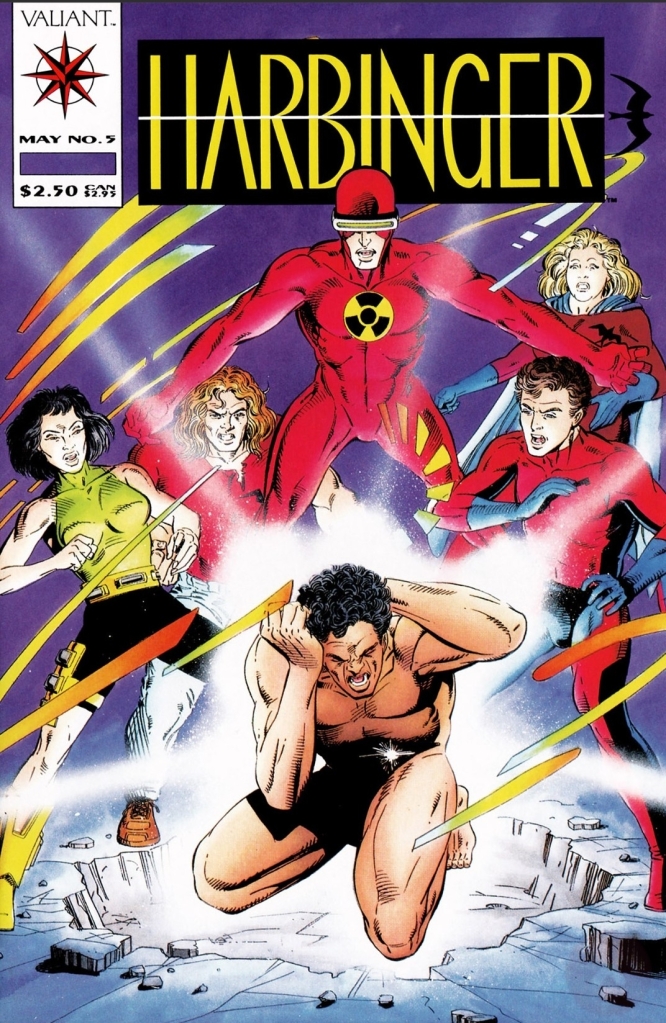
The cover.

Early story

The story begins on March 5, 1992 in New Orleans, Louisiana. Sting, Fatih, Flamingo, Kris and Torque are on vacation together. With hours to spare before having a group dinner, the team decide to split up and have fun discovering the local places individually.

That evening, while having a nice dinner together, Kris notices Sting looking tense. Sting reveals that he senses the presence of Toyo Harada and moments later, he and his teammates saw the TV news about the terrible explosion on a building in Dallas, Texas.

Over at the airport in Dallas, Toyo Harada arrives from Louisiana. He and his personnel travel together to the site of the explosion…

Quality
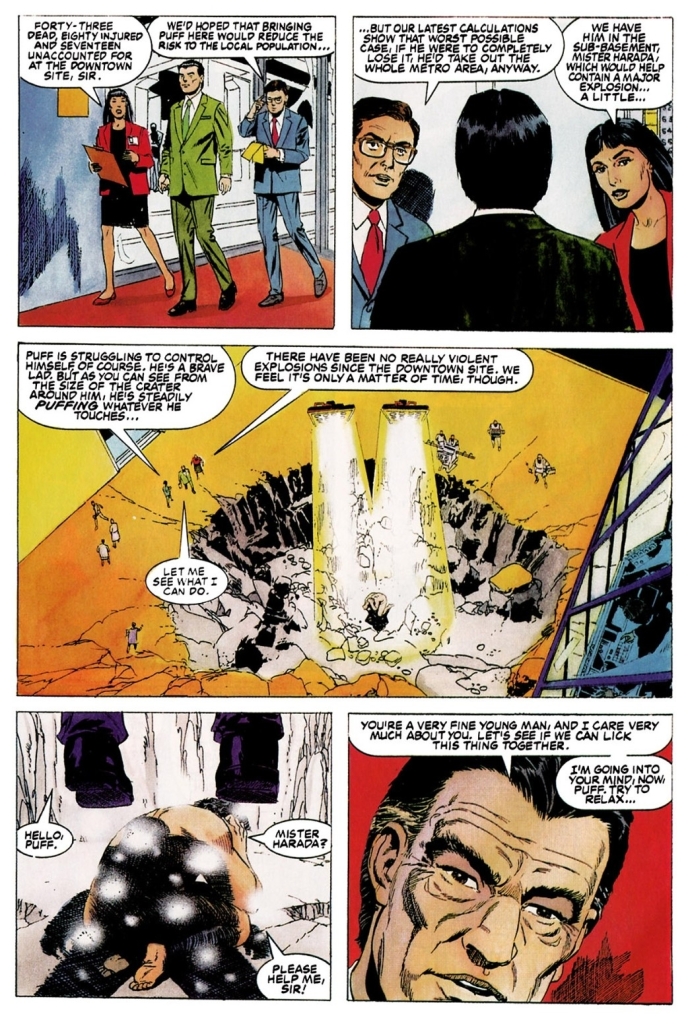
Harada arrives in Dallas, Texas.

I really liked the story here. Without spoiling the plot, the writers crafted a tale about a major incident that affected not only Sting and his teammates but also the Harbinger foundation  (including Toyo Harada himself) and even Valiant’s major figure Solar. Along the way, the creative team slightly expanded the lore of Harbinger within Valiant’s shared comic book universe further (specifically through the Harbinger foundation) before the crossover with Solar happened.

The story started in a really interesting way. I really enjoyed the way Sting, Faith, Kris, Torque and Flamingo were portrayed when they were not doing any superhero-related stuff as they enjoyed their vacation New Orleans. That being said, I felt like I was watching scenes of American teenagers from the 1980s movies written or directed by John Hughes. The scene in which Faith surprised Torque in the city zoo was amusing and believable to read.

Conclusion

Flamingo, Kris, Torque and Faith on vacation in New Orleans.

With a fine balance of spectacle, characterization, exposition and the obvious crossover with Solar, Harbinger (1992) is yet another solid Valiant comic book to read. The progression of the development of Sting and his teammates moved forward some more while simultaneously building up the presence of the Harbinger foundation as the most antagonistic non-military organization in the entire Valiant comic book universe of the era. This is a must-read!

Overall, Harbinger (1992) is highly recommended!

+++++

Thank you for reading. If you find this article engaging, please click the like button below and also please consider sharing this article to others as well as making a donation to support my publishing. If you are looking for a copywriter to create content for your special project or business, check out my services and my portfolio. Feel free to contact me with a private message. Also please feel free to visit my Facebook page Author Carlo Carrasco and follow me on Twitter at  @HavenorFantasy as well as on Tumblr at https://carlocarrasco.tumblr.com/ and on Instagram at https://www.instagram.com/authorcarlocarrasco
A Look Back at Fatale #1 (1996)

Disclaimer: This is my original work with details sourced from reading the comic book and doing personal research. Anyone who wants to use this article, in part or in whole, needs to secure first my permission and agree to cite me as the source and author. Let it be known that any unauthorized use of this article will constrain the author to pursue the remedies under R.A. No. 8293, the Revised Penal Code, and/or all applicable legal actions under the laws of the Philippines.

Before I start this retro comic book review, if you are a fan of comic book veteran Jim Shooter or if you are interested in his past works, check out my reviews of Warriors of Plasm issues #1, #2 and #3.

Have you ever heard about Broadway Comics? That was a short-lived comic book publisher that was established by Jim Shooter (former editor-in-chief of Marvel Comics and Valiant Comics) in the mid-1990s not so long after the closure of Defiant Comics (a certain lawsuit filed by Marvel Comics drained the company’s funds by means of legal fees). Broadway Comics published a few properties and among them is Fatale which was actually a spin-off of the company’s main series Powers That Be.

Fatale was not just another new project to help a new publisher make a splash in what was back then a lucrative comic book market. There was some inspiration from it as Shooter confirmed in his message in Fatale’s debut issue.

“As we developed Fatale, each person in our group recalled the strong women in their lives,” Shooter recalled.

“I told about my grandmothers, both whose husbands died young, both of whom raised their children alone, struggled and worked into their late eighties. Usually, there were no good jobs to be had (by women), but both did whatever they could, including dishwashing, door-to-door sales, and cleaning hotel rooms. They persevered against all odds, heroically. They taught me that self-reliance and honest work of any kind are the foundation of self-respect,” he added.

With those details laid down, here is a look back at Fatale , published by Broadway Comics in 1996 with a story written by Jim Shooter, Janet Jackson, Joseph A. James and Pauline Weiss with art done by J.G. Jones.

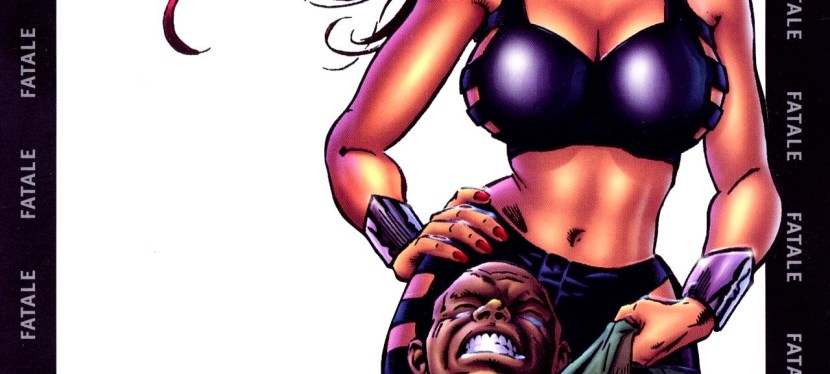
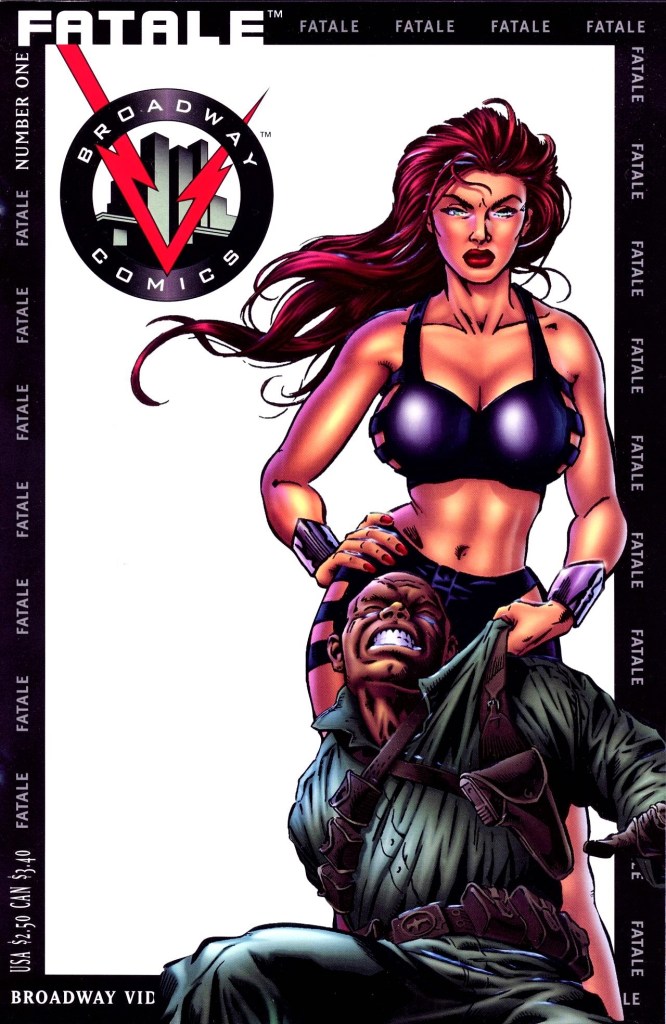
The cover.

Early story

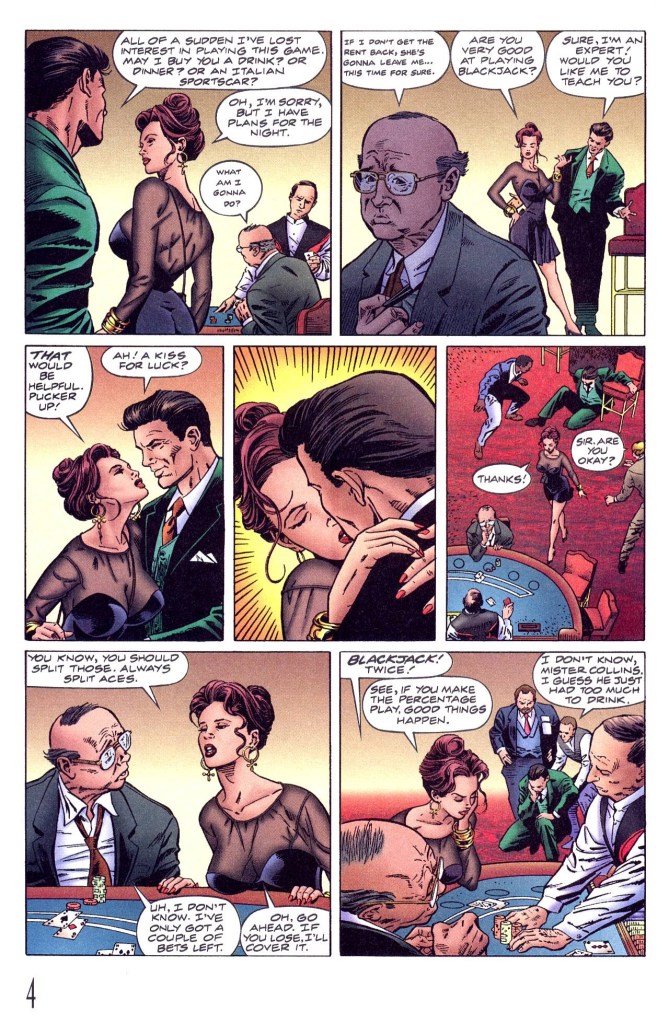
The story begins inside a casino in Atlantic City, New Jersey in September 1995. A very pretty lady walks down and attracts the attention of a few people. Her name is Desiree Hopewell and it turns out she is a gambler and she thinks luck will come to her that night. Just as she makes positive impact on a struggling gambler and starts socializing with a guy who is so attracted to her, a group of men wearing gloves and masks appeared which compels Desiree leave. She happens to be their target.

Just after exiting the casino, Desiree suddenly finds herself completely surrounded by armed people composed of those carrying shields and weapons. Even as a blast blanket successfully landed on her, Desiree finds a way to tear through it causing the armed personnel to use a drum lift on her.

Even so, Desiree continues to be hard for them to restrain and manages to move away from them…

Quality

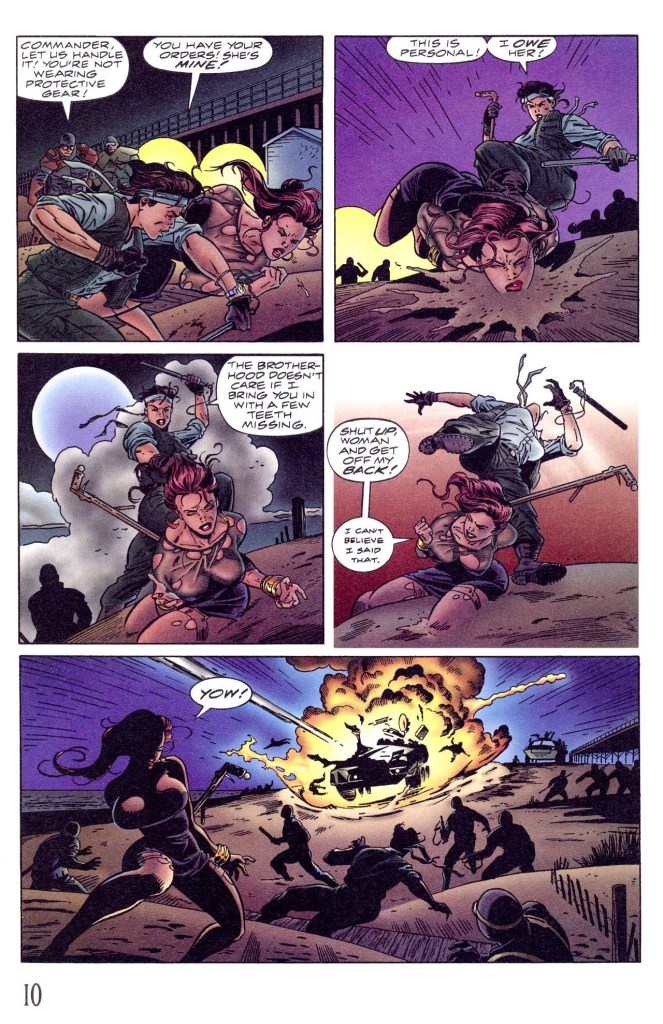
Desiree gets a break as the Brotherhood got attacked.

To start with, this comic book has a really intriguing plot laced with twists. Essentially this is the story of Desiree who is a very unusual lady with the ability to absorb something from men she kisses with on their lips (the Fatale thing). More than that, she is caught in the middle of a conflict between the Brotherhood and the Utah Faction, and she is allied with a few people trying to evade the two conflicting groups.

While the very nature of the conflict was not fully emphasized in this launch issue, Jim Shooter and his co-writers successfully defined Desiree’s nature clearly as well as her association with a man named Bill (a former Brotherhood member). That being said, this comic book is character-focused and it went to great lengths to connect readers with Desiree and the supporting cast.

When it comes to spectacle, there is a lot to enjoy here. On face value, Desiree’s uncanny ability evade the Brotherhood’s attempt to capture her was presented with superhero-inspired spectacle but never reaching the point of defining her as a superhero-type of protagonist.

Conclusion

Desiree the attraction and seasoned gambler.

Fatale (1996) is a rather unusual comic book that has some literary stuff to sell to superhero enthusiasts, and at the same time it has a protagonist who supposedly got presented as a strong-willed figure for women (while showing her personal interests and views that were supposed to be relatable to women). Within the pages of this comic book, Desiree is glamorous and attractive visually. Apart from helping a lady by physically stopping the man troubling her, Desiree has not done anything genuinely heroic and is truly more of an attraction of trouble makers.

As far as storytelling goes, you have a conflict between two groups and Desiree is a target for a reason that was not clearly defined (note: saving the answers for later issues obviously). While Bill is an interesting supporting character, the others are just not too interesting. If you are looking for intrigue, entertainment and mystery, you will find some of those here.

If you are seriously planning to buy an existing hard copy of Fatale (1996), be aware that as of this writing, MileHighComics.com shows that the near-mint copy of the regular edition costs $79 while the near-mint copies of the black-and-white Jim Shooter-signed edition, the black-and-white promo edition, and the Jim Shooter-signed edition cost $79, $53 and $70 respectively.

Overall, Fatale (1996) is satisfactory.

+++++

Thank you for reading. If you find this article engaging, please click the like button below and also please consider sharing this article to others. If you are looking for a copywriter to create content for your special project or business, check out my services and my portfolio. Feel free to contact me as well. Also please feel free to visit my Facebook page Author Carlo Carrasco and follow me at HavenorFantasy@twitter.com