A Look Back at Superman: The Man of Steel #18 (1992)

Disclaimer: This is my original work with details sourced from reading the comic book and doing personal research. Anyone who wants to use this article, in part or in whole, needs to secure first my permission and agree to cite me as the source and author. Let it be known that any unauthorized use of this article will constrain the author to pursue the remedies under R.A. No. 8293, the Revised Penal Code, and/or all applicable legal actions under the laws of the Philippines.

Welcome back superhero enthusiasts, 1990s culture enthusiasts and comic book collectors! Today we go back to the early 1990s and explore a key chapter in the post-Crisis era of DC Comics through a Superman comic book – the first full appearance of Doomsday!

To those of you who read my retro review of Adventures of Superman #498 (1993) – which was the opening chapter of the Funeral for a Friend storyline – you might be wondering why I decided to revisit the Death of Superman storyline so suddenly. It all comes down to context related to Superman’s eventual death and what killed him. Not only did Doomsday become a very important part of DC Comics’ gallery of super villains having achieved the killing of the Man of Steel, the oversized monster became part of DC’s further comic book universe reboots as well as part of multimedia adaptations of DC Comics stories specifically in the Smallville TV series as well as in 2016’s Batman v. Superman: Dawn of Justice.

Indeed, Doomsday’s place in American pop culture is sealed and that shows how much of an impact was made by the unstoppable super villain co-created by Dan Jurgens, Brett Breeding, Jerry Ordway, Louise Simonson and Roger Stern. Doomsday was conceived way back in 1991 during the brainstorming session of the Superman comics writers and editors of the time.

With those details laid down, here is a look back at Superman: The Man of Steel #18, published in 1992 by DC Comics with a story written by Louise Simonson and drawn by Jon Bogdanove. This comic book marked the beginning of the Death of Superman saga.
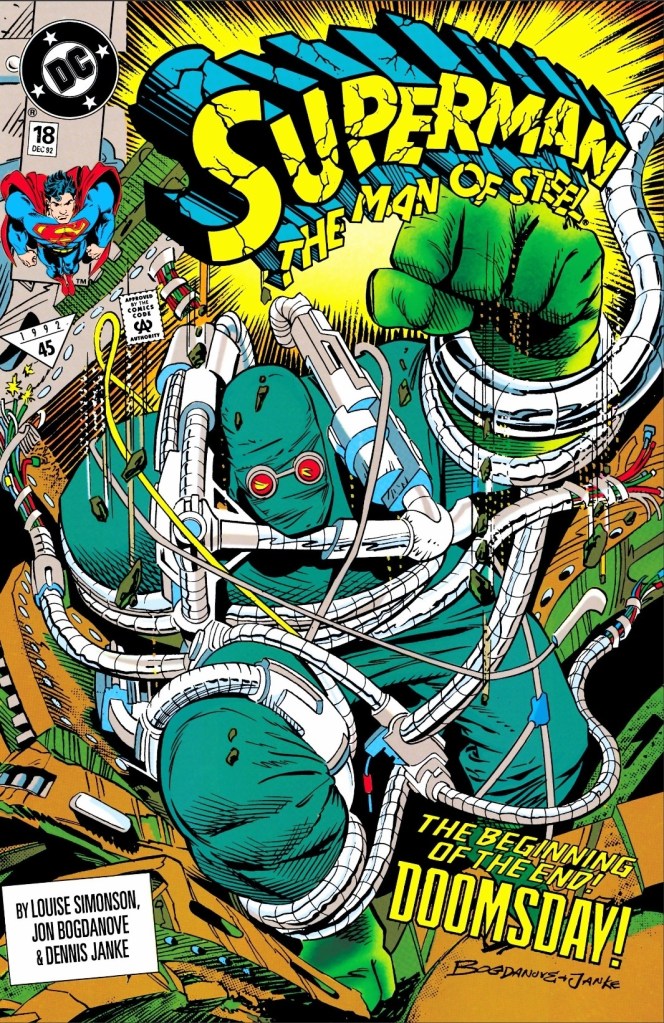
The cover.

Early story

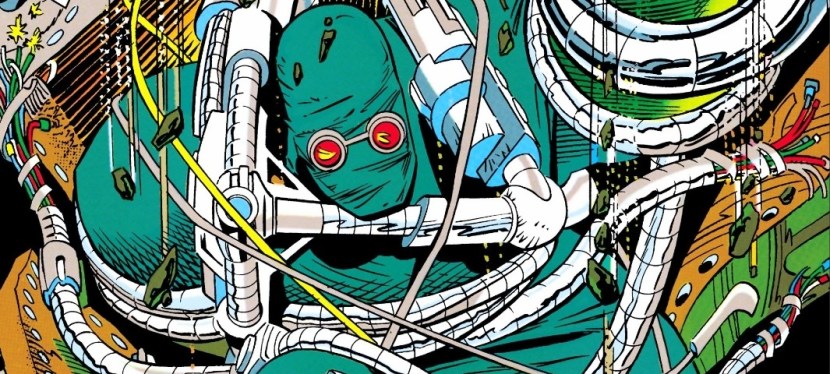
The story begins deep underground as the left fist of a covered, large being keeps punching the metallic wall to get out of containment. As the punches keep on pounding the wall, the glove gets torn revealing a fist with gray skin and sharp bones protruding through the knuckles. After making its way out of containment, the earth shakes and the animals got disturbed as the creature – mostly covered with an alien body suit  with only the left arm freed – makes its way from deep underground.

Miles away within the city of Metropolis, a young black boy buys a spray paint container (which has a fluorescent yellow paint that glows in the dark) inside a hardware store. In response to the curiosity of the store owner, the boy denies that he would use the glow-in-the-dark pain on a subway wall. The boy has a very tough task ahead of him as he will be going after monsters.

At a power station, a group of intelligent creatures make their way to steal electricity for their war machines…

Quality
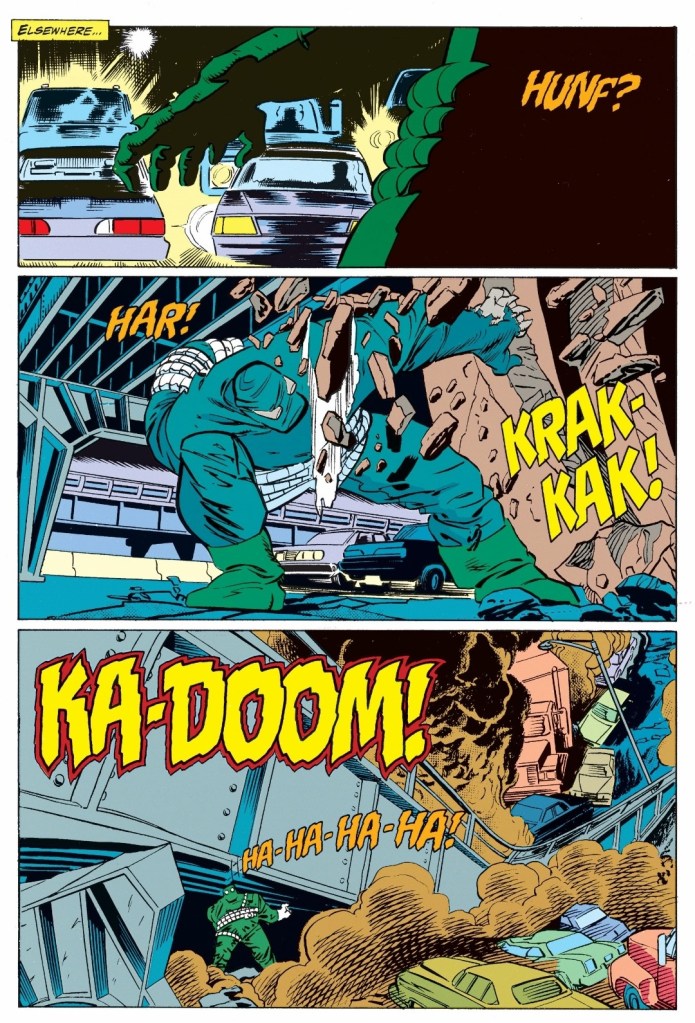
Even with only his left arm free, Doomsday still caused massive destruction causing injuries and deaths to others.

To make things clear, this comic book tells two stories that moved in parallel together. The first story involving Superman, Lois Lane and the affairs that involved the mentioned young black boy is the typical good-versus-evil superhero tale. What made that story standout was Lois Lane’s involvement as she got into trouble facing the opposition before Superman came in to save the day. As before, seeing Lois Lane talk to Superman in the presence of others while keeping his identity secret remains engaging to read. This tale was good enough to read.

The other story that follows the sudden appearance and the early rampage of Doomsday is the more engaging one to read. This was clearly a build-up for the Death of Superman concept but it was highly effective, well-paced and clearly defined by the creative team. Not only will you see Doomsday’s unstoppable power of destruction, you will witness his complete disregard of life – animals and humans – which strongly hints the an immense danger that Superman, the Justice League America (JLA) and the people of Metropolis are not prepared for. Like the Terminator, Doomsday cannot be reasoned with as massive destruction and death are his core elements. Within the pages of this comic book, it can be viewed that Doomsday was designed for endless waves of destroying life and anything that gets in the way.

Lastly, I should state that Simonson and Bogdanove presented Doomsday not only to be destructive but also as a frightening force that people in real life would not want to see realized.

Conclusion
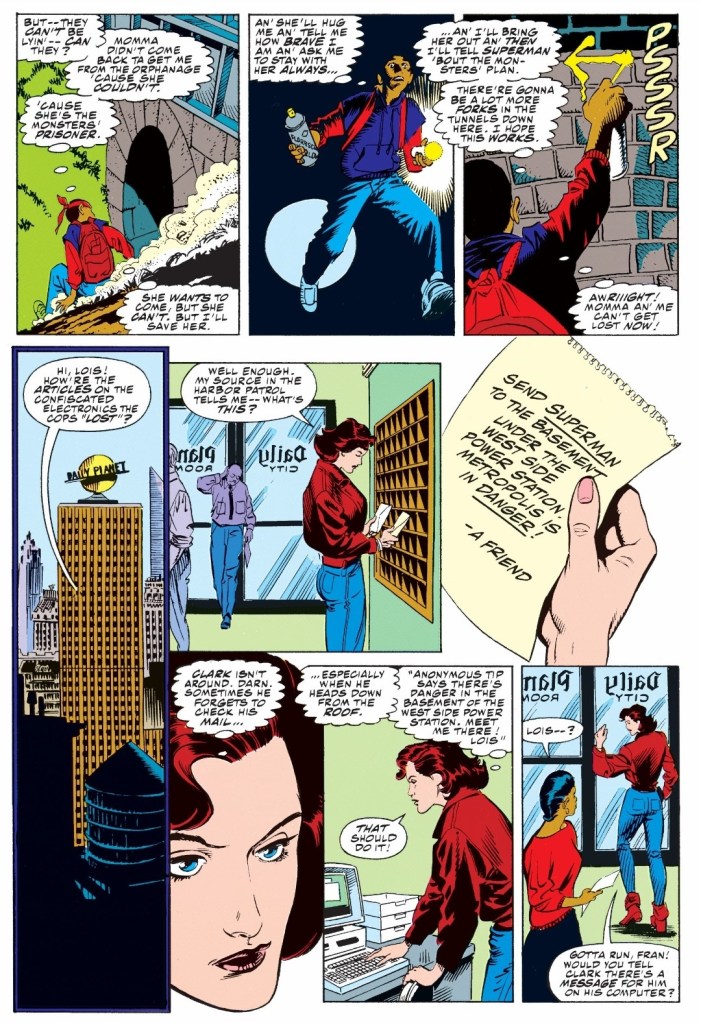
The other tale that involved Lois Lane and the young black boy.

Superman: The Man of Steel #18 (1992) remains a very powerful read. Yes, it is a build-up of Doomsday and the Death of Superman saga but it remains highly significant as it kicked-off the creative change of direction of DC’s Superman creative teams going towards tragedies that Superman and his allies cannot easily stop. This one marked start of Doomsday’s eventual high rise not only in comics but also in pop culture in general. That being said, this comic book is a must-have in your collection.  

Overall, Superman: The Man of Steel #18 (1992) is highly recommended.

+++++

Thank you for reading. If you find this article engaging, please click the like button below, share this article to others and also please consider making a donation to support my publishing. If you are looking for a copywriter to create content for your special project or business, check out my services and my portfolio. Feel free to contact me with a private message. Also please feel free to visit my Facebook page Author Carlo Carrasco and follow me on Twitter at  @HavenorFantasy as well as on Tumblr at https://carlocarrasco.tumblr.com/ and on Instagram at https://www.instagram.com/authorcarlocarrasco
A Look Back at Tomb Raider #1 (1999)

Disclaimer: This is my original work with details sourced from reading the comic book and doing personal research. Anyone who wants to use this article, in part or in whole, needs to secure first my permission and agree to cite me as the source and author. Let it be known that any unauthorized use of this article will constrain the author to pursue the remedies under R.A. No. 8293, the Revised Penal Code, and/or all applicable legal actions under the laws of the Philippines.

Welcome back superhero enthusiasts, 1990s culture enthusiasts and comic book collectors! Today we go back to 1999 which was the year when the wildly popular Tomb Raider video game franchise made its debut in comic books handled by Top Cow Productions with Image Comics as publisher.

To put things in perspective, Tomb Raider started as a video game in 1996 which astounded millions of gamers worldwide resulting in huge sales for game publisher Eidos Interactive. This, of course, led to sequels which impacted console gaming and established Lara Croft as a video gaming and pop culture icon. From 1996 to 1999, Eidos Interactive released one new Tomb Raider game on consoles selling many millions of copies. Given the tremendous video game success achieved, Tomb Raider’s expansion into the comic book industry was inevitable.

With those details laid down, here is a look back at Tomb Raider , published in 1999 by Image Comics with a story written by Dan Jurgens and drawn by Andy Park.

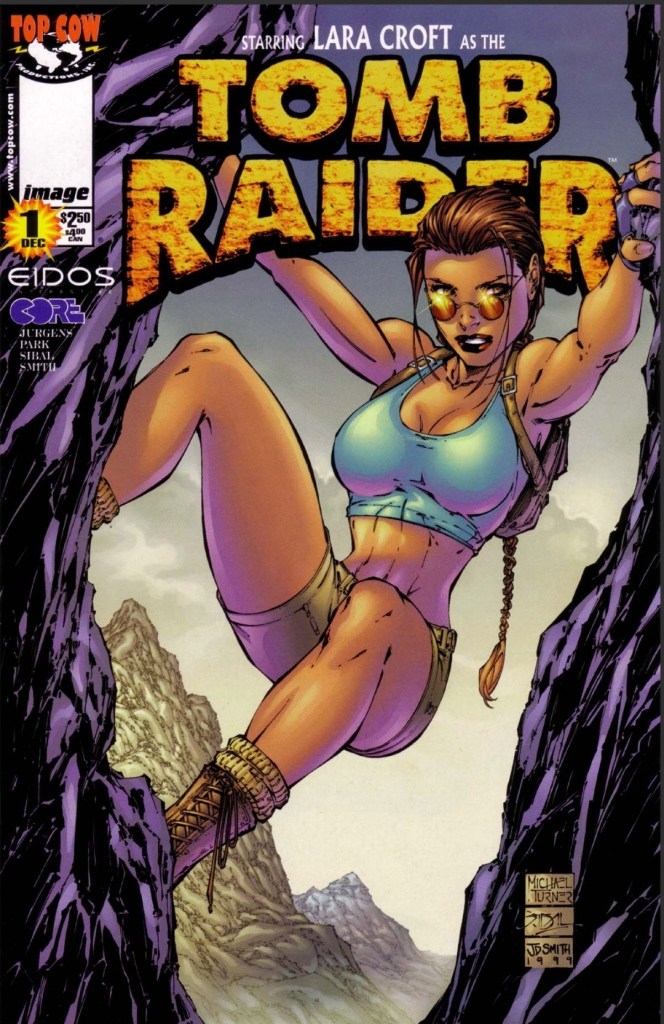
The cover.

Early story

The story begins in Iran, a nation that remains hostile to Westerners due to their government being led by fundamentalists with vested interest in terrorism. Two vehicles arrived at a very laid back town and immediately several armed men forcibly unmask the local women searching for a certain Westerner.

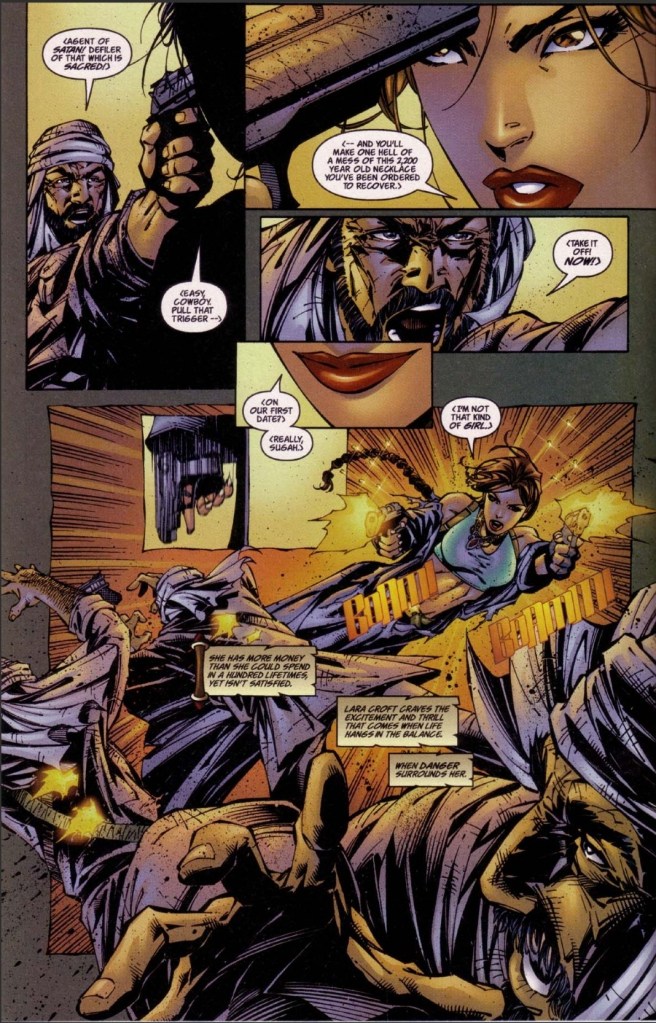
One Iranian soldier approaches a lady clothed and masked in black. Upon unmasking the said lady, the Iranian soldier discovers a lady from the West…the Tomb Raider herself – Lara Croft – wearing an extravagant looking necklace. The Iranian soldier puts his gun on Lara’s face and demands she takes the necklace off.

Lara Croft answers by firing her two guns at the Iranian soldiers hitting some while also forcing other soldiers to run away. Knowing she has to get out of Iran, Lara runs away from the soldiers and gets into a jeep forcing the man to drive the vehicle and move away. As the jeep moves out of the town, a truck full of enemy soldiers chases them…

Quality

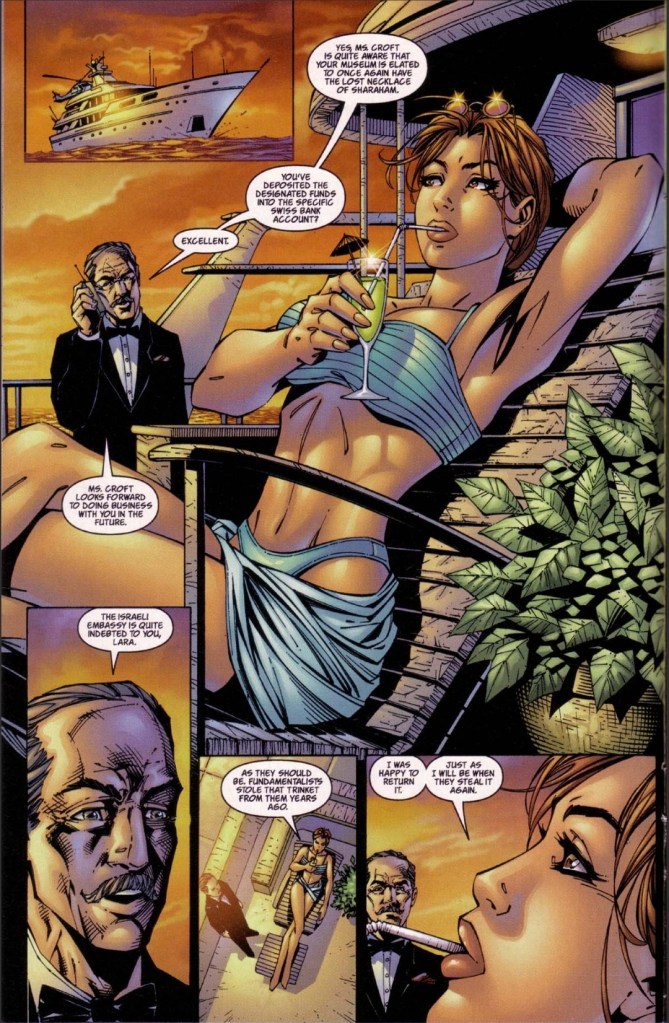
Lara Croft relaxing as her assistant gets updates about the business dealings.

To get straight to the point, this comic book debut of Tomb Raider and its iconic Lara Croft was clearly written to build up the initial concept the creative team came up with for the series. That being said, Dan Jurgens came up with the clever move to make Lara’s literary introduction action-packed and fast-paced, and his portrayal of Iran remains highly relevant to this day. Lara’s debut is a lively portrayal of the icon’s bravery, determination and special talent on acquiring treasure or items of tremendous value.

In relation to what I stated earlier, the rest of the comic book is a detailed build-up for Lara’s next mission which shows how she deals with powerful clients and why she still accepts million-dollar tasks even though she inherited her family’s huge wealth. While there is a lot of build-up and some exposition here and there, the script by Jurgens is not a bore Jurgens captured Lara Croft’s personality well and there is a good amount of spectacle that balanced well with the wordy exposition that came with the story build-up.

On the art, Andy Park’s work here is pretty good to look at. His visual take of Lara Croft does not involve realism at all as he gave her a look that make her look familiar with how women in comic books looked like in the 1990s. Park clearly is aware of Lara’s iconic status which explains his implementation of dynamism on the action scenes and the unexpected turnout of events that involved her. Still related to the protagonist’s iconic status, it is unsurprising to see Park show off Lara as a sexy action hero dedicated on her risky work.

Conclusion

After getting threatened, Lara Croft fights back against the Iranians! This is symbolic as even until now in real life, Iran’s government is still full of fundamentalists who are causing terror in the Middle East.

As it was the debut issue of a monthly series, Tomb Raider (1999) served its purpose to build up the comic book vision the creators came up with while managing to introduce Lara Croft in her illustrated literature form complete with enough pages of action and spectacle. Even though there is no grand event, this is still an entertaining comic book to read and its build-up never created a single boring moment. By the time I reached the end of this comic book, I got to familiarize myself with literary Lara Croft and more importantly, I got interested enough with this small showcase of what Jurgens and Park prepared. I got interested enough to find out what happens next.

Overall, Tomb Raider (1999) is recommended.

+++++

Thank you for reading. If you find this article engaging, please click the like button below, share this article to others and also please consider making a donation to support my publishing. If you are looking for a copywriter to create content for your special project or business, check out my services and my portfolio. Feel free to contact me with a private message. Also please feel free to visit my Facebook page Author Carlo Carrasco and follow me on Twitter at  @HavenorFantasy as well as on Tumblr at https://carlocarrasco.tumblr.com/ and on Instagram at https://www.instagram.com/authorcarlocarrasco