A Look Back at Wonder Woman #22 (1988)

Disclaimer: This is my original work with details sourced from reading the comic book and doing personal research. Anyone who wants to use this article, in part or in whole, needs to secure first my permission and agree to cite me as the source and author. Let it be known that any unauthorized use of this article will constrain the author to pursue the remedies under R.A. No. 8293, the Revised Penal Code, and/or all applicable legal actions under the laws of the Philippines.

Welcome back, superhero enthusiasts, comic book collectors and fans of DC Comics! I wonder how many among you readers got to watch Zack Snyder’s Justice League? That was the so-called definitive version of the Justice League live-action movie that Zack Snyder originally envisioned and reportedly it was the big dream come true for fans of the director and his own vision of the current cinematic universe of DC Comics superheroes.

While the so-called Snyder Cut of Justice League has Gal Gadot as Wonder Woman, I personally am not too excited for it but I will watch it much later on Blu-ray or perhaps 4K Blu-ray someday. What I am anticipating right now is the 4K Blu-ray release of Wonder Woman 1984 scheduled for March 30, 2021.

With regards to the literary Wonder Woman (post-Crisis DC Comics universe) as I’ve been reviewing a lot for some time now, things went crazy with what happened in issue #21. I’m talking about something that involved Wonder Woman with the deities of Olympus.

With those details laid down, here is a look back at Wonder Woman #22, published by DC Comics in 1988 with a story written and drawn by George Perez with Bob McLeod credited with the finished art.
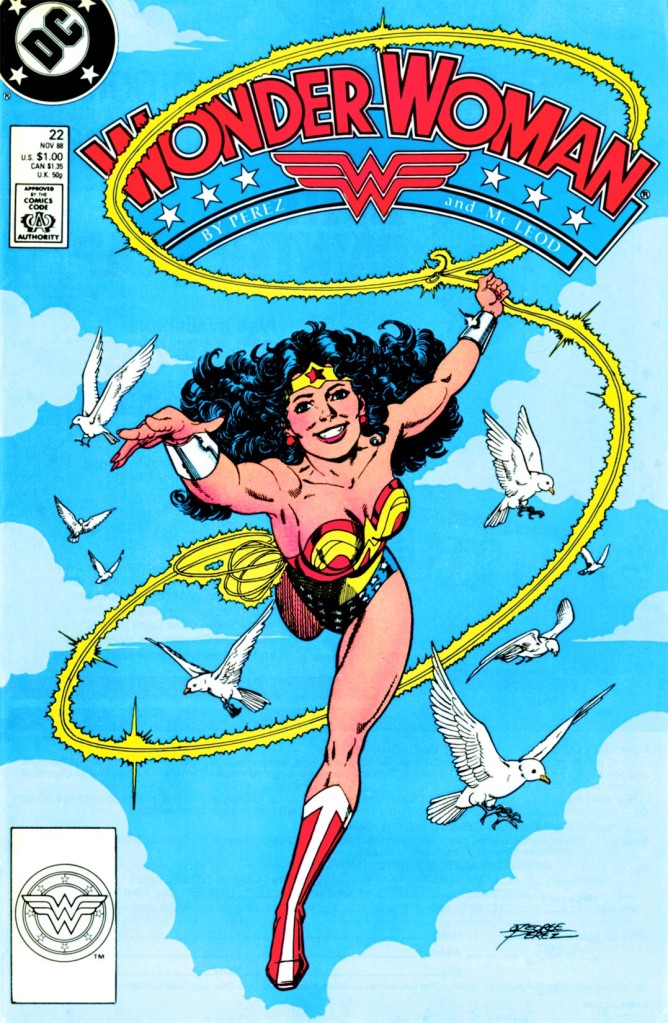
The cover.

Early story

The story begins in Themyscira. All the Amazons are called by Diana to a special audience in relation to an pending proclamation of a new decision that shall chart forevermore the path of the Amazon destiny.

In front of a large audience composed of her many Amazon sisters as well as her mother (Queen Hippolyte), the oracle Menalippe and headmistress Mnemosyne, Diana announces that a majority voted yes on the question of Themyscira opening her gates to the world outside and allowing man to set food on the shores of paradise island.

There was no fanfare, no cheers and no applause from the audience as the announcement marked the beginning of the new stage in the history of Amazons.

Meanwhile in outer space, a silvery orb flies around in very fast speed heading towards Earth…

Quality
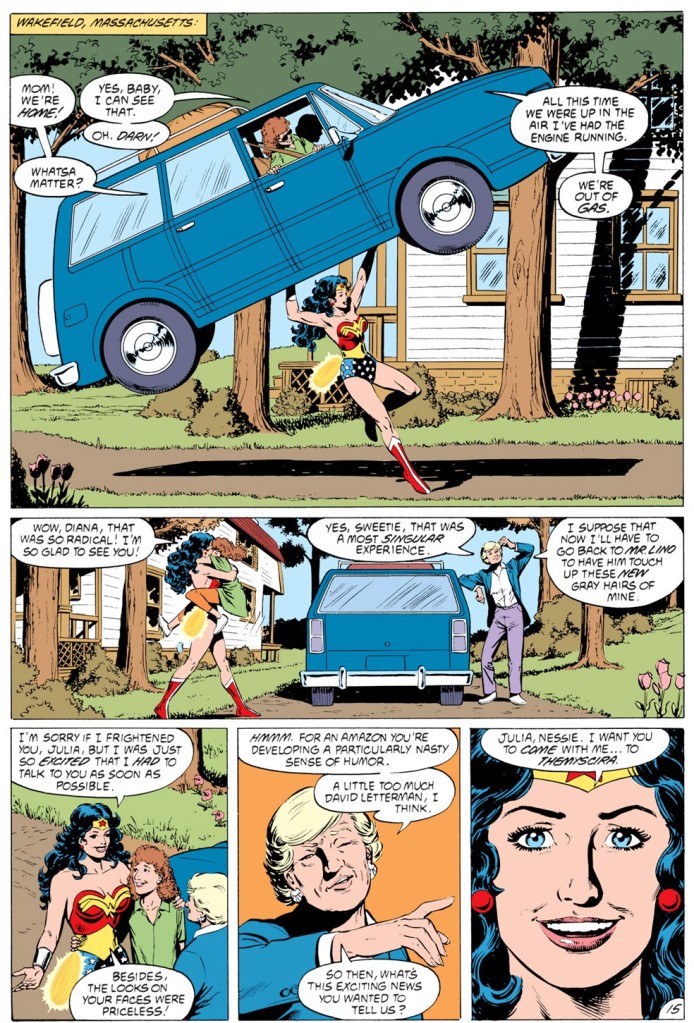
Wonder Woman’s lifting of the car looked inspired by the famous cover of Action Comics from 1938.

To make things clear, the story of this comic book is mainly a build-up for something significant that will happen later. There is no real battle of good-versus-evil here, nor would you see Wonder Woman encounter someone sinister.

In terms of build-up, the approval by the Amazons of cultural exchange and sharing of access with man’s world is itself a set-up for a significant event for Wonder Woman and her two closest friends on Earth. On other matters, the arrival of the space orb on Earth was presented very nicely and it surely is intriguing to see how it builds up for an upcoming new anti-hero element.

If you are a Wonder Woman fan expecting to see more of Diana getting dramatized and developed, you might be disappointed that this comic book has lesser content about her than usual. In fact, there is a good amount of pages here that pay close attention to Vanessa Kapatelis having a bad day in school, plus her mother Julia attracting the attention of a certain school teacher. This particular comic book really tried hard dramatizing the mother-and-daughter relationship of the two supporting characters but ultimately (and not surprising) it’s nowhere as engaging as that of Queen Hippolyte and Diana.

Conclusion
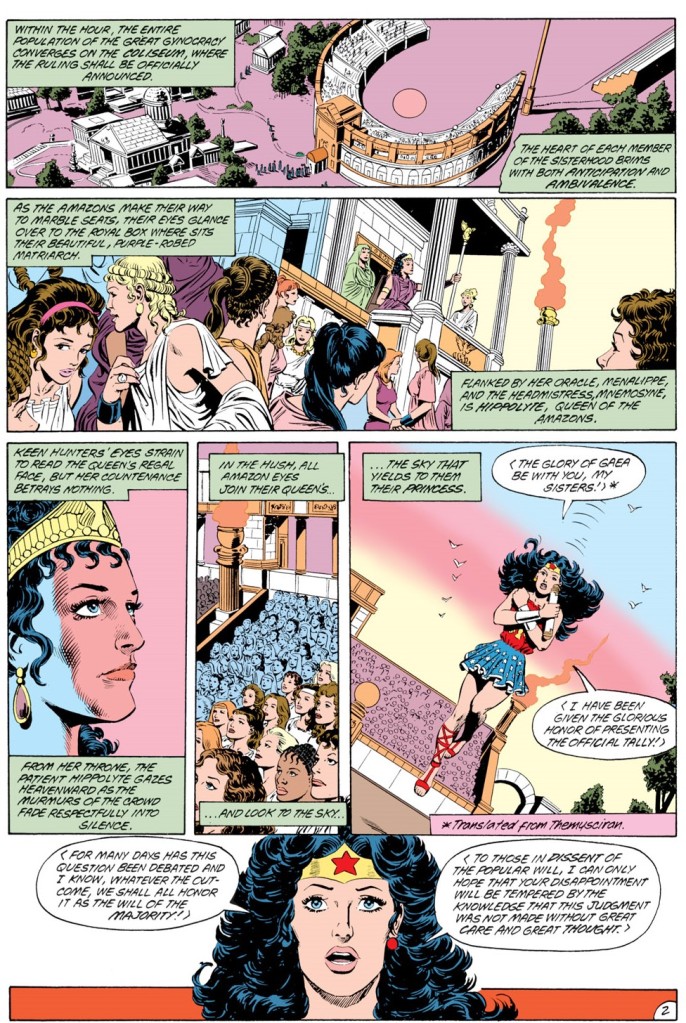
Diana doing her duty in front of a tremendous audience of her Amazon sisters plus her mother Queen Hippolyte.

Behind its beautiful cover, Wonder Woman #22 (1988) is not only an underwhelming follow-up to the epic development in issue #21, it is also the least engaging issue I’ve read about the post-Crisis version of Wonder Woman under the creative direction of George Perez. It’s really more about setting the stages for a future conflict and a special visit to Themyscira (you can guess who would visit to see Wonder Woman’s Amazon sisters). George Perez’s writing is still of pretty good quality and he really knows how to define each character’s personality but it’s the overall concept of the comic book that is underwhelming.

If you are seriously planning to buy an existing hard copy of Wonder Woman #22 (1988), be aware that as of this writing, MileHighComics.com shows that the near-mint copy of the regular edition costs $35 while the near-mint copy of the 2nd printing costs $350.

Overall, Wonder Woman #22 (1988) is satisfactory.

+++++

Thank you for reading. If you find this article engaging, please click the like button below and also please consider sharing this article to others. If you are looking for a copywriter to create content for your special project or business, check out my services and my portfolio. Feel free to contact me as well. Also please feel free to visit my Facebook page Author Carlo Carrasco and follow me at HavenorFantasy@twitter.com
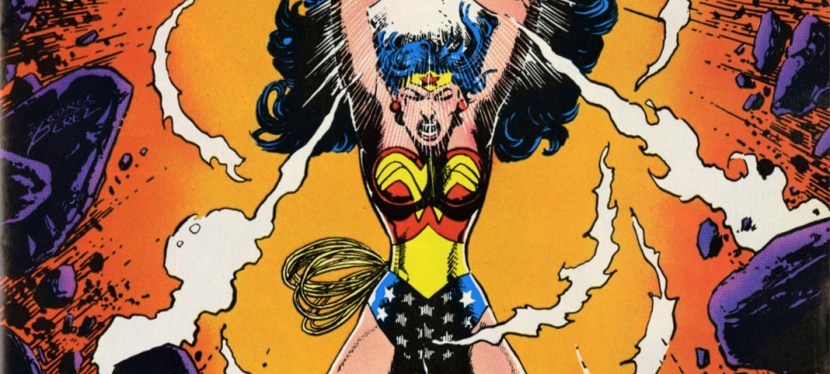
A Look Back at Wonder Woman #21 (1988)

Disclaimer: This is my original work with details sourced from reading the comic book and doing personal research. Anyone who wants to use this article, in part or in whole, needs to secure first my permission and agree to cite me as the source and author. Let it be known that any unauthorized use of this article will constrain the author to pursue the remedies under R.A. No. 8293, the Revised Penal Code, and/or all applicable legal actions under the laws of the Philippines.

Welcome back, superhero enthusiasts, comic book collectors and fans of superhero universe of DC Comics! I don’t know with you, my readers, but I love the way George Perez and his fellow writers characterized Wonder Woman during the very early stage of the post-Crisis era of DC Comics. The character development was not only a great way to achieve balance with spectacle and plotting for each story of Wonder Woman, but also a solid way to redefine the Queen of Superheroes to new fans as well as other comic book readers of the late 1980s. Such characterization efforts include redefining other key elements of the Wonder Woman concept such as the development of Themyscira and its all-women society, the struggle that the deities of Olympus had while the Amazons struggled, and most notably the way Wonder Woman and the people of man’s world adjusted to each other.

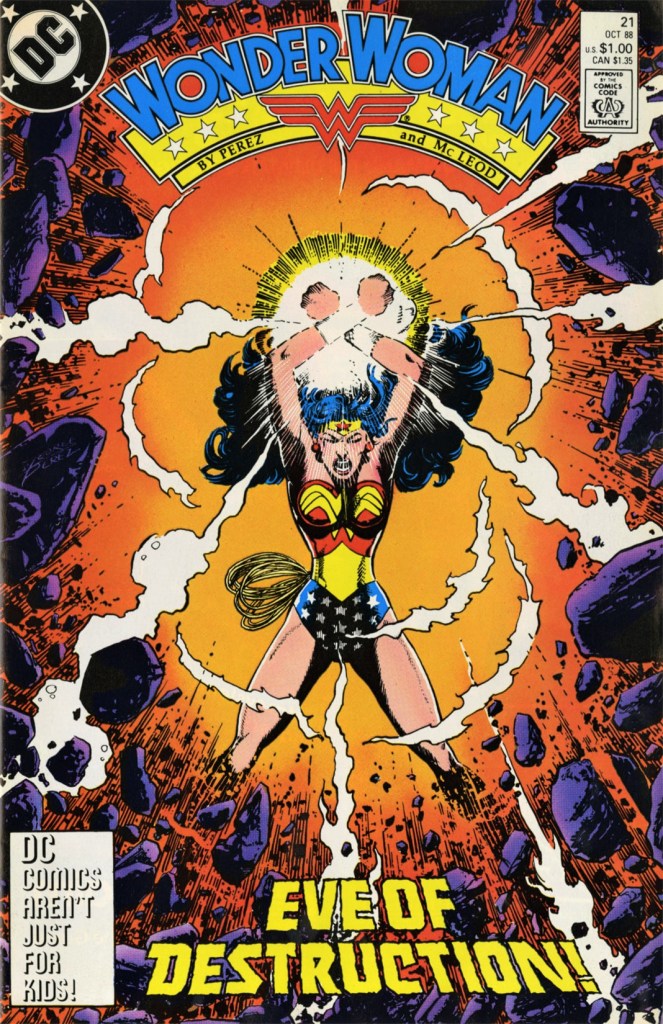
With those details laid down, we can find out more about Wonder Woman’s development in this look back at Wonder Woman #21, published by DC Comics in 1988 with a story written and drawn by George Perez with Bob McLeod credited with the finished art.

The cover.

Early story

The story begins in Themyscira. In the middle of the night, Menalippe, the oracle of the Amzons wakes up looking terrified. She makes a reference to the deities of Olympus. In Wakefield, Massachusetts, Diana/Wonder Woman, Julia Kapatelis and teenager Vanessa arrive home from the memorial service of the late Myndi Mayer. As Vanessa goes to her bedroom feeling depressed, Diana admits to Julia that she is deeply troubled over what happened in recent times. She also expressed that she can’t help feeling partially responsible for Mayer’s death.

As Julia tries to comfort Diana, several knocks were made at the house door. Upon opening it, a bird carrying a note suddenly flies into the house and heads straight to Diana who recognizes it and reads a new message written by her mother, the queen Hippolyte.

After reading it, Diana leaves for Themyscira with a promise to Julia and her daughter that she will return. Shortly after arriving in her nation, she, her mother and all their Amazon sisters assembled at the altar of Apollo and performed a ritual led by Menalippe. Menalippe claims to have made contact with the deities and states that she, Diana and Queen Hippolyte have been called to appear at the court in Mount Olympus…

Quality

The deities of Olympus were never holy and were in fact very flawed beings who happen to hold tremendous power over Wonder Woman and the Amazons.

I can say that this is a story about the foundation of Wonder Woman’s place in the DC Comic universe as it involves the link between Olympus and Themyscira. The good news here is that this story is very well written and the plot structure was nicely organized by George Perez.

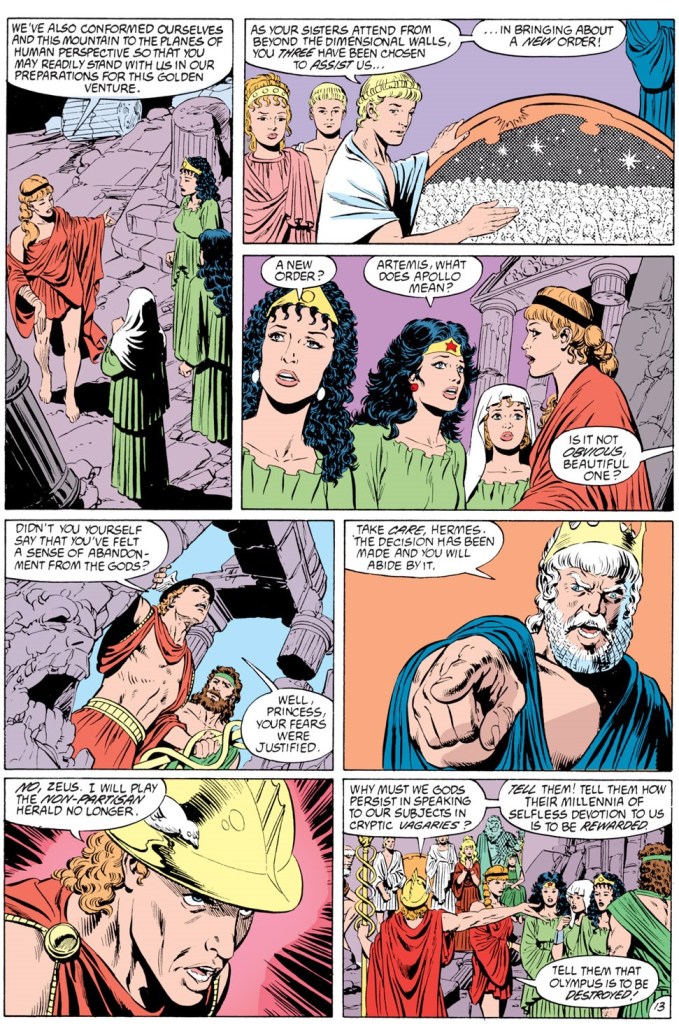
In many ways, this story is a continuation to Wonder Woman’s personal interaction with the deities of Olympus. The difference here is that her mother Queen Hippolyte and their oracle are much more involved and the deities – which include Zeus, Hera, Heracles and the rest – themselves have gotten into tremendous trouble as a result of what Darkseid did to them. This leads to the call of a new order which got the three Amazons chosen. This alone marks the new chapter in the lives of Amazons and Wonder Woman, who proved her worth in the Challenge of the Gods storyline, is unsurprisingly part of it.

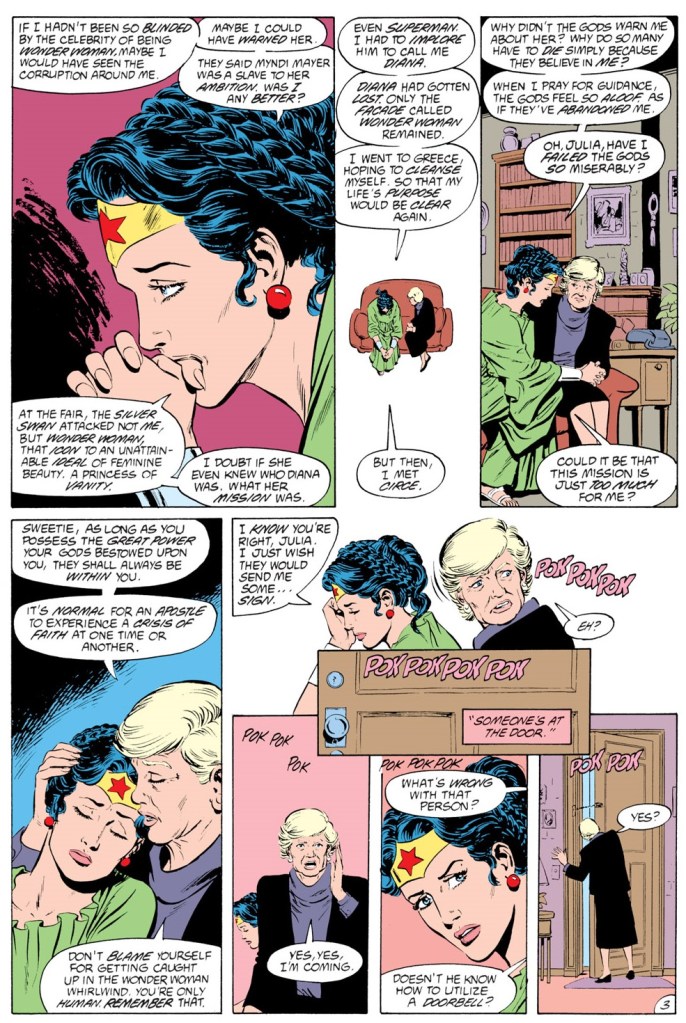
When it comes to the character development of Wonder Woman, the golden part happened early in this comic book. I love the way that George Perez portrayed Diana to be fragile as a person who realizes that her being a very powerful icon in man’s world causes both blessings and problems around her. Diana admits getting blinded by the celebrity of being Wonder Woman to the many people around her. The dialogue Perez wrote for Diana in the early scene (in the presence of Julia) is very rich and so touching, you will feel sympathy for the Queen of all Superheroes.

Conclusion

A very touching scene about Diana/Wonder Woman dealing with the responsibility of what went wrong recently.

Apart from being a new chapter for Wonder Woman and her Amazons, Wonder Woman #21 (1988) is a richly layered story to read. It does not have the usual good-versus-evil spectacle common with most superhero comic books, but the story succeeds in moving the narrative of the Amazons and Olympus deities forward while developing Diana as an even more human character (as opposed to being a superhero). This is another great work spearheaded by George Perez.

If you are seriously planning to buy an existing hard copy of Wonder Woman #21 (1988), be aware that as of this writing, MileHighComics.com shows that the near-mint copy of the regular edition costs $33 while the near-mint copy of the newsstand edition and the 2nd print edition cost $70 each.

Overall, Wonder Woman #21 (1988) is highly recommended!

+++++

Thank you for reading. If you find this article engaging, please click the like button below and also please consider sharing this article to others. If you are looking for a copywriter to create content for your special project or business, check out my services and my portfolio. Feel free to contact me as well. Also please feel free to visit my Facebook page Author Carlo Carrasco and follow me at HavenorFantasy@twitter.com