A Look Back at Harbinger #21 (1993)

Disclaimer: This is my original work with details sourced from reading the comic book and doing personal research. Anyone who wants to use this article, in part or in whole, needs to secure first my permission and agree to cite me as the source and author. Let it be known that any unauthorized use of this article will constrain the author to pursue the remedies under R.A. No. 8293, the Revised Penal Code, and/or all applicable legal actions under the laws of the Philippines.

Welcome back superhero enthusiasts, 1990s culture enthusiasts and comic book collectors! Today we go back to the early 1990s and explore a part of the Valiant Comics shared universe through the Harbinger monthly series.

In my previous review, Sting and new recruit Natalie (Stunner) were inside the stronghold of Kaliph deep within the terrorist state of Iran. Sting’s teammates went there on a high-risk mission to rescue the two even though they had no real resources to deal with Kaliph (first appearance in issue #19) and his private army, and they also had very little time to spare. Regardless, the dangerous mission proceeded and the rescue miraculously turned out successful. The success, however, came with a certain loss.

With those details laid down, here is a look back at Harbinger #21, published in 1993 by Valiant Comics with a story written by Maurice Fontenot and illustrated by Howard Simpson.
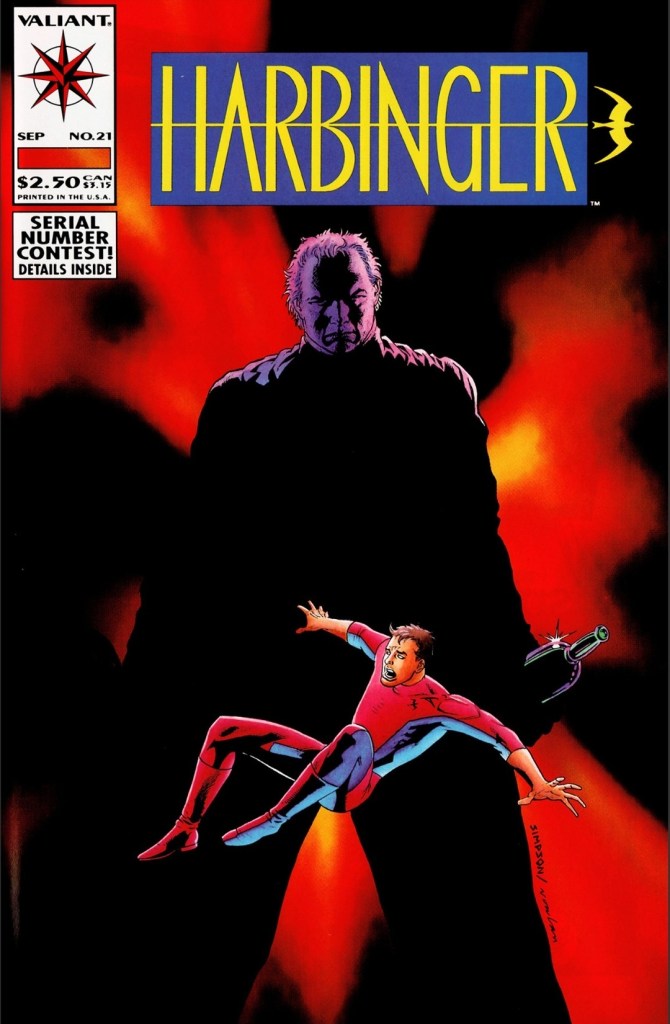
Cover.

Early story

The story begins inside the New Jersey apartment occupied by Sting and his teammates. Although weeks had passed since the dangerous mission in Iran, Sting remains in weak physical condition and he had to be carried by Faith/Zepplin and Flamingo as his lover Kris checks out a letter that was hidden from her.

Even though he is obviously not feeling well, Sting lies to Kris that he is fine. Kris reads the letter which turned out to be medical results on Sting done by Doctor Heyward. Sting was diagnosed with Mononucleosis. The weak leader of the group then falls into sleep.

Sometime later, Sting endures a nightmare and wakes up sweating and feeling very troubled…

Quality
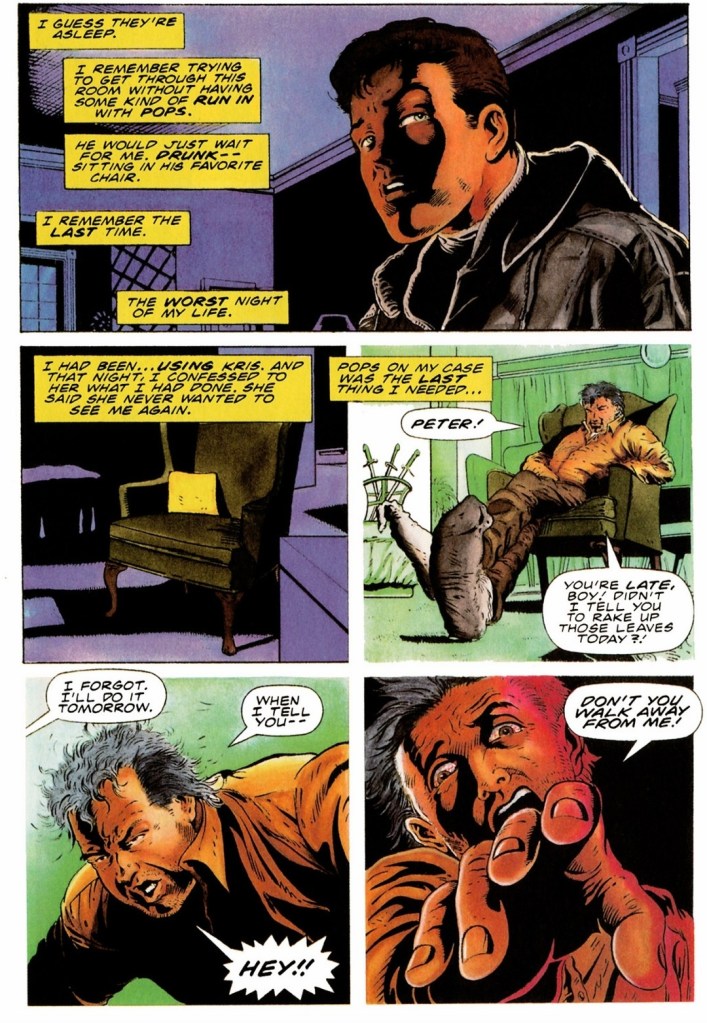
A look at Sting’s troubled relationship with his father in the past.

As a way of taking a change of direction following the previous two issues, this particular Harbinger story shifts the focus mainly on Sting and went ahead in explaining why he is such a flawed person, why he is reckless and even unworthy to be leading his teammates.

The core issue in this tale is Sting’s painful relationship with his father. Without spoiling the story details, I can say that the creative team succeed in not only dramatizing the strained father-son relationship, they also explored other elements from Sting’s past as Peter Stanchek – the young guy who had friends and lived a normal American life before his powers manifested and gradually changed everything.

More on Sting’s poor relationship with his father, the creative team came up with a pretty solid script and visuals that creatively emphasized the emotions, the pain and uncertainties on the part of the protagonist. More importantly, what they dramatized here clarified why Sting is immature, reckless and continues to live on with a distorted view of life that can be perceived as anti-family and even anti-social. Given the fact that he is unforgiving towards his father, the young team leader was revealed to be unworthy of not only of having super abilities but also unworthy of leading a group of friends who pretty much have faith in him. Sting is more than just a deeply flawed protagonist…he is also an unlikable superhero.   

Conclusion
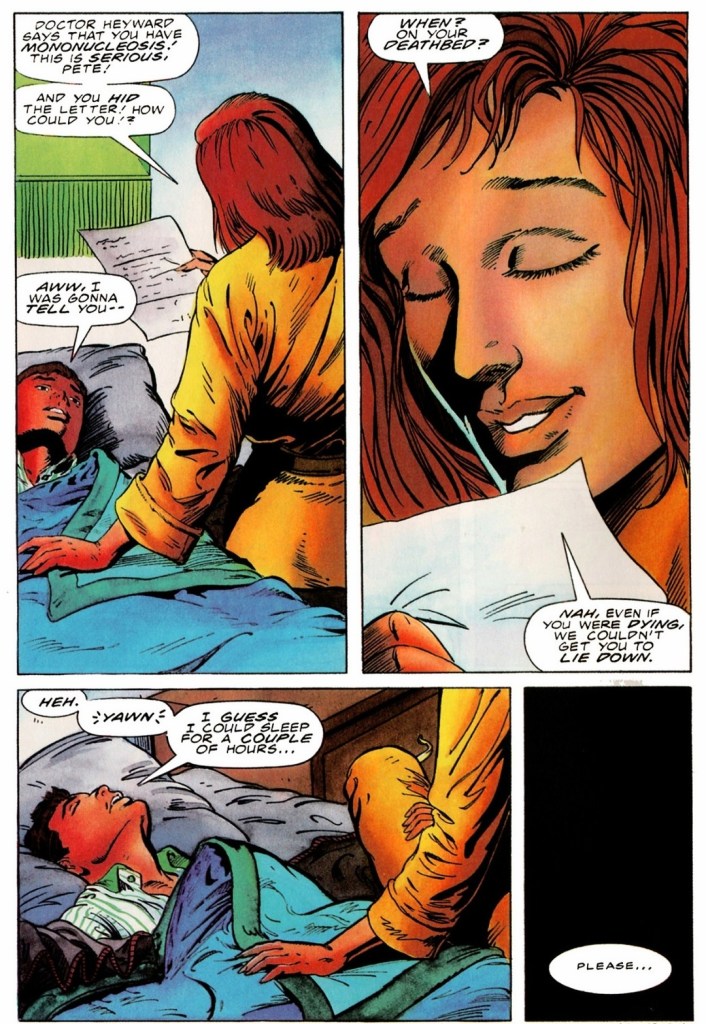
Even though he is sick, Sting still remains dishonest with Kris.

Harbinger #21 (1993) is a very power character study of Sting and the creative team deserve admiration for what is clearly the most in-depth development of the character so far in this series. It should be noted that the story, whether intention or not, clearly dramatizes that a person who rejects his or her father is often destined for frustration, pain, suffering and other negative elements in life. Even with super powers, the negative elements won’t disappear and the personal problems will continue to last long. If there is one thing that Sting could do to save himself and his family, it would be coming to his father with forgiveness and having the strong will to make peace with him and be willing to love him unconditionally. Ultimately, this comic book sets up Sting for a potential series of events that could challenge him personally as he continues to lead his team.

Overall, Harbinger #21 (1993) is highly recommended!

+++++

Thank you for reading. If you find this article engaging, please click the like button below, share this article to others and also please consider making a donation to support my publishing. If you are looking for a copywriter to create content for your special project or business, check out my services and my portfolio. Feel free to contact me with a private message. Also please feel free to visit my Facebook page Author Carlo Carrasco and follow me on Twitter at  @HavenorFantasy as well as on Tumblr at https://carlocarrasco.tumblr.com/ and on Instagram at https://www.instagram.com/authorcarlocarrasco

A Look Back at Harbinger #20 (1993)

Disclaimer: This is my original work with details sourced from reading the comic book and doing personal research. Anyone who wants to use this article, in part or in whole, needs to secure first my permission and agree to cite me as the source and author. Let it be known that any unauthorized use of this article will constrain the author to pursue the remedies under R.A. No. 8293, the Revised Penal Code, and/or all applicable legal actions under the laws of the Philippines.

Welcome back superhero enthusiasts, 1990s culture enthusiasts and comic book collectors! Today we go back to the early 1990s and explore a part of the Valiant Comics shared universe through the Harbinger monthly series.

In my previous review, the team led by Sting daringly broke into the Harbinger Foundation’s New York facility and freed the pretty blonde Natalie Toynbee (codename: Stunner) who happened to have a big ego and was not comfortable with the organization’s rules. While Sting and his team secured Natalie as their newest member, a sinister force from Iran arrives in America. 

With those details laid down, here is a look back at Harbinger , published in 1993 by Valiant Comics with a story written by Maurice Fontenot and illustrated by Howard Simpson.

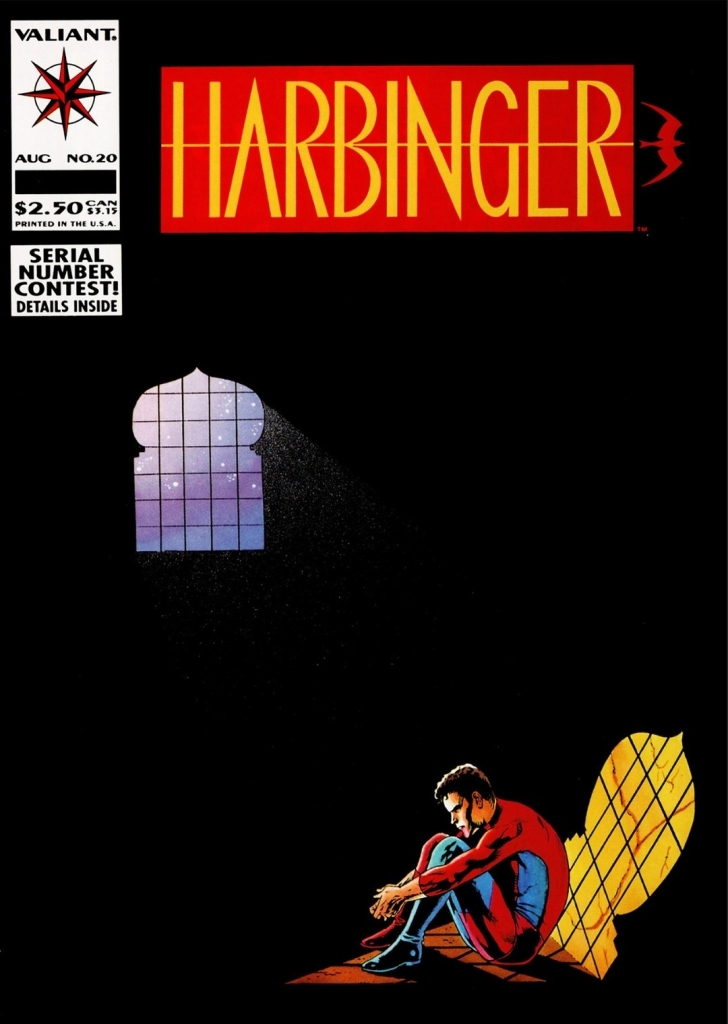
The cover.

Early story

The story begins deep in the nation of Iran on February 1, 1993. Thanks to the tremendous help of Screen, the Harbinger renegades composed of Flamingo, Kris, Shatiqua and Faith/Zephyr make their way through the busy section of Mashad, carefully communicating with each other while disguised in cultural clothing. Their mission is to find the hideout of Kaliph and rescue Sting and Natalie/Stunner knowing they only have ten hours left.

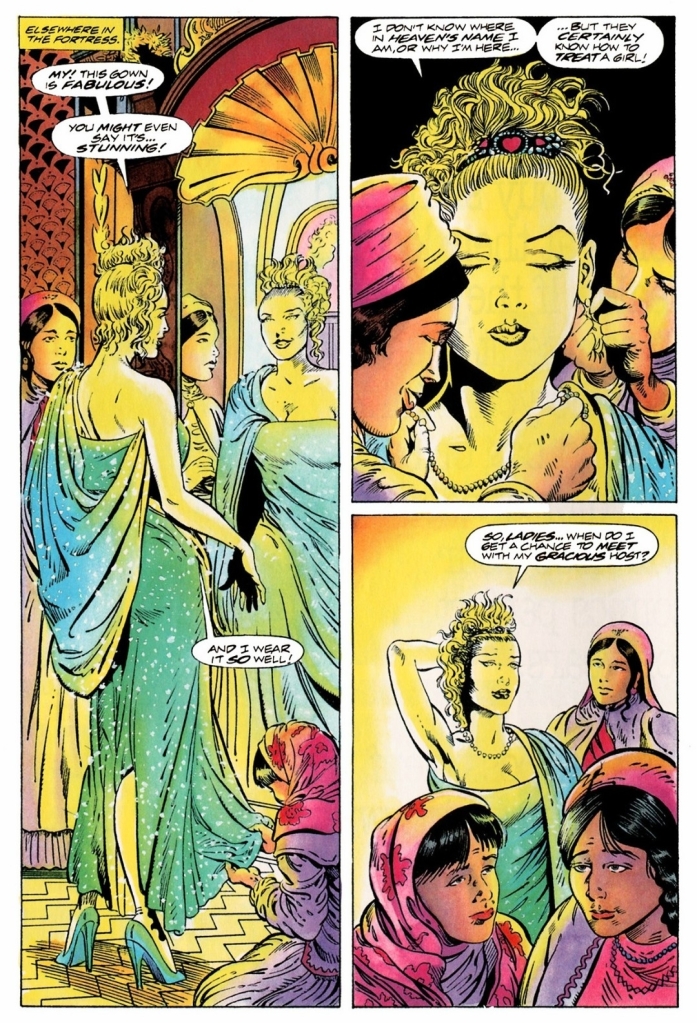
Inside Kaliph’s fortress, a very weak and uneasy Sting finds himself alone in a dark room while Natalie is being treated nicely by the servants of Kaliph in preparation for dinner with the sinister master himself…

Quality

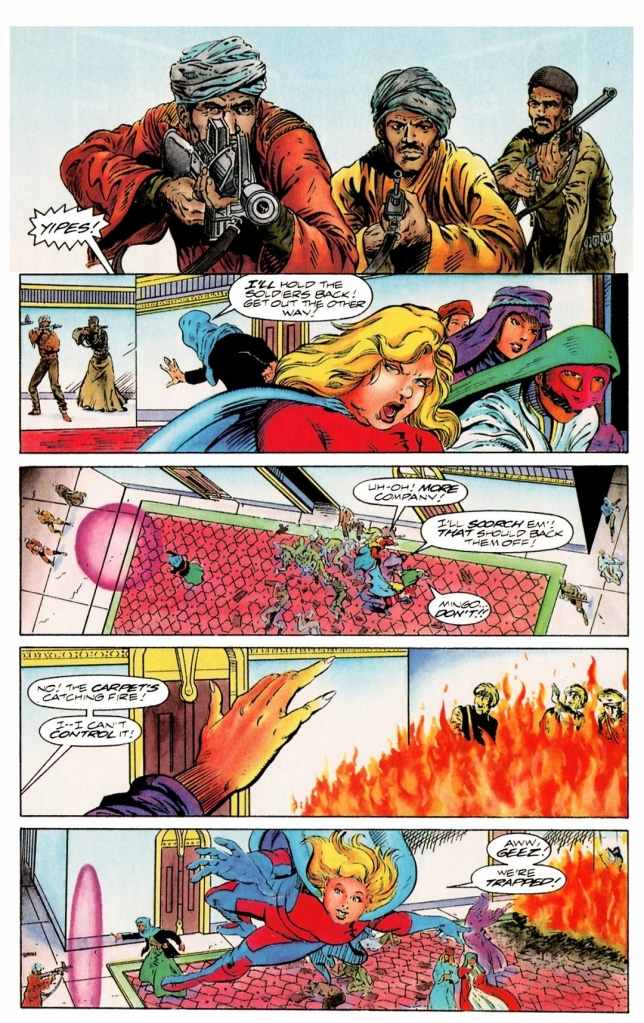
During their rescue effort, Sting’s teammates face off with the armed Iranians of Kaliph.

In terms of storytelling, this is a very solid continuation to the events that happened in the previous issue and it was a clever move by the creators to have the story set in enemy territory which easily raised the stakes for Sting’s team. While this is not the first time that the group went out on dangerous missions going into the turf of the opposition, having Iran as the setting and Kaliph as the powerful villain really made things fresh for this particular comic book series.

It should be noted that having Sting being very vulnerable added a nice layer of depth in this tale given the fact that he is still living with a false sense of maturity as well as traces of arrogance on his part believing that he could make positive changes by fighting powerful enemies and freeing powered youth from captivity without vast amounts of resources. For the newcomers reading this, Sting and his companions do not have much money to live with nor do they have technologies or connections to be powerful as a team. They simply have their own super powers and the will to move on and make things happen which makes them different compared to many other superhero teams in comics.

There are also signs of suicidal thoughts on Sting’s part as he recklessly moved to get to Kaliph even though the villain’s men were armed. By contrast, his teammates moved cautiously into Kaliph’s fortress and the way they handled the armed Iranians was believably presented. Not to be outdone here in Natalie who got a good share of the spotlight.

This comic book’s evil Iranian Kaliph was presented to be not only powerful but also talented as a business negotiator (which makes him somewhat similar with this comic book series’ super villain Toyo Harada) and even as a host of special guests. His evil nature here got emphasized further through his treatment of people as pawns of negotiations backed by his power of manipulation.

Conclusion

Natalie Toynbee being treated nicely by the servants not realizing the evil of the man she is about to meet.

Harbinger (1993) is both engaging and intriguing to read from start to finish. Having Sting’s team on a high-risk rescue mission in Iran made for a great setting and Kaliph turned out to be a more significant figure of evil. Through Kaliph and his violence-oriented servants, you will see the symbolism of the evil of Iran in real-life even though this comic book does not show any links between him and the regime that took power in 1979. Geopolitics are pretty much absent in the story but the evil presented through Kaliph make this old comic book highly relevant in relation to the evil of Iran today (for reference, click here, here, here, here, here and here). It should be noted that within the comic book, the Iranian people in general are not condemned and in real life, there are Iranians standing up against their government which itself has been sponsoring terrorists and organizing terrorism for a long time now. The brutality committed by Iran’s regime made several Iranians escape their country to be free.

Considering the very sensitive matter of Iran and other issues related with contemporary geopolitics, Harbinger (1993) not only aged well but is also a living reminder that people whose minds got poisoned with wickedness, political correctness and wokeness would not dare make a comic book showing the evil of Iran. The Leftist-oriented people prefer to make deals with terrorists (for examples, click here and here).

Overall, Harbinger (1993) is highly recommended!

+++++

Thank you for reading. If you find this article engaging, please click the like button below, share this article to others and also please consider making a donation to support my publishing. If you are looking for a copywriter to create content for your special project or business, check out my services and my portfolio. Feel free to contact me with a private message. Also please feel free to visit my Facebook page Author Carlo Carrasco and follow me on Twitter at  @HavenorFantasy as well as on Tumblr at https://carlocarrasco.tumblr.com/ and on Instagram at https://www.instagram.com/authorcarlocarrasco
A Look Back at Harbinger #19 (1993)

Disclaimer: This is my original work with details sourced from reading the comic book and doing personal research. Anyone who wants to use this article, in part or in whole, needs to secure first my permission and agree to cite me as the source and author. Let it be known that any unauthorized use of this article will constrain the author to pursue the remedies under R.A. No. 8293, the Revised Penal Code, and/or all applicable legal actions under the laws of the Philippines.

Welcome back superhero enthusiasts, 1990s culture enthusiasts and comic book collectors! Today we go back to the early 1990s and explore a part of the Valiant Comics shared universe through the Harbinger monthly series.

In my previous retro review, the creative team of Fontenot-Simpson told another story that built up Harbinger’s concept some more while introducing yet another new character – Screen – who is not part of the team led by Sting. The story symbolically showed the further growth of the tremendous power of Toyo Harada not only through his control of the Harbinger foundation but also of his connection with the new United States President of the time. 

With those details laid down, here is a look back at Harbinger , published in 1993 by Valiant Comics with a story written by Maurice Fontenot and illustrated by Howard Simpson.

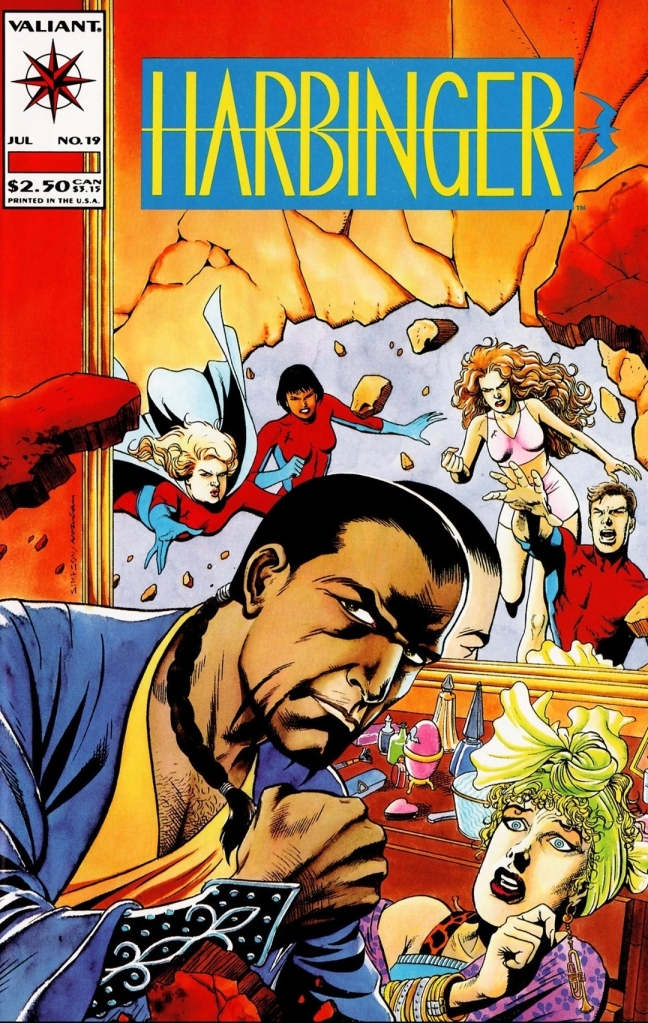
The cover.

Early story

The story begins on the afternoon of January 25, 1993. Inside the New York facility of the Harbinger foundation, a pretty blonde, young lady named Natalie Toynbee – codename: Stunner – gets scanned by the technicians handling the technologies. A technician’s request for Natalie to urinate into a cup reveals that the lady has a huge ego and pride of herself as she reacts negatively. 

Suddenly, the wall near Natalie and the technician got damaged by force unleashed by Sting who is accompanied by Faith, Flamingo and Shatiqua. Their mission is to free Natalie from the clutches of the Harbinger foundation which is a small part of their long-term vision of freeing and recruiting more powered young adults.

After subduing the Harbinger foundation personnel, Sting begins to explain to Natalie the situation and tells her to just trust him. Sting tells her to come with them which only drew more of Natalie’s ego along with skepticism. This reaction makes Faith think Natalie is not worth saving…

Quality

Imagine Iran invading America and causing terror like in this scene. Imagine Joe Biden and the Democrats allowing this to happen to Americans.

While the story was not crafted to follow-up closely on the events of issue #18, this comic book puts Sting and his teammates into a collision course with a new force of evil – the Iranians (note: issue confirms their national identity) who have interests on specific young adults with powers and special abilities. Along the way, the Fontenot-Simpson team introduced a new sinister force in the form of a very manipulative Iranian named Kaliph.

Kaliph’s introduction here is easily the biggest feature of the story and he unsurprisingly overwhelms the debut of Natalie. Kaliph here works in service of his unidentified superiors and as he does his job, he uses his special ability of manipulating people’s minds through sight and sound to gain information, find directions, make them do his orders and gain access into places that he could never have had he been an ordinary person. By the end of the story, I was convinced that Kaliph was created to be an enduring or recurring villain for Sting and his team.

More on the primary characters of this monthly series, Sting and his teammates were portrayed to get more harbingers (powered young adults) to join them and become part of their long-term opposition against Toyo Harada and the Harbinger foundation, even though their own team lacks the resources needed to support themselves. The lack of resources was cleverly highlighted through Natalie’s reactions (related to her big ego) to what Sting’s team has for her to live with. Looking at the bigger picture going back to issue , Sting’s vision of defeating Harada and winning the trust of powered young adults without any solid foundation (specifically resources, connections and security) emphasize his recklessness and false sense of maturity as a team leader.

Conclusion

Kaliph and his companion arrive in America with a sinister plan.

In my view, Harbinger (1993) is a solid change of direction for the monthly series complete with the introduction of a new, strong villain who originated from Iran which by today’s standards is the major force of terrorism in this world. The new villain Kaliph has a creepy aesthetic that other villains in this series lacked. More notably, the story remained consistently very engaging and pulled off some notable surprises which were indeed entertaining.

Overall, Harbinger (1993) is highly recommended!

+++++

Thank you for reading. If you find this article engaging, please click the like button below, share this article to others and also please consider making a donation to support my publishing. If you are looking for a copywriter to create content for your special project or business, check out my services and my portfolio. Feel free to contact me with a private message. Also please feel free to visit my Facebook page Author Carlo Carrasco and follow me on Twitter at  @HavenorFantasy as well as on Tumblr at https://carlocarrasco.tumblr.com/ and on Instagram at https://www.instagram.com/authorcarlocarrasco