BSP sees 6-7% economic growth in 2023 for Philippines

As far as the Bangko Sentral ng Pilipinas (BSP) is concerned, the Philippine economy will grow between 6% to 7% this year, according to a news report by BusinessWorld. By comparison, HSBC and the World Bank forecast growth rates of 4.4% and 5.4% respectively.

To put things in perspective, posted below is the excerpt from the BusinessWorld news article. Some parts in boldface…

THE “CONTINUED NORMALIZATION” of post-pandemic mobility will help the Philippine economy expand within the government’s 6-7% target this year, but slower growth is likely in 2024, the Bangko Sentral ng Pilipinas (BSP) said.

“GDP (gross domestic product) growth is projected to settle within the DBCC’s (Development Budget Coordination Committee) target of 6-7% for 2023, but economic headwinds could result in slower GDP growth in 2024,” the BSP said in its latest Monetary Policy Report (MPR).  

“The full-year growth forecast for 2023 was adjusted upward from the previous MPR. Meanwhile, the growth forecast for 2024 is lower compared to previous round, reflecting weaker global prospects and the impact of cumulative policy rate adjustments of the BSP,” it added.  

While the central bank does not give its exact growth forecasts, the DBCC targets 6.5-8% GDP growth in 2024.

According to the central bank, the economy will be “driven by growth in the industry sector as manufacturers signal increased production plans as the economy reopens further.”  

Based on data from the Philippine Statistics Authority (PSA), the service sector expanded by 9.8% in the fourth quarter last year, while the industry sector grew by 4.8%. Annually, services jumped by 9.2%, and industry expanded by 6.7%.

Better labor market conditions, higher demand for tourism, and greater economic activity due to the resumption of face-to-face classes are seen to boost growth in the services sector, the BSP said.  

“Moreover, the implementation of the Corporate Recovery and Tax Incentives for Enterprises (CREATE) Law, Financial Institutions Strategic Transfer (FIST) Act, and the second tranche of the reduction in personal income taxes could help further bolster the domestic outlook in 2023-2024,” it added.

Meanwhile, the overall balance of supply and demand conditions, as reflected by the output gap, is expected to “remain broadly neutral” in the near term.  

“Estimates from the BSP’s Policy Analysis Model for the Philippines (PAMPh) indicate that the output gap is estimated to be slightly positive in early 2023, reflecting the sustained economic expansion in 2022,” the central bank said.  

The economy grew by 7.6% in 2022, exceeding the government’s 6.5-7.5% target, and the fastest growth since 1975.

“Thereafter, the output gap is seen to remain in broadly neutral territory as the impact of policy interest rate adjustments takes hold on the economy. A projected slowdown in global growth owing in part to tightening monetary conditions across countries could likewise dampen aggregate demand,” the BSP said.  

The Monetary Board last week increased the benchmark policy rate by 50 basis points (bps) to 6%, the highest in nearly 16 years. Rates on the overnight deposit and lending facilities were also increased to 5.5% and 6.5%, respectively.

According to analysts, higher interest rates could drag economic growth slower this year.

Let me end this piece by asking you readers: What is your reaction to this recent development? Do you think the Philippines can achieve economic growth beyond 6% this year? Do you think the government should do more with post-pandemic living and economics in mind?

You may answer in the comments below. If you prefer to answer privately, you may do so by sending me a direct message online.

+++++

Thank you for reading. If you find this article engaging, please click the like button below, share this article to others and also please consider making a donation to support my publishing. If you are looking for a copywriter to create content for your special project or business, check out my services and my portfolio. Feel free to contact me with a private message. Also please feel free to visit my Facebook page Author Carlo Carrasco and follow me on Twitter at  @HavenorFantasy as well as on Tumblr at https://carlocarrasco.tumblr.com/ and on Instagram athttps://www.instagram.com/authorcarlocarrasco

Middle income earners in the Philippines will have lower income taxes this year

Recently, it was emphasized that middle income earners here in the Philippines will have lower income taxes to pay in accordance to the Tax Reform for Acceleration and Inclusion (TRAIN) law (Republic Act Number 10963) which will result in better take-home pay this year, according to a news article published by the Philippine News Agency (PNA). This is related to what was reported weeks ago by GMA Network news.

To put things in perspective, posted below is the excerpt from the PNA news report. Some parts in boldface…

Middle-income earners will have lower income taxes this year and thus, higher take-home pay, under Republic Act No 10963 or the Tax Reform for Acceleration and Inclusion (TRAIN) law.

Taxpayers earning more than PHP250,000 a year but not over PHP8 million will be subject to lower income tax rates ranging from 15 percent to 30 percent, from the previous 20 percent to 32 percent.

Those with annual taxable income of PHP250,000 or below will continue to be exempt from paying income taxes.

“Inaasahan natin na lalo pang lalakas ang domestic consumption na may malaking kontribusyon sa paglago ng ating ekonomiya. Dahil sa pinababang buwis, mas mataas ang take-home pay ng mga empleyado na magiging malaking tulong sa gitna ng mataas na presyo ng mga bilihin (We expect a stronger domestic consumption which will be big contribution to our economy. With lower tax and higher take-home pay, this will be a good help amid the rising prices of commodities),” Senator Sherwin Gatchalian said in a statement on Monday.

Gatchalian cited the Teacher 1 post, with a monthly salary of PHP25,439 or Salary Grade (SG) 11, will now have monthly tax savings of PHP420.83 or PHP5,050 for the year.

A Nurse III with SG 17 or an entry level monthly income of PHP43,030 will save PHP1,289.13 monthly or PHP15,469 yearly.

“Dahil sa mas mataas ang kanilang kita, inaasahan din natin na magiging maganda itong insentibo para sa mga empleyado na lalo pa nilang paghusayan ang kanilang trabaho at magtulak sa kanila para mag impok o kaya ay mamuhunan (Because of a higher take-home pay, workers will be inspired to work better, save and invest), Gatchalian said.

Also included in the TRAIN law are provisions for small and micro self-employed professionals, who now have the option to pay a simpler, flat tax of eight percent on gross sales in lieu of the income and percentage tax.

Taxpayers can save time falling in line and filing and paying from eight times a year will be reduced to just four.

Estate tax will also be lowered from 20 percent to a single rate of six percent for net estate with standard deduction of PHP5 million as well as exemption for the first PHP10 million for the family home.

Let me end this piece by asking you readers: What is your reaction to this new development? Are you qualified for a reduction of income taxes under the TRAIN Law? Have you consulted with a certified tax expert already?

You may answer in the comments below. If you prefer to answer privately, you may do so by sending me a direct message online.

+++++

Thank you for reading. If you find this article engaging, please click the like button below and also please consider sharing this article to others. If you are looking for a copywriter to create content for your special project or business, check out my services and my portfolio. If you want to support my website, please consider making a donation. Feel free to contact me with a private message. Also please feel free to visit my Facebook page Author Carlo Carrasco and follow me on Twitter at  @HavenorFantasy as well as on Tumblr at https://carlocarrasco.tumblr.com/ and on Instagram at https://www.instagram.com/authorcarlocarrasco/.

BIR confirms lower income tax rates for individual taxpayers effective on January 1, 2023

For those of you living and working here in the Philippines, be aware that starting January 1, 2023, lower tax rates will charged on individual taxpayers as confirmed by the Bureau of Internal Revenue (BIR), according to a recent GMA Network news report. Now is a good time to approach a certified expert on taxation if you want to see how this upcoming development will affect you.

To put things in perspective, posted below is the excerpt from the GMA Network news report. Some parts in boldface…

Individual taxpayers will be charged lower tax rates starting next year, the Bureau of Internal Revenue (BIR) said Friday.

Individuals earning purely compensation income, including non-business/non-profession related income and sole proprietors, “can look forward to a higher take-home pay in 2023,” according to the BIR.

The taxman said the lower income tax rate is pursuant to Republic Act 10963, or the Tax Reform for Acceleration and Inclusion (TRAIN) Law, which took effect on January 1, 2018.

Starting January 1, 2023, those with annual taxable income below P250,000.00 are still exempt from paying personal income tax, while the rest of taxpayers, except those with taxable income of more than P8 million, will have lower tax rates ranging from 15% to 30% by 2023.

To maintain progressivity, the BIR imposed a 35% tax rate on top individual taxpayers with annual taxable incomes exceeding P8 million, up from 32% previously.

The income tax on the individual’s taxable income shall be computed based on the following schedules, effective January 1, 2023, and onwards:

The taxation reference from GMA’s news report.

Compared to the income tax rates imposed during the initial implementation of the TRAIN Law in 2018, the new annual income tax rates for individuals significantly decreased by 5% for those with taxable income of more than P250,000.00 up to P2,000,000.00, while a 2% decrease in tax rate was noted for those with taxable income of more than P2,000,000.00 up to P8,000,000.00.

The above article ended stating that employers must use the revised withholding tax table to calculate the withholding taxes on their employees’ compensation income taking effect on January 1, 2023.

Let me end this piece by asking you readers: What is your reaction to this new development? When was the last time you consulted with a tax expert for insight about your income tax returns? Do you think this new development will boost the national economy as a whole somehow in 2023?

You may answer in the comments below. If you prefer to answer privately, you may do so by sending me a direct message online.

+++++

Thank you for reading. If you find this article engaging, please click the like button below and also please consider sharing this article to others. If you are looking for a copywriter to create content for your special project or business, check out my services and my portfolio. If you want to support my website, please consider making a donation. Feel free to contact me with a private message. Also please feel free to visit my Facebook page Author Carlo Carrasco and follow me on Twitter at  @HavenorFantasy as well as on Tumblr at https://carlocarrasco.tumblr.com/ and on Instagram at https://www.instagram.com/authorcarlocarrasco/.

Deadline for payment of business permits and licenses in Las Piñas City extended to March 31, 2022

If you are running a business in Las Piñas City and you need more time to settle your dues with the City Government, then you should be delighted to know that the deadline for paying business permits, licenses, taxes, fees and charges has been extended all the way to March 31, 2022 as a result of a move done by the City Council with the approval of Mayor Imelda Aguilar, according to a Manila Bulletin news report.

To put things in perspective, posted below is the excerpt from the Manila Bulletin report. Some parts in boldface…

The Las Pinas City Council, headed by Vice-Mayor April Aguilar, has extended the deadline for the payment of business permits, licenses, taxes and other commercial and industrial fees and charges until March 31 without interests, penalties, and surcharges.

Mayor Imelda Aguilar immediately signed the resolution passed and approved by the City Council to give local businesses relief, ease their burden, and help them to recover from the severe effects of the COVID-19 pandemic.

Aguilar endorsed the letter of Wilfredo Gaerlan, chief of the Business Permit and Licensing Office (BPLO), requesting for the extension of the deadline of the payment of business permit and licenses.

The vice-mayor, upon receiving the endorsement of the mayor, convened the City Council to pass a resolution after learning of the decrease in business permit and license renewal due to the recent surge in COVID-19 cases in the National Capital Region (NCR) due to the Omicron variant.

The City Council heeded the call of the Anti-Red Tape Authority (ARTA) for local government units to extend the period of renewal of business permits and payment of real property tax until the end of the first quarter given the surge in COVID-19 cases.

Let me end this piece by asking you readers: If you are managing a business in Las Piñas City, what is your reaction to this recent development? How helpful is the extension for you and your business?

You may answer in the comments below. If you prefer to answer privately, you may do so by sending me a direct message online.

+++++

Thank you for reading. If you find this article engaging, please click the like button below and also please consider sharing this article to others. If you are looking for a copywriter to create content for your special project or business, check out my services and my portfolio. Feel free to contact me with a private message. Also please feel free to visit my Facebook page Author Carlo Carrasco and follow me on Twitter at  @HavenorFantasy as well as on Tumblr at https://carlocarrasco.tumblr.com/

For more South Metro Manila community news and developments, come back here soon. Also say NO to fake news, NO to irresponsible journalism, NO to misinformation, NO to plagiarists, NO to reckless publishers and NO to sinister propaganda when it comes to news and developments. For South Metro Manila community developments, member engagements, commerce and other relevant updates, join the growing South Metro Manila Facebook group at https://www.facebook.com/groups/342183059992673

Better than Streaming: Let’s help the local cinema industry recover from its massive loss

It’s been two days since cinemas around Metro Manila officially reopened which is a welcome move not because I personally want to watch movies on the big screen inside the theater but because the local cinema industry will contribute to the economic recovery of our nation from this ongoing COVID-19 crisis. That being said, I urge you readers – who got fully vaccinated locally – who love watching movies to take time out to support the local cinema operators and their employees by visiting their venues, buying tickets over the counter and watch movies on the big screen while following the local health protocols (note: local cinemas have invested a lot in making their venues safe and sanitized).

Be reminded that streaming will NEVER match the grandeur and immersion of the cinema! The cinema is always better than streaming. Movie venue choices aside, local moviegoers now have the opportunities to watch A Quiet Place Part II  and the big blockbuster Dune (2021).

Going back to the topic of economic recovery, there is no doubt that the COVID-19 crisis combined with all the restrictions imposed by the local, regional and nation authorities brought down the national economy in 2020 along with all the economic sectors and the employees. All of these also translate into a major loss of tax revenue for the local governments, provincial governments and the national government.

In the case of the local cinema industry, the shutdown of cinemas since the pandemic started in March 2020 resulted a huge, collective industry loss of revenue according to a BusinessWorld report. I’m talking about many BILLIONS of Pesos lost!

To put things in perspective, posted below is an excerpt of the BusinessWorld report. Some parts in boldface…

The cinema industry had P19 billion in foregone revenue from March 2020 to September this year, Film Development Council of the Philippines (FDCP) Chairperson Mary Liza Diño-Seguerra said in a Teams video interview.

The loss had ballooned to P21 billion as of Oct. 11, Charmaine N. Bauzon, president of Cinema Exhibitors Association of the Philippines, told PTV News.

Local government units, which charge 10% amusement tax per movie ticket, lost P1.09 million daily from the country’s more than a thousand movie screens, according to estimates by the National Tax Research Center.

“We earned P11.5 billion yearly from the box office [before the pandemic],” Ms. Seguerra said. “We sold about 52 million tickets each year.”

Cinema operators get 50% of ticket sales, while the other half goes to producers, who then give as much as a quarter to the distributor, who’s in charge of marketing and distributing the film to the public.

Last year, cinemas in areas under a more relaxed quarantine made a measly P327,000, Ms. Seguerra said.

Take note that before the pandemic started, the local cinema industry as a whole had a work force of 300,000 employees and those who lost their jobs and income really suffered. In the City of San Juan, the Manila Bulletin reported about the reopening of local cinemas there with Mayor Francis Zamora issuing statements and leading the inspection on the venues. Posted below is an excerpt from the Manila Bulletin article.

San Juan City Mayor Francis Zamora led the inspection of cinemas in the city starting with the Greenhills Promenade Cinema.

Zamora inspected the health and safety protocols of the cinema such as the disinfection process of the establishment and the procedure of buying the tickets, which can be done before entry to the cinema or online, new seating arrangements with strict physical distancing, and the guidelines of actual movie viewing under the new normal.

I know how Filipinos miss watching movies in silver screens which have been shut down for almost two years due to the pandemic, but now the long wait is over. With the approval of the IATF, we are allowing the opening of our cinemas in the city, provided that we take extra care and observe stringent protocols as we are still facing threats of COVID-19 despite the easing of restrictions to Alert Level 2,” Zamora said.

I want to personally make sure that our cinemas in San Juan will be safe for all of us, not only for the moviegoers but for the employees of these establishments as well,” he added.

During Alert Level 2, the operational capacity of several businesses has been increased to accommodate more customers. It has also eased down quarantine restrictions in various indoor establishments and recreational venues including movie houses and cinemas.

Under the Inter Agency Task Force (IATF) guidelines, cinemas can accommodate up to 50 percent of its maximum venue capacity, but only those who are fully vaccinated will be allowed entry into the cinemas.

For added insight, posted below are two news videos for your viewing…

Going back to choices of movies, be aware that opening soon locally in cinemas are Black Widow (November 17) and Shang-Chi and the Legend of the Ten Rings (November 24). For those who prefer Philippine movies, the Metro Manila Film Festival (MMFF) will return to cinemas next month!

Once I again, I urge you readers based in Metro Manila and in nearby provinces who got fully vaccinated to come out to support our local cinema operators and make a contribution to economic recovery as you enjoy watching on the big screen again.

Let me end this piece by asking you readers: Now that cinemas within Metro Manila have reopened, are you planning to revisit them and watch movies on the big screens anytime soon? Does Dune (2021) interest you a lot? When was the last time you saw a movie inside the movie theater? Do you realize that as a paying customer, what you pay helps not only movie producers and cinema operators but also their employees and the varied government units (that collect amusement taxes)?

You may answer in the comments below. If you prefer to answer privately, you may do so by sending me a direct message online.

+++++

Thank you for reading. If you find this article engaging, please click the like button below and also please consider sharing this article to others. If you are looking for a copywriter to create content for your special project or business, check out my services and my portfolio. Feel free to contact me as well. Also please feel free to visit my Facebook page Author Carlo Carrasco and follow me at HavenorFantasy@twitter.com

For more South Metro Manila community news and developments, come back here soon. Also say NO to fake news, NO to irresponsible journalism, NO to misinformation, NO to plagiarists, NO to reckless publishers and NO to sinister propaganda when it comes to news and developments. For South Metro Manila community developments, member engagements, commerce and other relevant updates, join the growing South Metro Manila Facebook group at https://www.facebook.com/groups/342183059992673

If you wish to join a group of movie enthusiasts and talk about cinema, visit the Movie Fans Worldwide Facebook group at https://www.facebook.com/groups/322857711779576

COVID-19 Crisis: Online stockbroker predicts PSE index to reach 8,100 level by the end of 2021

With the enhanced community quarantine (ECQ) all set to take effect all over Metro Manila for two weeks starting August 6, a lot of people are disturbed about what lies ahead. For one thing, there is the highly infectious Delta variant spreading nationwide. There is also the potential economic damage and the effects ECQ will have on many workers.

And then there is the local stock exchange. While many investors are constantly looking on different directions and varied factors to decide what to do with their respective investments, the COL Financial Group recently revised its end-of-the-year estimate for the Philippine Stock Exchange (PSE) but their new prediction still points to a higher count than what the current index shows.

To put things in perspective, posted below is an excerpt from the Philippine News Agency (PNA) article. Some parts in boldface…

Online stockbroker COL Financial Group expects the Philippine Stock Exchange index (PSEi) to end the year at 8,100, slightly lower than previously projected, supported by optimism for faster economic recovery and earnings growth.

COL chief equity strategist April Lynn Tan said their forecast for PSEi has been reduced from 8,300 considering the lower earnings incurred by property companies as their mall operations are affected most by the implementation of enhanced community quarantine (ECQ).

The National Capital Region (NCR) will be placed under the most restrictive ECQ from Aug. 6 to 20 to prevent the spread of the more infectious Delta coronavirus variant.

This, after the one implemented from May 17 to April 13, 2021 to stem the country’s coronavirus disease 2019 (Covid-19) surge.

We cut our earnings forecast and fair value estimates for the property companies given that they are part of a lot of the big holding companies that also dragged our fair value estimates. (But) an 8,100 target is still significantly higher from where we are today. That is why, we keep on saying that the negatives are priced in,” Tan said in a virtual press briefing Monday.

She said companies are “coping well” with the pandemic, adding that almost all sectors, except the property sector, reported higher year-on-year earnings.

“The reason why companies were able to deliver higher profits in the first quarter of this year compared to last year even though we are still in the pandemic is because they have adapted to the pandemic scenario by cutting cost and of course they also benefited from the lower tax rate, thanks to the CREATE (Corporate Recovery and Tax Incentives) law,” Tan said.

President Rodrigo Duterte last March 26 signed into law the CREATE Act reducing the corporate income tax rate by 5 to 10 percent for micro, small and medium enterprises (MSMEs) and other corporations.

Moreover, Tan said they remain bullish of the stock market on the back of efficient vaccination efforts and inflation reaching its peak.

Predicting the future is very unpredictable no matter what category gets discussed. Remember when the International Olympic Committee (IOC) predicted a brighter post-Olympics future for the city of Rio de Janeiro in relation to hosting the 2016 Summer Olympic Games? What happened after Rio Olympics were lots of unfulfilled promises, deteriorating facilities and a lot of embarrassment.

Going back to Philippine stocks, the COL Financial Group showed lots of details in their explanations of their 8,100 index end-of-2021 prediction. They were right to point to the CREATE Law which itself was a factor in the spike of foreign direct investments (FDI) in the country last April. The CREATE Law effectively reduced the corporate income tax rates for micro, small and medium enterprises (MSMEs). From this point on, it is interesting to see how the CREATE Law will impact the national economy and the local stock exchange in the months to come.

Let me end this piece by asking you readers: If you are an investor, what can you say about COL Financial Group’s end-of-the-year prediction for the Philippine Stock Exchange? Are you confident that the economic stakeholders, the businesses and investors will emerge stronger starting with the end of the next ECQ period until the end of the year? Is the CREATE Law positively impacting your business and/or investments?

You may answer in the comments below. If you prefer to answer privately, you may do so by sending me a direct message online.

+++++

Thank you for reading. If you find this article engaging, please click the like button below and also please consider sharing this article to others. If you are looking for a copywriter to create content for your special project or business, check out my services and my portfolio. Feel free to contact me as well. Also please feel free to visit my Facebook page Author Carlo Carrasco and follow me at HavenorFantasy@twitter.com

For more South Metro Manila community news and developments, come back here soon. Also say NO to fake news, NO to irresponsible journalism, NO to misinformation, NO to plagiarists, NO to reckless publishers and NO to sinister propaganda when it comes to news and developments. For South Metro Manila community developments, member engagements, commerce and other relevant updates, join the growing South Metro Manila Facebook group at https://www.facebook.com/groups/342183059992673

COVID-19 Crisis: The high cost of ECQ on the Philippine economy

You must be wondering how much of a price did the nation pay as a result of the 2-week ECQ (enhanced community quarantine) ordered on NCR Plus (National Capital Region plus the provinces of Bulacan, Cavite, Laguna and Rizal).

The answer? P180 billion in terms of economic losses according to the Department of Trade and Industry (DTI) accounting for 1% of the nation’s gross domestic product (GDP). To put things in perspective, posted below is an excerpt from the Philippine News Agency (PNA) article of April 15, 2021. Some parts in bold…

The Department of Trade and Industry (DTI) has estimated that the country lost 1 percent of gross domestic product (GDP) during the two-week enhanced community quarantine (ECQ) in National Capital Region (NCR) and four nearby provinces.

During the Laging Handa public briefing Thursday, DTI Secretary Ramon Lopez said the economic loss due to the half-a-month ECQ in NCR, Bulacan, Cavite, Laguna, and Rizal (NCR Plus) is equivalent to PHP180 billion.

Earlier, Lopez said around 1.5 million Filipinos had no jobs during the ECQ in NCR Plus, and only 500,000 jobs were brought back when the quarantine classification for areas was downgraded to a less strict modified ECQ (MECQ).

“We want to see lower Covid-19 (coronavirus disease 2019) cases and lower utilization rate of (Covid-19 beds) before we ease the status to GCQ (general community quarantine),” he said in Filipino.

The DTI chief also downplayed speculation that the reopening of economic activities and business establishments became the ‘super spreader’ of Covid-19.

To manage the rate of infection of the coronavirus, Lopez said the Inter-Agency Task Force for the Management of Emerging Infectious Diseases (IATF) will not allow high-risk and non-essential activities and gatherings.

He added the government must slow down the daily Covid-19 cases while increasing the health care capacity to relax community quarantine status in the NCR Plus.

Clearly, the 2-week ECQ period on NCR Plus was damaging not only to the businesses and people of the affected region but on the Philippine economy as well. What we cannot see yet is exactly how many more people – specifically those who lost jobs in NCR Plus because of ECQ – fell into poverty. Take note that the more people fall into poverty, the more costly it becomes for the local government units (LGUs) and the nation government to provide support to them using taxpayers’ money.

As it has been a week since NCR Plus shifted to MECQ (modified enhanced community quarantine), we will find out soon how much the region and the national economy recovered from the high cost of ECQ.

If you do the math, a single week of ECQ on NCR Plus costs P90 billion. Can you just imagine the dramatic cost to the nation had ECQ went on for a full year of 52 weeks? Do not forget that all the unemployed bad need jobs and income.

Right now, the national government and varied forms of governing units are still struggling to balance themselves between economics and public health during this COVID-19 (China virus) pandemic that has lasted over a year now. No matter how you do your business, how you make your important transactions, follow the health protocols to avoid getting infected with the China virus.

By the way, whenever possible, support the business joints in your local community whenever you need to buy or consume something. By the way, never let the Political Left fool you with their propaganda related to economy and the pandemic.

+++++

Thank you for reading. If you find this article engaging, please click the like button below and also please consider sharing this article to others. If you are looking for a copywriter to create content for your special project or business, check out my services and my portfolio. Feel free to contact me as well. Also please feel free to visit my Facebook page Author Carlo Carrasco and follow me at HavenorFantasy@twitter.com

For more South Metro Manila community news and developments, come back here soon. Also say NO to fake news, NO to irresponsible journalism, NO to misinformation, NO to plagiarists, NO to reckless publishers and NO to sinister propaganda when it comes to news and developments. For South Metro Manila community developments, member engagements, commerce and other relevant updates, join the growing South Metro Manila Facebook group at https://www.facebook.com/groups/342183059992673

CREATE bill to boost Philippine economy by cutting corporate income tax and implementing incentives

Yesterday, Department of Trade and Industry (DTI) Secretary Ramon Lopez announced that the Corporate Recovery and Tax Incentives for Enterprises (CREATE) Act is aimed to reduce the corporate income tax which should lead to creating more jobs as well as attracting investments.

Given the dramatic fall of the Philippine economy as a result of the COVID-19 pandemic, the CREATE bill could be the big solution to boost the economy and pave the way for recovery. For almost a year now, the said pandemic caused a lot of people to lose their jobs and much of their income. A lot of businesses closed down as well.

For your reference, here is a long excerpt of the news release about the said bill published via Philippine News Agency (PNA). Key words are highlighted in bold:

The recent bicameral approval of the game-changing CREATE Act can also provide a big boost to the National Employment Recovery Strategy (NERS) Task Force chaired by the DTI and co-chaired by the Department of Labor and Employment (DOLE) and the Technical Education and Skills Development Authority (TESDA), which was signed last Feb. 5 by several agencies.  

“The landmark tax and incentives reform bill that we expect to be signed by the President is expected to bring in (a) massive inflow of investments that will create more jobs, especially as we focus efforts in the National Employment Recovery during this period of the pandemic and beyond. The passing of CREATE will firm up the tax and incentive reforms that will make the investment climate significantly more attractive than the current tax and incentive regime,” Lopez said in a statement.

He said the bill will certainly encourage more investments with the lowering of the corporate income taxes rate from 30 percent to 20 percent for micro, small and medium enterprises (MSMEs), and 25 percent for large corporations.

“Modernizing the incentives system likewise makes the incentives such as income tax holiday (ITH), special corporate income tax rates (SCIT) or enhanced deductions (ED), available to industries considered strategic, critical or export oriented,” he added.

The Trade chief said the length of incentives, such as four to seven years of ITH plus five or 10 years of SCIT or ED, will depend on the nature of industry, export or domestic oriented, degree of technology and value adding, and geographical location, with additional years outside the Metro Manila and urban centers.

“There is also (a) longer transition period for those currently granted incentives. Thus, incentives are now made more performance-based, focused and timebound,” Lopez said.

CREATE is a bill certified urgent by President Rodrigo Roa Duterte upon the recommendation of the economic team led by Finance Secretary Carlos Dominguez III.

Lopez also thanked the legislators at the Senate and the House of Representatives, with Sen. Pia Cayetano and Rep. Joey Salceda, respectively, as principal authors, for the hard work of the committee members in bringing the CREATE bill to fruition.

“The passing of CREATE will unleash the growth potential of investments by removing uncertainties during the period that the bill was under deliberation,” Lopez said. “Based on our estimate and those from Cong. Joey Salceda, CREATE can bring in over PHP200 billion of new investments that can generate 1.4 (million) to 2 million incremental jobs.”

CREATE will help boost investments in the Philippines, which would support the 2021 target of the Board of Investments (BOI) of PHP1.25-trillion investment approvals.

A report by the United Nations Conference on Trade and Development (UNCTAD) had also estimated that the Philippines bucked the trend in Southeast Asia, and had increased its foreign direct investments (FDIs) during the pandemic by 29 percent last year.

Meanwhile, the NERS 2021-2023 is a medium-term plan anchored on the updated Philippine Development Plan 2017-2022 and ReCharge PH by expanding the Trabaho, Negosyo, Kabuhayan initiative and improving access and security of employment.

The strategy also takes into consideration the changes in the labor market brought about by the pandemic and the fast adoption of Fourth Industrial Revolution (FIRe) technologies.

“NERS shall also consolidate all measures, programs, and institutions that influence the demand and supply of labor, as well as the functioning of labor markets,” Lopez said.

Members of NERS Oversight Committee include the Departments of Transportation (DOTr), Tourism (DOT), Public Works and Highways (DPWH), Science and Technology (DOST), Social Welfare and Development (DSWD), Agriculture (DA), Agrarian Reform (DAR), Interior and Local Government (DILG), Information and Communications Technology (DICT),  Environment and Natural Resources (DENR), Education (DepEd), Commission on Higher Education (CHED), and National Security Council (NSC), as well as the Office of the Cabinet Secretary (OCS), Departments of Finance (DOF) and Budget and Management (DBM), and the National Economic and Development Authority (NEDA).

DOLE Secretary Silvestre Bello III said: “This JMC (joint memorandum circular) will fortify our collective undertaking as a Task Force working to develop a policy environment that encourages the generation of more employment opportunities, improves employability and productivity of workers, and supports existing and emerging businesses.”

Lopez further stressed the importance of continuing with the calibrated and safe reopening of the economy to allow the country to regain the growth momentum that it had before the pandemic. 

+++++

Thank you for reading. If you find this post engaging, please click the like button below and also please consider sharing this article to others. If you are looking for a copywriter to create content for your special project or business, check out my services and my portfolio. Feel free to contact me as well. Also please feel free to visit my Facebook page Author Carlo Carrasco and follow me at HavenorFantasy@twitter.com

Las Piñas City Tax Amnesty announced, good until May 15, 2021

Yesterday the City Government of Las Piñas announced that property owners in the city who have not settled their dues have until May 15, 2021 to avail of the Tax Amnesty which is the result of the approval of City Ordinance No. 1729-20 (Series of 2021).

The Tax Amnesty covers all unpaid property taxes as well as Local Government interests, penalties and surcharges. Payment of taxes can be done by means of cash or by installment within the stipulated period.

The Tax Amnesty is meant to alleviate the financial concerns of the local constituents by giving them sufficient time to settle their taxes as the City Government is fully aware of the challenges and hardships caused by the pandemic on public health and on the economy.

Those who will be doing transactions at City Hall are advised to follow health and safety protocols.

+++++

The above information was provided by the Las Piñas City Government for the purpose of public information and transparency. Some parts were edited for this website.

For more South Metro Manila community news and developments, come back here soon. Also say NO to fake news, NO to irresponsible journalism, NO to misinformation, NO to plagiarists, NO to reckless publishers and NO to sinister propaganda when it comes to news and developments. For South Metro Manila community developments, member engagements, commerce and other relevant updates, join the growing South Metro Manila Facebook group at https://www.facebook.com/groups/342183059992673

Muntinlupa Assessor’s Office releases new schedule of operations, advices taxpayers to transact online

Due to the influx in the number of clients transacting business with Muntinlupa City Assessor’s Office and to ensure strict enforcement of physical distancing, a new schedule for document requests shall be implemented starting Tuesday (December 1, 2020).

MCAO released a new schedule of daily operations in the city’s website in a bid to limit the number of taxpayers transacting in Muntinlupa City Hall in adherence to IATF health protocols.

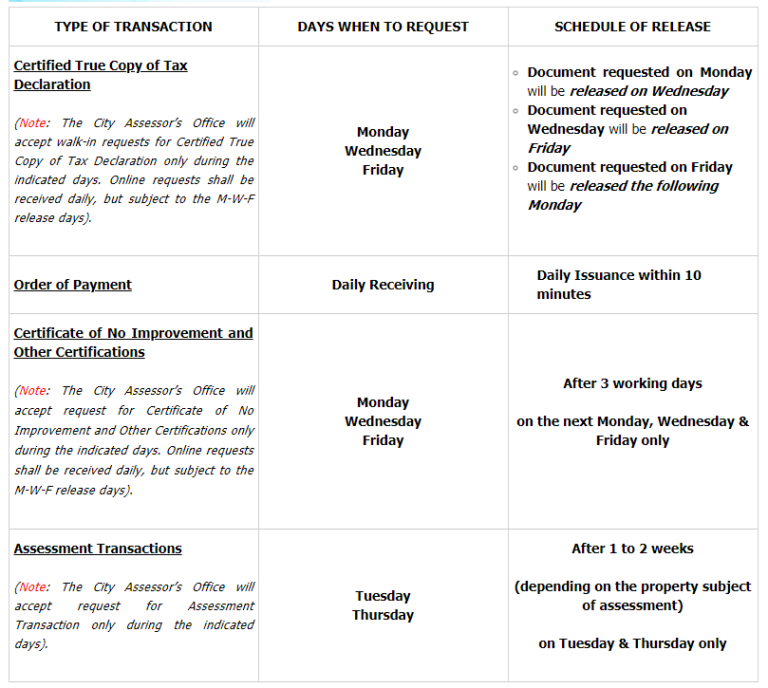
The processing of Certified True Copy of Tax Declaration and Certificate of No Improvement and other certifications will only be accommodated during Mondays, Wednesdays, and Fridays. Documents requested will also be released during the same schedule.

Further, Assessment Transactions are scheduled on Tuesdays and Thursdays. Depending on the property subject of assessment, the turnaround time for the release of documents is 1 to 2 weeks. While the schedule for the processing of Order of Payment will remain on a daily basis with daily issuance within 10 minutes.

The public is encouraged to accomplish forms online thru Assessor’s Online Application Form (bit.ly/2zEQ6jb) or Real Property Tax Order of Payment Online Request (bit.ly/2ZdqTGM).

The City Assessor’s Office will accept walk-in requests only during the indicated days per transaction. Online requests shall be received daily but subject to the indicated release days.

For more information, you may visit www.muntinlupacity.gov.ph or reach MCAO at 8862-5111 or 8862-6450. The City Assessor’s Office is located at G/F Main Building, Muntinlupa City Hall, National Road, Putatan, Muntinlupa City.

Recently, the City Government of Muntinlupa waived penalties and surcharges incurred for the non-payment of business taxes from 2nd to 4th quarter of 2020 through City Ordinance 2020-150 in a bid to help the private sector to recover from losses due to the COVID-19 pandemic.

However, all business taxes due for the said period shall however be subject to the penalties and interest prescribed by Muntinlupa Revenue Code if not paid on or before December 29, 2020. Muntinlupa City Business Permits and Licensing Office advised business taxpayers in the city to settle all outstanding balances on or before the deadline to avoid incurring penalties.

As of November 26, Muntinlupa City has 4,891 confirmed cases with 4,675 recoveries, 58 active cases, 158 reported deaths, 34 suspect cases, and 293 probable cases.

+++++

Latest City Government of Muntinlupa details sourced from their official media release. Some parts were edited for this website.

For more South Metro Manila community news and developments, come back here soon. Also say NO to fake news, NO to irresponsible journalism, NO to misinformation, NO to plagiarists, NO to distorted views, NO to reckless publishers, and NO to sinister propaganda when it comes to news and developments. For South Metro Manila-related community developments, engagements, commerce and other relevant updates, visit and join the South Metro Manila FB group at https://www.facebook.com/groups/342183059992673