Even as the fighting against the Islamic terrorist regime of Iran continues, a major proposal to build a permanent United States embassy in the eternal capital of Jerusalem was approved by Israel, according to a news report by The Jerusalem Post.
To put things in perspective, posted below is an excerpt from the news report of The Jerusalem Post. Some parts in boldface…
Israel approved a proposal to allocate land at the Allenby Complex in Jerusalem for the construction of a permanent United States Embassy on Tuesday.
The approval was announced in a joint statement from Prime Minister Benjamin Netanyahu, Minister of Foreign Affairs Gideon Sa’ar, and Construction and Housing Minister Haim Katz.
Netanyahu, Sa’ar, and Katz described the building of the embassy as a “major diplomatic move” originally set in motion by US President Donald Trump’s “courageous and historic decision during his first term to recognize Jerusalem as Israel’s capital and relocate the US Embassy there.”
The establishment of the permanent embassy will serve as a “tangible, central, and long-term expression of the US’ commitment to Jerusalem as the capital of Israel and the resilience of the special relationship between the two countries,” the announcement statement continued.
Netanyahu, Sa’ar, and Katz additionally thanked US Ambassador to Israel Mike Huckabee for his cooperation and the Ministry of Foreign Affairs for working to finalize the decision.
For additional insight, posted below are YouTube videos about the 2018 opening of the US Embassy in Jerusalem.
Still in relation with the recent breakthrough, I share with the holy scripture below and I encourage you to pray to the Lord for the peace of Jerusalem.
Pray for the peace of Jerusalem! May they prosper who love you [the Holy City]!
May peace be within your walls and prosperity within your palaces!
For my brethren and companions’ sake, I will now say, Peace be within you!
For the sake of the house of the Lord our God, I will seek, inquire for, and require your good.
Psalm 122:6-9 (AMPC)
For other updates about what has been going lately in the Middle East, watch the YouTube news videos below.
Let me end this piece by asking you readers: What is your reaction to this development? Are you supportive of Israel’s approval of allocating land in Jerusalem and building a permanent US Embassy on it?
An unexpected turn of events just happened as US President Donald Trump announced that America and the Islamic terrorist regime of Iran had very good and productive conversations and already he instructed the Department of War to postpone all military strikes against the Iranian power plants for a period of five days, according to a news report by The Jerusalem Post.
To put things in perspective, posted below is an excerpt from the news report of The Jerusalem Post. Some parts in boldface…
US President Donald Trump asserted on Monday that the US and Iran have had “very good and productive” discussions over the last two days regarding a permanent end to the war.
“I am pleased to report that the United States of America, and the country of Iran, have had, over the last two days, very good and productive conversations regarding a complete and total resolution of our hostilities in the Middle East,” Trump wrote on Truth Social.
Iranian parliament speaker Mohammad-Bagher Ghalibaf is leading the talks with the United States, a source told The Jerusalem Post.
Trump added that, based on the “tenor and tone” of the discussions, which he described as “in depth, detailed, and constructive,” he had instructed the Department of Defense to postpone planned military strikes on Iranian power plants and energy infrastructure.
According to the president, the delay will span a five-day period, “subject to the success of the ongoing meetings and discussions.“
Trump’s post contradicts a statement he published on the social media platform the day prior, when the president vowed the US would destroy Iran’s power plants if the Strait of Hormuz was not fully opened within 48 hours.
Iran reportedly denies talks to end war – An Iranian source later denied that the US and Iran were holding talks about ending the war.
“There is no direct contact with Trump, not even through intermediaries. Trump retreated after hearing that our targets would be all power plants in West Asia,” the unnamed source told the Iranian state-affiliated Fars News Agency.
For additional insight, watch the YouTube news videos below.
I am surprised by this newest development. Trump previously announced that America would strike the power plants of the terrorist regime if Iran does not fully open the Strait of Hormuz within 48 hours. One has to wonder which Iranians has America been conversing with lately because the Islamic terrorist regime denied such talks happened. Could it be that Trump and his team have some sort of strategic surprise to unleash in due time? Remember that this is clearly not a ceasefire. The operations against the military sites, government sites and missile launchers of Iran were never halted. The clock is ticking and the pressure is only rising.
Let me end this piece by asking you readers: What is your reaction to this development? Were you surprised by Trump’s latest announcement? Do you think that America and Iran could be communicating with each other via back channels? What do you think Israel will do now that this development happened? Do you think it is possible for the Islamic terrorist regime of Iran to surrender unconditionally?
To put things in perspective, posted below is an excerpt from the news report of The Jerusalem Post. Some parts in boldface…
The United States will destroy Iran’s power plants if the Strait of Hormuz is not fully opened within 48 hours, US President Donald Trump threatened in a Truth Social post on Saturday night.
“If Iran doesn’t FULLY OPEN, WITHOUT THREAT, the Strait of Hormuz, within 48 HOURS from this exact point in time, the United States of America will hit and obliterate their various POWER PLANTS,” Trump wrote.
The US strikes will start with “the biggest one [power plant] first,” Trump stated.
Trump’s statement follows a report in Japanese media that Tehran is ready to let Japanese-related vessels pass through the Strait of Hormuz.
The report came from Kyodo News, citing Iranian Foreign Minister Abbas Araghchi.
Tehran has started talks with Tokyo about possibly opening the Strait, Araghchi told the Japanese news agency in a phone interview on Friday.
Meanwhile, the US and its allies have ramped up efforts to reopen the Strait of Hormuz, deploying low-flying warplanes to strike Iranian boats and Apache helicopters to intercept drones, US officials told the Wall Street Journal on Thursday.
If the Islamic terrorist regime of Iran refuses to give in to Trump, I would not be surprised. Iran’s wicked leaders prefer to die fighting and terrorizing the region instead of doing things diplomatically. Iran is guilty of not only attacking Israel but also Kuwait, Saudi Arabia, the United Arab Emirates, Islamist Qatar and others. It is likely the terrorist regime of Iran will remain defiant even though many of its senior leaders and officials have been eliminated. The regime itself is obsessed with death and destruction. Whatever happens, here is hoping that the US-Israel joint forces will bring down the Islamic terrorist regime for good and liberate the oppressed and freedom-hungry Iranians.
For additional insight, watch the YouTube news videos below.
Let me end this piece by asking you readers: What is your reaction to this development? Do you think the Islamic terrorist regime of Iran will defy Trump’s latest warning? Are you convinced that Iran is being led by its so-called supreme leader or by a group of their highest ranking commanders who think they can fool the world? Do you think NATO will eventually get involved in the Middle East conflict and help secure the Strait of Hormuz?
The North Atlantic Treaty Organization (NATO) – an intergovernmental military alliance between more than thirty member states – was slammed by US President Donald J. Trump and labeled a paper tiger due to its cowardice as it never supported the military operations against the Islamic terrorist regime of Iran, according to a news report by Newsmax.
To put things in perspective, posted below is an excerpt from the report of Newsmax. Some parts in boldface…
President Donald Trump on Friday blasted NATO and key European allies, calling the alliance “a paper tiger” and accusing its members of cowardice for refusing to back efforts to secure the Strait of Hormuz while the United States and Israel continue military strikes against Iran.
“Without the U.S.A., NATO IS A PAPER TIGER!” Trump wrote in a Truth Social post. “They didn’t want to join the fight to stop a Nuclear Powered Iran.
“Now that fight is Militarily WON, with very little danger for them, they complain about the high oil prices they are forced to pay, but don’t want to help open the Strait of Hormuz, a simple military maneuver that is the single reason for the high oil prices.“
Although Trump has argued the conflict is effectively over and that Iran’s military has been severely weakened, he has stopped short of formally declaring victory.
“So easy for them to do, with so little risk,”Trump wrote. “COWARDS, and we will REMEMBER!“
Trump’s criticism came after Japan, the United Kingdom, France, Germany, Italy, and the Netherlands signaled Thursday that they were prepared to assist in keeping the vital shipping lane open.
“We express our readiness to contribute to appropriate efforts to ensure safe passage through the Strait,” the countries’ leaders wrote in a letter. “We welcome the commitment of nations who are engaging in preparatory planning.”
The letter did not specify what role those countries would play in any Hormuz security effort. The strait carries about 20% of the world’s daily oil supply, and the joint statement also voiced “deep concern” over the effect of Iranian strikes on global energy markets.
The United Kingdom, France, Germany, Italy, and the Netherlands are NATO members.
Trump has repeatedly pressed NATO and European allies to help secure the Strait of Hormuz and has urged several countries to take part in the military campaign, though they have so far resisted direct involvement.
NATO Secretary General Mark Rutte said Thursday he believes the alliance and its members will ultimately reach a solution to restore passage through the strategic waterway.
“I’m confident that allies, as always, will do everything in support of our shared interest as we always do,” he said.
This development raises doubts about the credibility and relevance of NATO in the 21st century. Among NATO’s members are Spain and Turkey whose leaders openly support Islamic terrorists and hate Israel. I am surprised that Italy – led by its conservative Prime Minister Giorgia Meloni – did not get involved considering her nation’s healthy ties with Trump’s America and Israel. Let’s be clear here…a lot of European nations rely on oil tankers that pass through the Strait of Hormuz. Finally, I believe it is arrogant and wrong for NATO to ignore Iran’s attacks against other states in the Gulf such as Kuwait, Saudi Arabia, the United Arab Emirates (UAE) and even Islamist Qatar.
For additional insight, watch the YouTube news videos below.
Let me end this piece by asking you readers: What is your reaction to this development? Apart from the obvious cowardice, what do you think are the other factors as to why NATO and its members stayed away from the military operations against the Islamic terrorist regime of Iran? Do you think the wicked Iranian regime has deep connections with most of NATO’s members? Do you consider NATO relevant and needed in this current century?
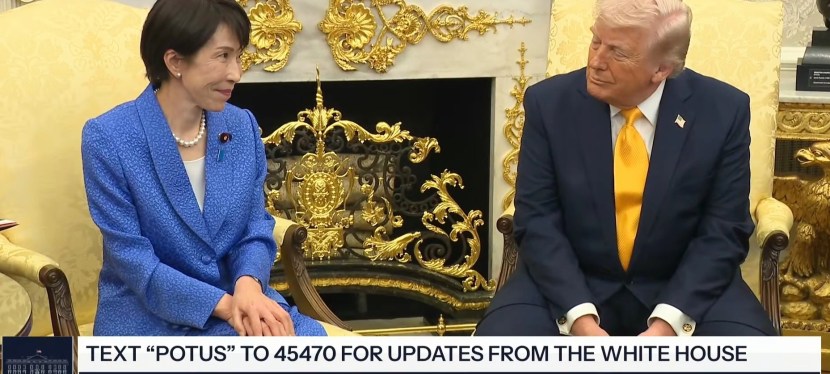
Japanese Prime Minister Takaichi Sanae visited Washington for the first time as the head of her nation and met with US President Donald Trump at the White House where they discussed very important matters in front of the media and officials, according to a news report by Kyodo News. Takaichi also praised the President for his peace efforts.
To put things in perspective, posted below is an excerpt from the news report of Kyodo News Some parts in boldface…
Prime Minister Sanae Takaichi told U.S. President Donald Trump on Thursday that Japan is ready to contribute to the safety of the Strait of Hormuz as the U.S.-Israeli war on Iran intensifies, while explaining Tokyo’s legal constraints on sending ships from its defense forces to the region.
Takaichi told reporters after her meeting at the White House with Trump that she told the U.S. leader “in detail what Japan can do and cannot do” from a legal perspective under the country’s war-renouncing Constitution.
Trump, for his part, reiterated his expectation that Japan would be engaged, while saying during the part of their talks open to media that he believes Japan has been “stepping up to the plate” in recent days over the Iran war, “unlike NATO.”
The U.S. leader has made public his dissatisfaction with Washington’s allies, including Tokyo and members of the trans-Atlantic alliance, over their reluctance to pitch in to help secure the Hormuz strait, a vital waterway for global oil transportation now largely blocked by Iran.
“I expect Japan to step up, because, you know, we have that kind of relationship,” he said. “We have 45,000 soldiers in Japan. We have, we spend a lot of money on Japan…so I expect, I’m not surprised that they would step up.“
Noting also that more than 90 percent of Japan’s crude oil imports normally pass through the strait, Trump said Japan has a “big reason” to do more.
In affirming Japan-U.S. collaboration on expanding U.S. energy production, Takaichi said she proposed to Trump a joint oil-reserve project to ease supply concerns driven by the Middle East conflict.
At the talks, Takaichi praised Trump’s “peace” efforts, expressing readiness to assist by reaching out to other countries. “Donald is the only person who can bring peace and prosperity across the world,” she said.
Takaichi emphasized that the prospect of Iran developing nuclear weapons is unacceptable. Trump alluded earlier to Iran’s nuclear program to explain the U.S. decision to launch its military campaign against the country.
Facing an increasingly assertive China, Takaichi also reminded Trump that the security environment remains severe in the Indo-Pacific, at a time when reports have emerged that some U.S. military assets are being moved from the region to the Middle East.
The two leaders “committed to peace and stability across the Taiwan Strait as an indispensable element of regional security and global prosperity” and “opposed any attempts to unilaterally change the status quo, including by force or coercion,” the White House said in a press release without naming China.
They confirmed that their nations oppose measures threatening critical mineral supplies such as export controls, senior Japanese government officials told reporters, apparently referring to Beijing’s tighter regulations on rare earths exports.
They agreed to advance broad defense cooperation, including joint missile development and production, and promote a free and open Indo-Pacific, according to Takaichi. The White House said the production of the interceptor Standard Missile-3 Block 2A in Japan will be quadrupled.
“We were able to affirm many concrete forms of cooperation that will further enhance the quality of our alliance in wide-ranging fields,” Takaichi said, adding that she and Trump are aiming to elevate bilateral ties to “a higher level” together.
Trump welcomed Japan buying “a lot of” U.S. military equipment. He further stressed that he has a “very fine relationship” with Takaichi, describing her as “a very special person” who is doing a “fantastic job.”
The U.S. side did not bring up fresh demands for Japan to spend more on its defense, the officials said.
Takaichi’s main goals in her first trip to the United States since taking office in October were to strengthen the personal trust in her ties with Trump and reaffirm the U.S. security commitment to the Indo-Pacific region as China’s influence grows.
The meeting came amid increasing concerns within Japan that the U.S. focus in terms of policy and military assets could shift from the Indo-Pacific to the Middle East if the U.S.-Israeli war with Iran drags on, a development that would work in China’s favor.
The U.S. military has reportedly begun relocating the amphibious assault ship Tripoli and over 2,000 Marines from their bases in southwestern and southern Japan to the Middle East.
Takaichi got off to a positive start in building personal ties with Trump when they met in person for the first time in October in Tokyo, shortly after she became Japan’s first female prime minister.
Since the outbreak of the Middle East conflict, Tokyo has sought to strike a delicate balance between maintaining its strong alliance with Washington and its friendly relations with Tehran.
For more insight about the Trump-Takaichi meeting, watch the videos below.
Let me end this piece by asking you readers: What is your reaction to this development? What is your impression about the many matters and announcements that happened during the Trump-Takaichi meeting at the White House? Were you surprised when it was announced that US allies Japan, Italy, England, Netherlands, Germany, and France jointly agreed to secure the Strait of Hormuz in response to Trump’s demand? With Japan having a close relationship with Trump’s America now, do you think Communist China and North Korea will feel intimidated at their side of the Pacific?
Esmaeil Khatib – the Minister of Intelligence of the Islamic terrorist state of Iran – was eliminated successfully by Israel which severely damaged the regime whose number of officials have been reduced even more, according to a news report by The Jerusalem Post. Israel’s Defense Minister Israel Katz and the military confirmed the assassination.
To put things in perspective, posted below is an excerpt from The Jerusalem Post news report. Some parts in boldface…
The IDF has assassinated Iranian Intelligence Minister Esmaeil Khatib, Defense Minister Israel Katz, and the military both confirmed on Wednesday.
Before the assassination was confirmed, two sources gave The Jerusalem Post different indications on the likelihood of the success of the operation, which took place Tuesday night.
Khataib’s death marks the next most significant assassination in Iran since the early days of the war, other than the killing of Ali Larijani and the Basij chief on Monday night.
Khatib has been the intelligence minister since August 2021, when ultra-hardliner and former Iranian president Ebrahim Raisi was elected.
When Raisi was killed in a helicopter crash, and Masoud Pezeshkian succeeded him as Iranian president, he kept Khatib in his role, an unusual move given that traditionally new presidents replace top ministers with their own close associates.
Khatib seen as hardliner close to Khamenei checking Pezeshkian – However, Khatib was close to Ayatollah Ali Khamenei and was viewed as a hardliner who could keep Pezeshkian’s more moderate positions in check.
In addition, over the years, the Islamic Revolutionary Guard Corps (IRGC) started to displace aspects of the authorities and power of the intelligence ministry, causing friction and competition between the bodies.
Raisi was closer to the IRGC than former president Hassan Rouhani, and Khatib spent much of his career in the IRGC’s intelligence branch.
When Raisi moved Khatib from the IRGC to run the intelligence ministry, it also cemented some of the IRGC’s new intelligence powers.
Khamenei wanted to keep Khatib in place partially to ensure continued IRGC dominance.
Although the IRGC was viewed by Khamenei as more loyal and ideologically committed to his causes, the Post has reported that the intelligence ministry had been viewed by outside CIA and Mossad officials as far more professional and competent.
If IRGC intelligence officials might sometimes be promoted to their roles due to ideological loyalty, top intelligence ministry officials usually only achieve promotion based on outstanding spycraft.
Indeed, the elimination of Khatib is very significant and it weakens the regime even more. The regime, whose so-called new supreme leader could not even show himself living, will continue to pretend it is functioning even after losing Ali Larijani and the Basij chief prior to Khatib. Under the leadership of Prime Minister Benjamin Netanyahu, Israel is very capable of tracking and finding Iranian regime leaders for elimination. If the Islamic terrorist proxies realize that Iran – whose entire military has been decimated already by Israel and Trump’s America – has a pretentious and smaller leadership existing, they will feel the pressure knowing they can’t keep on fighting without Iran’s support.
As for the oppressed Iranians who protested against their government, the eliminations of Khatib, Larijani and the Basic commander should embolden them to take action against the wicked regime soon.
For additional insight, watch the YouTube news video below.
Let me end this piece by asking you readers: What is your reaction to this development? Do you think the Islamic terrorist regime of Iran has much fewer commanders remaining behind the scenes? Do you think their so-called new supreme leader is in a coma behind closed doors? With Khatib dead, do you think the number of Iranian soldiers and police officers will contemplate abandoning their posts to escape overseas?
In what can be described as the most significant eliminations since that of the demonic Ayatollah Ali Khamenei, the Israel Defense Forces (IDF) successfully eliminated Iran’s Supreme National Security Council Secretary Ali Larijani and Basij Commander Gholamreza Soleimani, according to a news report by The Jerusalem Post.
To put things in perspective, posted below is an excerpt from The Jerusalem Post news report. Some parts in boldface…
Iran’s Supreme National Security Council Secretary Ali Larijani was killed in a targeted Israeli airstrike in Iran overnight, the IDF and Defense Minister Israel Katz confirmed on Tuesday afternoon.
Israeli confirmation of the assassination came after three separate sources confirmed to The Jerusalem Post he was targeted in what is the single most momentous targeted killing following the death of former supreme leader Ali Khamenei.
The military referred to Larijani as “the de facto leader of the Iranian terror regime.”
Basij commander killed along with ‘majority of leadership’ – The IDF also confirmed it had assassinated the head of the Islamic Revolutionary Guard Corps’ Basij paramilitary militia, Gholamreza Soleimani, and his deputy, Seyyed Karishi. The two were killed in a makeshift tent area, which had been set up to make it harder to follow them as opposed to in a known headquarters.
An Israeli official also confirmed to The Jerusalem Post that the majority of the Basij leadership was eliminated overnight in the Israeli airstrike.
The military also announced that it killed the IRGC’s Aerospace Force chief.
Larijani was due to give public address in Iran on Tuesday – Iranian authorities stated that Larijani was due to give a public address on Tuesday, but two IDF sources expressed skepticism about his making a statement and expressed stronger optimism that the strike succeeded in killing him, before his death was announced.
After Larijani’s death was confirmed, the Mossad Farsi account posted on X/Twitter, saying “In the end, people without mercy will die.”
The Prime Minister’s Office released an image later on Tuesday, which it said captured the moment in which Prime Minister Benjamin Netanyahu issued the order for the targeted assassinations.
Netanyahu also released a statement via video following confirmation of Larijani’s death, calling him the “boss” of the regime, whom he called a “group of gangsters.”
“We’re undermining the regime, in the hope of giving the Iranian nation the opportunity to get rid of it,” he said. “It won’t happen all at once, it won’t happen easily, but if we commit to it, we’ll be able to give them the chance to take their fates into their own hands.”
Larijani was ‘de-facto leader’ of Iran after Khamenei’s killing – Some have viewed Larijani as the man running the Iranian regime since Ayatollah Ali Khamenei was assassinated by the IDF, along with Iran’s military chief, IRGC chief, defense minister, and around 40 other top officials on February 28.
Larijani has been the Islamic regime’s most public voice, responding directly to threats and comments by US President Donald Trump and others.
Whereas Mojtaba Khamenei has been technically appointed the next supreme leader, IDF and American intelligence have said he is badly wounded, and given a total lack of public appearances, doubts have been expressed about whether he is actually running the country.
Further, Larijani was promoted to run day-to-day operations for the country and all negotiations with the West over the conflict in the weeks before the war started.
Larijani, on March 1, announced that he would be heading an interim committee for running the country, given Khamenei’s death. However, just because Larijani issued such a statement does not mean that he is for sure calling the shots.
The Iranian leader has had ups and downs with Khamenei, having been an IRGC commander, speaker of parliament, and a national security council chief, but then was disqualified from running for Iranian president to pave the way for Ebrahim Raisi’s election in 2021, and was out of favor for a time.
However, in recent months, Larijani made a comeback as one of the older and still living top advisers to Khamenei, following so many top officials being killed in June 2025, and became Khamenei’s number two, running the country’s day-to-day security affairs and nuclear negotiations with the US.
If Larijani has been the number one official in Iran these last two weeks, and even if he is only one of the top few, killing or wounding him could significantly impact the overall strategic picture.
This development is the latest addition to the number of Islamic terrorist leaders Israel eliminated under the leadership of Prime Minister Netanyahu. With Larijani confirmed dead, one has to wonder who exactly are leading the Islamic terrorist regime of Iran and why is it their chosen so-called supreme leader – son of the demon Ali Khamenei – has not physically emerged. For additional insight, watch the YouTube news video below.
Let me end this piece by asking you readers: What is your reaction to this development? Do you think the significance of the latest Islamic terrorist leaders of Iran will be realized soon as the war in the Middle East goes on? Who do you think is actually leading the evil regime of Iran right now?
Even as the United States is busy working alongside Israel on the war against the Islamic terrorist state of Iran, the Trump administration announced that it will launch tariff investigations on several countries including trade partners like Japan, according to a news report by Kyodo News. The probes are meant to find out if unfair trading practices exist.
To put things in perspective, posted below is an excerpt from the Kyodo News report. Some parts in boldface…
U.S. President Donald Trump’s administration said Wednesday it will launch tariff investigations into what it sees as unfair practices by China, Japan and over a dozen other American trading partners.
According to U.S. Trade Representative Jamieson Greer, the move is intended to “uncover a variety of unfair trading practices related to excess capacity in production” in the manufacturing sector, and replace Trump’s sweeping tariff regime that was invalidated by the Supreme Court in February.
“Our view is that key trading partners have developed production capacity that is really untethered from the market incentives of domestic and global demand,” Greer told reporters.
The other trading partners facing the investigations, carried out under Section 301 of the Trade Act of 1974, are the European Union, Bangladesh, Cambodia, India, Indonesia, Malaysia, Mexico, Norway, Singapore, South Korea, Switzerland, Taiwan, Thailand and Vietnam, Greer said.
The statute, which allows the U.S. government to impose tariffs in response to a foreign country’s alleged unfair practices, was a favorite tool of Trump for justifying higher tariffs on Chinese imports when he started a trade war with Beijing during his first term as president.
After the U.S. top court on Feb. 20 struck down a large chunk of Trump’s far-reaching tariff agenda as imposed under the International Emergency Economic Powers Act, his administration introduced a new 10 percent global duty.
However, the new 10 percent surcharge, relying on a different legal framework, can only last 150 days unless Congress approves an extension.
Greer said the Trump administration seeks to complete the investigations as quickly as possible and prepare for new Section 301 tariffs within the 150-day period.
The statute requires consultations with the governments of the targeted trading partners before tariffs can be imposed.
Let me end this piece by asking you readers: What is your reaction to this development? Do you think the United States is doing the right thing with the multiple trade investigations? How do you think the Trump administration will adjust its tariff policy once the 150-day period expires?
The establishment of online pre-entry immigration checks and much higher residency fees could become a reality as the Japanese government approved a bill to amend the immigration control law, according to a Kyodo News report.
To put things in perspective, posted below is an excerpt from the news report of Kyodo News Some parts in boldface…
The Japanese government on Tuesday approved a bill to amend the immigration control law to establish an online pre-entry screening system for overseas arrivals and significantly increase residence status application fees for foreigners.
The Cabinet-endorsed bill will be submitted to the current Diet session, and if enacted, the government aims to implement the entry eligibility screening system called the Japan Electronic System for Travel Authorization, or JESTA, in fiscal 2028.
The amendment includes raising the upper limit for visa application and renewal fees from 10,000 yen ($63) to 300,000 yen, marking the first increase since 1982.
The introduction of JESTA aims to prevent terrorism and illegal employment, according to the Immigration Services Agency. It would target the current 74 countries and regions whose citizens are exempt from obtaining short-stay visas.
Several days before traveling to Japan, applicants would be required to provide information online, including their name, the purpose of their stay, and the locations they intend to visit. Those suspected of traveling for illegal employment or other violations would be denied boarding on aircraft and ships.
Fees are currently set at 10,000 yen for application for permanent residency and 6,000 yen for residence period renewals.
It has been pointed out that these fees, which cover only actual costs and are also allocated to coexistence measures, are significantly lower than those in Western countries.
The number of foreign residents in Japan at the end of 2025 stood at approximately 4.13 million, a record high.
The government would aim to use the increased cap to cover system costs for efficient visa screening and the establishment of consultation services.
The amendment sets the cap at 300,000 yen for permanent residency applications and 100,000 yen for visa extensions and similar procedures.
The limits have been set in anticipation of future inflation. Going forward, the specific amounts for each fee would be determined by government ordinance with the aim of applying them within fiscal 2026.
According to sources, the permanent residency application fee is being considered at around 200,000 yen, while other fees would range from 10,000 yen to 70,000 yen depending on the intended period of stay.
Let me end this piece by asking you readers: What is your reaction to this development? Do you think the proposed changes will make a tremendous impact on immigration in Japan? Do you expect the bill to be approved this year? How far do you think Japan should go with reforming their immigration system?
Since the first strikes happened on February 28, the joint military operations of the United States and Israel have heavily damaged the military, energy and government sites of the Islamic terrorist state of Iran. As the war with Iran has impacted the global economy and a new so-called supreme leader of Iran was selected, US President Donald Trump stated that the war is expected to end “very soon” but not at the end of this week, according to a news report by Kyodo News.
To put things in perspective, posted below is an excerpt from the Kyodo News report. Some parts in boldface…
U.S. President Donald Trump said Monday the ongoing war with Iran is expected to be over “very soon” but ruled out the possibility of it coming to an end this week.
“We’re winning very decisively. We’re way ahead of schedule,” Trump, who had initially predicted the conflict could last four to five weeks, claimed during a press conference in Florida.
Trump’s remarks came after Iran selected Mojtaba Khamenei as its new supreme leader after his father was killed in the first wave of U.S.-Israeli strikes.
Khamenei, the late leader’s second son, is known for his close ties with the Islamic Revolutionary Guard Corps. His rise to power has raised concern among many countries that the war, entering its second week, could further destabilize the Middle East and quickly ripple through the global economy.
While insisting that the United States has achieved an “unprecedented” military success, Trump said he was “disappointed” with Iran’s choice of supreme leader.
“We think it’s going to lead to just more of the same problem for the country,” he said.
Sending conflicting messages, Trump also warned that the United States will aggressively attack Iran if it attempts to block the world’s energy supply.
“We will hit them so hard that it will not be possible for them or anybody else helping them to ever recover that section of the world,” he said.
But he struck an optimistic note on oil prices, saying they would be much lower after the war ends. On disruption to oil shipments through the Strait of Hormuz, Trump said the United States was less affected than China.
It seems that the joint Israel-America operations have achieved more than what was previously expected. The Islamic regime’s navy has been demolished, the air force crushed, and the oil refineries destroyed. It has also been reported that more military personnel of the regime have left their posts and moved out of the country using fake passports. The oppressed Iranians, meanwhile, should get more motivated to go out and protest as the regime’s military and police forces weaken.
Looking at the bigger picture, the massive devastation on the Islamic terrorist state made the leaders of Russia and Communist China worried. China needs oil from Iran while Russia needs Iranian-made weapons. Geopolitically, it’s like Trump’s America stuck two birds with one stone. In the case of Israel, Islamic terrorist groups are weakening now that the Islamic regime of Iran cannot support them. Going back to Iran, there are opportunities for the affected Iranians to move out of the country and enter Armenia as refugees. Already there are groups at the Armenian side of the border who intend to help Iranian refugees.
For more updates about what happened lately, watch the videos below.
Let me ending this post by asking you readers to pray to the Lord for victory, for the protection of the American and Israeli forces, for the safety of civilians everywhere, for the end of the Islamic terrorist regime of Iran to happen soon, and for the liberation of the oppressed Iranian people. Pray to Him to also bless US President Trump and Prime Minister Benjamin Netanyahu, as well as their respective administrations. Pray to God for more peace and stability in the Middle East and for the stability of the global economy.




 Author Carlo Carrasco