From a former sleepy town in the south, Muntinlupa City, now a bustling metropolis and leading business-hub in Metro Manila celebrated its 26th anniversary yesterday.
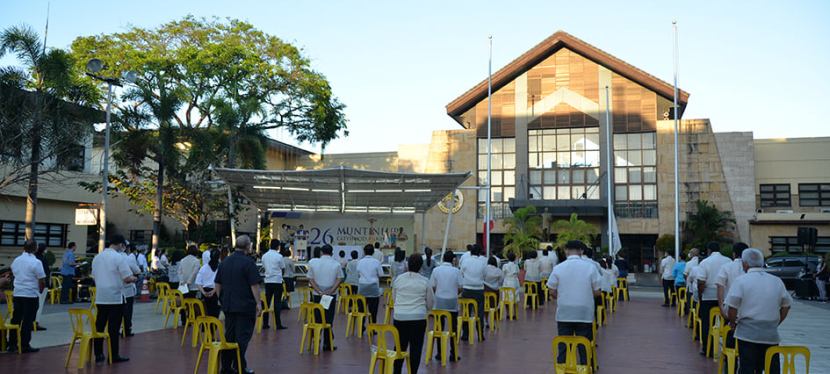
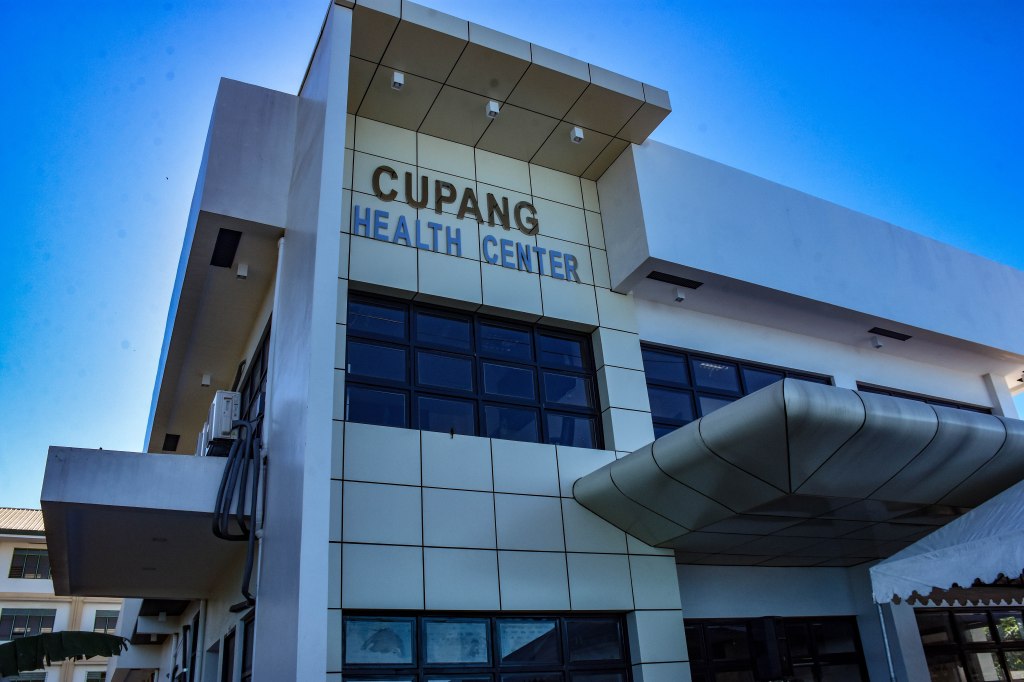
Mayor Jaime Fresnedi together with other local executives led the cityhood anniversary, a special (non-working) holiday by virtue of RA No. 9191. A simple program was organized at the Muntinlupa City Hall Quadrangle starting with a thanksgiving mass and followed by the inauguration of the Cupang Health Center and simultaneous distribution of food packs in different local communities.
The anniversary celebration held at the quadrangle of Muntinlupa City Hall. (source – Muntinlupa PIO)
Mayor Jaime Fresnedi delivered his remarks. (source – Muntinlupa PIO)
In his message, Fresnedi reported the city’s COVID-19 Vaccine Plan and his willingness to be inoculated to encourage the public to avail the government’s vaccination service.
“I am ready to be vaccinated, along with our City Councilors and Congressman Ruffy Biazon, upon the arrival of supply in in Muntinlupa to build the confidence of our constituents in the vaccines approved by our Food and Drug Administration,” Fresnedi said.
Muntinlupa City has secured 400,000 doses from British pharmaceutical firm AstraZeneca through a tripartite agreement with the National Task Force against COVID-19 (NTF). The city’s COVID-19 vaccination plan and other best practices on public health earn praise from officials of the Department of Health’s Coordinated Operations to Defeat Epidemic (CODE) Team.
The City Health Office has identified 6,758 medical frontliners from barangay health centers, emergency responders, public and private hospitals/clinics to be prioritized in the roll-out of vaccines. Under the local COVID-19 vaccination plan, there will be 82 vaccination teams to be deployed in 35 vaccination posts and 8,200 target individuals to be vaccinated per day.
The Cupang Health Center is one of the recent projects fulfilled. (source – Muntinlupa PIO)
On February 26, the City Government of Muntinlupa launched “Merkado sa Muntinlupa,” an open-air market and bazaar located in Sports Complex open grounds along Laguna Lake as part of the cityhood anniversary. Merkado sa Muntinlupa is an outdoor market showcasing homegrown products and is open on weekends, every Friday 4:00 pm – 9:00 pm and every Saturday-Sunday, 8:00 am – 9:00 pm.
Further, a new park in Alabang Viaduct including the newly constructed Muntinlupa National High School Tunasan Annex Covered Court and Extension of Muntinlupa Student Center for Life Skills in Brgy. Tunasan were inaugurated last week in celebration of Muntinlupa’s anniversary.
On March 1, 1995, Muntinlupa was converted from a municipality to a highly urbanized city and became the 65th city of the Philippines by virtue of Republic Act 7926. Today, it has transformed as one of the leading investment hubs in the country with nine equally progressive barangays and a population of 504,509 (2015 Census).
+++++
The above information was provided by the City Government of Muntinlupa for the purpose of public information and transparency. Some parts were edited for this website.
For more South Metro Manila community news and developments, come back here soon. Also say NO to fake news, NO to irresponsible journalism, NO to misinformation, NO to plagiarists, NO to reckless publishers and NO to sinister propaganda when it comes to news and developments. For South Metro Manila community developments, member engagements, commerce and other relevant updates, join the growing South Metro Manila Facebook group at https://www.facebook.com/groups/342183059992673
This past weekend, the New South Homeowners Association (NSHA) inside BF Homes subdivision, Parañaque City, organized their annual election which resulted seven winners who will serve for two years as members of the association’s board of directors (BOD).
Those who got elected in the February 27, 2021 village polls were Karen Abanilla with 45 votes, Michael Paul Togle and Bon Obial with 42 votes each, Emmanuel Malicden with 40 votes, Danilo Lesaca with 39 votes, Fred Morales with 38 votes and Christopher Baliog with 36 votes.
Three of the seven newly elected village directors posed with the official results after the counting ended.
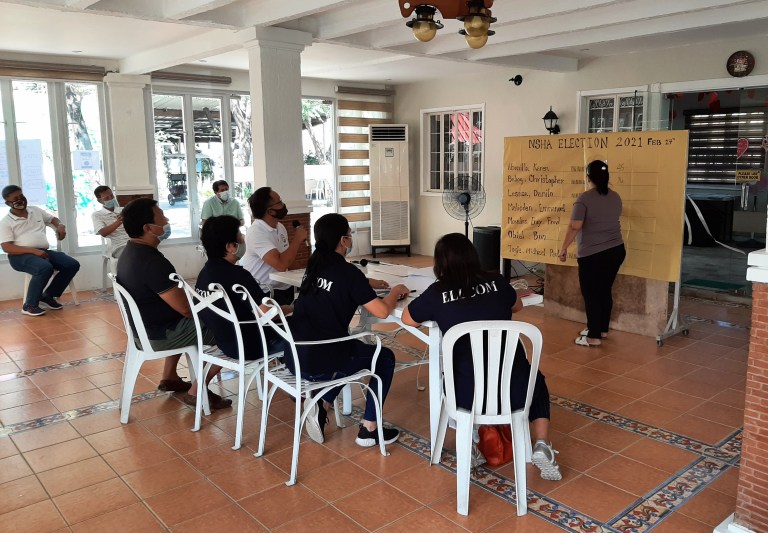
The NSHA election committee in a group shot with the results.
The newly elected people will join the other six incumbent directors (who are due for next year) in completing the 13-member NSHA BOD and soon, they will convene and elect among themselves and come up with the new lineup of NSHA officers.
What makes the NSHA election significant this year was that it was organized with the ongoing COVID-19 pandemic. As such, the association took measures that would lower the risk of new infections while still allowing legitimate members to vote efficiently and safely.
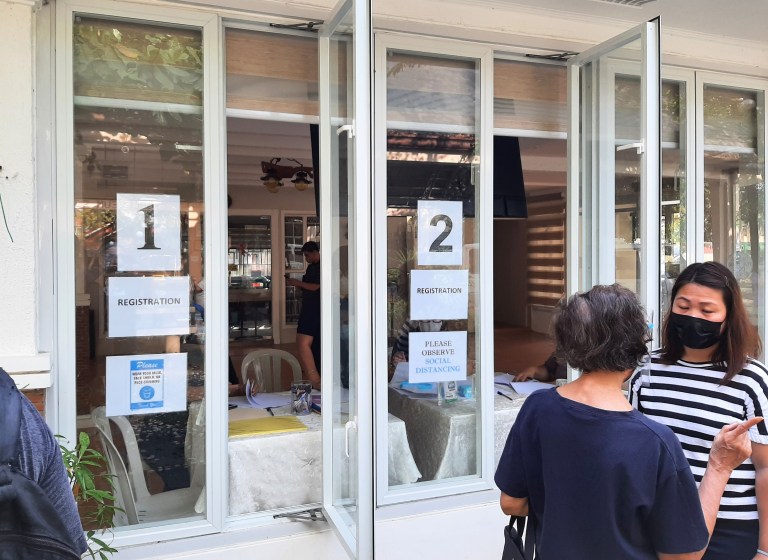
The NSHA election committee (ELECOM) headed by Gerard Castro used their indoor facility (part of the clubhouse which has the office) as the key venue. ELECOM officers were inside and worked behind specific windows which the legitimate HOA members (who are outside) visited one-by-one to vote manually. Social distancing was practiced and everyone wore a face mask. At the nearby basketball court (a Golezeum), there were some plastic chairs arranged with social distancing in mind for the comfort of the voting members.
A view from outside the venue.
Windows 1 and 2 were where the legitimate members registered.
The ELECOM from inside the venue handling registration.
The election process was pretty simple: Step 1 – From waiting area go to Window 1 or 2 to register and get ballot. Step 2 – Go to designated voting area to vote your selected candidates for directors. Step 3 – Go to Window 3 to put your thumb mark on ballot and put ballot (divided in half) in ballot box.
After voting, the legitimate members were directed to go to the designated waiting area for snacks and refreshments.
A view of Window 3 from the outside.
The counting of the votes was done with transparency.
In the afternoon, the counting of votes took place inside the venue. Each vote was counted carefully and the names of the candidates who received the votes were clearly spoken. The results were certified by the ELECOM and the seven winners were proclaimed. It was indeed a transparent process.
For more South Metro Manila community news and developments, come back here soon. If you want to have your local community featured on this website or if you have a press release that needs to be published to inform the readers, please approach me. Also say NO to fake news, NO to irresponsible journalism, NO to misinformation, NO to plagiarists, NO to reckless publishers and NO to sinister propaganda when it comes to news and developments. For South Metro Manila community developments, member engagements, commerce and other relevant updates, join the growing South Metro Manila Facebook group at https://www.facebook.com/groups/342183059992673
It has been almost fifty years since Shakey’sfirst opened here in the Philippines and went on to become one of the most defining restaurants that families visit for very delicious meals, especially when it comes to pizza. Shakey’s has over 200 stores (both franchised and owned by the company) nationwide according to details posted in the Shakey’s Philippines website. Its strong presence in the Philippines was confirmed in 2015 when Euromonitor published a report showing that Shakey’s is the market leader in the categories of chained pizza full-service restaurants and in chained full-service restaurants. The results for both categories were 26.7% and 57.7% market shares.
Along the way, Shakey’s Philippines has a sibling business called Peri-Peri Charcoal Chicken which has a growing number of outlets. Inside BF Homes subdivision in Parañaque City, the Shakey’s branch along Aguirre Avenue has a Peri-Peri outlet right beside it.
Of course, the COVID-19 pandemic negatively affected businesses and societies in 2020. It was so severe, the Philippine economy shrank by a record 9.5%. As of this writing, a whole lot of people around the nation remain unemployed and more people fell under poverty.
The year 2021, however, will be different as far as Shakey’s Philippines is concerned. The company just announced that they will open fifteen new Shakey’s branches as well as fifteen new Peri-Peri outlets this year. These are parts of their plan to restart a store network expansion strategy that was put on hold last year due to the pandemic. Below is an excerpt from Shakey’s press release published on Philippine News Agency (PNA).
“For Shakey’s, we are looking to further strengthen the brand’s visibility and awareness, especially in underpenetrated second and third-tier cities outside of Metro Manila. For Peri, there are still a number of unserved markets which don’t have access to the brand’s great-tasting products,” Shakey’s president and chief executive officer Vicente Gregorio said.
Last 2020, the company ended with 245 Shakey’s restaurants, three of which were located abroad, and 34 Peri outlets all located in the Philippines.
It also launched a number of new offerings in select outlets including the ability for guests to ‘Park & Dine’, ‘Park & Order’, eat outdoors, and order R&B milk tea -one of the leading milk tea brands in Singapore.
“With evolving consumer habits brought about by the pandemic, our network expansion strategy has likewise adapted to ensure we maximize both our in-store and out-of-store presence. Our new openings this year will cater not only to our guests’ dine-in preference, but also their increasing need for more convenient and flexible out-of-store options,” Gregorio said.
He said Shakey’s will be unveiling a number of so-called ghost kitchens or kitchen extensions “to further strengthen our presence in delivery” at a time when off-premise channels are gaining prominence.
In the last few months, the company has been piloting a ‘31 Minute Delivery, If It’s Late, It’s Free’ guarantee in select areas in Metro Manila.
Gregorio added the company’s planned expansion this year “will come hand in hand with other exciting new business innovations that will maximize our existing asset base.”
“2021 will definitely be an exciting ‘bounce-back’ year,” he said.
As you can see in the above details, Shakey’s Philippines continues to push forward with their business and strategies even during this COVID-19 crisis. This is indeed encouraging not only for the business-minded people but also to Shakey’s many loyal customers as well as other food enthusiasts who love pizza, pasta and other meals served by the company.
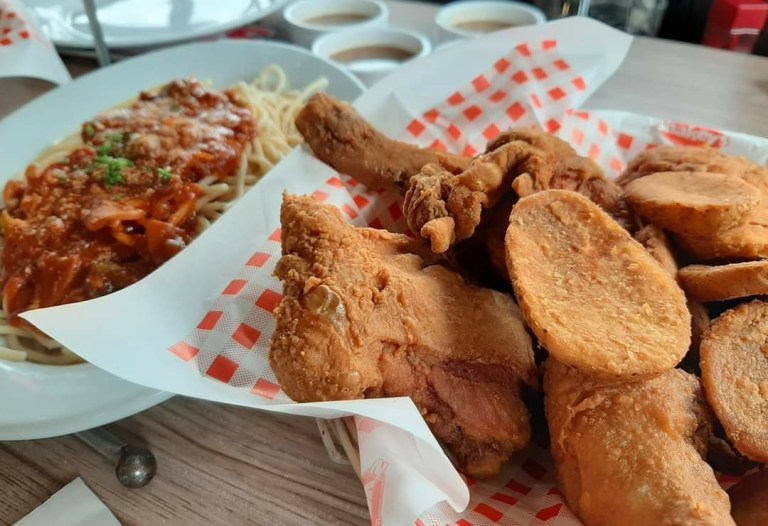
In my experience, Shakey’s always serve very delicious fried chicken, mojos and spaghetti.
As Shakey’s president and CEO Gregorio stated, their company is taking steps on keeping up with the changing consumer habits and, more notably, they are making their business accessible to the consumers. In short, Shakey’s Philippines won’t allow itself to be a victim of change but rather be a part of it and keep on feeding the customers. That being said, 2021 is for them a bounce-back year.
Now that you have read this, I’d like to ask when was the last time you eat inside a Shakey’s? Have you ordered food from them lately? What is the first type of food that comes to your mind when you hear their brand?
+++++
For more South Metro Manila community news and developments, come back here soon. Also say NO to fake news, NO to irresponsible journalism, NO to misinformation, NO to plagiarists, NO to reckless publishers and NO to sinister propaganda when it comes to news and developments. For South Metro Manila community developments, member engagements, commerce and other relevant updates, join the growing South Metro Manila Facebook group at https://www.facebook.com/groups/342183059992673
People here in Metro Manila who have gotten tired with the general community quarantine (GCQ) limitation during the COVID-19 pandemic will have to wait a bit longer as President Rodrigo Duterte refused to shift the entire nation to the less restrictive modified general community quarantine (MGCQ) status because the vaccination for COVID-19 should be done first.
This was announced during the Cabinet meeting last night. Below is an excerpt from the Philippine News Agency report…
“President Rodrigo Roa Duterte gave his directive to the Cabinet that the Philippines would not be placed under modified general community quarantine unless there is a rollout of vaccines,” he said in a statement.
While Duterte acknowledged the need to reopen the economy, Roque said the President refused to put people’s health and safety at risk.
“The Chief Executive recognizes the importance of reopening the economy and its impact on people’s livelihoods. However, the President gives higher premium to public health and safety,” he added.
The President made it clear that the vaccination roll-out should go first before shifting the entire nation into MGCQ control. While it is clear that reopening the economy is essential, Duterte prefers to take time to be cautious and reduce the risks of new infections. As far as he is concerned, vaccines should go first.
Going back to Metro Manila, a majority of mayors voted to have the metropolis shift to MGCQ status by March 1. As the President made the rejection and insisted vaccination should go first, business owners, their affected employees and the unemployed will have to wait longer before MGCQ will be declared not only for the National Capital Region (NCR) but for the entire nation. The MGCQ status for the Philippines is key to economic revival which the Department of Trade and Industry (DTI) supports.
For those of you reading this, do you think the President made the right decision? Would you insist on declaring an MGCQ status nationwide without the COVID-19 vaccines? Please answer by commenting below. Thank you.
+++++
Thank you for reading. If you find this article engaging, please click the like button below and also please consider sharing this article to others. If you are looking for a copywriter to create content for your special project or business, check out my services and my portfolio. Feel free to contact me as well. Also please feel free to visit my Facebook page Author Carlo Carrasco and follow me at HavenorFantasy@twitter.com
For more South Metro Manila community news and developments, come back here soon. Also say NO to fake news, NO to irresponsible journalism, NO to misinformation, NO to plagiarists, NO to reckless publishers and NO to sinister propaganda when it comes to news and developments. For South Metro Manila community developments, member engagements, commerce and other relevant updates, join the growing South Metro Manila Facebook group at https://www.facebook.com/groups/342183059992673
President Rodrigo Duterte will have a big decision to make that will affect millions of residents and businesses in Metro Manila as a majority of the mayors voted to shift the metropolis from general community quarantine (GCQ) to modified general community quarantine (MGCQ) status by March 1, 2021, as based on a news release on Philippine News Agency (PNA) that got published just last night.
Here’s an excerpt from the PNA report:
The Metro Manila Council (MMC), composed of Metro Manila mayors and national government officials, has voted to support the proposed shift to the less restrictive modified general community quarantine (MGCQ) in Metro Manila.
“Ang karamihan po ng alkalde ng kalakhang maynila ay bumoto na MGCQ na po ang magiging posisyon nila pagdating sa Metro Manila (Most of the mayors in Metro Manila voted for having MGCQ as their position in Metro Manila),” Metropolitan Manila Development Authority (MMDA) chairman Benjamin “Benhur” Abalos Jr. said in a press conference on Thursday.
This, he said, will be sent to the Inter-Agency Task Force for the Management of Emerging Infectious Diseases (IATF-EID) and to President Rodrigo R. Duterte who will make the final decision on whether to implement eased quarantine restrictions by March 1.
He declined to provide the actual number of votes the proposal received but said that all Metro Manila mayors will support the decision.
Indeed, Abalos did not reveal the number of Yes and No votes but the Manila Bulletin reported that the score among Metro Manila mayors was 9-8 in favor of MGCQ.
To put things in perspective, Metro Manila still has yet to adjust to MGCQ status. Metro Manila is the hot spot of multiple cities where a lot of residents as well as business entities of varied sizes are located at. Right now, the nation needs a major boost to its economy even as there is still the need to be vigilant to avoid new COVID-19 infections. Lots of people in the metropolis remain unemployed and badly need income, and having Metro Manila shift to MGCQ status will help revive other businesses and pave the way for more people to get back to work.
It would be nice to see the Metro Manila Council research more and observe closely how other cities and provinces are doing while maintaining MGCQ statuses for months already.
“It is about time we move to MGCQ after a year of lockdown,” Lopez told reporters in a Viber message Tuesday. “Lockdown was supposed to buy us time to prepare our health system and improve contact tracing and ‘Trace-Test-Treat’.”
Since June 2020, the National Capital Region (NCR) has not graduated from GCQ status, a stricter community quarantine measure than MGCQ.
It even went back to much stricter modified enhanced community quarantine (MECQ) from Aug. 4 to 18 last year as health care facilities in Metro Manila were overwhelmed due to the increasing number of Covid-19 cases during that period.
“As the Philippines recovers, Metro Manila has a very weak recovery, worse in employment and hunger recovery, and that means more urban poor. The damages to malnutrition and other health and social issues will be irreversible,” Lopez said.
NCR accounted for around 40 percent of the Philippine gross domestic product (GDP).
But Lopez added the reopening of more economic activities should depend on the Covid-19 statistics.
As pointed out by Trade secretary Lopez, Metro Manila is lagging behind in terms of recovery from the pandemic. Apart from joblessness and lack of income, poverty in the National Capital Region is an important problem to solve. The more people fall under poverty, the more local government units (LGUs) need to exert and spend their limited resources to support them.
Right now, the Metro Manila Council’s approval of shifting to MGCQ status will soon be dealt with by the Inter-Agency Task Force for the Management of Emerging Infectious Diseases (IATF-EID) and President Duterte.
In ending this, here are some videos about combatting the China virus.
+++++
For more South Metro Manila community news and developments, come back here soon. Also say NO to fake news, NO to irresponsible journalism, NO to misinformation, NO to plagiarists, NO to reckless publishers and NO to sinister propaganda when it comes to news and developments. For South Metro Manila community developments, member engagements, commerce and other relevant updates, join the growing South Metro Manila Facebook group at https://www.facebook.com/groups/342183059992673
In a recent notice to its constituents, the City Government of Las Piñas announced that it is collecting data for those who will be granted a free COVID-19 vaccine covering all barangays in the city.
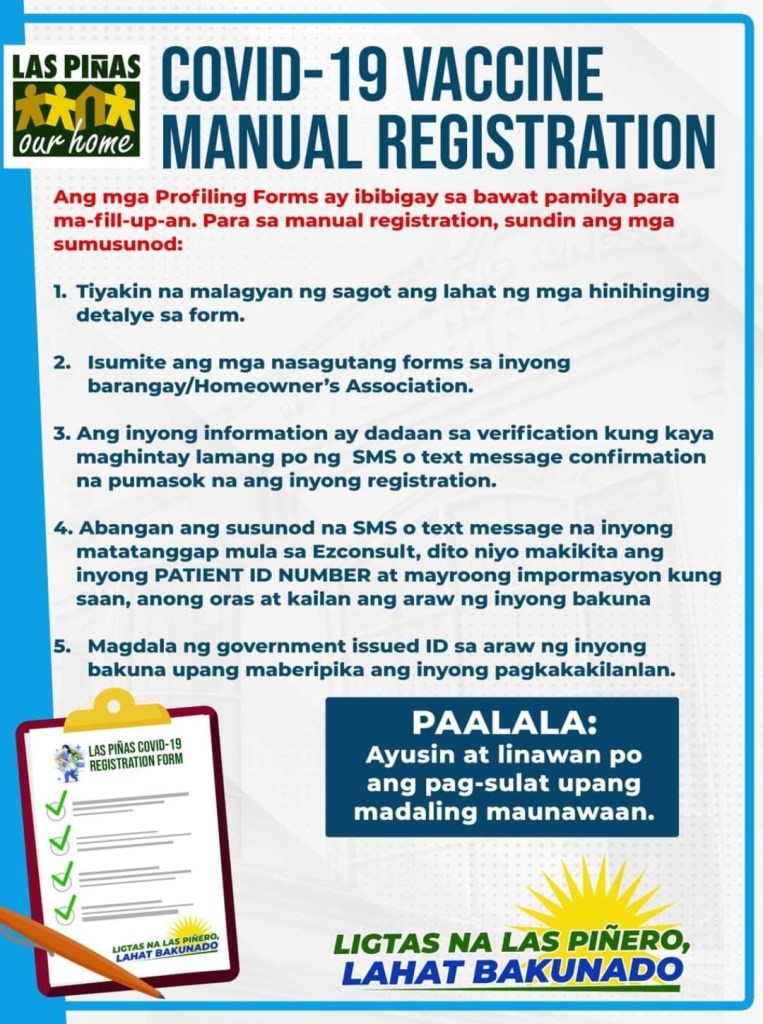
Specifically, each family will be given profiling forms to be filled out. The steps to be followed for manual registration are as follows (UPDATED January 2022):
1. Make sure that all the requested details in the form are answered.
2. Submit the understood forms to your barangay / Homeowner’s Association (HOA).
3. Include one (1) 2 x2 size ID photo and photocopy of any government issued ID with address.
4. Wait for a text message from Ezconsult. Your PATIENT ID NUMBER and other relevant information will be revealed.
5. Bring a government-issued ID with you on the day of your vaccination.
Registration can also be done online with the following steps:
2. Answer the questions and make sure your details are correct.
3. Your information will be verified. Wait for a text message.
4. Wait for a text message from Ezconsult. Your PATIENT ID NUMBER and other relevant information will be revealed.
5. Bring a government-issued ID with you on the day of your vaccination.
Offered recently is what the City Government referred to as on-site assisted registration. The City Government described on-site assisted registration as follows (translated from Tagalog): There are designated officers-of-the-day at every vaccination site in the city where they are ready to assist residents who wish to register. Residents who register on-site will also be given a profiling form where they will need to disclose their details.
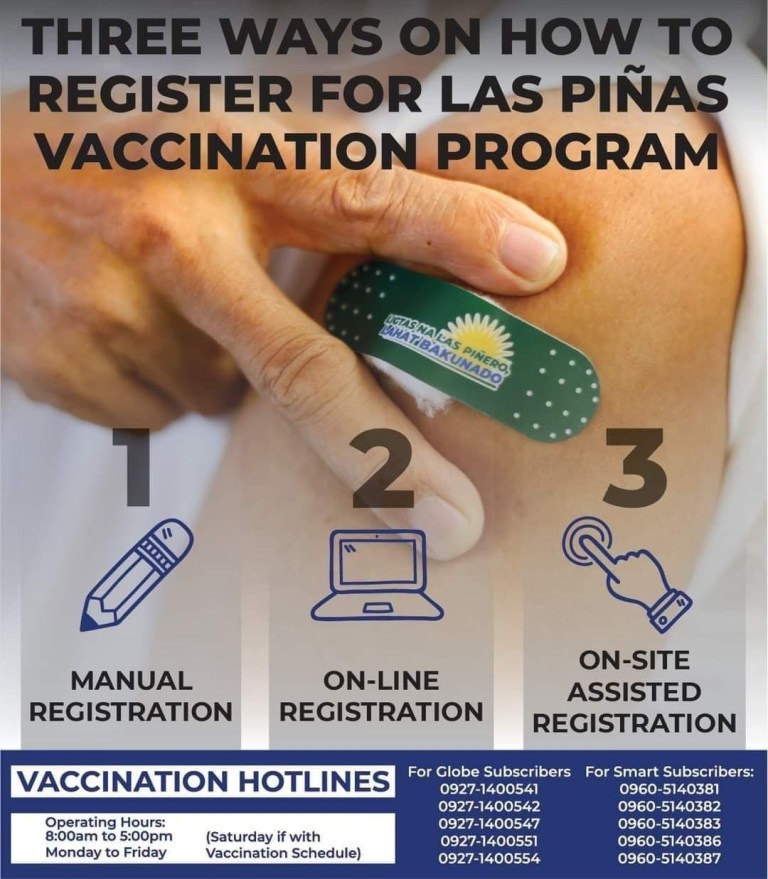
The latest update from the city shows the three ways to get registered for free COVID-19 vaccines.
A fourth method of registration was introduced by the City Government. For this, let’s refer to it as the eZConsult method. Below are the visual references. Read the details carefully.
And now we can focus on COVID-19 vaccine registration for minors (aged 12 to 17). If you are a parent and your family resides in the city, you can do the registration by clicking http://laspinascityonline.laspinascity.gov.ph/eCVRS/
Previously the City Government and its strategic partners conducted a simulation on how the vaccination will happen. The said simulation was attended by Mayor Imelda “Mel” Aguilar and Vice Mayor April Aguilar-Nery.
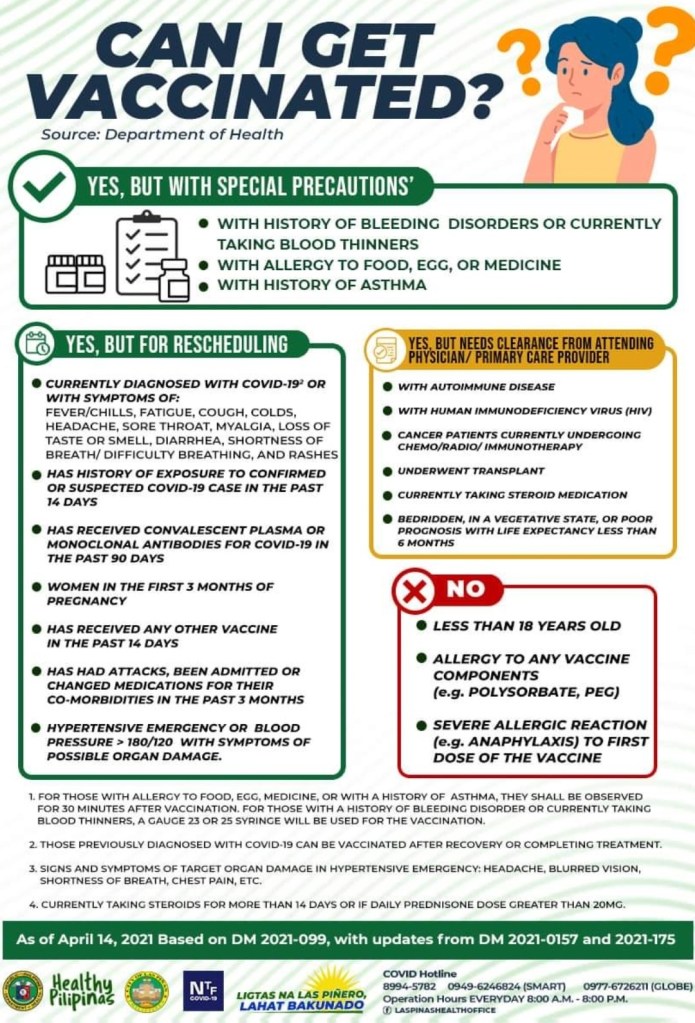
For your references, posted below are important information. Please read and pay close attention to the details. These are official references from the local health office.
+++++
For more South Metro Manila community news and developments, come back here soon. Also say NO to fake news, NO to irresponsible journalism, NO to misinformation, NO to plagiarists, NO to reckless publishers and NO to sinister propaganda when it comes to news and developments. For South Metro Manila community developments, member engagements, commerce and other relevant updates, join the growing South Metro Manila Facebook group at https://www.facebook.com/groups/342183059992673
Wow. That was quite a ride of information updates that happened the last few days. Last Friday, the Inter-Agency Task Force for the Management of Emerging Infectious Diseases (IATF-EID) announced that it has allowed a variety of businesses around the Philippines to resume operations so that they can recover from this ongoing COVID-19 pandemic.
Such businesses specified were driving schools, video arcades, theme parks, natural sites, historical landmarks, parks and, most notably of all, cinemas (or movie theaters).
However, the Metro Manila mayors reacted and expressed their opposition against the national government’s decision on allowing cinemas to reopen. Through the media, Metropolitan Manila Development Authority (MMDA) chairman Benhur Abalos stated that a “majority of Metro Manila mayors agreed not to open as far as cinema is concerned.”
Below is an excerpt from the Manila Times article on Abalos…
He noted that movie theaters are enclosed and air-conditioned spaces where people stay for more than 30 minutes, conditions that increase the risk of coronavirus transmission.
To put things in perspective, Metro Manila is composed of many major Philippine cities such as Makati, Quezon City, Manila and Muntinlupa to name a few. Until now, Metro Manila remains under GCQ (General Community Quarantine) status while certain other cities or provinces have been enduring the MGCQ (Modified General Community Quarantine) status. As of this writing, the only cinemas operating here in the Philippines are those located in MGCQ areas.
Here in Metro Manila, movie theaters have been closed since March 2020. Take note of that.
As a result of the Metro Manila mayors’ opposition, it has been announced that the reopening of cinemas has been moved to March 1, 2021, but that is not guaranteed. According to the news release published yesterday at Philippine News Agency, the reopening of cinemas in GCQ areas has been moved to the first of March to allow consultations with local officials, and this is the result of talks with MMDA’s Abalos, MMDA General Manager Jojo Garcia and Trade Secretary Lopez.
Malacañang stated in the release: The IATF respects the position of mayors, especially those in Metro Manila. That’s why the resolution stated that the reopening of cinemas will be effective after drafting guidelines with local governments particularly when it comes to seating capacity in cinemas.
As you can see, there is still some work needed to be done before Metro Manila movie theaters (or any theaters in GCQ areas in general) can be allowed to reopen. This is why, in my view, the March 1 target for reopening could be missed.
More on the cinemas, I wonder if the Metro Manila mayors and their advisers did enough research about the economics. I understand they want to avoid the risk of people getting infected with COVID-19 within their respective cities, but there is still the need for economic recovery even if cinemas are to operate at less than 100% capacity and efficiency
From an economic point of view, thanks to information released by Trade Secretary Ramon Lopez, the so-called traditional cinema industry of the nation employed 300,000 workers and had generated revenues of P13 billion BEFORE the pandemic started last year. Because of the pandemic, 2020 theater revenues shrunk down to only P1.3 billion.
Whatever happened to them as a result of the pandemic, 300,000 cinema employees is a figure that should not be ignored nor dismissed so quickly by the mayors and their advisers. Economic recovery is a must.
In an ABS-CBN news report, the cinema operators and movie producers have decided to adopt a so-called wait-and-see approach on the reopening of cinemas in GCQ areas.
Here’s an excerpt from the report:
Although they welcome the easing of quarantine restrictions, local producers and theater operators believe that ultimately, the reopening of cinemas will still be dependent on the clearance of local government units.
Roselle Monteverde and Vincent del Rosario, who helm Regal and Viva Entertainment, respectively, told ABS-CBN News that they have the capability to provide cinemas with movie material, some of which have long been canned. Nonetheless, along with other members of the local producers association, the movie magnates are still awaiting the IATF guidelines and, more important, the guidance of mayors.
And here’s another excerpt, this time about two major cinema chain operators.
Megaworld Cinemas and SM Cinemas, which both control a vast chain of theater chains, told ABS-CBN News that they will wait for the final guidelines of the IATF and local government units.
Bomboy Lim of Robinson Cinemas also told ABS-CBN News that the bottomline is securing the approval of local government units. “Priority din namin ang ligtas na panonood ng tao. Kailangan nating sundin ang lahat ng guidelines including the IATF. Right now, they are still making it.”
Robinson Cinemas, which has an estimated 200 theaters nationwide in its malls nationwide, have not reopened since March 2020.
Over at the City of Manila, the local authorities there announced it will offer free swab tests to movie theater workers within their jurisdiction. Mayor Isko Moreno said that the swab tests are required before the city government allows malls to open their movie houses. Cinema workers specified are janitors, security guards, tellers, ushers, porters, ticket sellers and snack bar attendants to name some. Managers of malls in the city were asked by the mayor to present to the city government their respective preparations for the reopening of their cinemas with public safety in mind.
As I personally observed in shopping malls with cinemas here in South Metro Manila, each of them has established rules and set up special equipment to monitor the health statuses of people entering their respective places. I can imagine local cinemas inside these malls having similar equipment, disinfectant machines, and temperature scanners. It would be helpful if the malls or cinema operators can afford to set up sanitation tunnels (like those in Israel) for moviegoers to pass thru when entering and exiting the movie theater. Watch the video below…
Even though things look unclear, the fact remains is that operators of movie theaters and their employees now have a chance to resume their business and do their part in the recovery economically and socially. How the IATF and the Metro Manila mayors will decide the fate of the cinemas remains to be seen.
If there are any major updates, you will be notified right here at www.CarloCarrasco.com
+++++
For more South Metro Manila community news and developments, come back here soon. Also say NO to fake news, NO to irresponsible journalism, NO to misinformation, NO to plagiarists, NO to reckless publishers and NO to sinister propaganda when it comes to news and developments. For South Metro Manila community developments, member engagements, commerce and other relevant updates, join the growing South Metro Manila Facebook group at https://www.facebook.com/groups/342183059992673
Recently the City Government of Las Piñas headed by Mayor Imelda “Mel” Aguilar and Vice Mayor April Aguilar-Nerry and in cooperation with the Department of Health (DOH) conducted a simulation or dry run of their vaccination program for COVID-19 at the vaccination site located at Las Piñas Elementary School Central, P. Diego Cera, Barangay Elias Aldana.
Present during the simulation were DOH Assistant Regional Director Ma. Paz Corrales and physicians of the City Health Office Dr. Ferdinand Eusebio, Dr. Julie Gonzales and Dr. Ellaine Gumpal.
Las Piñas City Mayor Imelda Aguilar (front row, middle), Vice Mayor April Aguilar-Nery (front row, left) and other officials at the vaccination site on February 8, 2021. (source – Las Piñas City Facebook page)
The simulation is part of the City Government’s preparation and cooperation with the government’s mass vaccination program for the expected arrival of vaccines in the country this February.
During the simulation, the City Government and the CHO prepared an orderly, comprehensive and concrete vaccination plan to ensure the safety of vaccinators and prevent the possible spread of diseases in the city.
The Mayor and Vice Mayor observe during the simulation. (source – Las Piñas City Facebook page)
In ensuring order, a screening site has been set up in each barangay to initially list the potential recipients of the vaccine. There are five registration sites in District 1 and District 2 for validation and profiling of the initial list. Based on the final masterlist, QR codes will be issued to those who qualified. Each of the 20 barangays has one vaccination site where Las Piñas City residents will be vaccinated at. This past January, the City Government conducted a community level census for the COVID-19 vaccine.
The order of each area (waiting area, registration area, counseling area, medical screening, vaccination area, encoding area and post vaccination and monitoring area) will be followed at a designated vaccination site with the rules and procedures that must be followed by the locals for their safety before and after they are vaccinated.
Already personnel of City Hall underwent simulations of vaccinations in the area to demonstrate the Local Government’s preparation in tandem with the local Health Office.
When it comes to cold storage for vaccines, a storage facility has been prepared and there are ten additional freezers set for standby to temporarily store vaccines to keep them safe for the program.
The City Government aims to vaccinate three thousand residents per day. Previously, the City Government allocated P200 million for the purchase of additional COVID-19 vaccines. About 500,000 doses of COVID-19 vaccines were secured after Mayor Aguilar signed the tripartite contract with British drug maker AstraZeneca in collaboration with the government.
+++++
The above information was provided by the Las Piñas City Government for the purpose of public information and transparency. Some parts were edited for this website.
For more South Metro Manila community news and developments, come back here soon. Also say NO to fake news, NO to irresponsible journalism, NO to misinformation, NO to plagiarists, NO to reckless publishers and NO to sinister propaganda when it comes to news and developments. For South Metro Manila community developments, member engagements, commerce and other relevant updates, join the growing South Metro Manila Facebook group at https://www.facebook.com/groups/342183059992673
Yesterday, Department of Trade and Industry (DTI) Secretary Ramon Lopez announced that the Corporate Recovery and Tax Incentives for Enterprises (CREATE) Act is aimed to reduce the corporate income tax which should lead to creating more jobs as well as attracting investments.
Given the dramatic fall of the Philippine economy as a result of the COVID-19 pandemic, the CREATE bill could be the big solution to boost the economy and pave the way for recovery. For almost a year now, the said pandemic caused a lot of people to lose their jobs and much of their income. A lot of businesses closed down as well.
For your reference, here is a long excerpt of the news release about the said bill published via Philippine News Agency (PNA). Key words are highlighted in bold:
The recent bicameral approval of the game-changing CREATE Act can also provide a big boost to the National Employment Recovery Strategy (NERS) Task Force chaired by the DTI and co-chaired by the Department of Labor and Employment (DOLE) and the Technical Education and Skills Development Authority (TESDA), which was signed last Feb. 5 by several agencies.
“The landmark tax and incentives reform bill that we expect to be signed by the President is expected to bring in (a) massive inflow of investments that will create more jobs, especially as we focus efforts in the National Employment Recovery during this period of the pandemic and beyond. The passing of CREATE will firm up the tax and incentive reforms that will make the investment climate significantly more attractive than the current tax and incentive regime,” Lopez said in a statement.
He said the bill will certainly encourage more investments with the lowering of the corporate income taxes rate from 30 percent to 20 percent for micro, small and medium enterprises (MSMEs), and 25 percent for large corporations.
“Modernizing the incentives system likewise makes the incentives such as income tax holiday (ITH), special corporate income tax rates (SCIT) or enhanced deductions (ED), available to industries considered strategic, critical or export oriented,” he added.
The Trade chief said the length of incentives, such as four to seven years of ITH plus five or 10 years of SCIT or ED, will depend on the nature of industry, export or domestic oriented, degree of technology and value adding, and geographical location, with additional years outside the Metro Manila and urban centers.
“There is also (a) longer transition period for those currently granted incentives. Thus, incentives are now made more performance-based, focused and timebound,” Lopez said.
CREATE is a bill certified urgent by President Rodrigo Roa Duterte upon the recommendation of the economic team led by Finance Secretary Carlos Dominguez III.
Lopez also thanked the legislators at the Senate and the House of Representatives, with Sen. Pia Cayetano and Rep. Joey Salceda, respectively, as principal authors, for the hard work of the committee members in bringing the CREATE bill to fruition.
“The passing of CREATE will unleash the growth potential of investments by removing uncertainties during the period that the bill was under deliberation,” Lopez said. “Based on our estimate and those from Cong. Joey Salceda, CREATE can bring in over PHP200 billion of new investments that can generate 1.4 (million) to 2 million incremental jobs.”
CREATE will help boost investments in the Philippines, which would support the 2021 target of the Board of Investments (BOI) of PHP1.25-trillion investment approvals.
A report by the United Nations Conference on Trade and Development (UNCTAD) had also estimated that the Philippines bucked the trend in Southeast Asia, and had increased its foreign direct investments (FDIs) during the pandemic by 29 percent last year.
Meanwhile, the NERS 2021-2023 is a medium-term plan anchored on the updated Philippine Development Plan 2017-2022 and ReCharge PH by expanding the Trabaho, Negosyo, Kabuhayan initiative and improving access and security of employment.
The strategy also takes into consideration the changes in the labor market brought about by the pandemic and the fast adoption of Fourth Industrial Revolution (FIRe) technologies.
“NERS shall also consolidate all measures, programs, and institutions that influence the demand and supply of labor, as well as the functioning of labor markets,” Lopez said.
Members of NERS Oversight Committee include the Departments of Transportation (DOTr), Tourism (DOT), Public Works and Highways (DPWH), Science and Technology (DOST), Social Welfare and Development (DSWD), Agriculture (DA), Agrarian Reform (DAR), Interior and Local Government (DILG), Information and Communications Technology (DICT), Environment and Natural Resources (DENR), Education (DepEd), Commission on Higher Education (CHED), and National Security Council (NSC), as well as the Office of the Cabinet Secretary (OCS), Departments of Finance (DOF) and Budget and Management (DBM), and the National Economic and Development Authority (NEDA).
DOLE Secretary Silvestre Bello III said: “This JMC (joint memorandum circular) will fortify our collective undertaking as a Task Force working to develop a policy environment that encourages the generation of more employment opportunities, improves employability and productivity of workers, and supports existing and emerging businesses.”
Lopez further stressed the importance of continuing with the calibrated and safe reopening of the economy to allow the country to regain the growth momentum that it had before the pandemic.
+++++
Thank you for reading. If you find this post engaging, please click the like button below and also please consider sharing this article to others. If you are looking for a copywriter to create content for your special project or business, check out my services and my portfolio. Feel free to contact me as well. Also please feel free to visit my Facebook page Author Carlo Carrasco and follow me at HavenorFantasy@twitter.com
In an effort to strengthen its COVID-19 response and contact tracing efforts, the City Government of Muntinlupa in partnership with the Department of Health recently launched the Staysafe.PH app as the official digital contact tracing system in the city and will implement a “No QR Code, No Entry Policy” in all local establishments.
Mayor Jaime Fresnedi, Department of Health exec Dr. Anatoly de los Santos, and other local officials led the launching event at Festival Mall Alabang this past Friday.
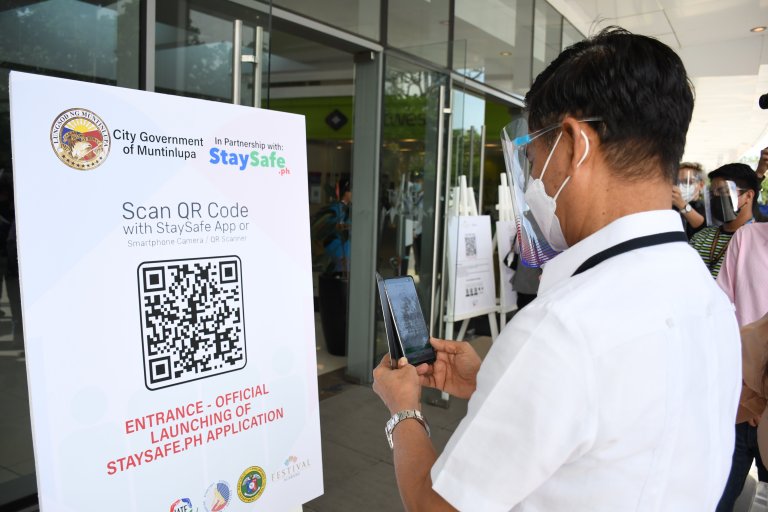
Mayor Jaime Fresnedi personally scanned the QR code using the StaySafe.ph app at Festival Mall, Filinvest City, Alabang. (source – Muntinlupa PIO)
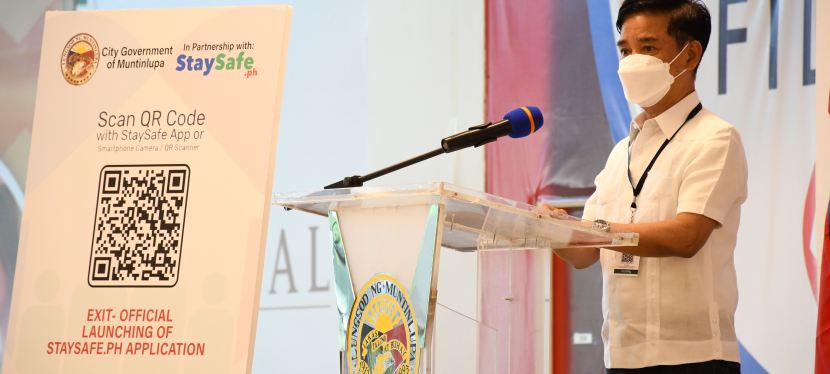
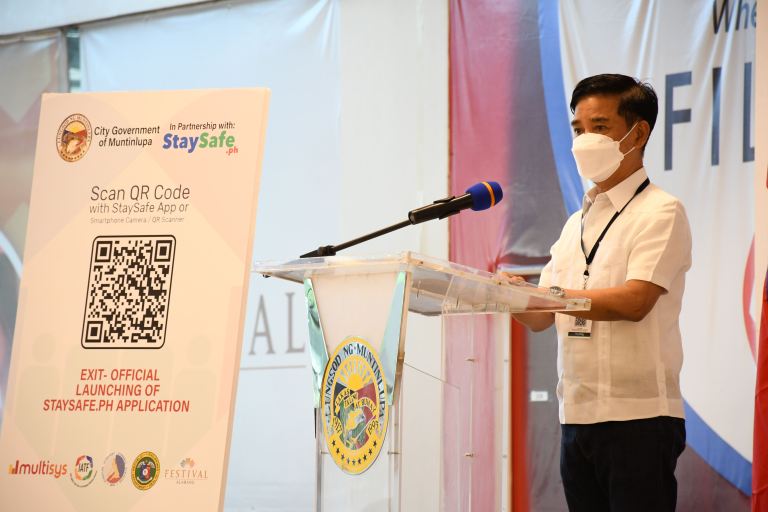
Mayor Fresnedi delivering his remarks during the launch event inside Festival Mall. (source – Muntinlupa PIO)
Fresnedi said the adoption of StaySafe.PH in Muntinlupa was executed in compliance with the national government’s recommendation for a uniformed contact tracing system to prevent further COVID-19 transmission, especially with the detection of the B.1.1.7. SARS-CoV-2 variant (UK variant) in the country.
Also joining the ceremony were Congressman Ruffy Biazon, City Health Officer Dra. Maria Teresa Tuliao, Filinvest Land senior vice president Joselito Santos, Committee on Health and Sanitation chairman Coun. Allan Rey Camilon, City Administrator Engr. Allan Cachuela, MultiSys Technologies Corporation CEO David Almirol, and other local executives.
Following the launch event, members of the Muntinlupa City StaySafe.Ph Task Force will conduct an city-wide inspection to ensure compliance of local public and private establishments.
Muntinlupa City Council passed City Ordinance No. 2020-181 mandating the installation and use of Staysafe.PH system as an automated contact tracing through the use of QR Codes in all commercial establishments, workplaces, churches, and government offices in the city.
All residents and visitors who will enter, work, or do business in all indoor or enclosed public and private establishments in Muntinlupa shall be required to download and register at the StaySafe.PH application and secure a unique QR Code which they can store on their phone or print for physical copy. QR Codes for non-smartphone user registrants shall be generated by their respective barangays and shall be distributed to where the registrant resides.
Under the local ordinance, all establishments in the city are mandated to designate personnel to ensure each individual who will enter their premises possesses a StaySafe.PH unique personal QR Code. All customers, visitors, and employees of the public and private establishments shall not be allowed entry unless they present their own QR Code.
Allowing other person to use an individual’s unique QR Code to gain entry into the premises of the covered establishment and intentionally registering more than once for the purpose of possessing more than one unique personal QR Code shall be prohibited. Covered establishments shall be required to transmit a copy of their digital log book to the City Health Office on a daily basis for data integration.
For non-compliant establishments, violators will be charged with P2,000 penalty and suspension of franchise or business permit until violation has been rectified for first offense, P3,000 for second offense, and suspension or revocation of franchise or business permit including a P5,000 penalty for the third offense. In case the offender is a government official or employee, the maximum penalty shall be imposed including the filing of administrative, civil, or criminal action.
Recently, the Department of the Interior and Local Government issued MC No.2020-129 enjoining local government units to use of StaySafe.PH v.2 application system as the official social distancing, health condition reporting, and contact tracing system that will assist in the government’s response to COVID-19.
As of January 28, 2021, Muntinlupa City has 64 active cases, 5,326 confirmed cases with 5,094 recoveries, 168 reported deaths, 71 suspect cases, and 389 probable cases.
+++++
The above information was provided by the City Government of Muntinlupa for the purpose of public information and transparency. Some parts were edited for this website.
For more South Metro Manila community news and developments, come back here soon. Also say NO to fake news, NO to irresponsible journalism, NO to misinformation, NO to plagiarists, NO to reckless publishers and NO to sinister propaganda when it comes to news and developments. For South Metro Manila community developments, member engagements, commerce and other relevant updates, join the growing South Metro Manila Facebook group at https://www.facebook.com/groups/342183059992673

















 Author Carlo Carrasco