

Disclaimer: This is my original work with details sourced from reading the comic book and doing personal research. Anyone who wants to use this article, in part or in whole, needs to secure first my permission and agree to cite me as the source and author. Let it be known that any unauthorized use of this article will constrain the author to pursue the remedies under R.A. No. 8293, the Revised Penal Code, and/or all applicable legal actions under the laws of the Philippines.
Hey Wonder Woman and superhero fans! By now, many of you are aware that I wrote and published several retro comic book reviews about the Post-Crisis Wonder Woman specifically the comic books that involved the legendary George Perez, Greg Potter and the late Len Wein. For today, I’ll be reviewing Wonder Woman #1 (1987), the landmark comic book that marked the start of what was back then the new age of greatness of Wonder Woman, the Queen of all Superheroes!
Before starting my review, let’s take a short look back at the publishing history with the online research I did.
In the mid-1980s, DC Comics published the maxi-series Crisis on Infinite Earths to not only celebrate their 50th anniversary but also to conclude what was the original multi-verse (multiple universes) of the publisher. Written by Marv Wolfman and drawn by George Perez, Crisis on Infinte Earths became critically acclaimed and a major seller as the saga saw the deaths of hundreds of characters, destruction of worlds and ultimately paved the way for DC Comics to reboot their superhero universe entirely.
And then the post-Crisis era of DC Comics happened. After Superman and Batman were successfully reintroduced, the Queen of all Superheroes herself – Wonder Woman – was up for a relaunch.
While detailed descriptions about what happened behind the scenes at DC Comics regarding the Wonder Woman reboot have been published, writer Greg Potter himself made some clarifications to set the record straight. For all of you readers and Wonder Woman fans, posted below is Potter’s clarification published with his permission.
The ideas for the rebooted Wonder Woman did not start with brainstorming between Janice Race and me. Having recently finished my Jemm Son of Saturn series, I was approached at a comic con in Chicago by Dick Giordano. He asked if I would like to submit a proposal for a rebooted Wonder Woman series. I sent him my ideas and he approved them. Dick then assigned Janice to the book (she had been my editor on Jemm) and I began writing the script for issue number one. It was after that that George walked into Janice’s office and offered his services as illustrator with a proviso that he also had a hand in plotting the stories.
Janice accepted and George and I subsequently met in her office to discuss our working relationship going forward. George and I agreed that the focus of the character would be her identity as an Amazon who’d lived in the Ancient Greek tradition and knew little about the outside world. I knew a great deal about Greek mythology but George knew even more. He supplied me with a book on the Greek gods that was extremely helpful in writing the first book. I in turn supplied him with many photos of Boston (I once had lived there) which he used in his artwork to make the backgrounds authentic.
It was a wonderful collaboration and made for a great introduction to the new Diana.
Eventually George Perez got involved in the creative process at DC. The famed illustrator and Potter worked closely on reintroducing Wonder Woman with an established identity and a rich cultural background. Indeed, something special transpired before the first issue got published.
“That was the background of the Wonder Woman character, which I felt was also the thing that made her unique as a character, and I thought that it had been downplayed in order to make her more of a standard superhero,” Perez stated.
Perez and Potter were co-writers. Perez himself conducted research on mythology which served as the foundation of the fantasy element of the planed post-Crisis Wonder Woman monthly series. This involved portrayals of deities of Olympus whose acts affect the Amazons living in the flesh. Apart from the fantasy and mythology, Perez implemented some key elements (specifically involving feminism and humanism) thanks to his discussion with Wonder Woman editor Karen Berger.
“A lot of research went into this first issue, and my bookshelves are full of reference material on mythology, Greek hairstyles, armor, clothing and even attitudes of the time. Some compromises were made where different references contradicted each other, but no decision was made without thought. We all have fallen in love with this project and want everyone to share in our excitement,” Perez wrote in the introduction in Wonder Woman #1 (1987).
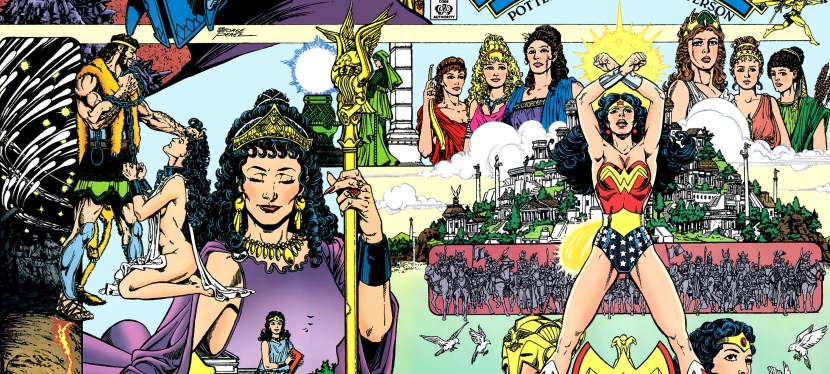
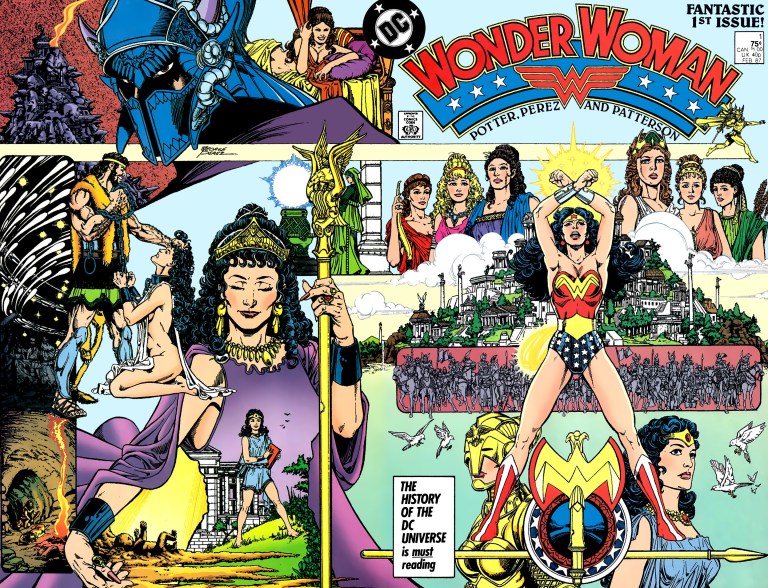
Now that the history lesson is over, we can now all take a look back at Wonder Woman #1, published in 1987 by DC Comics with a story co-written by Greg Potter and George Perez. The art was done by Perez supported by the ink work of Bruce Patterson.
Early story
The story begins in the distant past of 30,000 B.C. Inside a cave, a man hits a pregnant woman’s head with his club instantly killing her and the unborn child.
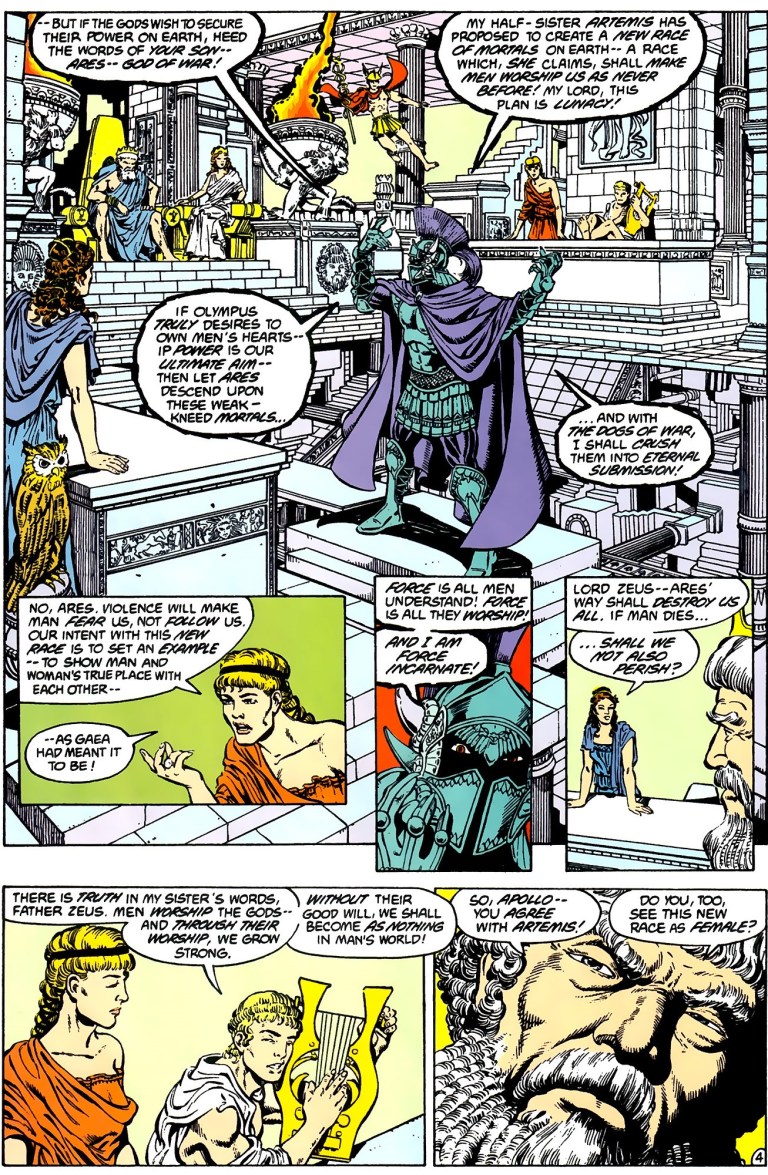
In 1,200 B.C. at Mount Olympus, the god of war Ares tells his father Zeus (with the presence of other deities watching) that if Olympus truly desires to own the hearts of men and gain power, they should let him descend upon mortals. Ares views the mortals as weak and stressed that he could crush them all into eternal submission.
But Artemis (Ares’ half-sister), whose plan to create a new race of mortals on Earth was vehemently opposed by the god of war, responded by stressing that violence will make men fear them and not follow them. She stressed that the intention behind the plan was to set an example by showing man and woman’s true place with each other. The new race of mortals was planned to be female. Zeus, who is aware of the plan, leaves and tells the others to settle the plan among themselves. For his part, Ares leaves Olympus laughing.
With the many souls stuck in limbo for generations available to them, the deities Aphrodite, Artemis, Athena, Hestia and Demeter create the Amazons who appeared with adult bodies. The first to come out among them all was Hippolyte, the mother of Diana/Wonder Woman. In the presence of the many Amazons, Hippolyte was declared queen by the deities…
Quality
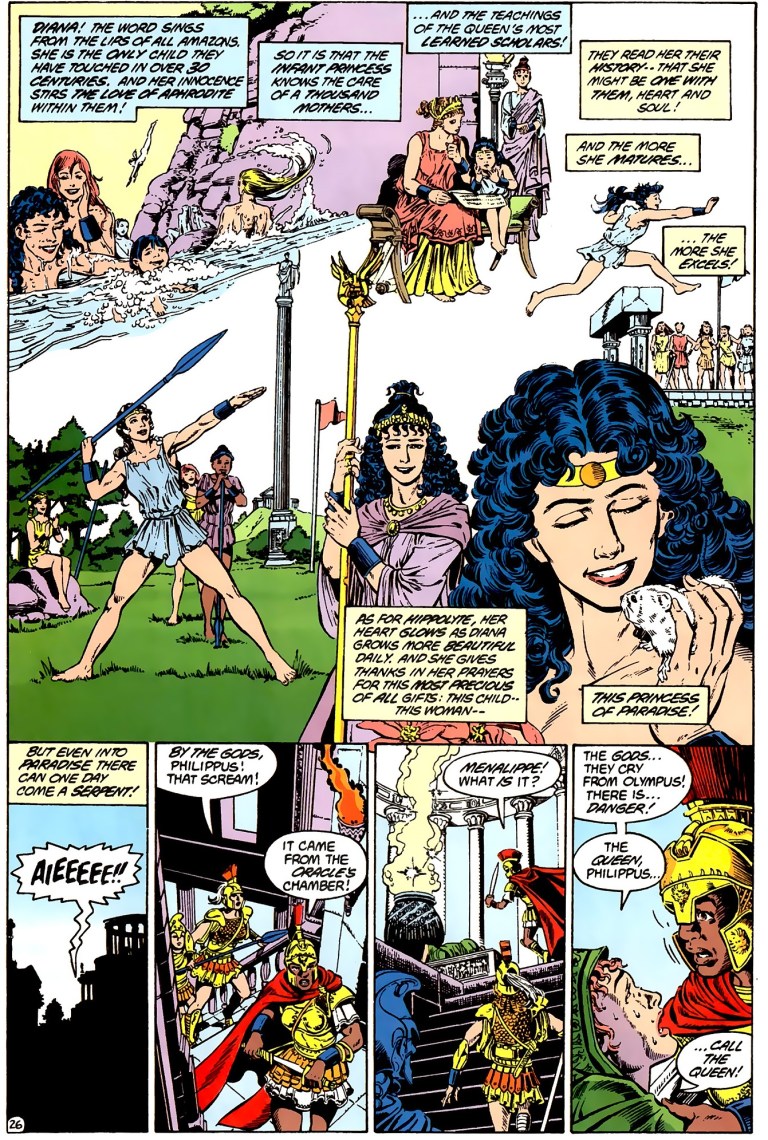
When it comes to quality of storytelling, art, characterization and spectacle, Wonder Woman #1 is unquestionably an excellent comic book even by today’s standards! For the story, Greg Potter and George Perez crafted an epic fantasy tale retelling the origin of not only Wonder Woman but also of the Amazons complete with a very inspired portrayal of the deities of Olympus who actions and decisions affect the mortals. I should mention here that the portrayal of the mother-and-daughter relationship between Queen Hippolyte and Princess Diana really was compelling to see. Not only that, there were also elements of gender conflict, intrigue and worship portrayed.
It is clear that Perez really studied mythology and Greek culture to create a story that is still believable when it comes to emphasizing Wonder Woman for what was back then the modern readers of 1987 from the superhero geeks to long-time Wonder Woman fans and to girls and women in general. More than that, this story is timeless and clearly it is an illustrated literature classic on its own right.
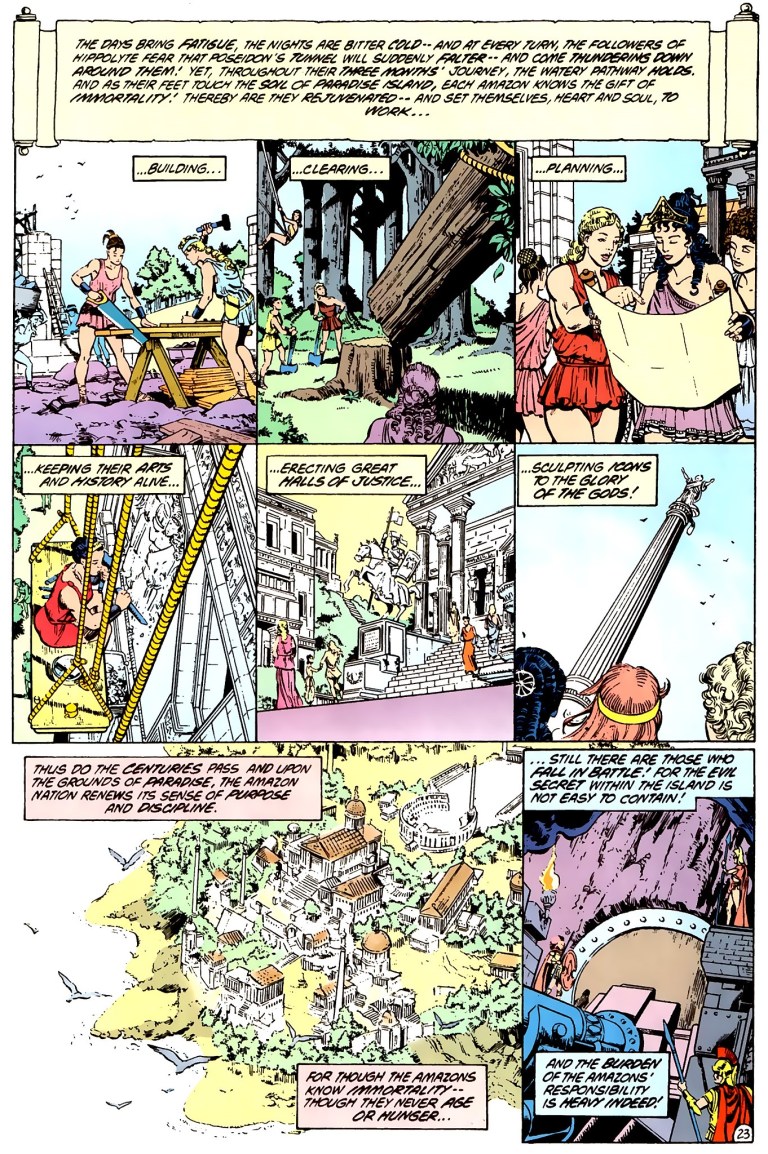
The comic book has over thirty pages of story and art, with the pace ranging from medium to fast. As such, it managed to completely tell the stories of the Amazons and Princess Diana in just one comic book. By the time I finished this comic book, I got enlightened about the background of the Amazons and Wonder Woman herself.
When it comes to the art, each and every page of Wonder Woman #1 is very beautifully drawn by George Perez. His research on Greek culture and mythology is nicely reflected in his drawings. Just look at how he visualizes Olympus, the armor worn by soldiers, the clothes, the hairstyles, the coliseum, the architecture and more complete with a good amount of details visualized. The final page Perez drew remains very stunning, inspiring and heroic!
Conclusion
There is no doubt in my mind that Wonder Woman #1 of 1987 is truly one of the greatest superhero comic books ever published. The creative team succeeded in not only reintroducing Wonder Woman, her people and their part in the post-Crisis DC Comics universe, they also succeeded in modernizing them as well as dramatizing their origins altogether within the 32 pages of this comic book.
While it is a fact that a lot of people nowadays are highly familiar with the cinematic Wonder Woman (memorably played by Gal Gadot), for me the post-Crisis version of the Queen of Superheroes remains the definitive version and I can only wish that director Patty Jenkins would adapt more elements from this. It should be noted that this particular rebooted Wonder Woman is believable and can be taken more seriously among all superheroes.
If you are seriously planning to buy an existing hard copy of Wonder Woman #1 (1987), be aware that as of this writing, MileHighComics.com shows that the near-mint copy of the regular edition costs $51. The near-mint copies of the newsstand edition and the edition without a month printed cost$102 and $153 respectively.
Overall, Wonder Woman #1 (1987) is highly recommended!
Thank you for reading. If you find this article engaging, please click the like button below and also please consider sharing this article to others. If you are looking for a copywriter to create content for your special project or business, check out my services and my portfolio. Feel free to contact me as well. Also please feel free to visit my Facebook page Author Carlo Carrasco and follow me at HavenorFantasy@twitter.com



 Author Carlo Carrasco