The movement towards a safe, nuclear-powered Philippines moved forward slightly as an official survey of the Social Weather Station (SWS) commissioned by the Department of Energy (DOE) revealed that more Filipinos favor the use of nuclear power for electricity, according to a Philippine News Agency (PNA) news article.
To put things in perspective, posted below is an excerpt from the news article of the PNA. Some parts in boldface…
A bigger share of Filipinos surveyed for their insights on the potential of nuclear energy as among the sources of electricity in the country favor its use, the Department of Energy (DOE) said Monday.
Citing results of the DOE-commissioned Social Weather Station (SWS) survey on Public Perception Survey on Nuclear Energy conducted on May 6-24, 2025 to around 7,520 adult respondents nationwide, the department said over 70 percent of the respondents “believe that nuclear can deliver reliable electricity, reduce reliance on imported fuels, create jobs, and help fight climate change, while 76 percent of Filipinos are eager to learn more about nuclear energy.”
Survey results also showed that “net approval for rehabilitating the Bataan Nuclear Power Plant is at +66 nationwide, while support for building new nuclear plants stands at +45.”
“Support is also stronger among higher-income households, younger Filipinos, and those with higher levels of education,” the press release said.
Energy Secretary Sharon Garin said the strong public support reflected in this survey “tells us that Filipinos are ready to embrace nuclear energy as part of our energy future.”
“This gives us the confidence to move forward with careful, calibrated steps to ensure safe, secure, and sustainable development of nuclear power in the Philippines,” she added.
Let me end this post by asking you readers: What is your reaction to this recent development? Do you personally approve of the use of nuclear power for electricity? Are you convinced that nuclear power is the key to achieving abundant energy for the Philippines in the long-term?
In what could be a boost for a nuclear-powered Philippines, the Department of Energy (DOE) is officially hosting the Philippine International Nuclear Supply Chain Forum (PINSCF) which will take place in Quezon City from November 13 to 15, 2024, according to a news article by the Philippine News Agency (PNA).
To put things in perspective, posted below is an excerpt from the PNA news article. Some parts in boldface…
Eyeing to lead Southeast Asia in deploying nuclear energy technology, the Department of Energy (DOE) will host the Philippine International Nuclear Supply Chain Forum (PINSCF) from Nov. 13 to 15.
Happening at Solaire Resort North in Quezon City, the PINSCF will gather local and foreign stakeholders to discuss the latest technology and innovations, as well as share best practices in the nuclear energy industry.
Expected participants in the forum are power generation companies, government agencies, embassies, academia, and other key sectors.
“We are bringing together companies from countries with proven track records in building and maintaining the critical infrastructure needed by the energy sector. This forum will showcase their innovations and best practices, offering the Philippines the opportunity to learn and benefit from their experiences,” the DOE said in a statement Wednesday.
Stakeholders from the United States, Canada, France, Japan, and South Korea, which are among the leading countries in nuclear technology, will provide insights for the Philippines as the government explores nuclear energy for a balanced, resilient, and low-carbon energy system to drive sustainable economic growth.
“As the world transitions away from fossil fuels, each nation is weighing options for achieving energy independence and security. This forum allows us to engage with the global community while ensuring that our own stakeholders are part of the discussions,” the DOE said.
Let me end this post by asking you readers: What is your reaction to this recent development? Do you wish to see the entire nation powered by nuclear energy using the latest power-generating technologies found in nuclear-powered small modular reactors (SMRs) and microreactors? Do you realize that nuclear power is more capable on providing the nation abundant energy better than the unreliable solar and wind power?
Have you ever heard of a corporation called Solar Philippines? That company boasted being the largest solar company in Southeast Asia and the national government awarded them with lots of contracts years ago. The results, however, are disastrous as Solar Philippines failed to fulfill the energy commitments which compelled the government to initiate moves to discontinue 21 of the 42 contracts, according to a GMA Network news report.
To put things in perspective, posted below is an excerpt from the GMA News report. Some parts in boldface…
The Department of Energy (DOE) on Thursday said it is set to discontinue 21 or half of the 42 service contracts it awarded to Solar Philippines following the company’s alleged failure to carry out its energy commitments.
The DOE made the announcement at the Senate finance subcommittee hearing on the agency’s budget after Senate President Pro Tempore Jinggoy Estrada inquired about the matter.
“Twenty-one of the contracts are already being processed for termination because they are not able to deliver the scheduled targets of the work program,” Energy Undersecretary Rowena Cristina Guevara said at the hearing.
Estrada said different renewable energy companies were awarded a total of 473 service contracts for the construction of solar farms as of last March, supposedly for 32,359 megawatts of renewable energy supply.
He said that only 174.41 megawatts or 2% had been completed and started commercial operations of the 10,000 megawatts committed by Solar Philippines and its affiliates.
“The vast majority of the total commitment have not yet entered the development stage and remain in various phases of pre-development. How will this affect the department’s targets?” the senator asked.
He was referring to the Iba-Palawig project, Iba-Palawig 2 project, and San Marcelino phase 3 project.
Guevara said that acquisition of land, either through lease or purchase, is the most challenging part of energy companies in constructing power facilities.
“Previously, possessory rights were not required when we issued service contracts. However, under the new guidelines, developers must have possessory rights before service contracts are granted,” she said.
Estrada, however, inquired specifically as to why Solar Philippines, owned by businessman Leandro Leviste, was taking too long to adhere with the terms of its service contracts compared with other developers.
“You know, my conclusion is that while other project developers take an average of around two to three years to develop solar power projects, Solar Philippines and its affiliates have taken more than three years to even take its projects to development phase and much longer for actual construction,” the senator said.
“Bakit masyadong pinagkakatiwalaan itong Solar Philippines? (Why put so much trust with Solar Philippines?) Why do you keep on awarding contracts to them?” he added.
Guevara said 22,000 megawatts of capacity were already fully developed or are in development of 32,359 megawatts covered by service contracts.
“The remaining 10,000 megawatts depend on Solar Philippines, which could significantly compromise the DOE’s ability to meet its commitment to transitioning to renewable energy. I hope you seriously consider this matter,” Estrada said.
Senators Pia Cayetano and Sherwin Gatchalian also inquired about delays in the commitments indicated in the service contracts.
According to Guevara, the DOE would issue new sets of terms of reference for its succeeding green energy auctions, to include the performance of renewable energy companies as qualifying conditions.
In my honest opinion in relation to this development, renewable energy sources like solar and wind are truly unreliable. On the part of Solar Philippines (founded in 2013), generating 174.41 megawatts instead of the required 10,000 megawatts over the years is shocking. That being said, initiating moves to discontinue the 21 contracts with Solar Philippines makes a lot of sense.
Again, in my own view, the government should stop focusing so much on renewable energy and focus more on nuclear power to ensure clean and abundant energy for the entire nation as the energy needs of the people and businesses will only keep on growing. Solar power cannot be relied on as the sun does not shine brightly 365 days per year nor can the power collected through solar panels be enough to meet the needs to the nation.
Let me end this post by asking you readers: What is your reaction to this recent development? Do you think it is right for the government to move to terminate the 21 contracts with Solar Philippines? Are you convinced that solar power is not the solution for the nation’s energy requirements? What excuse can Solar Philippines come up with to convince the government to retain the 21 contracts?
The path will be long and challenging for the Philippines to become a nuclear-powered nation but the Department of Energy (DOE) remains determined on achieving that goal by the year 2032 with the use of small modular reactor (SMR) technologies that could generate an initial 1,200 megawatts, according to a news article by the Philippine News Agency (PNA).
To put things in perspective, posted below is an excerpt from the PNA news article. Some parts in boldface…
Department of Energy (DOE) top and senior officials said the agency is targeting to get a 1,200-megawatt installed power capacity from nuclear resources using small modular reactor (SMR) technologies by 2032.
This was confirmed by DOE Secretary Raphael Lotilla as well as Undersecretaries Rowena Cristina Guevara and Sharon Garin to reporters in an interview in Taguig City on Thursday.
Lotilla said the government remains open to all technologies that will supply the growing power demand of the country in the coming years.
“(T)he commercial rollout of certain nuclear technologies are going to be there… (W)e can start planning for 2032 at the earliest. From the figures, you can see these are modest figures, 1,200 (MW) by 2032,” the DOE chief.
In her speech at the B2B Matching to Support Energy Transition (B2B SET), Guevara said this potential capacity would come from eight 150-MW SMRs.
She added that under the DOE’s Clean Energy Scenario (CES) 1, the 1,200 MW potential installed capacity for nuclear by 2032 is forecast to have additional 1,200 MW capacity by 2035 and another 2,400 MW by 2050.
Manila Electric Company has partnered with American firm Ultra Safe Nuclear Corp. (USNC) to explore the potential of micro-modular reactors in the country.
AboitizPower Corp. is also exploring collaborations with NuScale Power Corp. and USNC in this sector.
Aside from the latest SMR technologies, Garin said the country is studying the viability of conventional nuclear reactors like the existing Bataan Nuclear Power Plant (BNPP).
Garin said the DOE is in talks with the Korea Hydro and Nuclear Power Co., Ltd. (KHNP) for a more comprehensive feasibility study for the BNPP.
She added that the feasibility study with KHNP will determine if the government should pursue BNPP as a nuclear energy source in the future.
She said around 12 sites, mostly in the western parts of the country, are being studied for future locations of nuclear power facilities.
Safety first – Meanwhile, Lotilla stressed that the government will ensure that the safety concerns on nuclear energy technologies will be addressed first before putting up nuclear power plants.
Let me end this piece by asking you readers: What is your reaction about this recent development? Do you think the both the government and the private sector can make breakthroughs happen to pave the way for a nuclear-powered Philippines? Are there many people in your local community who are still afraid of nuclear energy because of what they saw in movies or TV shows that showed nuclear disasters?
In recent times the City Government of Las Piñas headed by its Mayor Imelda “Mel” Aguilar has been making a lot of progress with modernizing public transportation within its jurisdiction by releasing to local tricycle drivers and operators electric tricycle (e-trike) units that they received from the Department of Energy (DOE).
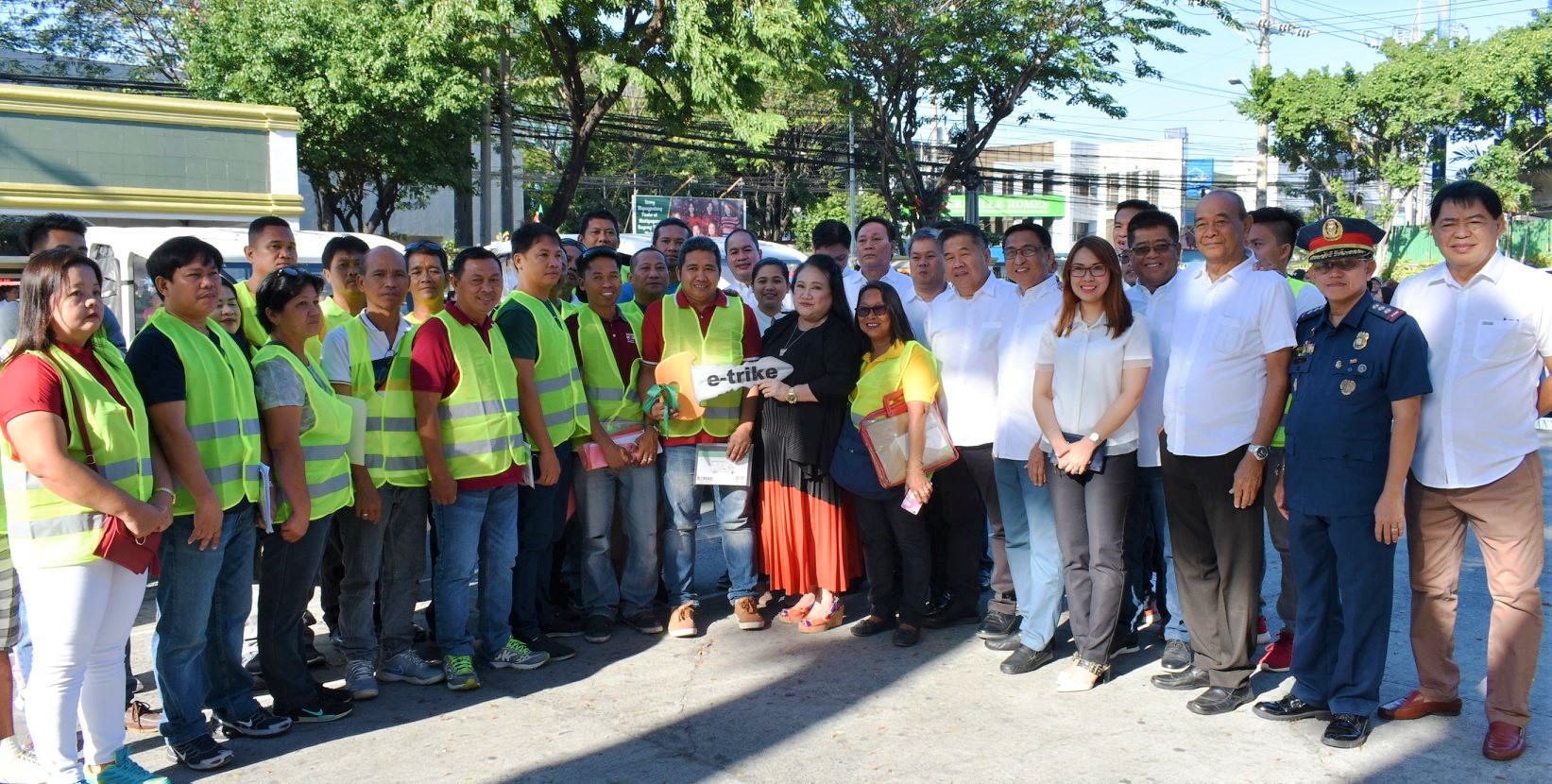
The DOE donated 100 e-trikes to Las Piñas which in turn coordinated with the varied tricycle operators from the city’s twenty barangays. On April 5, 2019, the City Government’s Facebook page posted pictures of its most recent turnover of e-trikes to specific operators. Posted below is one of them.
Las Piñas City Government officials with the recipients in a turnover ceremony at City Hall. (photo by Shawnette Ramos for City of Las Piñas Facebook page)
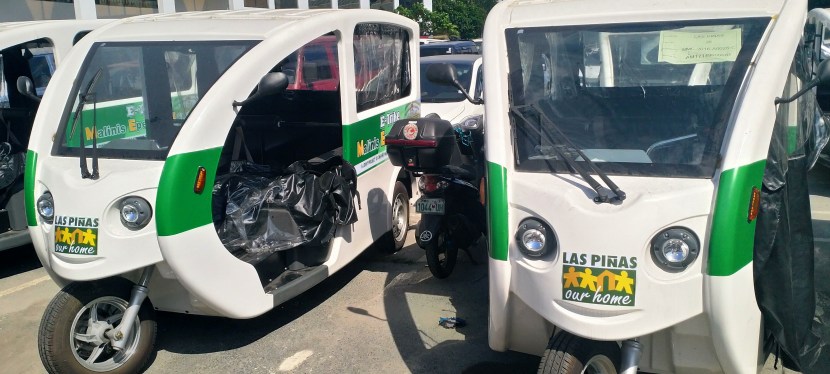
Right below is a picture of electric tricycle units that I photographed during my visit at Las Piñas City Hall.
From my visit at Las Piñas City Hall.
The future of local public transportation in the city is looking bright. Once these electric tricycles go into full operation, the following is expected to happen:
A more comfortable ride for passengers thanks to the new tricycle design. The e-trike is one whole unit (versus the motorcycle linked with a passenger-carrying unit of the old tricycle design).
Reduction on noise pollution because there is no fuel-based engine.
Reduction on air pollution because there is no fuel-based engine and no exhaust.
Complete avoidance on spending money on fuel which by the liter, as of this writing, is expensive. Recharging, not refueling, is the way for E-Trike operators to recover and keep operating the next day.
Think about it carefully. E-Trikes can bring passengers through the quiet villages more safely, quieter and without adding anymore air pollution that would affect families at their homes.
Now that the benefits of E-Trikes have been discussed, it’s time to take a close look as to how these positive developments in Las Piñas happened in the first place.
The answer is City Ordinance Number 1536-18 (Series of 2018). and below is a summary of the details written on it.
The Ordinance
Formally titled “An Ordinance Allowing The Operation of E-Trike in The City of Las Pinas and Providing Guideliness Thereto.”, with “E-Trike Ordinance” as the shorter title, City Ordinance Number 1536-18 (Series of 2018) was approved by the City Council and Mayor Aguilar on May 28, 2018. As written on the Ordinance, it was deemed that the adoption of the e-trike project is a necessary step in combating unreasonable high oil prices and ending dependency on oil. The E-Trike was viewed to be eco-friendly, noise-free and air pollution-free. It has the potential to generate higher income for operators and even create new jobs.
Section 2 of the Ordinance states: The City of Las Pinas fully supports the national government’s e-tricle project. It is also committed in enforcing the applicable provisions of the Clean Air Act and in addressing community concerns about high oil prices, pollution and health hazard as well as in providing new job opportunities.
Section 4 (E-trike Franchise Grant) legalizes the use of electric tricycles within the territorial jurisdiction of the city. For this purpose, one hundred units of three-wheeled electric power driven vehicle or e-trike shall be granted franchise by the City of Las Pinas through the Sangguniang Panglunsod.
Section 5 (Guidelines) states that no e-trike franchise shall be granted unless the unit utilizes environmental-friendly batteries as determined by the Environment and Natural Resources Office, has an on-board charger and is deemed roadworthy while also possessing the required safety features.
The individual applicant is an actual resident and registered voter of the city. The transport cooperative may be granted in its name up to five franchises subject to compliance with the qualification requirements of the drivers.
For E-Trike Rent-To-Own Program or variations thereof and/or meanwhile that the ownership of the unit is not yet fully transferred to the intended buyer, a provisional franchise may be granted in favor of the proponent. Provided, that the qualification requirements of the intended buyers or drivers of the vehicle are complied with.
Section 6 (Parts Availability) – the proponent shall make available within the city such parts as may be needed for the continued operation of the E-Trike.
Section 7 (Charging Stations) – charging stations shall be established in strategic public places in the city. For the total franchises herein fixed, no less than two charging stations shall be required of the proponents to establish. In this regard, not all contemplated franchises shall be issued by the Sangguniang Panglunsod unless the establishment of the charging stations is assured or completed.
Section 8 (Incentives) – Franchisees shall be granted a 50% discount on all fees applicable to trimobiles specifically the franchise fee, the annual supervision fee, the mayor’s permit fee, the legal research fee, the sticker fee and the police inspection fee.
If you wish to obtain copies of the Ordinance, visit City Hall.
Conclusion
With the E-Trike Ordinance in full force, Las Piñas City is clearly on its way forward with modernizing public transportation within its jurisdiction using electric tricycles which serve passengers traveling between the important city roads and the villages.
As far as South Metro Manila is concerned, Las Piñas has joined the electric vehicle bandwagon with Muntinlupa City (which has e-trikes and electric jeepneys already for years) for public transportation.
The City of Parañaque meanwhile remains behind. Last time I checked at Parañaque City Hall, they don’t even have a draft ordinance needed to legalize the use of electric vehicles for public transportation.
Speaking of Parañaque, I can’t forget the embarrassing failed launch of the electric tricycle project of the BF Federation of Homeowner Associations, Inc. (BFFHAI) of 2016. From the way things looked back then, BFFHAI failed to verify if Parañaque (which occupies a huge portion of BF Homes subdivision) had any ordinance legalizing the use of electric vehicles for public transportation. Back then, Las Piñas (which occupies another large portion of BF Homes subdivision) obviously did not have a similar ordinance.
Right now in South Metro Manila, Las Piñas and Muntinlupa are leading the way for public commuters with electric vehicles.
On display at the grounds of Parañaque City Hall was this large solar-powered electric tricycle (e-trike). The irony is that Parañaque itself has no law to legitimize electric vehicles for public transportation.
The love and care for the natural environment is often present in the minds of people who manage the city government. Really nobody wants to live in a city filled with scattered garbage, lots of air pollution and poor drainage.
An extension of the care for the environment is the focus on the use of electric vehicles which generate much less noise and much less air pollution. Here in the Southern portion of Metro Manila, the cities of Muntinlupa and Las Pinas respectively have laws that legitimized the use of electric vehicles for public transportation purposes.
This means that commuters can choose to ride a jeepney or a tricycle that runs on electric power whenever they are available in public. When they do ride an e-vehicle, there is much less noise and air pollution created by their ride. Potentially more e-vehicles replacing those gasoline/diesel-burning vehicles can bring down air pollution and improve the quality of air in the city.
Recently the Department of Energy (DOE) donated 150 electric tricycle units to the City of Muntinlupa and 100 electric tricycle units to the City of Las Pinas (which subsequently turned them over to local tricycle operators).
As for the nearby City of Parañaque……ZERO!
Considering the huge population of Parañaque and the City Government’s strong advocacy of environmental care and city cleanliness under the leadership of incumbent mayor Edwin Olivarez, it is weird that nothing has been done to legitimize the use of e-vehicles for public transportation.
I was at Parañaque City Hall on January 23 and during my visit I checked thoroughly with officials there to verify if there is any existing law (or city ordinance) that would make public transportation with electric vehicles happen.
As it turned out, officials confirmed to me that no such ordinance has been approved until now.
What is even more disturbing, as I kept on digging for answers, was the confirmation that there is not even a draft proposal submitted for legislation!
For as long as no city ordinance has been approved to legalize the use of e-vehicles for public transportation, Parañaque’s streets (including those inside villages) will be occupied by fossil fuel-guzzling jeepneys, buses and tricycles that are not only making the air dirty but also remain noisy and even unsafe and uncomfortable (due to outdated vehicular designs) for commuters to ride.
This also means that no village administrator can just establish and fully operate its own line of electric tricycles within the city. Back in 2016 in BF Homes, the BF Federation of Homeowner Associations, Inc. (BFFHAI) launched its line of electric tricycles with mayor Olivarez and vice mayor Rico Golez as special guests. Because they were in Parañaque (which has a huge jurisdiction of BF Homes subdivision) and there was no ordinance to legalize the use of electric vehicles for public transportation within the city, the BFFHAI’s e-trikes were not accepted by the Land Transportation Franchising and Regulatory Board (LTFRB) and they were not fully operated. As such, those electric tricycles got wasted and was limited to being parked at the side of the BF Homes clubhouse along Elsie Gatches street. Because pictures of those parked electric tricycles became public viewed, the federation quietly had them removed.
Until now Parañaque remains behind Muntinlupa and Las Pinas when it comes to using technology to improve public transportation and reducing air and noise pollution at the same time. For the past few years, Muntinlupa has electric jeepneys on public roads and some electric tricycles serving villagers. In Las Pinas, the number of electric tricycles serving local communities is slowly growing which is the result of their City Council and Mayor approving the “E-trike Ordinance” (City Ordinance Number 1536-18, Series of 2018) on May 28, 2018. Back to Parañaque, no legislation means no progressive change will happen.
It is notable that Parañaque lost its edge when it comes to city competitiveness nationwide. According to the Cities and Municipalities Competitiveness Index 2018 released during the 6th Regional Competitiveness Summit, Parañaque ranked only #21. Even provincial cities like Bacolod and Naga are way ahead at numbers 9 and 10 respectively. With these mentioned, Parañaqu
After finding out the truth about the lack of a law for the public transportation use of e-vehicles in Parañaque, I walked out of the building and as I moved on further on City Hall grounds, I saw two electric tricycle units (made by Star 8) on display at an environment-oriented exhibit. I pictured the more elaborate e-trike (the one above).
Wow. Think about that. Electric tricycles on display in a city that does not even allow electric vehicles to be used to serve commuters publicly.
Before I forget, let me state that the City Government was celebrating the 18th anniversary of Republic Act Number 9003which is the national law on ecological solid waste management which itself emphasizes care and responsibility of the environment.
Now when will Parañaque’s officials start working to legitimize e-vehicles for public transportation? If you are a certified city resident who wants to see those fuel-burning public utility vehicles be replaced gradually with e-vehicles, consider taking time out to write letters to the city government officials. Even though there is an upcoming democratic exercise in the form of a local election on May 2019, communicating with your officials is still recommended.
Thank you for reading. If you enjoyed this article, please click the like button below and also please consider sharing this article to others. Also my fantasy book The World of Havenor is still available in paperback and e-book format.






 Author Carlo Carrasco