A Look Back at Punisher 2099 #1 (1993)

Disclaimer: This is my original work with details sourced from reading the comic book and doing personal research. Anyone who wants to use this article, in part or in whole, needs to secure first my permission and agree to cite me as the source and author. Let it be known that any unauthorized use of this article will constrain the author to pursue the remedies under R.A. No. 8293, the Revised Penal Code, and/or all applicable legal actions under the laws of the Philippines.

As already established here on my website, I reviewed several comic books of the Marvel 2099 line of superhero comics. I reviewed the respective launch issues of X-Men 2099, Spider-Man 2099 and Ravage 2099 to name a few.

Some of you must be wondering what was the first-ever Marvel 2099 comic book I bought back in the 1990s. Believe it or not, it was not Spider-Man 2099 (the one comic book that launched the Marvel 2099 line in late 1992). It was actually Punisher 2099 which I bought in December 1992 (comic book was cover dated February 1993).

You read that right. I was a latecomer on discovering the Marvel 2099 universe in the late 1990s. Prior to the launch of Punisher 2099, comic books of Spider-Man 2099, Ravage 2099 and Doom 2099 were already on the shelves of comic book stores.

One day in Makati here in the Philippines, I passed by a comic book stall in a department store and saw Punisher 2099 (which had a gimmick cover) and other 2099-related comic books displayed. After observing the available 2099 comics, I decided to buy Punisher 2099 not simply because of its gimmick cover but because I wanted to discover the 2099 universe through the futuristic version of the Punisher (which I’m not even a fan of).

Here is my retro comic book review of Punisher 2099 published by Marvel Comics in late 1992 with a story by Pat Mills and Tony Skinner with illustrations done by Tom Morgan.
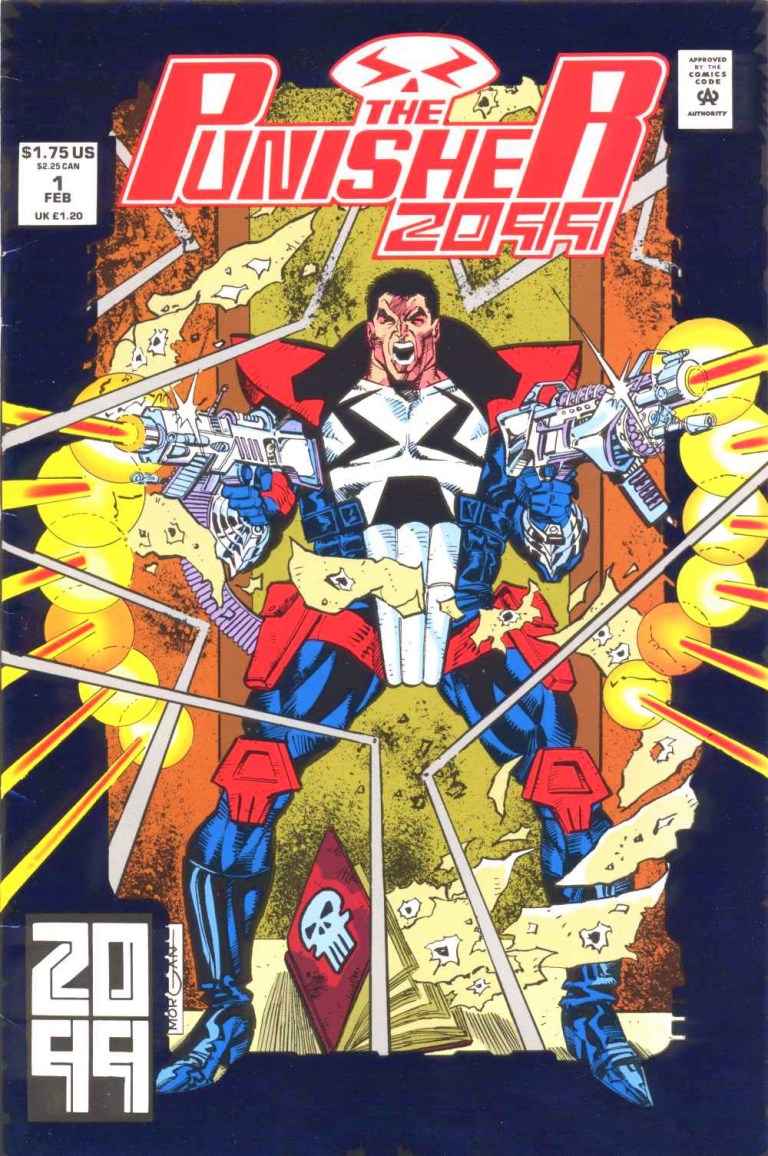
Cover
The cover.

Early story

The story begins with a man running away from danger. Because he does not have enough money to summon law enforcement for protection (note: cities in 2099 are all run by corporations and even public services have been privatized), he easily gets ganged up and killed by crooks armed with surgical devices. They killed him to get his heart.

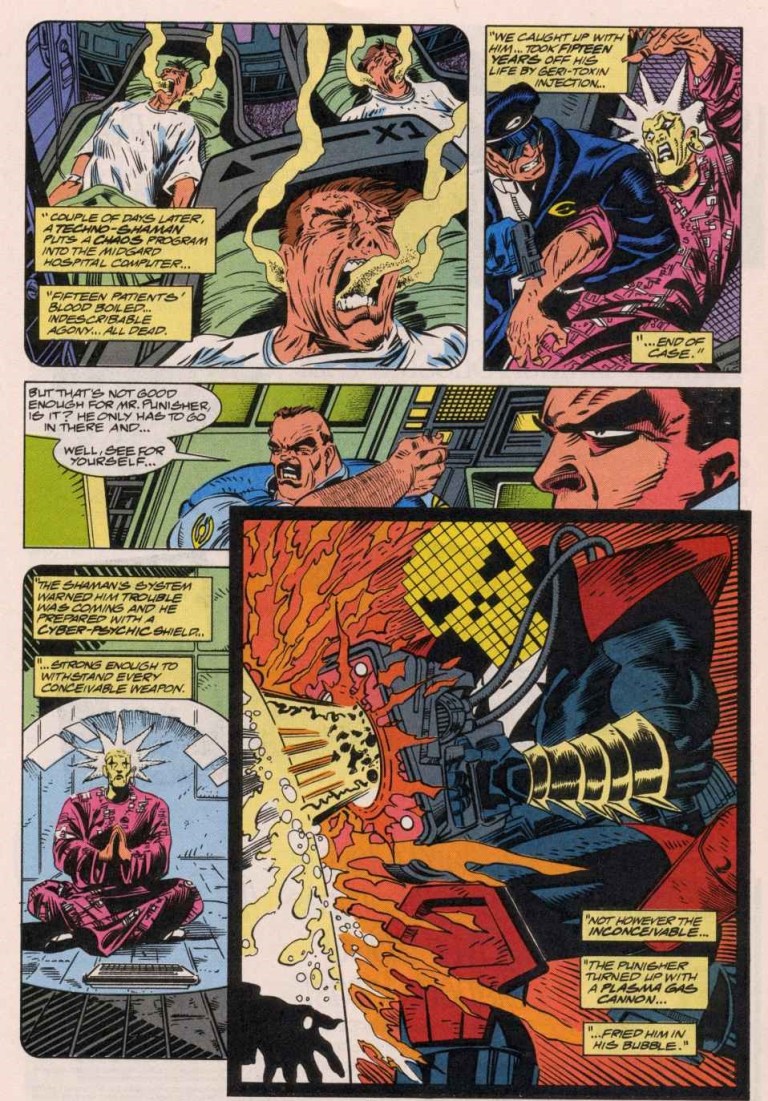
Shortly after, the Punisher of 2099 arrives and easily kills the crooks. His action caught the attention of Public Eye Police Force (note: a service of police protection that responds to transactions by paying clients) via the city surveillance system, the cameras of which are unable to identify him because his head is automatically covered digitally (the Punisher here has his own identity protection system).
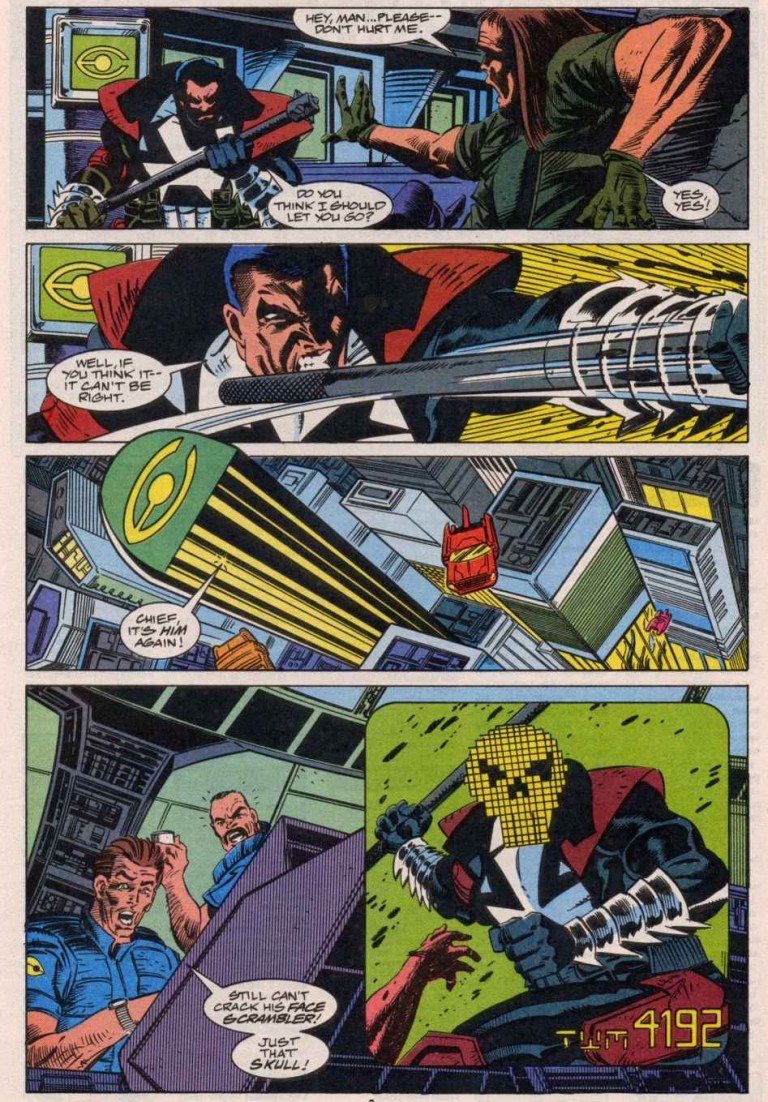
86

Jake Gallows, who is Punisher 2099 himself, enters the office of Public Eye. He is an employed enforcer of theirs and he notices that his employer has been watching his acts of violence against criminals…..

Quality

When it comes to establishing Punisher of 2099, the creators of this comic book pulled of a decent job. They not only introduced Marvel’s vigilante of the far future efficiently, they also made him look interesting temporarily. They also did a nice job with connecting Jake Gallows with Frank Castle, the 20th century Punisher.

Still, Punisher 2099 #1’s clear weak point in presentation was the back story of Jake Gallows who became the Punisher as a result of his family getting killed by group of armed, wicked people. In concept, this is too similar to the origin of the original Punisher who also lost his family.

While the origin lacked creativity, the creative team at least tried something new by introducing Kron Stone as the first-ever villain for Punisher 2099. Kron Stone, if you know your 1990s Marvel 2099 history, was not only the son of Alchemax chief Tyler Stone (a key character in the Spider-Man 2099 series) but also went on to become Venom 2099 (who debuted fully in Spider-Man 2099 #35).

The creative team also made a nice move establishing Jake Gallows as an actual working law enforcer who took a huge risk as he also secretly made moves as a vigilante when he’s not working.

While the comic book writers did a decent job with the story and characterization even though they had less than 25 pages of storytelling, the art by Tom Morgan will only please readers who enjoy violent and gritty imagery. Personally, I’m not impressed with Morgan’s art and his work on the cover of this comic book is laughable. Punisher 2099’s character design (what’s with those three frontal tubes that formed the teeth of the skull design?) is really corny to look at and not even famous painter Joe Jusko could improve the character’s overall look.
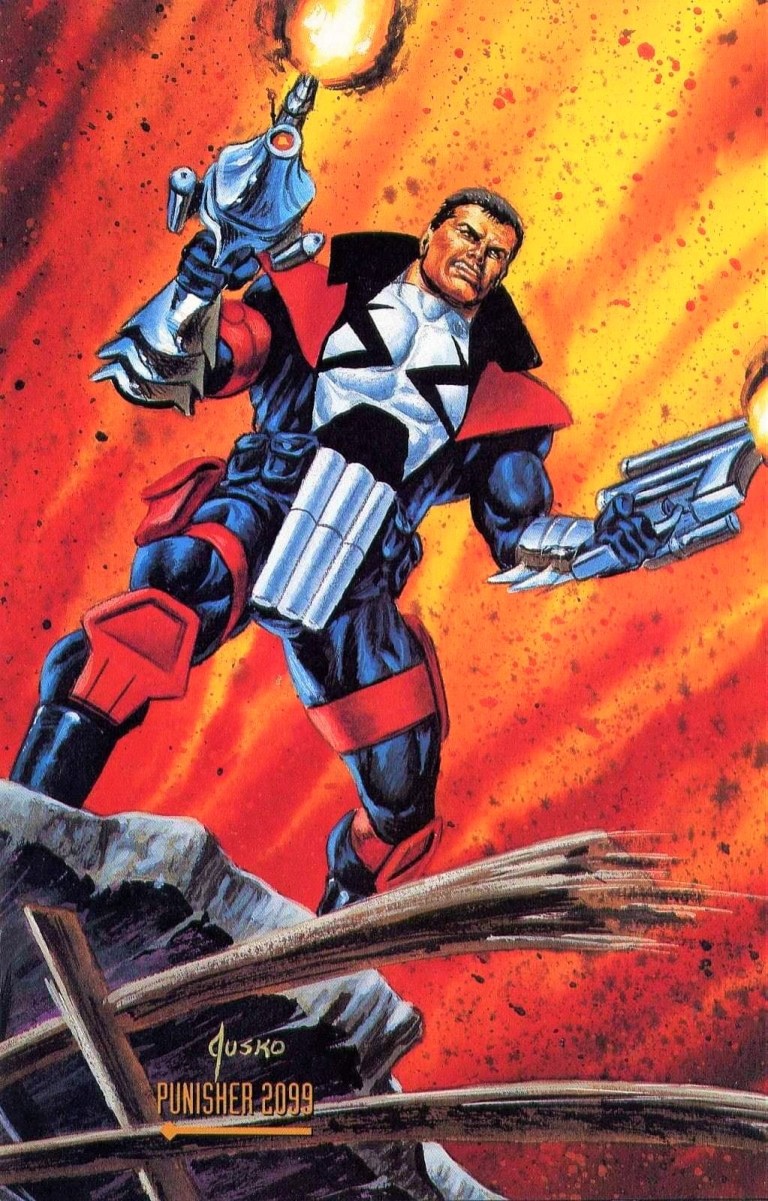
JuskoCardPun2k99
Punisher 2099 as painted by Joe Jusko for the Marvel Masterpieces card series.

Conclusion

Given the fact that Punisher 2099 never became a significant character of Marvel Comics all these decades, I would suggest thinking very carefully before spending any money to buy or even rent Punisher 2099 . It’s not a terrible comic book, just flawed with some limited engaging stuff here and there. If you are really craving for early 1990s Marvel superhero stuff, then this one could be worth it.

If you are seriously considering acquiring an existing copy of Punisher 2099 , be aware that as of this writing, and according to the rates of Mile High Comics online, a near-mint copy of the regular edition costs $6 while a near-mint copy of the newsstand edition is priced at $16.

Overall, I say that it’s best to purchase a copy of Punisher 2099 BELOW its cover price.


A Look Back at What If #58 (1994)

Disclaimer: This is my original work with details sourced from reading the comic book and doing personal research. Anyone who wants to use this article, in part or in whole, needs to secure first my permission and agree to cite me as the source and author. Let it be known that any unauthorized use of this article will constrain the author to pursue the remedies under R.A. No. 8293, the Revised Penal Code, and/or all applicable legal actions under the laws of the Philippines.

In early 1994, I was still in high-school. There was a time when I passed by a local comic book store that showed a new What If? comic book displayed among the many new titles. That particular comic book caught my attention because of its key question: What if the Punisher had killed Spider-Man?

That comic book was What If #58 published by Marvel Comics with a story by Chuck Dixon and art by Gordon Purcell. Check out the cover below.

Cover
The cover of this comic book took a lot of inspiration from that of Amazing Spider-Man .

To put things in perspective, Spider-Man and Punisher are both heroes in the universe of Marvel Comics but with very drastic differences between them. Spider-Man/Peter Parker fights crooks and other types of bad guys while maintaining a lawfully good nature even as he struggles to live a normal, personal life. Punisher, who is privately Frank Castle, is a killer who is driven to fight criminals beyond the boundaries of the law. The Punisher resorts to extreme forms of violence and guns are his main weapons. Due to the tragic loss of his wife and children, Punisher lives to wage a one-man war against criminals which only reflects the huge loss of his humanity.

Spider-Man and the Punisher first encountered each other in Amazing Spider-Man . Through the years, the two would face-off again and again. In the mid-1980s, the Punisher went on to rise in high popularity with comic book readers as Marvel Comics published three regular series: The Punisher, The Punisher War Journal and The Punisher War Zone.

That being said, we take a look back at What If #58.

Early story

Without involving Marvel’s galactic Watcher, the comic book begins with the Punisher aiming his gun at a man seated behind his desk. It turns out Punisher is waiting for the police to arrive at the place they are in.

From this point, the story is told in flashback with Punisher narrating. He is with the Jackal on the roof top of a building in New York City. Even as the Jackal pushes him to shoot a certain target already, the Punisher decides not to do it. He stressed he wants to study the target.

“It seemed right. Taking down a high profile outlaw like Spider-Man looked like the right way to go,” Punisher thought. “And Jackal promised unlimited funding of my war on crime if I succeeded.”

6
Punisher doing research.

Gradually, the Punisher prepares himself to kill Spider-Man…

Quality

Let me start with the concept of this comic book. Exploring what would happen had the Punisher actually killed Spider-Man (note: this is so obvious from the cover) is a bold and clever story to tell. To put things in perspective, the Punisher’s attempt to kill Marvel’s iconic superhero happened way back in Amazing Spider-Man which was published way back in 1974. Very clearly, Punisher failed and Spider-Man went on to live and fight for good.

When it comes to storytelling, Chuck Dixon delivered a strong script and carefully crafted a standalone story that looks at the Punisher’s first-ever attempt to shoot Spider-Man but the narrative was more on the vigilante’s point-of-view. The dialogue was solid and the narration gives readers a good look at the personality of Frank Castle. I also liked the way the story was paced.

What also makes this comic book really good is that it shows in convincing fashion what else would have happened after the successful assassination of Spider-Man. Without spoiling the surprise, you can ask yourself how would Punisher react once he learned who Spider-Man really was, how would the many people who personally knew Spider-Man (whether good or evil) would react and what the state of crime in New York would be like.

10
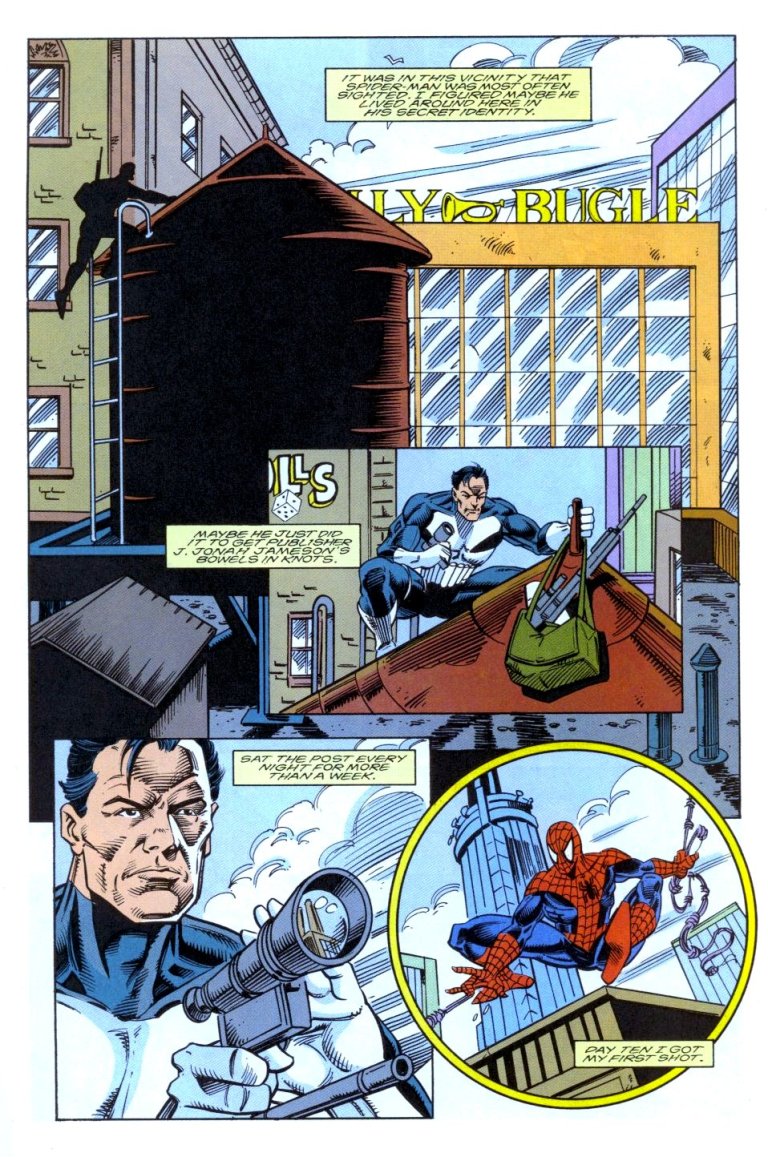
The Punisher anticipating Spider-Man outside The Daily Bugle.

As for the art, Gordon Purcell did a decent job. He captured what was back then modern day 1990s look of the Punisher (completely rejecting the way the character looked in Amazing Spider-Man ) and he knew how to present him from different angles regardless of what action was taken. On drawing Spider-Man, Purcell proved to be good. I noticed in some parts of the comic book, he tried hard to make Spidey look dynamic while traveling high above the streets of the city. The big money shot (in terms of illustration) for me was the moment Spider-Man got killed.

Conclusion

Overall, What If #58 is a good and fun comic book to read. Historically, this was released at a time when Spider-Man and the Punisher were both wildly popular. The decision to tell an alternate reality off Amazing Spider-Man was inevitable and ultimately was nicely pulled off.

If you are thinking about acquiring What If #58, as of this writing MileHighComics.com shows that a near-mint copy of the regular edition is at $26 while the near-mint copy of the newsstand edition is at $77.

What If #58 is recommended.


Thank you for reading. If you find this article engaging, please click the like button below and also please consider sharing this article to others. If you are looking for a copywriter to create content for your special project or business, check out my services and my portfolio. Feel free to contact me as well. Also please feel free to visit my Facebook page Author Carlo Carrasco and follow me at HavenorFantasy@twitter.com