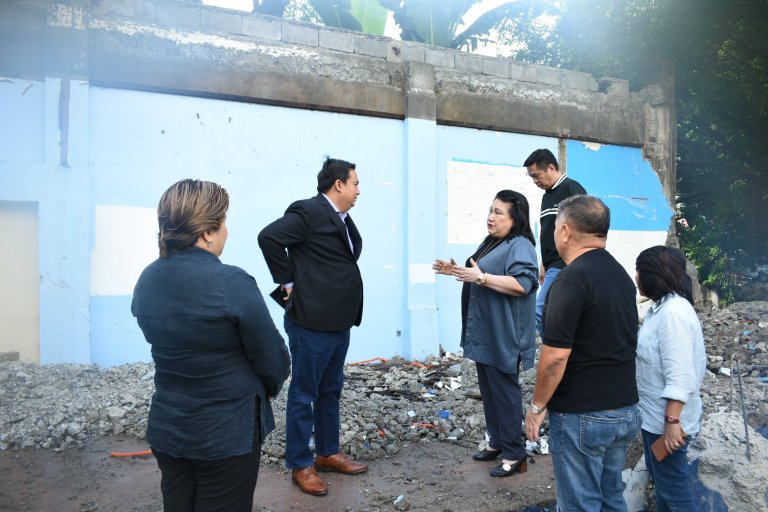
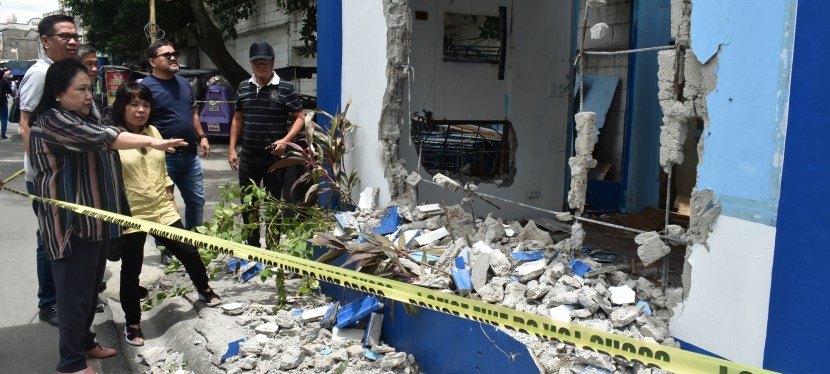
On the afternoon of September 24, the City Government of Las Piñas posted via its official Facebook page its response to a report they received from people living at Ohanan Place in Barangay Almanza Uno regarding a key area (located beside the condominium) described as a massive dengue mosquito breeding ground.
The said area is a construction site.
As a result, Mayor Imelda “Mel” Aguilar issued orders to the City Health Office and the City Engineering Office to address the Ohana residents’ concern.
The City Health Office responded saying it has conducted an inspection (jointly done with Barangay Almanza Uno personnel) of the construction site which has stagnant water and, so far, a negative result for mosquito larvae was found.
The contractor of the construction site, who remains unidentified as of this writing, was asked by the City Health Office to clean the site. The City Engineering Office, which also organized its own inspection, asked the contractor to pump out the stagnant water immediately.
To put things in perspective, stagnant bodies of water serve as breeding spots for dengue mosquitoes. If left unchecked, those mosquitoes can multiply, fly around, bite and infect people and cause dengue fever.
Going back to the City Government, Mayor Aguilar and her daughter Vice Mayor April Aguilar-Nery requested their citizens to report immediately to the City Health Office or to their respective Barangays what could be possible spots in their local communities that may be breeding grounds for dengue mosquitoes. It was announced that local health centers are equipped with dengue testing kits for free to the residents.
Meanwhile, people who are already infected with dengue virus and are sick should consider using papaya leaf juice. Of course, consult with a doctor first or a medical expert who is experienced with papaya leaf juice as a cure.
The City Government of Parañaque declared on September 23 a state of calamity as already over 1,700 dengue cases have been recorded in the city from January 1 to September 14.
Dengue fever is a harsh condition that includes symptoms of high fever, vomiting, pains on the muscle and joints, headache, pain behind the eyes, fatigue and skin rash. The time it takes for a sufferer to recover from it is two to seven days. However, there have been a small number of cases in which dengue fever becomes severe (referred to as dengue hemorrhagic fever). The symptoms for severe dengue include low blood platelets, bleeding and blood plasma leakage. There is also dengue shock syndrome which includes low blood pressure.
Watch out for more South Metro Manila updates here.
However, if you are a reader based in South Metro Manila and you want to expose a possible dengue mosquito breeding ground or create awareness about dealing with dengue fever, please contact me via mobile phone at 0905-3350831 or send me an email at Carlo.Carrasco@gmail.com
In response to a certain city government’s claim that it has joined other cities on being 100% compliant with the national government order to clear roads of obstructions, the Department of the Interior and Local Government (DILG)stated on September 13 that no local government unit (LGU) yet has been declared as fully compliant.
“We have not made any determination on which LGUs are fully compliant because the assessment of all LGUs will come after the 60-day deadline which will be on September 29, 2019,” DILG spokesperson and Undersecretary Jonathan Malaya said in a statement.
Malaya made the clarification in response to the claim made by the City Government of Makati that it has joined the cities of Marikina, Malabon, Navotas, Pasay, San Juan, Valenzuela and the municipality of Pateros, which earlier reports said are 100-percent compliant with the campaign to clear roads of obstructions, ahead of the 60-day deadline imposed by the DILG.
Citing the department’s Memorandum Circular No. 121-2019, Undersecretary Malaya said full compliance with the order is not based on road clearing operations alone.
Malaya specified that in order for an LGU to be declared as fully compliant, it should enact or revisit ordinances that are related to road clearing, the banning of illegal construction, preparing an inventory of roads within their jurisdiction, implementing displacement strategies and the like.
He added that compliance reports on the matter submitted by LGUs to the DILG regional offices and its Bureau of Local Government Supervision (BLGS) are still subject to validation.
Speaking of validation with regards to South Metro Manila, the City Government of Las Piñas claimed on its September 13, 2019 Facebook page post that the DILG “has validated the 100% completion of the clearing operations weeks ahead of the scheduled deadline on September 29,” in relation to DILG Undersecretary RJ Echiverri’s very recent visit and inspection of the result of the local clearing operation which involved the presence of Mayor Imelda “Mel” Aguilar and other city officials.
Excerpt from the City Government of Las Piñas Facebook page post:
The ocular inspection validated the report of Mayor Mel Aguilar and the city government’s Task Force Kaayusan. DILG has validated the 100% completion of the clearing operations weeks ahead of the scheduled deadline on September 29.
Undersecretary Echiverri gave positive comments about the result of the clearing operations in Las Piñas.
Now if only the DILG itself will react to the Facebook claim of the City Government of Las Piñas.
Today the City Government announced that Department of the Interior and Local Government (DILG) Undersecretary RJ Echiverri visited the city, met officials (led by Mayor Imelda “Mel” Aguilar), inspected the primary and secondary roads where the clearing operations were done. He was accompanied by the Mayor and some other local officials.
Las Piñas City Mayor Imelda Aguilar explains something to DILG Undersecretary Echiverri. (photo credit: City Government of Las Piñas)
According to the City Government, Undersecretary Echiverri gave positive comments about the result of the clearing operation done locally by Task Force Kaayusan and that the DILG validated it.
Part of the team that accompanied Mayor Aguilar, Vice Mayor April Aguilar-Nery (daughter of the mayor), and Undersecretary Echiverri during the inspection were Ms. Mary Anne Planas, Mr. Walsur Espinosa, Engr. Rose Bantog, Mr. Jose Gonzales, Dr. August Basangan, Engr. Cezar Perillo, Mr. Wifredo Gaerlan, Mr. Reynaldo Balagulan, Atty. Glenda Lucena and former city councilors Mark Santos and Henry Medina.
Anyone among you readers from Las Piñas City? Were you able to see the above officials inspecting the cleared areas of the city?
Please feel free to reply in the comments section below.
Las Piñas City Mayor Imelda T. Aguilar (left) supervises the voluntary demotion of Police Community Precinct (PCP) 6 in Barangay Talon IV during the clearing operation to rid the sidewalks of obstruction. With Mayor Aguilar is City Engineer Rosabella A. Bantog (center), who was instructed to look for an area to relocate the station. Mayor Aguilar reported 100% completion of the clearing operation before the September 29 deadline. Also in photo were: Mark Anthony Santos, city chief of staff and City administrator Rey Balagulan. (photo issued by Las Piñas Media Team)
The City Government of Las Piñas announced on September 4 that it has accomplished 100% completion of road clearing operations well ahead of the September 29 deadline that was set for all local government units which received orders to clear the roads and sidewalks of obstructions.
Mayor Imelda T. Aguilar has directed the city’s Task Force Kaayusan and officials in the city’s twenty barangays to continue monitoring the cleared and demolished areas, even after the deadline at the end of September, to ensure that no new obstructions or illegal structures would block the roadways and pedestrian lanes
“We have finished clearing the major roads of any obstruction including illegally parked vehicles and vendors, even during the first month operation, although we did not immediately announced it since we have been doing this before the President Rodrigo Duterte’s directive,” Mayor Aguilar said.
The mayor personally supervised the voluntary demolition of Police Community Precinct (PCP) in Barangay Talon IV which was partly occupying the sidewalk during the initial week of the clearing operation.
Several service utilities have also been warned and directed to hasten all their excavation works which contribute to sidewalk obstruction.
Mayor Aguilar added that the city’s clearing operation was a continuing campaign in line with the effort of the city to address the traffic gridlock along Alabang-Zapote Road which is the only main thoroughfare of Las Piñas.
“We have also written several homeowners in private villages and subdivisions along the Friendship Route, the city’s alternate route, to voluntarily remove illegally parked vehicles and plant boxes along the sidewalks so pedestrians can use them,” she added.
Previously, the Department of the Interior and Local Government (DILG) issued an order to local government units to clear roads of obstruction. On August 1, Mayor Aguilar met with the heads of the barangays and warned them of extreme consequence if they fail to clear their respective areas of obstruction and illegal structures.
On August 6, Department of Health (DOH) secretary Francisco Duque II declared a National Dengue Epidemic in relation to the 146,062 cases recorded (January to July 20) this year here in the Philippines.
Duque revealed that the reported cases are almost 100% higher than compared to the same period in 2018. The total number of deaths recorded this year is now at 622.
The declaration was the result of a full council meeting at the National Disaster Risk Reduction and Management Council (NDRRMC) that took place at Camp Aguinaldo in Quezon City.
In South Metro Manila, the City Government of Las Piñas responded to the declaration by informing their constituents to be prepared and vigilant of dengue. Mayor Imelda Aguilar and her daughter Vice Mayor April Aguilar-Nery called on all city residents to be careful and strive to clean up their homes and spots of their local areas. The City Government confirmed that all health centers around the city have dengue testing kits and the testing itself will be done for free.
Now that a national dengue crisis has been confirmed, now is the time for people living and working here in the Philippines to find not only the most effective methods to protect themselves from the disease but also to help cure the people already suffering from it.
To put things in perspective, the term dengue refers to both the virus and the fever. Dengue virus is a mosquito-borne, single positive-stranded RNA virus of the family Flaviviridae; genus Flavivirus.
Dengue fever is a harsh condition that includes symptoms of high fever, vomiting, pains on the muscle and joints, headache, pain behind the eyes, fatigue and skin rash. The time it takes for a sufferer to recover from it is two to seven days. However, there have been a small number of cases in which dengue fever becomes severe (referred to as dengue hemorrhagic fever). The symptoms for severe dengue include low blood platelets, bleeding and blood plasma leakage. There is also dengue shock syndrome which includes low blood pressure.
How to cure dengue? A scientist I met in Makati City told me it was papaya leaf juice.
For the newcomers reading this, the use of papaya leaf juice in treating dengue is not new. Rather it has been used for a long time in some areas of India and Southeast Asia. As dengue continues to spread and affect new victims around the world, it is expected that papaya leaf juice will grow in terms of demand.
To put things perspective, let’s start with the health benefits that papaya leaves carry. The leaf of the papaya contains a large amount of enzymes that include papain and chymopapain. These aid digestion and prevent bloating as well as digestive disorders. When it comes to vitamins and minerals, papaya leaves are rich in vitamins A, C, E, K and B while the specific minerals are iron, sodium magnesium, calcium and magnesium. The papaya leaf juice also comes with a compound that help with blood clotting and restricting internal bleeding.
Dr. Sheela Krishnaswamy, a nutritionist based in Bangalore, stated that certain studies “have shown that papaya leaf juice contributes significantly in the production of platelets.”
According to Dr. Ashutosh Gautam, 30 ml of fresh papaya leaf juice helps in increasing the blood platelet count which is crucial in treating dengue.
A team of chemical engineers in the Food and Pharmaceutical Engineering Group at the university are working on extracting carpaine (a bioactive compound) for use in the form of a pill. Because dengue is a huge health problem as the Aedes mosquito population grows, Associate Professor Dr. Ching Lik Hii (who leads the research at UNMC) got inspired to come up with methods to make the herbal remedy easier to process and consume.
Even as there are skeptics about papaya leaf juice as a cure for dengue, the confirmed results so far showed signs of effectiveness on the blood platelet count which itself is an important indicator on the patient’s health status while suffering dengue fever. In addition, papaya leaves
For the meantime, it would be helpful to convince local authorities (especially those who work in health and in government) to at least take a look at research of papaya leaf juice as an option for curing dengue. It is also timely right now that we should examine our nation’s harvest of the papaya trees with stronger focus on growing the leaves.
Do you see a papaya tree near you? Do NOT burn it and do NOT cut it down. Its leaves can be crucial to helping your nation deal with the ongoing dengue crisis. If you know someone who is suffering from dengue fever, then it is crucial to buy many papaya leaves and convert them into liquid form for drinking!
As the Philippines has a dengue crisis to deal, now is the time to contact your barangay (community government) officials, the city government officials, the provincial government officials (for those living in the provinces), the members of the House of Representatives and the Senators to encourage them to explore (if not utilize) papaya leaf juice as an option to treat dengue sufferers.
The time to act is now!
Thank you for reading. If you find this article engaging, please click the like button below and also please consider sharing this article to others. Also my fantasy book The World of Havenoris still available in paperback and e-book format. If you are looking for a copywriter to create content for your special project or business, check out my services and my portfolio. Feel free to contact me as well. Also please feel free to visit my Facebook page Author Carlo Carrasco and follow me at HavenorFantasy@twitter.com
The many heads of the barangays in the meeting spearheaded by Las Piñas City Mayor Imelda “Mel” Aguilar (facing them from the background). (photo credit: Shawnette Ramos)
Recently the City of Las Piñas made waves in the national news. This was because Mayor Imelda “Mel” Aguilar issued a warning to the leaders of twenty barangays of extreme consequence if they fail to clear the respective areas of obstructions and structures that are illegal.
During a meeting held on August 1, the mayor met with the barangay chairpersons from the city’s two districts and laid down the City Government’s plan action to rid all roads and sidewalks of illegal vendors, illegally parked vehicles and overlapping structures, including those unfinished excavations by various service utilities.
“You will be accountable to me if you fail to implement the rules that endanger the lives of our fellow Las Piñero,” Mayor Aguilar told the barangay leaders.
Along with the other Metro Manila city mayors, Mayor Aguilar committed to the 60-day period given by Department of Interior and Local Government (DILG) Secretary Eduardo Año to clear the metro roads of obstructions.
But prior to the DILG directive, the mayor already convened Task Force Kaayusan last month which immediately conducted clearing operations in the city to address concerns on traffic and road hazards. The task force is composed of the Estate Management and Development Office (EMDO), City Engineering Office, the local Philippine National Police, the Business Permit and Licensing Office (BPLO), and spearheaded by the Mayor’s Office.
“These obstructions must be permanently rid from our main road, which is the Alabang-Zapote Road, as well as the inner roads must likewise be cleared of any obstacles. Let us give back the sidewalks to the pedestrians and the roads to motorists,” the mayor said.
She also requested the City Council, through Vice Mayor April Aguilar-Nery (the mayor’s daughter), to review the existing ordinances on obstruction and public order and safety.
Las Piñas City Government signs deal with Perpetual Help Medical Center for Green Card program
Las Piñas City hospitalization through the Green Card Program could now be availed at the Perpetual Help Medical Center of Las Piñas according Mayor Imelda T. Aguilar and Vice Mayor April Aguilar-Nery.
The Perpetual Help Medical Center-Las Piñas is the latest medical facility to accredit the Green Card Program of the City Government, in addition to Las Piñas Doctor’s Hospital, San Juan de Dios Hospital, Philippine General Hospital, and Las Piñas City Medical Center.
“We are happy to announce that we have another partner in providing hospitalization benefits to our Las Piñeros, the Perpetual Help Medical Center, as we continue to explore ways to deliver enhanced service to our kababayans,” Mayor Aguilar said.
Green Card holders among the city residents could avail of the free hospitalization services worth P30,000 per patient who would be confined at any of the accredited hospitals.
The Green Card is the hospitalization support program managed by the Mayor’s Office, City Health Office, and City Social Welfare and Development Office. It has now around 200,000 Green Card holders.
The free hospitalization program was initiated by former Mayor Vergel “Nene” Aguilar in 2000 with about 10,000 Green Card holders, including city hall employees, which was accredited at Las Piñas Doctor’s Hospital and San Juan De Dios Hospital. The number of household beneficiaries has been expanded and in nearly 20 years the program signed up with five accredited hospitals to cater to the medical needs of the Las Piñeros.
For details about the City Government’s Green Card program, click here.
On the morning of July 8, the City Government of Las Piñas led by Mayor Imelda “Mel” Aguilar formally observed National Disaster Resilience Month (NDRM) with a special activity that emphasized how essential disaster preparedness is. The intention was to make the constituents aware of disaster preparedness and, at the same time, encourage them to participate in related activities organized by their respective barangays which number a total of twenty in the city.
From Left to Right: Las Piñas City Vice Mayor April Aguilar-Nery, Mayor Imelda Aguilar and City Police Chief Simnar S. Gran observe an activity on July 8 as the City Government observed National Disaster Resilience Month. (image sourced from Las Piñas DRRMO/Shawnette Ramos)
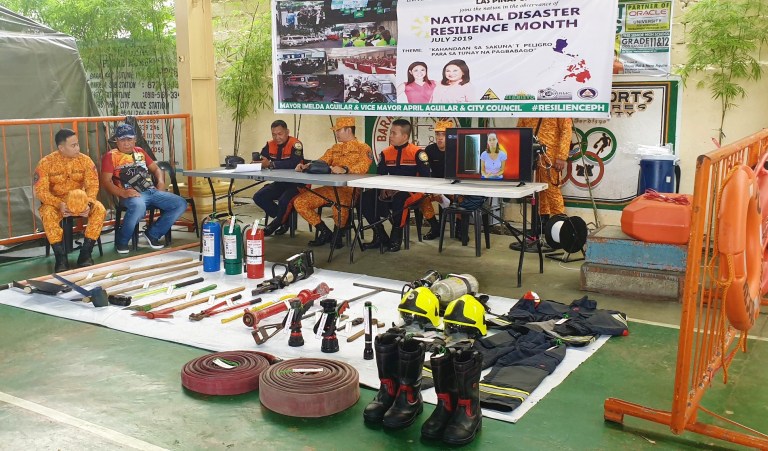
Held at the Verdana covered court in Barangay Pamplona Tres was an exhibition of emergency equipment, kits and uniformed personnel who were present to answer inquiries. Some personnel demonstrated procedures on how to provide first aid. The exhibition served as the kick-off activity of the citywide observation of disaster preparedness.
A display of disaster-related equipment at the exhibition of the NDRM held at the Verdana Covered Court in Barangay Pamplona, Tres. (image sourced from Las Piñas DRRMO/Shawnette Ramos)
Over at City Hall, City Government officials led by Mayor Aguilar, her daughter Vice Mayor April Aguilar-Nery expressed their full support to the City Disaster Risk Reduction and Management Office (Las Piñas DRRMO).
The said department is sponsoring the inaugural Inter-School On-The-Spot Poster-Making Competition as well as the 2nd Inter-Barangay First Aid Competition. Both competitions are designed to make Las Piñas residents aware of disaster preparedness and interested parties are welcome to call landline 552-7694 for inquiries about the activities.
In accordance to Executive Order Number 29 (2017), the month of July was declared as National Disaster Resilience Month which calls for observation nationwide for the entire month. It is practiced annually each July and it involves various sectors to do their part. The theme for National Disaster Resilience Month this year is “Kahandaan sa Sakuna’t Peligro Para sa Tunay na Pagbabago.”
For more information about the City of Las Piñas, click here.
Las Piñas City Mayor Imelda T. Aguilar announced that the City Government has issued their Green Card which is now accredited at the Las Piñas City Medical Center (CityMed). Holders of the said card may use it in case of confinement at the mentioned hospital.
CityMed is the newest hospital where the Las Piñas City Green Card may be used. It is located along Marcos Alvarez Ave. Barangay Talon Singko, Las Piñas City. The other hospitals where Green Card is accredited are Las Piñas Doctors Hospital (LPDH), Philippine General Hospital (PGH), and San Juan De Dios Hospital. These hospitals have coordinators to help facilitate the confinement of the card holder. There is a special ward dedicated to patients who have Green Card in LPDH and CityMed.
“The additional hospital accreditation of the Green Card will provide more options and convenience to Las Piñeros when seeking medical help,” Mayor Aguilar said.
Green Card is the hospitalization support program of the city government of Las Piñas; it subsidizes up to P30,000 of the total hospital bill of the confined patient. Every member of the family when hospitalized is entitled to the subsidy.
Presently, there are 200,000 Green card users. The Green Card project is being managed by the Mayor’s Office and the City Social Welfare and Development Office. It may be availed by all bonafide Las Piñas residents.
According to Mayor Aguilar, “we are in the process of negotiating with more hospitals in Las Piñas for the expansion of Green Card accreditation.”
In recent times the City Government of Las Piñas headed by its Mayor Imelda “Mel” Aguilar has been making a lot of progress with modernizing public transportation within its jurisdiction by releasing to local tricycle drivers and operators electric tricycle (e-trike) units that they received from the Department of Energy (DOE).
The DOE donated 100 e-trikes to Las Piñas which in turn coordinated with the varied tricycle operators from the city’s twenty barangays. On April 5, 2019, the City Government’s Facebook page posted pictures of its most recent turnover of e-trikes to specific operators. Posted below is one of them.
Las Piñas City Government officials with the recipients in a turnover ceremony at City Hall. (photo by Shawnette Ramos for City of Las Piñas Facebook page)
Right below is a picture of electric tricycle units that I photographed during my visit at Las Piñas City Hall.
From my visit at Las Piñas City Hall.
The future of local public transportation in the city is looking bright. Once these electric tricycles go into full operation, the following is expected to happen:
A more comfortable ride for passengers thanks to the new tricycle design. The e-trike is one whole unit (versus the motorcycle linked with a passenger-carrying unit of the old tricycle design).
Reduction on noise pollution because there is no fuel-based engine.
Reduction on air pollution because there is no fuel-based engine and no exhaust.
Complete avoidance on spending money on fuel which by the liter, as of this writing, is expensive. Recharging, not refueling, is the way for E-Trike operators to recover and keep operating the next day.
Think about it carefully. E-Trikes can bring passengers through the quiet villages more safely, quieter and without adding anymore air pollution that would affect families at their homes.
Now that the benefits of E-Trikes have been discussed, it’s time to take a close look as to how these positive developments in Las Piñas happened in the first place.
The answer is City Ordinance Number 1536-18 (Series of 2018). and below is a summary of the details written on it.
The Ordinance
Formally titled “An Ordinance Allowing The Operation of E-Trike in The City of Las Pinas and Providing Guideliness Thereto.”, with “E-Trike Ordinance” as the shorter title, City Ordinance Number 1536-18 (Series of 2018) was approved by the City Council and Mayor Aguilar on May 28, 2018. As written on the Ordinance, it was deemed that the adoption of the e-trike project is a necessary step in combating unreasonable high oil prices and ending dependency on oil. The E-Trike was viewed to be eco-friendly, noise-free and air pollution-free. It has the potential to generate higher income for operators and even create new jobs.
Section 2 of the Ordinance states: The City of Las Pinas fully supports the national government’s e-tricle project. It is also committed in enforcing the applicable provisions of the Clean Air Act and in addressing community concerns about high oil prices, pollution and health hazard as well as in providing new job opportunities.
Section 4 (E-trike Franchise Grant) legalizes the use of electric tricycles within the territorial jurisdiction of the city. For this purpose, one hundred units of three-wheeled electric power driven vehicle or e-trike shall be granted franchise by the City of Las Pinas through the Sangguniang Panglunsod.
Section 5 (Guidelines) states that no e-trike franchise shall be granted unless the unit utilizes environmental-friendly batteries as determined by the Environment and Natural Resources Office, has an on-board charger and is deemed roadworthy while also possessing the required safety features.
The individual applicant is an actual resident and registered voter of the city. The transport cooperative may be granted in its name up to five franchises subject to compliance with the qualification requirements of the drivers.
For E-Trike Rent-To-Own Program or variations thereof and/or meanwhile that the ownership of the unit is not yet fully transferred to the intended buyer, a provisional franchise may be granted in favor of the proponent. Provided, that the qualification requirements of the intended buyers or drivers of the vehicle are complied with.
Section 6 (Parts Availability) – the proponent shall make available within the city such parts as may be needed for the continued operation of the E-Trike.
Section 7 (Charging Stations) – charging stations shall be established in strategic public places in the city. For the total franchises herein fixed, no less than two charging stations shall be required of the proponents to establish. In this regard, not all contemplated franchises shall be issued by the Sangguniang Panglunsod unless the establishment of the charging stations is assured or completed.
Section 8 (Incentives) – Franchisees shall be granted a 50% discount on all fees applicable to trimobiles specifically the franchise fee, the annual supervision fee, the mayor’s permit fee, the legal research fee, the sticker fee and the police inspection fee.
If you wish to obtain copies of the Ordinance, visit City Hall.
Conclusion
With the E-Trike Ordinance in full force, Las Piñas City is clearly on its way forward with modernizing public transportation within its jurisdiction using electric tricycles which serve passengers traveling between the important city roads and the villages.
As far as South Metro Manila is concerned, Las Piñas has joined the electric vehicle bandwagon with Muntinlupa City (which has e-trikes and electric jeepneys already for years) for public transportation.
The City of Parañaque meanwhile remains behind. Last time I checked at Parañaque City Hall, they don’t even have a draft ordinance needed to legalize the use of electric vehicles for public transportation.
Speaking of Parañaque, I can’t forget the embarrassing failed launch of the electric tricycle project of the BF Federation of Homeowner Associations, Inc. (BFFHAI) of 2016. From the way things looked back then, BFFHAI failed to verify if Parañaque (which occupies a huge portion of BF Homes subdivision) had any ordinance legalizing the use of electric vehicles for public transportation. Back then, Las Piñas (which occupies another large portion of BF Homes subdivision) obviously did not have a similar ordinance.
Right now in South Metro Manila, Las Piñas and Muntinlupa are leading the way for public commuters with electric vehicles.












 Author Carlo Carrasco