
COVID-19 Crisis: ECQ for Metro Manila announced (August 6 to August 20, 2021)

A lot of people were very surprised yesterday with the sudden announcement that Metro Manila will be placed under the stricter enhanced community quarantine (ECQ) status effective August 1 until August 20, 2021 supposedly in connection to the rising spread of the highly infectious Delta variant (Parañaque and Las Piñas each have one) and COVID-19 cases in general. It is surprising because very recently it was announced that the National Capital Region (which Metro Manila is clearly part of) would be placed under the strict form of general community quarantine (GCQ) from August 1 to 15, 2021.

Take note that the Metro Manila mayors favored ECQ and even set terms that include the national government will provide financial assistance to their respective constituents plus millions of vaccines.

To put things in perspective, posted below is the excerpt from the Philippine News Agency (PNA) article about the sudden ECQ announcement. Some parts in boldface…

Metro Manila will be placed under the most restrictive enhanced community quarantine (ECQ) from August 6 to 20, Malacañang said on Friday.

This, after President Rodrigo Duterte approved the Inter-Agency Task Force for the Management of Emerging Infectious Diseases’ (IATF-EID) recommendation to impose the strict quarantine classification in Metro Manila.

In an announcement aired over state-run PTV-4, Presidential Spokesperson Harry Roque said Metro Manila will stay under general community quarantine (GCQ) “with heightened restrictions” from July 30 to August 5 and will shift to ECQ from August 6 to 20.

“Hindi po naging madali ang desisyon na ito. Maraming oras ang ginugol para pagdebatehan ang bagay na ito (It is not an easy decision. We have spent so much time to debate on the proposal [to place Metro Manila under ECQ]),” Roque said.

Metro Manila is currently under GCQ with heightened restrictions. Its quarantine status was supposed to be extended until August 15.

However, Metro Manila mayors have urged the IATF-EID to implement a two-week ECQ in the country’s metropolis to prevent the spread of the more infectious Delta coronavirus variant.

More restrictions

Roque said “additional restrictions” would be imposed in Metro Manila from July 30 to August 5.

The heightened restrictions for NCR are more stringent compared to the GCQ with heightened restrictions of other areas,” he said in a press statement.

Roque said indoor dine-in services and al fresco dining are prohibited and only take-out and delivery are allowed in Metro Manila.

“For people working in these establishments, operations are allowed to continue and finish within the day,” he said.

Personal care services like beauty salons, beauty parlors, barber shops and nail spas may operate up to 30 percent of venue or seating capacity, Roque said.

He added that indoor sports courts and venues and indoor tourist attractions and specialized markets of the Department of Tourism (DOT) may not operate, while outdoor tourist attractions, as may be defined by the DOT, will be allowed at 30 percent venue capacity.

Roque said only Authorized Persons Outside their Residences will be allowed to travel “into and out” of NCR Plus, which is composed of Metro Manila, Bulacan, Cavite, Laguna, and Rizal.

Only virtual religious gatherings shall be allowed. Gatherings for necrological services, wakes, inurnment and funerals for those who died of causes other than Covid-19 shall be allowed, provided they are limited to immediate family members, he said.

Avoid panic buying

Following the government’s decision to implement ECQ in Metro Manila from August 6 to 20, Roque reminded the public not to resort to panic buying.

“Meron naman tayong isang linggo para mag-prepara dito sa two weeks na ECQ. Wala pong dahilan para mag panic buying dahil maski ECQ po, bukas naman po ang ating mga groceries (We still have one week to prepare for the two-week implementation of ECQ. There’s no reason for panic buying because despite the ECQ implementation, groceries are still open),” he said.

Apart from Metro Manila, Iloilo province and its city, Cagayan de Oro City, and the City of Gingoog in Misamis Oriental have also been placed under ECQ from July 21 to August 7.

On Tuesday, Roque announced that individuals residing in Iloilo province and its city, as well as the cities of Cagayan de Oro City and Gingoog, will receive cash assistance worth PHP1,000 per individual or PHP4,000 per family.

When quizzed if Metro Manila residents would also be given financial aid, Roque said: “Most likely but will seek confirmation.”

And here are related news videos to watch…

Economic damage and losses very likely

While it is understandable that ECQ is a response to the Delta variant and COVID-19 problems, it is very clear that this will result more financial losses on businesses and damage the nation’s economy which itself has been struggling to stand up and grow. Take note that the more businesses lose money, it could lead to job losses and result in lower tax collection on the part of the national government and LGUs. For insight, posted below is an excerpt from another PNA article published before the ECQ announcement. Some parts in boldface…

Department of Trade and Industry (DTI) Secretary Ramon Lopez has thanked President Rodrigo Duterte for approving the recommendation of the Inter-Agency Task Force for the Management of Emerging Infectious Diseases (IATF) to put Metro Manila and nearby provinces under general community quarantine (GCQ) with heightened restrictions.

The economy cannot bear another massive lockdown. We lose around PHP30 billion for a two-week lockdown. Many lost their jobs, livelihood, most of them are micro (and) SMEs (small and medium enterprises),” Lopez said during the Laging Handa public briefing Thursday.

He said the recommendation of placing National Capital Region (NCR) Plus under GCQ with heightened restrictions is in accordance with the IATF’s consultations with reliable health experts.

“We really take a balance, a holistic approach,” he added.

Lopez underscored that the IATF enforces restrictions amid the threats of the more infectious Covid-19 Delta variant.

But the restrictions are focused on ‘super spreader’ activities like mass gatherings, while lockdowns will remain a granular lockdown approach, the DTI chief said.

He also called on businesses to create their own health and safety committee that will ensure minimum public health protocols are being monitored and maintained in their respective establishments.

COVID-19 vaccination operations will still continue

Meanwhile, COVID-19 vaccination operations will still proceed during the ECQ period. Check out this excerpt from the GMA Network news report below…

Malacañang said the government’s COVID-19 vaccination program will proceed in Metro Manila even if the region will be under the enhanced community quarantine (ECQ) from August 6 to 20.

Yes, definitely [it will proceed]. Details will be provided in due course of the COVID-19 vaccination committee,” Roque said.

Let me end this piece by asking you readers: Are you surprised about the sudden announcement of ECQ for Metro Manila? Do you believe that the Metro Manila Council (MMC) is correct that the national government should provide the financial aid and vaccines for their respective constituents?  Could it be possible that certain city governments or LGUs (local government units) of Metro Manila have ran out of funds and have no choice but to rely on the national government to provide for them?

If you are a business owner within Metro Manila, do you believe that August 6 is too early for the imposition of another ECQ? Do you think that the Metro Manila mayors spent enough time researching about the potential economic damage of the ECQ they pushed for?

You may answer in the comments below. If you prefer to answer privately, you may do so by sending me a direct message online.

+++++

Thank you for reading. If you find this article engaging, please click the like button below and also please consider sharing this article to others. If you are looking for a copywriter to create content for your special project or business, check out my services and my portfolio. Feel free to contact me as well. Also please feel free to visit my Facebook page Author Carlo Carrasco and follow me at HavenorFantasy@twitter.com

For more South Metro Manila community news and developments, come back here soon. Also say NO to fake news, NO to irresponsible journalism, NO to misinformation, NO to plagiarists, NO to reckless publishers and NO to sinister propaganda when it comes to news and developments. For South Metro Manila community developments, member engagements, commerce and other relevant updates, join the growing South Metro Manila Facebook group at https://www.facebook.com/groups/342183059992673

COVID-19 Crisis: Local government units (LGUs) must comply with national government rules regarding face shields

Are you tired of using face shields when moving around in public here in the Philippines during this COVID-19 crisis? The issue about face shields became hot recently in relation to what President Rodrigo Duterte said about them which drew mixed reactions on a national scale. That being said, the national government made a move about the issue with the local government units (LGU) according to a news report by GMA Network.

To put things in perspective, posted below is an excerpt from the GMA Network report. Some parts in bold…

Local government units must adjust their ordinances on the use of face shields to match the national government’s decision on the matter amid the coronavirus disease 2019 (COVID-19) pandemic.

According to Vonne Aquino’s report on “24 Oras Weekend,” Inter-Agency Task Force co-chairperson Secretary Karlo Nograles said President Rodrigo Duterte currently has a memorandum on the use of face shields.

“Apart from ‘yung sinabi ni Pangulo na hospitals, may idadagdag din doon sa memo na list nung places kung saan kailangan mag soot ng face shield,” he said.

(Apart from the what President said on hospitals, the memo includes other places where the use of face shields is mandatory.)

“So completely and clearly, makikita natin doon saan lang talaga… na dapat mandatory magsoot ng face shield. All other places, it won’t be mandatory. Kumbaga, magiging ano na lang siya… voluntary,” he added.

(So completely and clearly, we can see places where use is mandatory. All other places, it won’t be mandatory. It will be voluntary.)

Malacañang on Thursday said the President’s statement on the wearing of face shields on top of face masks only in hospitals is considered policy.

Nograles said local governments must adjust their ordnances.

“It cannot be over and beyond ‘yung policy ng national, no? You cannot have LGUs na mas strict ‘yung guidance or ‘yung enforcement kaysa sa ano, kasi magkakalituhan, eh,” he said.

(It cannot be over and beyond ‘yung policy ng national. You cannot have LGUs with stricter guidance or enforcement because it will lead to confusion.)

Meanwhile, the Metro Manila Council said it has yet to tackle the issue.

“Ang mag mayors, may kaniya-kaniyang pananaw dito… it’s better for the IATF since they got experts there. At, of course, mapag-uusapang maiigi ito,” Metropolitan Manila Development Authority chairman Benhur Abalos said.

(The mayors have varying views on this. It’s better for the IATF since they have experts there. Of course, we will talk about this.)

And now here is a related news video by GMA Network…

Let me end this piece by asking you readers: Do you believe that there more disadvantages than advantages with the use of face shields in public? Do you believe that face shields are truly protective? Is your local government clear and specific with regards to the use of face shields? Do you believe that it is excessive for a person to be arrested and imprisoned for failing to use a face shield? Do you think that the national government knows what it is doing over the issue of face shields?

Who do you think would benefit the most when people are required to use face shields?

You may answer in the comments below. If you prefer to answer privately, you may do so by sending me a direct message online.

+++++

Thank you for reading. If you find this article engaging, please click the like button below and also please consider sharing this article to others. If you are looking for a copywriter to create content for your special project or business, check out my services and my portfolio. Feel free to contact me as well. Also please feel free to visit my Facebook page Author Carlo Carrasco and follow me at HavenorFantasy@twitter.com

For more South Metro Manila community news and developments, come back here soon. Also say NO to fake news, NO to irresponsible journalism, NO to misinformation, NO to plagiarists, NO to reckless publishers and NO to sinister propaganda when it comes to news and developments. For South Metro Manila community developments, member engagements, commerce and other relevant updates, join the growing South Metro Manila Facebook group at https://www.facebook.com/groups/342183059992673

COVID-19 Crisis: Muntinlupa City Government urges residents to be cautious in workplaces, public transportation amid rising COVID-19 cases

Recording a 65% increase in active cases over the last month, the City Government of Muntinlupa is urging city residents to remain observing health protocols especially the working class who are the subject of recent COVID-19 transmission.

Muntinlupa City Health Officer Dra. Teresa Tuliao said recent COVID-19 active cases are residents who work outside the city and may have contracted the virus in their workplaces or during their commute. Tuliao noted that most of infected employees have transmitted the virus to their family members leading to the increase of cases in the city.

As of March 7, Muntinlupa CHO recorded 129 active cases from the city’s nine barangays. Muntinlupa only has 78 active cases last February 7.

The doubling time, or the number of days for COVID-19 cases to double in number, is 28.60 days and the attack rate is at 10.46/1000 as of March 7. The average daily new cases for the past 2 weeks in Muntinlupa is 12 cases per day while the recovery rate is at 94.69%.

While the city remains to have one of the lowest COVID-19 attack rates among local government units in Metro Manila, the Muntinlupa CHO reminds the public to observe “utmost caution” especially when taking a commute in public transportation and in their workplaces. The local government is set to coordinate with companies and tricycle and jeepney operators to reinforce the implementation of health measures in their establishments and vehicles.

Recently, Muntinlupa City StaySafe.PH Task Force intensifies its contact tracing efforts through the implementation of StaySafe.PH app. Members of the Business Permits and Licensing Office has conducted inspections in various malls and other establishments to ensure full compliance to the contact tracing initiatives.

Mayor Jaime Fresnedi urged city residents not to let their guard down and strictly follow minimum health protocols amid rising cases in the city.

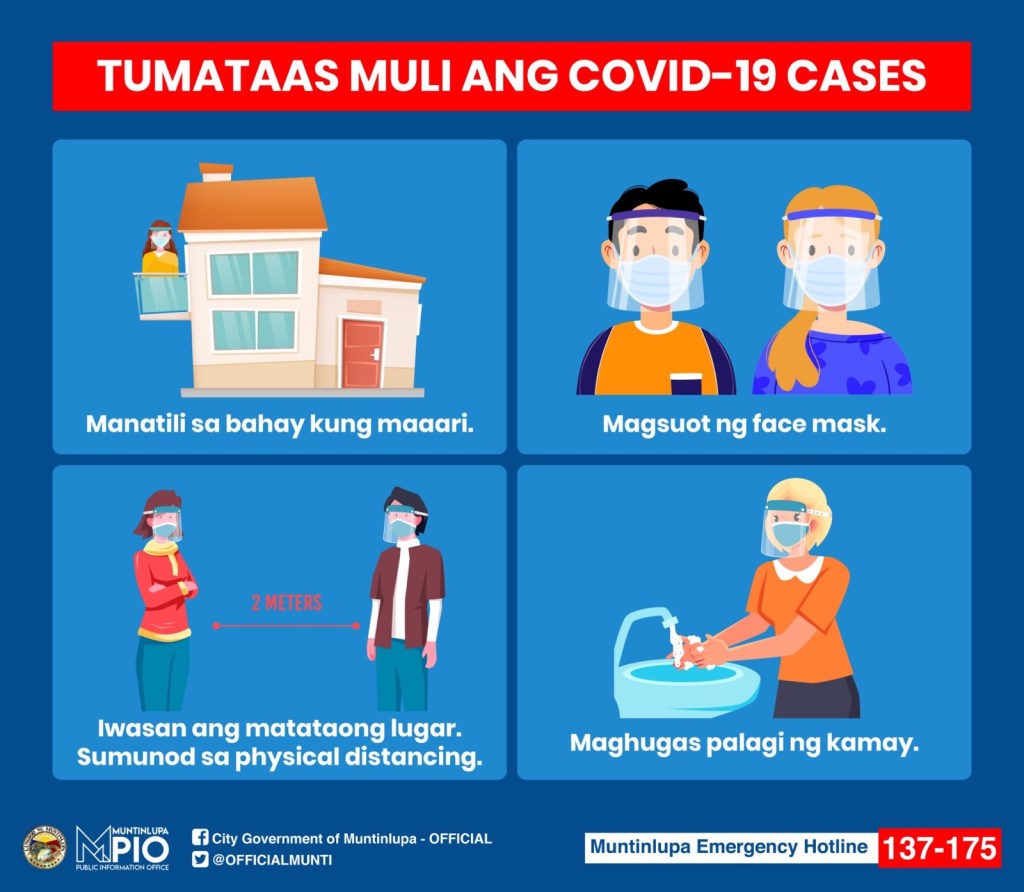
Public reminder from the City Government. (source – Muntinlupa PIO)

“The arrival of COVID-19 vaccines in the country should not give us a false sense of security. COVID-19 is still here and we should continue observing health protocols such as wearing our face mask and face shield, physical distancing, and washing of hands,” the local exec said. He also appealed to the public to refrain taking non-essential trips.

While the IATF has issued guidelines for a unified travel protocols for all local government units easing cross-border trips, the City Government eyes to impose stricter travel protocols for inbound visitors especially individuals coming from the province. Muntinlupa also supports the decision of the Metro Manila Council for the deferment of reopening cinemas due to health concerns.

+++++

The above information was provided by the City Government of Muntinlupa for the purpose of public information and transparency. Some parts were edited for this website.

For more South Metro Manila community news and developments, come back here soon. Also say NO to fake news, NO to irresponsible journalism, NO to misinformation, NO to plagiarists, NO to reckless publishers and NO to sinister propaganda when it comes to news and developments. For South Metro Manila community developments, member engagements, commerce and other relevant updates, join the growing South Metro Manila Facebook group at https://www.facebook.com/groups/342183059992673
Step-by-step MGCQ for the Philippines?

By now, it has been made clear that the Philippines won’t shift to modified general community quarantine (MGCQ) because President Rodrigo Duterte wants vaccination for COVID-19 to happen first. To put it short, health and personal safety are being prioritized although this means more waiting on the part of many people who are still unemployed and struggling without the needed income.

Yesterday, a new report published by Philippine News Agency (PNA) states that Duterte is taking a “step-by-step” approaching to the planned shift to MGCQ for the nation according to Cabinet Secretary Karlo Nograles.

Here is an excerpt from the report…

“For him (Duterte), it’s a step-by-step approach. Itong step muna before we go to the next step (We have to take this step first before we go to the next step), Nograles said in an online press briefing.

Nograles said it was “difficult” for Duterte to turn down the proposed shift to MGCQ.

However, Duterte wants to make sure that people’s health and safety would not be compromised, Nograles said.

“Again, the President and the government recognize the urgency of reopening the economy so we can resume the pre-pandemic upward trajectory and sustained growth of the economy. This, however, should be done side-by-side with measures that will ensure that we do not compromise efforts to contain Covid-19,” he said.

As seen above, the national leadership is aware of the need for economic recovery so that people suffering can be assisted by means economic opportunities. They are balancing economics with health as they are trying to find solutions and decide when to execute solutions. Shifting the whole nation to MGCQ can be done but with caution so that the risk of new infections won’t be too great.

Here is another excerpt…

The government was supposed to start its free vaccination program this month. However, there was a delay in the delivery of Covid-19 vaccines due to indemnification requirements.

Nograles said the IATF-EID would stick to the “month-to-month” assessment even if the government starts its mass immunization drive.

“If we go by the procedure, every end of the month, that is when we discuss ano ‘yung magiging recommendations namin kay Pangulo (what our recommendations to the President would be) for that succeeding month. So siguro (perhaps), in terms of timeline, perhaps that might be the same procedure that we follow,” he said.

The delayed arrival of the COVID-19 vaccines is indeed painful. Of course, people need to realize that while they can be helpful, the vaccines may not be the greatest solution to take during this pandemic. Even if a person gets vaccinated, caution must still be practiced when moving around in public.

More on the issue of shifting the entire nation to MGCQ status, I hope that the Metro Manila mayors as well as their advisers and experts would start researching how local governments and community leaders in other cities and provinces are doing under the declared MGCQ statuses in their respective areas. With Duterte’s refusal to move the nation into MGCQ, Metro Manila leaders have time to do such research.

Going back to Duterte and his cabinet, a new executive order (EO) is being prepared to institutionalize the 2021-2022 National Employment Recovery Strategy (NERS) with the goal of bringing back jobs in the labor market. Here’s an excerpt from the Philippine News Agency report…

In a virtual presser, Cabinet Secretary Karlo Nograles said the NERS was discussed and approved during the 52nd Cabinet meeting presided over by President Rodrigo Duterte at the Malacañan Palace on Monday night.

“Another initiative that was discussed yesterday (Monday) was the 2021-2022 National Employment Recovery Strategy or NERS…An executive order (EO) is now being readied to institutionalize the NERS task force in order to oversee all of these efforts,” he said.

Nograles said the NERS is meant to help create a policy environment that encourages the generation of more employment and entrepreneurship opportunities.

It is also expected to improve the employability and productivity of workers as it provides support to existing and emerging businesses.

“The strategic framework of the NERS is based on the following pillars — stimulating the economy and employment; supporting enterprises, jobs, and income; protecting workers in the workplace, and trusting social dialogue to encourage innovative solutions,” he said.

Watch out for more national developments here.

+++++

For more South Metro Manila community news and developments, come back here soon. Also say NO to fake news, NO to irresponsible journalism, NO to misinformation, NO to plagiarists, NO to reckless publishers and NO to sinister propaganda when it comes to news and developments. For South Metro Manila community developments, member engagements, commerce and other relevant updates, join the growing South Metro Manila Facebook group at https://www.facebook.com/groups/342183059992673

No vaccine for COVID-19, no MGCQ for the Philippines

People here in Metro Manila who have gotten tired with the general community quarantine (GCQ) limitation during the COVID-19 pandemic will have to wait a bit longer as President Rodrigo Duterte refused to shift the entire nation to the less restrictive modified general community quarantine (MGCQ) status because the vaccination for COVID-19 should be done first.

This was announced during the Cabinet meeting last night. Below is an excerpt from the Philippine News Agency report…

“President Rodrigo Roa Duterte gave his directive to the Cabinet that the Philippines would not be placed under modified general community quarantine unless there is a rollout of vaccines,” he said in a statement.

While Duterte acknowledged the need to reopen the economy, Roque said the President refused to put people’s health and safety at risk.

“The Chief Executive recognizes the importance of reopening the economy and its impact on people’s livelihoods. However, the President gives higher premium to public health and safety,” he added.

The President made it clear that the vaccination roll-out should go first before shifting the entire nation into MGCQ control. While it is clear that reopening the economy is essential, Duterte prefers to take time to be cautious and reduce the risks of new infections. As far as he is concerned, vaccines should go first.

It has already been reported that vaccine shipments to the Philippines have been delayed. This is undoubtedly bad news for the entire nation as there are lots of people who lost their jobs and fell into poverty as restrictions severely brought the economy down. The more people fall down into poverty, the more expensive it becomes for local governments to serve them. Speaking of local governments, the City of Las Piñas made preparations for COVID-19 vaccination and already they are handling the applications of constituents who applied to register themselves. Over at Muntinlupa City, meetings and preparations for COVID-19 vaccines were done.

Going back to Metro Manila, a majority of mayors voted to have the metropolis shift to MGCQ status by March 1. As the President made the rejection and insisted vaccination should go first, business owners, their affected employees and the unemployed will have to wait longer before MGCQ will be declared not only for the National Capital Region (NCR) but for the entire nation. The MGCQ status for the Philippines is key to economic revival which the Department of Trade and Industry (DTI) supports.

For those of you reading this, do you think the President made the right decision? Would you insist on declaring an MGCQ status nationwide without the COVID-19 vaccines? Please answer by commenting below. Thank you.

+++++

Thank you for reading. If you find this article engaging, please click the like button below and also please consider sharing this article to others. If you are looking for a copywriter to create content for your special project or business, check out my services and my portfolio. Feel free to contact me as well. Also please feel free to visit my Facebook page Author Carlo Carrasco and follow me at HavenorFantasy@twitter.com

For more South Metro Manila community news and developments, come back here soon. Also say NO to fake news, NO to irresponsible journalism, NO to misinformation, NO to plagiarists, NO to reckless publishers and NO to sinister propaganda when it comes to news and developments. For South Metro Manila community developments, member engagements, commerce and other relevant updates, join the growing South Metro Manila Facebook group at https://www.facebook.com/groups/342183059992673

Majority of Metro Manila Mayors support shift to MGCQ status by March 1, 2021

President Rodrigo Duterte will have a big decision to make that will affect millions of residents and businesses in Metro Manila as a majority of the mayors voted to shift the metropolis from general community quarantine (GCQ) to modified general community quarantine (MGCQ) status by March 1, 2021, as based on a news release on Philippine News Agency (PNA) that got published just last night.

Here’s an excerpt from the PNA report:

The Metro Manila Council (MMC), composed of Metro Manila mayors and national government officials, has voted to support the proposed shift to the less restrictive modified general community quarantine (MGCQ) in Metro Manila.

“Ang karamihan po ng alkalde ng kalakhang maynila ay bumoto na MGCQ na po ang magiging posisyon nila pagdating sa Metro Manila (Most of the mayors in Metro Manila voted for having MGCQ as their position in Metro Manila),” Metropolitan Manila Development Authority (MMDA) chairman Benjamin “Benhur” Abalos Jr. said in a press conference on Thursday.

This, he said, will be sent to the Inter-Agency Task Force for the Management of Emerging Infectious Diseases (IATF-EID) and to President Rodrigo R. Duterte who will make the final decision on whether to implement eased quarantine restrictions by March 1.

He declined to provide the actual number of votes the proposal received but said that all Metro Manila mayors will support the decision.

Indeed, Abalos did not reveal the number of Yes and No votes but the Manila Bulletin reported that the score among Metro Manila mayors was 9-8 in favor of MGCQ.

To put things in perspective, Metro Manila still has yet to adjust to MGCQ status. Metro Manila is the hot spot of multiple cities where a lot of residents as well as business entities of varied sizes are located at. Right now, the nation needs a major boost to its economy even as there is still the need to be vigilant to avoid new COVID-19 infections. Lots of people in the metropolis remain unemployed and badly need income, and having Metro Manila shift to MGCQ status will help revive other businesses and pave the way for more people to get back to work.

It would be nice to see the Metro Manila Council research more and observe closely how other cities and provinces are doing while maintaining MGCQ statuses for months already.

On a grander scale, the Department of Trade and Industry (DTI) supports the recommendation to have the entire nation placed under MGCQ status by March. The said recommendation was made by Acting Socioeconomic Planning Secretary Karl Kendrick Chua in recent times. Below is an excerpt from the PNA report:

“It is about time we move to MGCQ after a year of lockdown,” Lopez told reporters in a Viber message Tuesday. “Lockdown was supposed to buy us time to prepare our health system and improve contact tracing and ‘Trace-Test-Treat’.”

Since June 2020, the National Capital Region (NCR) has not graduated from GCQ status, a stricter community quarantine measure than MGCQ.

It even went back to much stricter modified enhanced community quarantine (MECQ) from Aug. 4 to 18 last year as health care facilities in Metro Manila were overwhelmed due to the increasing number of Covid-19 cases during that period.

“As the Philippines recovers, Metro Manila has a very weak recovery, worse in employment and hunger recovery, and that means more urban poor. The damages to malnutrition and other health and social issues will be irreversible,” Lopez said.

NCR accounted for around 40 percent of the Philippine gross domestic product (GDP).

But Lopez added the reopening of more economic activities should depend on the Covid-19 statistics.

As pointed out by Trade secretary Lopez, Metro Manila is lagging behind in terms of recovery from the pandemic. Apart from joblessness and lack of income, poverty in the National Capital Region is an important problem to solve. The more people fall under poverty, the more local government units (LGUs) need to exert and spend their limited resources to support them.

Right now, the Metro Manila Council’s approval of shifting to MGCQ status will soon be dealt with by the Inter-Agency Task Force for the Management of Emerging Infectious Diseases (IATF-EID) and President Duterte.

In ending this, here are some videos about combatting the China virus.

+++++

For more South Metro Manila community news and developments, come back here soon. Also say NO to fake news, NO to irresponsible journalism, NO to misinformation, NO to plagiarists, NO to reckless publishers and NO to sinister propaganda when it comes to news and developments. For South Metro Manila community developments, member engagements, commerce and other relevant updates, join the growing South Metro Manila Facebook group at https://www.facebook.com/groups/342183059992673