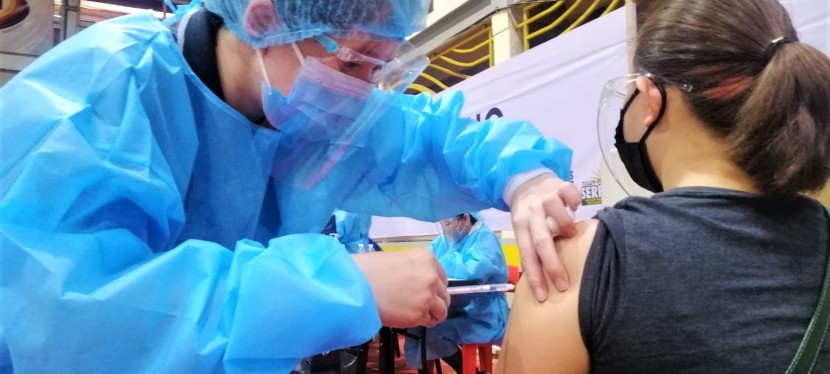
The City Government of Las Piñas announced that vaccines sourced from AztraZeneca and Sinovac were injected into their local health workers including personnel in Temporary Treatment and Management Facilities (Safe 1 and Safe 2) at the vaccination site at the University of Perpetual Help System Dalta (UPHSD) Gymnasium, in Barangay Pamplona Tres.
A local health worker got vaccinated for the China virus. (photo source – City Government of Las Piñas)
As part of their local campaign against COVID-19 (China Virus), the said vaccines were used depending on the health and protection of front liners. The City Government continues to work to ensure the protection of health, safety and the welfare of the people during this time of pandemic. Already Senator Cynthia Villar expressed happiness about the city’s vaccination rollout.
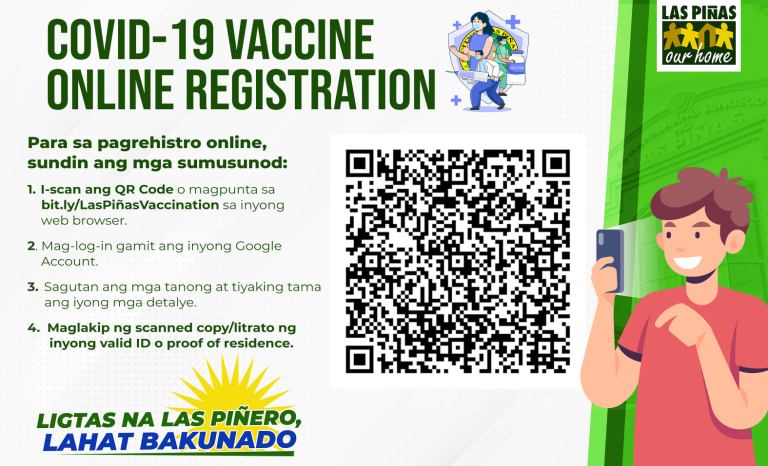
Meanwhile, local citizens who wish to avail of COVID-19 vaccines are encouraged to get themselves registered with the City Government by means of digital method (QR code scanning, Google account to be used) or the manual method. For reference about Las Piñas vaccine registration, posted below are official images of instruction.
+++++
The above information was provided by the Las Piñas City Government for the purpose of public information and transparency. Some parts were edited for this website.
Thank you for reading. If you find this article engaging, please click the like button below and also please consider sharing this article to others. If you are looking for a copywriter to create content for your special project or business, check out my services and my portfolio. Feel free to contact me as well. Also please feel free to visit my Facebook page Author Carlo Carrasco and follow me at HavenorFantasy@twitter.com
For more South Metro Manila community news and developments, come back here soon. Also say NO to fake news, NO to irresponsible journalism, NO to misinformation, NO to plagiarists, NO to reckless publishers and NO to sinister propaganda when it comes to news and developments. For South Metro Manila community developments, member engagements, commerce and other relevant updates, join the growing South Metro Manila Facebook group at https://www.facebook.com/groups/342183059992673
With tighter contact tracing efforts and integration of local COVID-19 data in the StaySafe.PH system, confirmed cases and their close contacts in Muntinlupa cannot falsify their health condition and will be barred entry from local establishments.
The City Epidemiology and Surveillance Unit of Muntinlupa and Management Information System Office have started tagging COVID-19 cases in the StaySafe.PH app allowing establishments to identify confirmed, probable, and suspect cases based from real-time data from the City Health Office.
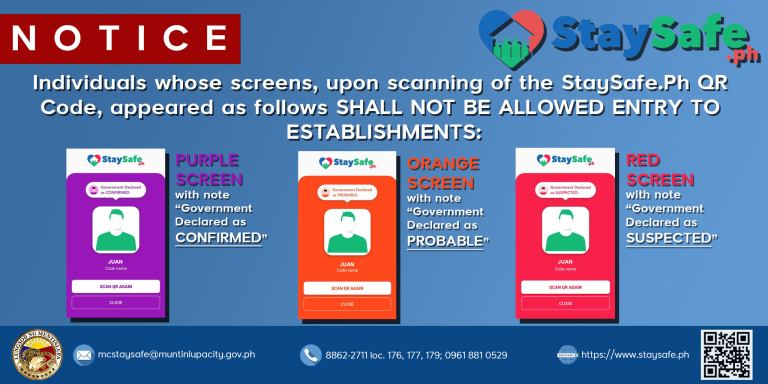
Since March 9, 2021, the profiles of all individuals under the surveillance of Muntinlupa CHO were identified in the contact tracing system and were adjusted accordingly. Individuals with purple screen corresponds to “Government Declared as CONFIRMED,” orange screen as “Government Declared as PROBABLE,” and red screen as “Government Declared as SUSPECTED.”
Establishments are advised to prohibit entry, isolate immediately, and report to the City Health Office or Barangay Health Emergency Response Team those individuals with non-eligible screens upon scanning of the StaySafe.Ph QR Code. Upon recovery, the profile of individuals with confirmed or probable status will revert to “good condition” with a green screen and will be allowed entry to establishments anew.
The color-based indicators from StaySafe.ph app. (source – Muntinlupa PIO)
Recently, the City Government of Muntinlupa, in partnership with the Department of Health, launched the Staysafe.PH app as the official digital contact tracing system in the city and has implemented a “No QR Code, No Entry Policy” in all commercial establishments, workplaces, churches, and government offices in the city.
Mayor Jaime Fresnedi urged all residents and owners of establishments in the city to use the StaySafe.PH app amid rising COVID-19 cases. He said the adoption of StaySafe.PH in Muntinlupa is in compliance with the national government’s recommendation for a uniformed contact tracing system to prevent further COVID-19 transmission, especially with the detection of the contagious variants in the country.
All residents and visitors who will enter, work, or do business in all indoor or enclosed public and private establishments in Muntinlupa shall be required to download and register at the StaySafe.PH application and secure a unique QR Code which they can store on their phone or print for physical copy. QR Codes for non-smartphone user registrants shall be generated by their respective barangays and shall be distributed to where the registrant resides.
Members of the Muntinlupa City StaySafe.Ph Task Force has conducted regular inspections to ensure compliance of local public and private establishments. As of March 11, 2021, the local Task Force has issued 235 notice of violations to non-compliant establishments.
Violators will be charged with P2,000 penalty and suspension of franchise or business permit until violation has been rectified for first offense, P3,000 for second offense, and suspension or revocation of franchise or business permit including P5,000 for the third offense. In case the offender is a government official or employee, the maximum penalty shall be imposed including the filing of administrative, civil, or criminal action.
+++++
The above information was provided by the City Government of Muntinlupa for the purpose of public information and transparency. Some parts were edited for this website.
For more South Metro Manila community news and developments, come back here soon. Also say NO to fake news, NO to irresponsible journalism, NO to misinformation, NO to plagiarists, NO to reckless publishers and NO to sinister propaganda when it comes to news and developments. For South Metro Manila community developments, member engagements, commerce and other relevant updates, join the growing South Metro Manila Facebook group at https://www.facebook.com/groups/342183059992673
Recently the City Government of Las Piñas headed by Mayor Imelda “Mel” Aguilar and Vice Mayor April Aguilar-Nerry and in cooperation with the Department of Health (DOH) conducted a simulation or dry run of their vaccination program for COVID-19 at the vaccination site located at Las Piñas Elementary School Central, P. Diego Cera, Barangay Elias Aldana.
Present during the simulation were DOH Assistant Regional Director Ma. Paz Corrales and physicians of the City Health Office Dr. Ferdinand Eusebio, Dr. Julie Gonzales and Dr. Ellaine Gumpal.
Las Piñas City Mayor Imelda Aguilar (front row, middle), Vice Mayor April Aguilar-Nery (front row, left) and other officials at the vaccination site on February 8, 2021. (source – Las Piñas City Facebook page)
The simulation is part of the City Government’s preparation and cooperation with the government’s mass vaccination program for the expected arrival of vaccines in the country this February.
During the simulation, the City Government and the CHO prepared an orderly, comprehensive and concrete vaccination plan to ensure the safety of vaccinators and prevent the possible spread of diseases in the city.
The Mayor and Vice Mayor observe during the simulation. (source – Las Piñas City Facebook page)
In ensuring order, a screening site has been set up in each barangay to initially list the potential recipients of the vaccine. There are five registration sites in District 1 and District 2 for validation and profiling of the initial list. Based on the final masterlist, QR codes will be issued to those who qualified. Each of the 20 barangays has one vaccination site where Las Piñas City residents will be vaccinated at. This past January, the City Government conducted a community level census for the COVID-19 vaccine.
The order of each area (waiting area, registration area, counseling area, medical screening, vaccination area, encoding area and post vaccination and monitoring area) will be followed at a designated vaccination site with the rules and procedures that must be followed by the locals for their safety before and after they are vaccinated.
Already personnel of City Hall underwent simulations of vaccinations in the area to demonstrate the Local Government’s preparation in tandem with the local Health Office.
When it comes to cold storage for vaccines, a storage facility has been prepared and there are ten additional freezers set for standby to temporarily store vaccines to keep them safe for the program.
The City Government aims to vaccinate three thousand residents per day. Previously, the City Government allocated P200 million for the purchase of additional COVID-19 vaccines. About 500,000 doses of COVID-19 vaccines were secured after Mayor Aguilar signed the tripartite contract with British drug maker AstraZeneca in collaboration with the government.
+++++
The above information was provided by the Las Piñas City Government for the purpose of public information and transparency. Some parts were edited for this website.
For more South Metro Manila community news and developments, come back here soon. Also say NO to fake news, NO to irresponsible journalism, NO to misinformation, NO to plagiarists, NO to reckless publishers and NO to sinister propaganda when it comes to news and developments. For South Metro Manila community developments, member engagements, commerce and other relevant updates, join the growing South Metro Manila Facebook group at https://www.facebook.com/groups/342183059992673
Muntinlupa City records the lowest COVID-19 prevalence in Metro Manila and the second lowest active cases in the region, a sharp drop of from 768 cases in September 1 to 89 cases as of October 19.
Muntinlupa City Health Officer Dra. Teresa Tuliao reported the improvement in COVID-19 cases in the city to Department of Transportation Secretary Arthur Tugade, Mayor Jaime Fresnedi, and members of the local task force in a virtual meeting last October 20.
Tuliao said the recovery rate has further improved to 94.80%, an all-time high since the start of the pandemic, and Muntinlupa City now has the second lowest active cases in NCR following the Municipality of Pateros with over 49 active cases. She reported that no COVID-19 related fatality has been recorded over the last week.
The local health officer noted that Muntinlupa earned the lowest prevalence among Metro Manila cities with a rate of 0.16. The city’s prevalence rate or the number of cases over the total population is below the ‘acceptable rate’ of 1.0.
As of October 19, the doubling time in Muntinlupa City is at 17.94 days. Doubling time refers to the number of days for COVID-19 cases to double in number and the standard rate of transmission should be at 7-30 days to be considered decelerating. Tuliao said the improvement can be accounted to the city’s holistic approach in curbing COVID-19 which include surveillance-isolation-treatment strategies, intensified targeted mass testing, contact tracing, psychosocial interventions, and massive information drives, among others.
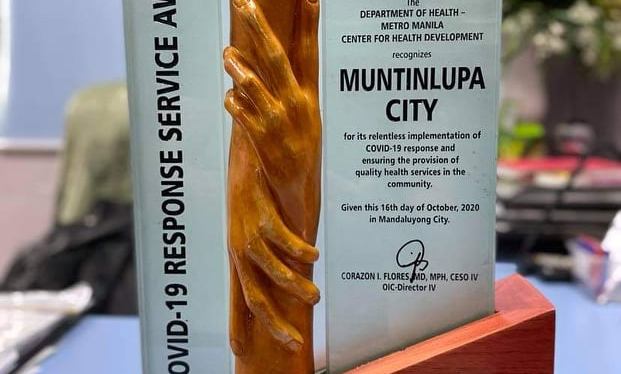
DOH Metro Manila Center for Health Development confers COVID-19 Response Service Award to Muntinlupa City last October 16 in recognition of its programs to ensure the provision of quality health services in the community amid the pandemic. (source – Muntinlupa PIO)
Muntinlupa CHO has conducted at least 18,944 swab tests as of October 19 which is equivalent to 3.50% of the city’s population. The city surpassed the national target of testing two percent of the population.
Recently, the 144-bed We Heal As One quarantine facility has opened in Pacwood Site, Barangay Tunasan for COVID-19 positive, suspect cases, and residents who have undergone swabbing tests. Each room has a comfort room, air-conditioning unit, and supplies. Residents who will occupy the isolation rooms will be given COVID-19 essentials bag consisting of a hygiene kit, vitamins, medicine, thermometer, bedsheet, pillow blanket, and towels, among others.
Self-isolation or admission to city isolation facilities is mandatory for anyone who have undergone COVID-19 swab testing in Muntinlupa under City Ordinance 2020-126. Currently, there are 6 occupants in the facility from Barangay Ayala Alabang and Barangay Putatan.
DOTr Sec. Arthur Tugade lauded Muntinlupa’s strategies towards the fight against COVID-19 and vowed to continue to support the city’s COVID-19 response efforts. Tugade was assigned by the IATF to monitor Muntinlupa’s health system performance, critical care capacity, and stringent compliance to surveillance, isolation, and treatment protocols.
The Department of Health – Metro Manila Center for Health Development also lauded this development as it conferred the COVID-19 Response Service Award to Muntinlupa City last October 16 in recognition of its programs ensuring the provision of quality health services in the community amid the pandemic.
Mayor Jaime Fresnedi welcomes the improvement of COVID-19 situation in the city highlighting the significant decrease of cases being monitored from by the hundreds down to the tens. However, the local exec warns residents not to be complacent with the positive results. He urged the public to continue to strictly follow minimum health protocols and safety measures such as wearing of face masks, observing physical distancing and washing of hands.
As of October 19, Muntinlupa City has 4,559 confirmed cases with 4,322 recoveries, 89 active cases, 148 reported deaths, 144 suspect cases, and 402 probable cases.
+++++
Latest City Government of Muntinlupa details sourced from their official media release. Some parts were edited for this website.
For more South Metro Manila community news and developments, come back here soon. Also say NO to fake news, NO to irresponsible journalism, NO to misinformation, NO to plagiarists, NOT to distorted views and NO to sinister propaganda when it comes to news and developments. For South Metro Manila community developments, engagements, commerce and updates, visit https://www.facebook.com/groups/342183059992673
On August 6, Department of Health (DOH) secretary Francisco Duque II declared a National Dengue Epidemic in relation to the 146,062 cases recorded (January to July 20) this year here in the Philippines.
Duque revealed that the reported cases are almost 100% higher than compared to the same period in 2018. The total number of deaths recorded this year is now at 622.
The declaration was the result of a full council meeting at the National Disaster Risk Reduction and Management Council (NDRRMC) that took place at Camp Aguinaldo in Quezon City.
In South Metro Manila, the City Government of Las Piñas responded to the declaration by informing their constituents to be prepared and vigilant of dengue. Mayor Imelda Aguilar and her daughter Vice Mayor April Aguilar-Nery called on all city residents to be careful and strive to clean up their homes and spots of their local areas. The City Government confirmed that all health centers around the city have dengue testing kits and the testing itself will be done for free.
Now that a national dengue crisis has been confirmed, now is the time for people living and working here in the Philippines to find not only the most effective methods to protect themselves from the disease but also to help cure the people already suffering from it.
To put things in perspective, the term dengue refers to both the virus and the fever. Dengue virus is a mosquito-borne, single positive-stranded RNA virus of the family Flaviviridae; genus Flavivirus.
Dengue fever is a harsh condition that includes symptoms of high fever, vomiting, pains on the muscle and joints, headache, pain behind the eyes, fatigue and skin rash. The time it takes for a sufferer to recover from it is two to seven days. However, there have been a small number of cases in which dengue fever becomes severe (referred to as dengue hemorrhagic fever). The symptoms for severe dengue include low blood platelets, bleeding and blood plasma leakage. There is also dengue shock syndrome which includes low blood pressure.
How to cure dengue? A scientist I met in Makati City told me it was papaya leaf juice.
For the newcomers reading this, the use of papaya leaf juice in treating dengue is not new. Rather it has been used for a long time in some areas of India and Southeast Asia. As dengue continues to spread and affect new victims around the world, it is expected that papaya leaf juice will grow in terms of demand.
To put things perspective, let’s start with the health benefits that papaya leaves carry. The leaf of the papaya contains a large amount of enzymes that include papain and chymopapain. These aid digestion and prevent bloating as well as digestive disorders. When it comes to vitamins and minerals, papaya leaves are rich in vitamins A, C, E, K and B while the specific minerals are iron, sodium magnesium, calcium and magnesium. The papaya leaf juice also comes with a compound that help with blood clotting and restricting internal bleeding.
Dr. Sheela Krishnaswamy, a nutritionist based in Bangalore, stated that certain studies “have shown that papaya leaf juice contributes significantly in the production of platelets.”
According to Dr. Ashutosh Gautam, 30 ml of fresh papaya leaf juice helps in increasing the blood platelet count which is crucial in treating dengue.
A team of chemical engineers in the Food and Pharmaceutical Engineering Group at the university are working on extracting carpaine (a bioactive compound) for use in the form of a pill. Because dengue is a huge health problem as the Aedes mosquito population grows, Associate Professor Dr. Ching Lik Hii (who leads the research at UNMC) got inspired to come up with methods to make the herbal remedy easier to process and consume.
Even as there are skeptics about papaya leaf juice as a cure for dengue, the confirmed results so far showed signs of effectiveness on the blood platelet count which itself is an important indicator on the patient’s health status while suffering dengue fever. In addition, papaya leaves
For the meantime, it would be helpful to convince local authorities (especially those who work in health and in government) to at least take a look at research of papaya leaf juice as an option for curing dengue. It is also timely right now that we should examine our nation’s harvest of the papaya trees with stronger focus on growing the leaves.
Do you see a papaya tree near you? Do NOT burn it and do NOT cut it down. Its leaves can be crucial to helping your nation deal with the ongoing dengue crisis. If you know someone who is suffering from dengue fever, then it is crucial to buy many papaya leaves and convert them into liquid form for drinking!
As the Philippines has a dengue crisis to deal, now is the time to contact your barangay (community government) officials, the city government officials, the provincial government officials (for those living in the provinces), the members of the House of Representatives and the Senators to encourage them to explore (if not utilize) papaya leaf juice as an option to treat dengue sufferers.
The time to act is now!
Thank you for reading. If you find this article engaging, please click the like button below and also please consider sharing this article to others. Also my fantasy book The World of Havenoris still available in paperback and e-book format. If you are looking for a copywriter to create content for your special project or business, check out my services and my portfolio. Feel free to contact me as well. Also please feel free to visit my Facebook page Author Carlo Carrasco and follow me at HavenorFantasy@twitter.com










 Author Carlo Carrasco