

COVID-19 Crisis: DTI says restaurants in MECQ areas are allowed to have outdoor dining

In what is clearly a move with economic recovery in mind, Department of Trade and Industry (DTI) Secretary Ramon Lopez declared that restaurants (located in places under MECQ or modified enhanced community quarantine status) with outdoor dining services and set-ups are allowed to resume but with certain limitations.

To make things clear, below is an excerpt from the Philippine News Agency (PNA) article which was published just yesterday. For greater emphasis, some parts are in bold.

In a text message to reporters Sunday night, Lopez said food establishments with alfresco dining services are only allowed up to 50 percent capacity, with diagonal seating arrangement and acrylic dividers on tables.

He added that indoor dine-in services are still not allowed in areas under MECQ, but food establishments can continue to operate with their take-out and delivery services.

From April 12 to 30, the National Capital Region, Bulacan, Cavite, Laguna, and Rizal or the NCR Plus as well as Santiago City in Isabela, and the provinces of Quirino and Abra were also placed under MECQ.

Earlier, the DTI chief said that the Inter-Agency Task Force for the Management of Emerging Infectious Diseases (IATF) might be sensitive in allowing indoor dine-in due to the highly contagious new variants of Covid-19.

“The IATF recommended to the President to shift to MECQ after two weeks of ECQ to restore more jobs and livelihood for the people,” Lopez said.

Clearly the local authorities are trying hard to balance themselves between economics and public health as new cases of COVID-19 (China Virus) continue to be counted in very high numbers on a daily basis in recent times. On April 2, the count of infections reached over 15,000.

Going back to the issue of allowing restaurants with outdoor dining (AKA alfresco) within the MECQ areas, it is good news that they are allowed to resume operations. It will still be a challenge for food establishments to attract enough paying customers and make their business’ financial ends meet.

On a personal experience, I love eating ramen and Tsukemen at Sigekiya Ramen in Alabang. I prefer that such meals would be cooked by the restaurant and be served to me at a table at their place. The alternative of taking the cooked ramen out and consume it at home is just not a convincing option for me because ramen is meant to be consumed quickly while it is hot. The alternative of taking home ingredients and noodles, and have them cooked at home does not appeal to me as I prefer Sigekiya’s cooks make the meal I paid for.

A delicious meal like this one is best to be eaten at the restaurant, even outdoors.

Also located in Alabang is the local branch of Akrotiri, a really fine restaurant that serves authentic Greek meals that my family and friends enjoyed. They also have meals that, in my opinion, are best consumed at their place and their Alabang branch (Commercenter to be precise) has space for outdoor dining. It was at Akrotiri Alabang where I treated 2019 SEA Games gold medalist Kim Mangrobang to a meal and organized an exclusive interview with her. They really have a fine-looking place. Visit their website at https://akrotiri.ph/

It is important to keep in mind that restaurants around the nation have struggled a lot since the pandemic started last year. These business establishments are also struggling with retaining their respective employees, notably their cooks, the baristas, waiters and waitresses. Remember that the meals and drinks you enjoy would not be the same when the people who prepared them get laid off.

With the DTI’s declaration of allowing food establishments with outdoor dining setups and services to resume, I encourage you my readers to consider supporting these businesses for your food and beverage needs. If you can’t have a meal with the family outdoors, perhaps you can push through with a business meeting with a corporate associate or reunite with your friend or relative with the outdoor setting of a restaurant while adhering to health protocols (wearing face masks, face shields, sanitizing yourselves, etc.). 

Now, let’s observe how the mayors, the barangay captains and other local authorities in MECQ areas will react to DTI’s declaration. You also might want to check with the local restaurants and coffee shops if they allow outdoor dining. Consider taking time out to call them or verify on their respective social media channels/accounts to see if outdoor dining is allowed.

+++++

Thank you for reading. If you find this article engaging, please click the like button below and also please consider sharing this article to others. If you are looking for a copywriter to create content for your special project or business, check out my services and my portfolio. Feel free to contact me as well. Also please feel free to visit my Facebook page Author Carlo Carrasco and follow me at HavenorFantasy@twitter.com

For more South Metro Manila community news and developments, come back here soon. Also say NO to fake news, NO to irresponsible journalism, NO to misinformation, NO to plagiarists, NO to reckless publishers and NO to sinister propaganda when it comes to news and developments. For South Metro Manila community developments, member engagements, commerce and other relevant updates, join the growing South Metro Manila Facebook group at https://www.facebook.com/groups/342183059992673

COVID-19 Crisis: National Capital Region (NCR) and 4 nearby provinces plus a few other places now under MECQ until April 30, 2021

After two whole weeks of being placed under the restrictive ECQ (enhanced community quarantine) during the ongoing COVID-19 pandemic, the National Capital Region (NCR) and the provinces Cavite, Bulacan, Rizal and Laguna (note: these form NCR Plus as called by the local authorities) are now under MECQ (modified enhanced community quarantine) until April 30, 2021. Far away from NCR Plus are the City of Santiago, the Province of Quezon and Abra in the Cordillera Administrative Region (CAR) which also have been placed under MECQ status.

The shift to MECQ was approved by President Rodrigo Duterte in relation to the commitments made by more public and private hospitals to provide rooms and beds for patients suffering from COVID-19 (China Virus). The President urged PhilHealth (Philippine Health Insurance Corporation) to expedite the payment of claims of hospitals. For more details on this, read the Philippine News Agency’s (PNA) article.

MECQ is supposed to be the less restrictive form of quarantine. For one thing, the hours of curfew in Metro Manila has been adjusted to 8PM to 5AM (versus 6PM to 5AM under ECQ). To put things in perspective, here is an excerpt from the PNA’s article…

According to amended omnibus guidelines of the Inter-Agency Task Force for the Management of Emerging Infectious Diseases (IATF-EID) as of April 3, 2021, strict home quarantine shall be observed in all households under MECQ. Movement of persons shall be limited to accessing essential goods and services, and for work in permitted offices or establishments or such activities allowed.

Persons below 18 years old, those who are over 65 years old, those with immunodeficiency, comorbidity, or other health risks, and pregnant women shall be required to remain at home at all times except for obtaining essential goods and services or for work.

Under the IATF-EID guidelines, the following establishments, persons, or activities shall not be permitted to operate, work, or be undertaken during MECQ:

— Entertainment venues with live performers such as karaoke bars, bars, clubs, concert halls, theaters, and cinemas;

— Recreational venues such as internet cafes, billiard halls, amusement arcades, bowling alleys, and similar venues;

— Amusement parks or theme parks, fairs/peryas, kid amusement industries such as playgrounds, playroom and kiddie rides;

— Outdoor sports courts or venues for contact sports, scrimmages, games, or activities;

— Indoor sports courts or venues, fitness studios, gyms, spas or other indoor leisure centers or facilities, and swimming pools;


— Casinos, horse racing, cockfighting and operation of cockpits, lottery and betting shops, and other gaming establishments except for the draws conducted by the Philippine Charity Sweepstakes Office;

— Indoor visitor or tourist attractions, libraries, archives, museums, galleries, and cultural shows and exhibits;

— Outdoor tourist attractions;

— Venues for meetings, incentives, conferences, and exhibitions;

— Personal care services which include beauty salons, beauty parlors, medical esthetic clinics, cosmetic or derma clinics, make-up salons, nail spas, reflexology, aesthetics, wellness and holistic centers, and other similar establishments; acupuncture and electrocautery establishments, and massage therapy including sports therapy establishments. It also includes establishments providing tanning services, body piercings, tattooing and similar services. Home service for these activities is likewise not permitted; and

— Indoor dine-in services of food preparation establishments such as commissaries, restaurants, and eateries.

Now that the MECQ is in effect, we will find out soon enough how the many struggling businesses will perform, how many affected employees will be able to return to work, how vehicular traffic on the highways and major roads will turn out and how these changes will affect the daily count of new COVID-19 cases which has been averaging over 10,000 a day recently.

It has been over a year since the China Virus spread worldwide and negatively impacted the way people lived, brought down their earnings, made attending on-site worship harder (note: the authorities in California did Satan’s bidding and the United States Supreme Court struck down their abuse of power legally), and pushed varied authorities to adjust the way they manage their places and constituents. No matter how grim the situation is, I urge you my readers to never lose hope and always look up to Lord Jesus who is the true Savior for us all. I encourage you to grab a copy of the Holy Bible and read the full Chapter 91 of the Book of Psalms, believe in it and come to Lord Jesus.

God will make a way for those who are faithful to Him. You do not need religion. You do not need unbelief. You do not need to believe in this screwed-up world we live in. You do not need idols for they are unholy and idolatry itself is foolish. You need unwavering faith in Him for He is holy and only He deserves our worship, trust and honor.

+++++

Thank you for reading. If you find this article engaging, please click the like button below and also please consider sharing this article to others. If you are looking for a copywriter to create content for your special project or business, check out my services and my portfolio. Feel free to contact me as well. Also please feel free to visit my Facebook page Author Carlo Carrasco and follow me at HavenorFantasy@twitter.com

For more South Metro Manila community news and developments, come back here soon. Also say NO to fake news, NO to irresponsible journalism, NO to misinformation, NO to plagiarists, NO to reckless publishers and NO to sinister propaganda when it comes to news and developments. For South Metro Manila community developments, member engagements, commerce and other relevant updates, join the growing South Metro Manila Facebook group at https://www.facebook.com/groups/342183059992673
COVID-19 Crisis: National Capital Region (NCR) and 4 nearby provinces now under GCQ until April 4, 2021

It is all over the news and already a lot of people got affected specifically in the National Capital Region (NCR) and the nearby provinces of Bulacan, Cavite, Laguna and Rizal. This past Sunday, the Inter-Agency Task Force (IATF) issued a new resolution (Resolution #104) in response to the spike of COVID-19 cases in the country. There was a single-day high of 7,999 new COVID-19 cases reported recently followed by blaming the government and economic managers.

Firstly, there is no lockdown which is good news. This is about retaining the General Community Quarantine (GCQ) status for NCR while the four nearby provinces have fallen under the same status.

To put things in perspective, posted below are excerpts from the Philippine News Agency (PNA) report…

Excerpt 1

Under IATF Resolution No. 104, he said only essential travel into and out of Metro Manila, Bulacan, Cavite, Laguna, Rizal will be allowed.

Excerpt 2

Traveling into and out of Metro Manila and the provinces of Bulacan, Cavite, Laguna, Rizal will be prohibited. We will have a sort of bubble in NCR, and the provinces of Bulacan, Cavite, Laguna, Rizal,” he said.

Travel of authorized persons outside their residences (APORs) such as essential workers, health and emergency frontline services personnel; government officials and government frontline personnel; duly-authorized humanitarian assistance actors; persons traveling for medical or humanitarian reasons; persons going to the airport for travel abroad, returning overseas Filipinos and overseas Filipino workers (OFWs) will be unimpeded for as long as they show their respective work identification cards.

Individuals crossing zones for work or business and going back home will also be allowed to travel to and from the said areas.

“Kung kayo ay uuwi, essential travel po ‘yun. Kailangan lang magpakita ng ID kung saan ka talaga nakatira (If you’re going back home that’s essential travel. All you need to do is show your ID to prove that you live there),” he said.

Excerpt 3

Public gatherings limited

All public gatherings, including religious gatherings, will be prohibited but weddings, baptism, and funerals will be allowed but must observe a 10-person venue capacity.

Current operational capacities of essential and non-essential services and industries will remain.

However, face-to-face meetings, group meals in workplaces will be prohibited. Instead, work-from-home and virtual meetings are encouraged.

Roque said the IATF resolution also enjoins the private sector to adopt similar alternative working arrangements as those in place in the executive branch of government such as operating on a 30 to 50 capacity.

Only outdoor dining allowed

As for dining, Roque said only outdoor dining will be allowed in areas under GCQ while indoor dining will be strictly prohibited.

“Pagdating po sa mga restaurants, ang papayagan lang po yung mga outdoor dining (When it comes to restaurants, we will only allow those with outdoor dining),” he said.

Outdoor dining must observe a maximum of 50 percent venue capacity.

Take out and delivery is encouraged, he added.

Wear masks at home

Although the economy will stay open, Roque said the IATF resolution will require persons below 18-years-old and above 65-years-old, those with comorbidities, and pregnant women to remain inside their residences at all times.

The IATF resolution also advises the wearing of face mask at home especially when living with elderly and vulnerable.

Accepting of visitors outside immediate family or household is strongly discouraged.

Operations of driving schools, traditional cinemas and video and interactive game arcades, libraries, archives, museums, and cultural centers, limited social events at accredited tourism establishments and limited tourism attractions will be temporarily suspended except open-air tourism attractions.

Before the IATF’s new resolution was issued, the Commission on Elections (COMELEC) went ahead in shortening the hours of voter registration as well as suspending the organizing of satellite registration (registration processes held outside of their office) which started yesterday. People around the Philippines have until the end September 2021 to register themselves or adjust their respective voter statuses in preparation of the May 2022 presidential, national and local elections.

For their part, the Department of Tourism (DOT) announced yesterday that it would yield to public health concerns in relation to the GCQ status for NCR and the 4 nearby provinces.

With regards to the IATF’s prohibition on indoor dining, already the shopping malls and restaurants here in South Metro Manila have made adjustments and updated their customers. Sigekiya Ramen announced that their restaurant at Commercenter, Filinvest City in Alabang, is still allowed to accommodate paying customers for outdoor dining. Like many others, they also offer takeout and delivery services. Alabang Town Center and Festival Mall in Alabang posted updates about safety protocols in accordance to IATF Resolution #104.

With all these developments in place, people in the NCR and the affected provinces under GCQ will have to adjust. It is okay to keep reporting to work but there is a need to be cautious with regards to personal safety and avoiding COVID-19 infection as much as possible. There is also the need to prioritize where to go and what to do. All of these are in effect until April 4, 2021 and here is hoping that the current situation will improve (that the daily COVID-19 count of new cases will go down) so that the new round of restrictions under GCQ will not be extended.

Better yet, I encourage you all to look up to our Lord Jesus and keep having unwavering faith in Him. I also encourage you all to read chapter 91 of the Book of Psalm in the Holy Bible and pray in tongues to our Lord in the privacy in your respective rooms (with the door shut closed). Open your heart to the Lord, always.

+++++

Thank you for reading. If you find this article engaging, please click the like button below and also please consider sharing this article to others. If you are looking for a copywriter to create content for your special project or business, check out my services and my portfolio. Feel free to contact me as well. Also please feel free to visit my Facebook page Author Carlo Carrasco and follow me at HavenorFantasy@twitter.com

For more South Metro Manila community news and developments, come back here soon. Also say NO to fake news, NO to irresponsible journalism, NO to misinformation, NO to plagiarists, NO to reckless publishers and NO to sinister propaganda when it comes to news and developments. For South Metro Manila community developments, member engagements, commerce and other relevant updates, join the growing South Metro Manila Facebook group at https://www.facebook.com/groups/342183059992673

COVID-19 Crisis: Contact tracing efforts in Muntinlupa City through StaySafe.PH app tightened in response to rising COVID-19 cases

With tighter contact tracing efforts and integration of local COVID-19 data in the StaySafe.PH system, confirmed cases and their close contacts in Muntinlupa cannot falsify their health condition and will be barred entry from local establishments.

The City Epidemiology and Surveillance Unit of Muntinlupa and Management Information System Office have started tagging COVID-19 cases in the StaySafe.PH app allowing establishments to identify confirmed, probable, and suspect cases based from real-time data from the City Health Office.

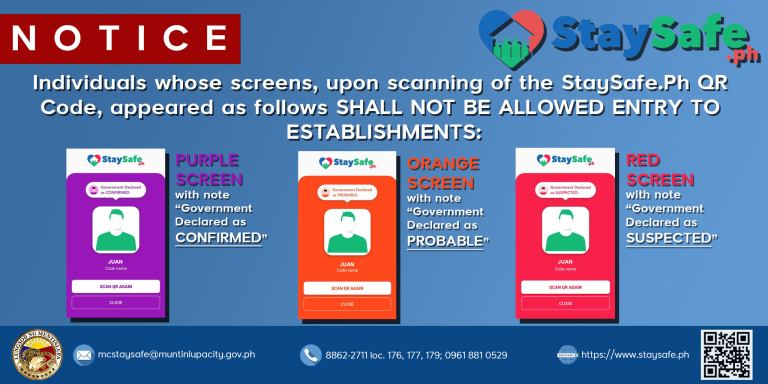
Since March 9, 2021, the profiles of all individuals under the surveillance of Muntinlupa CHO were identified in the contact tracing system and were adjusted accordingly. Individuals with purple screen corresponds to “Government Declared as CONFIRMED,” orange screen as “Government Declared as PROBABLE,” and red screen as “Government Declared as SUSPECTED.”

Establishments are advised to prohibit entry, isolate immediately, and report to the City Health Office or Barangay Health Emergency Response Team those individuals with non-eligible screens upon scanning of the StaySafe.Ph QR Code. Upon recovery, the profile of individuals with confirmed or probable status will revert to “good condition” with a green screen and will be allowed entry to establishments anew.

The color-based indicators from StaySafe.ph app. (source – Muntinlupa PIO)

Recently, the City Government of Muntinlupa, in partnership with the Department of Health, launched the Staysafe.PH app as the official digital contact tracing system in the city and has implemented a “No QR Code, No Entry Policy” in all commercial establishments, workplaces, churches, and government offices in the city.

Mayor Jaime Fresnedi urged all residents and owners of establishments in the city to use the StaySafe.PH app amid rising COVID-19 cases. He said the adoption of StaySafe.PH in Muntinlupa is in compliance with the national government’s recommendation for a uniformed contact tracing system to prevent further COVID-19 transmission, especially with the detection of the contagious variants in the country.

All residents and visitors who will enter, work, or do business in all indoor or enclosed public and private establishments in Muntinlupa shall be required to download and register at the StaySafe.PH application and secure a unique QR Code which they can store on their phone or print for physical copy. QR Codes for non-smartphone user registrants shall be generated by their respective barangays and shall be distributed to where the registrant resides.

Members of the Muntinlupa City StaySafe.Ph Task Force has conducted regular inspections to ensure compliance of local public and private establishments. As of March 11, 2021, the local Task Force has issued 235 notice of violations to non-compliant establishments.

Violators will be charged with P2,000 penalty and suspension of franchise or business permit until violation has been rectified for first offense, P3,000 for second offense, and suspension or revocation of franchise or business permit including P5,000 for the third offense. In case the offender is a government official or employee, the maximum penalty shall be imposed including the filing of administrative, civil, or criminal action.

+++++

The above information was provided by the City Government of Muntinlupa for the purpose of public information and transparency. Some parts were edited for this website.

For more South Metro Manila community news and developments, come back here soon. Also say NO to fake news, NO to irresponsible journalism, NO to misinformation, NO to plagiarists, NO to reckless publishers and NO to sinister propaganda when it comes to news and developments. For South Metro Manila community developments, member engagements, commerce and other relevant updates, join the growing South Metro Manila Facebook group at https://www.facebook.com/groups/342183059992673
DTI issues new memorandum for the reopening of cinemas in GCQ areas starting March 5, 2021

Do you miss watching movies in the cinemas? The COVID-19 pandemic really brought the movie theater industries around the world to a screeching halt which negatively impacted the way movies were distributed and led to the laying off of many employees who worked in the cinemas.

Here in the Philippines, movie theaters are only operating in cities or provinces which are under the state of MGCQ (Modified General Community Quarantine) which has lesser restrictions compared to GCQ (General Community Quarantine). The thing here is that Metro Manila (which is composed of multiple cities that each has its own government) is still under the GCQ level of control and as of this writing, movie theaters still have not reopened.

Just weeks ago, the Inter-Agency Task Force for the Management of Emerging Infectious Diseases (IATF-EID) announced it will allow a variety of businesses to resume operations and among them are the cinemas. Unsurprisingly, the Metro Manila mayors reacted negatively.

That was back then. Even though President Rodrigo Duterte refused to shift the entire nation into MGCQ status, movie theater operators (and their employees) in Metro Manila and other areas still under GCQ status now have something to be happy with as the Department of Trade and Industry (DTI) issued a new memorandum circular allowing movie theaters in GCQ zones to reopen starting March 5, 2021.

Below is an excerpt from the news article published the other night at Philippine News Agency’s website…

The Department of Trade and Industry (DTI) has issued Memorandum Circular (MC) No. 21-08 allowing movie houses in areas under general community quarantine (GCQ) to reopen starting March 5.

The circular stipulates that cinemas in GCQ areas are only allowed to operate up to 25-percent capacity.

However, moviegoers are prohibited to eat and drink, while face masks shall be worn at all times inside the cinema.

A one-meter physical distance on all sides is also required.

“In the event of free seating, cinema staff shall usher customers to their seats to comply with the physical distancing and maximum operational capacity requirements,” the MC said.

On the other hand, cinemas in modified general community quarantine (MGCQ) areas are allowed to operate at 50-percent capacity.

As you can see in the details in the above excerpt, movie theaters in GCQ zones will be allowed to resume operations but with limitations such as 25% maximum capacity (with social distancing implemented) allowed and the prohibition on moviegoers from consuming food and beverages (this limitation will hurt the cinemas’ food and beverage business partners).

As for the requirement to wear face shields inside the cinema, it’s really a detriment because face shields obscure people’s visions and therefore moviegoers won’t be able to enjoy the visuals displayed on the big screen. 

Let’s be honest here…how many people would really want to watch films inside the movie theater without food and beverages, and having to view films with their vision negatively affected by face shields? I can only state that the DTI should reconsider these limitations soon.

It is understandable that safety measures and the health protection for the public are essential for the national authorities to do which explain the limitations for cinemas in GCQ areas. Take note from the excerpt below…

“Following the earlier agreement at the IATF (Inter Agency Task Force for the Management of Emerging Infectious Diseases), DTI issued the circular that will guide the implementation of a safe and gradual reopening of more businesses and economic activities. This is part of our mandate to ensure that as more businesses reopen to provide more jobs and sources of income for our countrymen, the strict health protocols are enforced,” DTI Secretary Ramon Lopez said.

Lopez said while the government continues to reopen more economic and business activities, minimum health measures should be strictly implemented.

The thing which we should observe here in the Philippines is how the local government leaders of GCQ areas will react to DTI’s memorandum circular. Be aware that Metro Manila alone is home to lots of movie theaters, including those with 4D and IMAX technologies. These cinemas, many of which are part of shopping malls, have not operated for almost a year now and they badly need to resume their business not just to serve paying customers but also to take care of their employees such as security guards, ushers, ticket booth operators, film projector operators, etc. Do not forget about the businesses that partnered with cinemas to sell popcorn, snacks and beverages. Right now, economic recovery and job creation are of the utmost importance during this time of pandemic.

Now that you have read this, let me ask you what do you think about this news? Is the DTI right to issue the new memorandum? If you are living in a Metro Manila city, how has your local government leaders reacted to the news? When was the last time you watched a movie inside the cinema? Have you contacted your local cinema operator?

Watch out for further updates right here.

+++++

Thank you for reading. If you find this article engaging, please click the like button below and also please consider sharing this article to others. If you are looking for a copywriter to create content for your special project or business, check out my services and my portfolio. Feel free to contact me as well. Also please feel free to visit my Facebook page Author Carlo Carrasco and follow me at HavenorFantasy@twitter.com

For Shakey’s Philippines, 2021 will be a bounce-back year

It has been almost fifty years since Shakey’s first opened here in the Philippines and went on to become one of the most defining restaurants that families visit for very delicious meals, especially when it comes to pizza. Shakey’s has over 200 stores (both franchised and owned by the company) nationwide according to details posted in the Shakey’s Philippines website. Its strong presence in the Philippines was confirmed in 2015 when Euromonitor published a report showing that Shakey’s is the market leader in the categories of chained pizza full-service restaurants and in chained full-service restaurants. The results for both categories were 26.7% and 57.7% market shares.

Along the way, Shakey’s Philippines has a sibling business called Peri-Peri Charcoal Chicken which has a growing number of outlets. Inside BF Homes subdivision in Parañaque City, the Shakey’s branch along Aguirre Avenue has a Peri-Peri outlet right beside it.

Of course, the COVID-19 pandemic negatively affected businesses and societies in 2020. It was so severe, the Philippine economy shrank by a record 9.5%. As of this writing, a whole lot of people around the nation remain unemployed and more people fell under poverty.

The year 2021, however, will be different as far as Shakey’s Philippines is concerned. The company just announced that they will open fifteen new Shakey’s branches as well as fifteen new Peri-Peri outlets this year. These are parts of their plan to restart a store network expansion strategy that was put on hold last year due to the pandemic. Below is an excerpt from Shakey’s press release published on Philippine News Agency (PNA).

“For Shakey’s, we are looking to further strengthen the brand’s visibility and awareness, especially in underpenetrated second and third-tier cities outside of Metro Manila. For Peri, there are still a number of unserved markets which don’t have access to the brand’s great-tasting products,” Shakey’s president and chief executive officer Vicente Gregorio said.

Last 2020, the company ended with 245 Shakey’s restaurants, three of which were located abroad, and 34 Peri outlets all located in the Philippines.

It also launched a number of new offerings in select outlets including the ability for guests to ‘Park & Dine’, ‘Park & Order’, eat outdoors, and order R&B milk tea -one of the leading milk tea brands in Singapore.

“With evolving consumer habits brought about by the pandemic, our network expansion strategy has likewise adapted to ensure we maximize both our in-store and out-of-store presence. Our new openings this year will cater not only to our guests’ dine-in preference, but also their increasing need for more convenient and flexible out-of-store options,” Gregorio said.

He said Shakey’s will be unveiling a number of so-called ghost kitchens or kitchen extensions “to further strengthen our presence in delivery” at a time when off-premise channels are gaining prominence.

In the last few months, the company has been piloting a ‘31 Minute Delivery, If It’s Late, It’s Free’ guarantee in select areas in Metro Manila.

Gregorio added the company’s planned expansion this year “will come hand in hand with other exciting new business innovations that will maximize our existing asset base.”

“2021 will definitely be an exciting ‘bounce-back’ year,” he said.

As you can see in the above details, Shakey’s Philippines continues to push forward with their business and strategies even during this COVID-19 crisis. This is indeed encouraging not only for the business-minded people but also to Shakey’s many loyal customers as well as other food enthusiasts who love pizza, pasta and other meals served by the company.

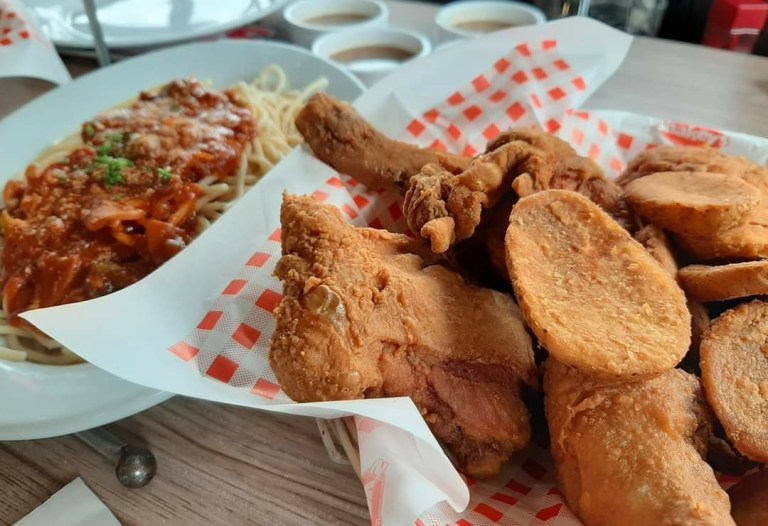
In my experience, Shakey’s always serve very delicious fried chicken, mojos and spaghetti.

As Shakey’s president and CEO Gregorio stated, their company is taking steps on keeping up with the changing consumer habits and, more notably, they are making their business accessible to the consumers. In short, Shakey’s Philippines won’t allow itself to be a victim of change but rather be a part of it and keep on feeding the customers. That being said, 2021 is for them a bounce-back year.

Now that you have read this, I’d like to ask when was the last time you eat inside a Shakey’s? Have you ordered food from them lately? What is the first type of food that comes to your mind when you hear their brand?

+++++

For more South Metro Manila community news and developments, come back here soon. Also say NO to fake news, NO to irresponsible journalism, NO to misinformation, NO to plagiarists, NO to reckless publishers and NO to sinister propaganda when it comes to news and developments. For South Metro Manila community developments, member engagements, commerce and other relevant updates, join the growing South Metro Manila Facebook group at https://www.facebook.com/groups/342183059992673

Step-by-step MGCQ for the Philippines?

By now, it has been made clear that the Philippines won’t shift to modified general community quarantine (MGCQ) because President Rodrigo Duterte wants vaccination for COVID-19 to happen first. To put it short, health and personal safety are being prioritized although this means more waiting on the part of many people who are still unemployed and struggling without the needed income.

Yesterday, a new report published by Philippine News Agency (PNA) states that Duterte is taking a “step-by-step” approaching to the planned shift to MGCQ for the nation according to Cabinet Secretary Karlo Nograles.

Here is an excerpt from the report…

“For him (Duterte), it’s a step-by-step approach. Itong step muna before we go to the next step (We have to take this step first before we go to the next step), Nograles said in an online press briefing.

Nograles said it was “difficult” for Duterte to turn down the proposed shift to MGCQ.

However, Duterte wants to make sure that people’s health and safety would not be compromised, Nograles said.

“Again, the President and the government recognize the urgency of reopening the economy so we can resume the pre-pandemic upward trajectory and sustained growth of the economy. This, however, should be done side-by-side with measures that will ensure that we do not compromise efforts to contain Covid-19,” he said.

As seen above, the national leadership is aware of the need for economic recovery so that people suffering can be assisted by means economic opportunities. They are balancing economics with health as they are trying to find solutions and decide when to execute solutions. Shifting the whole nation to MGCQ can be done but with caution so that the risk of new infections won’t be too great.

Here is another excerpt…

The government was supposed to start its free vaccination program this month. However, there was a delay in the delivery of Covid-19 vaccines due to indemnification requirements.

Nograles said the IATF-EID would stick to the “month-to-month” assessment even if the government starts its mass immunization drive.

“If we go by the procedure, every end of the month, that is when we discuss ano ‘yung magiging recommendations namin kay Pangulo (what our recommendations to the President would be) for that succeeding month. So siguro (perhaps), in terms of timeline, perhaps that might be the same procedure that we follow,” he said.

The delayed arrival of the COVID-19 vaccines is indeed painful. Of course, people need to realize that while they can be helpful, the vaccines may not be the greatest solution to take during this pandemic. Even if a person gets vaccinated, caution must still be practiced when moving around in public.

More on the issue of shifting the entire nation to MGCQ status, I hope that the Metro Manila mayors as well as their advisers and experts would start researching how local governments and community leaders in other cities and provinces are doing under the declared MGCQ statuses in their respective areas. With Duterte’s refusal to move the nation into MGCQ, Metro Manila leaders have time to do such research.

Going back to Duterte and his cabinet, a new executive order (EO) is being prepared to institutionalize the 2021-2022 National Employment Recovery Strategy (NERS) with the goal of bringing back jobs in the labor market. Here’s an excerpt from the Philippine News Agency report…

In a virtual presser, Cabinet Secretary Karlo Nograles said the NERS was discussed and approved during the 52nd Cabinet meeting presided over by President Rodrigo Duterte at the Malacañan Palace on Monday night.

“Another initiative that was discussed yesterday (Monday) was the 2021-2022 National Employment Recovery Strategy or NERS…An executive order (EO) is now being readied to institutionalize the NERS task force in order to oversee all of these efforts,” he said.

Nograles said the NERS is meant to help create a policy environment that encourages the generation of more employment and entrepreneurship opportunities.

It is also expected to improve the employability and productivity of workers as it provides support to existing and emerging businesses.

“The strategic framework of the NERS is based on the following pillars — stimulating the economy and employment; supporting enterprises, jobs, and income; protecting workers in the workplace, and trusting social dialogue to encourage innovative solutions,” he said.

Watch out for more national developments here.

+++++

For more South Metro Manila community news and developments, come back here soon. Also say NO to fake news, NO to irresponsible journalism, NO to misinformation, NO to plagiarists, NO to reckless publishers and NO to sinister propaganda when it comes to news and developments. For South Metro Manila community developments, member engagements, commerce and other relevant updates, join the growing South Metro Manila Facebook group at https://www.facebook.com/groups/342183059992673

Majority of Metro Manila Mayors support shift to MGCQ status by March 1, 2021

President Rodrigo Duterte will have a big decision to make that will affect millions of residents and businesses in Metro Manila as a majority of the mayors voted to shift the metropolis from general community quarantine (GCQ) to modified general community quarantine (MGCQ) status by March 1, 2021, as based on a news release on Philippine News Agency (PNA) that got published just last night.

Here’s an excerpt from the PNA report:

The Metro Manila Council (MMC), composed of Metro Manila mayors and national government officials, has voted to support the proposed shift to the less restrictive modified general community quarantine (MGCQ) in Metro Manila.

“Ang karamihan po ng alkalde ng kalakhang maynila ay bumoto na MGCQ na po ang magiging posisyon nila pagdating sa Metro Manila (Most of the mayors in Metro Manila voted for having MGCQ as their position in Metro Manila),” Metropolitan Manila Development Authority (MMDA) chairman Benjamin “Benhur” Abalos Jr. said in a press conference on Thursday.

This, he said, will be sent to the Inter-Agency Task Force for the Management of Emerging Infectious Diseases (IATF-EID) and to President Rodrigo R. Duterte who will make the final decision on whether to implement eased quarantine restrictions by March 1.

He declined to provide the actual number of votes the proposal received but said that all Metro Manila mayors will support the decision.

Indeed, Abalos did not reveal the number of Yes and No votes but the Manila Bulletin reported that the score among Metro Manila mayors was 9-8 in favor of MGCQ.

To put things in perspective, Metro Manila still has yet to adjust to MGCQ status. Metro Manila is the hot spot of multiple cities where a lot of residents as well as business entities of varied sizes are located at. Right now, the nation needs a major boost to its economy even as there is still the need to be vigilant to avoid new COVID-19 infections. Lots of people in the metropolis remain unemployed and badly need income, and having Metro Manila shift to MGCQ status will help revive other businesses and pave the way for more people to get back to work.

It would be nice to see the Metro Manila Council research more and observe closely how other cities and provinces are doing while maintaining MGCQ statuses for months already.

On a grander scale, the Department of Trade and Industry (DTI) supports the recommendation to have the entire nation placed under MGCQ status by March. The said recommendation was made by Acting Socioeconomic Planning Secretary Karl Kendrick Chua in recent times. Below is an excerpt from the PNA report:

“It is about time we move to MGCQ after a year of lockdown,” Lopez told reporters in a Viber message Tuesday. “Lockdown was supposed to buy us time to prepare our health system and improve contact tracing and ‘Trace-Test-Treat’.”

Since June 2020, the National Capital Region (NCR) has not graduated from GCQ status, a stricter community quarantine measure than MGCQ.

It even went back to much stricter modified enhanced community quarantine (MECQ) from Aug. 4 to 18 last year as health care facilities in Metro Manila were overwhelmed due to the increasing number of Covid-19 cases during that period.

“As the Philippines recovers, Metro Manila has a very weak recovery, worse in employment and hunger recovery, and that means more urban poor. The damages to malnutrition and other health and social issues will be irreversible,” Lopez said.

NCR accounted for around 40 percent of the Philippine gross domestic product (GDP).

But Lopez added the reopening of more economic activities should depend on the Covid-19 statistics.

As pointed out by Trade secretary Lopez, Metro Manila is lagging behind in terms of recovery from the pandemic. Apart from joblessness and lack of income, poverty in the National Capital Region is an important problem to solve. The more people fall under poverty, the more local government units (LGUs) need to exert and spend their limited resources to support them.

Right now, the Metro Manila Council’s approval of shifting to MGCQ status will soon be dealt with by the Inter-Agency Task Force for the Management of Emerging Infectious Diseases (IATF-EID) and President Duterte.

In ending this, here are some videos about combatting the China virus.

+++++

For more South Metro Manila community news and developments, come back here soon. Also say NO to fake news, NO to irresponsible journalism, NO to misinformation, NO to plagiarists, NO to reckless publishers and NO to sinister propaganda when it comes to news and developments. For South Metro Manila community developments, member engagements, commerce and other relevant updates, join the growing South Metro Manila Facebook group at https://www.facebook.com/groups/342183059992673

A chance for recovery for more Philippine cinemas (and their employees)

Wow. That was quite a ride of information updates that happened the last few days. Last Friday, the Inter-Agency Task Force for the Management of Emerging Infectious Diseases (IATF-EID) announced that it has allowed a variety of businesses around the Philippines to resume operations so that they can recover from this ongoing COVID-19 pandemic.

Such businesses specified were driving schools, video arcades, theme parks, natural sites, historical landmarks, parks and, most notably of all, cinemas (or movie theaters).

However, the Metro Manila mayors reacted and expressed their opposition against the national government’s decision on allowing cinemas to reopen. Through the media, Metropolitan Manila Development Authority (MMDA) chairman Benhur Abalos stated that a “majority of Metro Manila mayors agreed not to open as far as cinema is concerned.”

Below is an excerpt from the Manila Times article on Abalos…

He noted that movie theaters are enclosed and air-conditioned spaces where people stay for more than 30 minutes, conditions that increase the risk of coronavirus transmission.

To put things in perspective, Metro Manila is composed of many major Philippine cities such as Makati, Quezon City, Manila and Muntinlupa to name a few. Until now, Metro Manila remains under GCQ (General Community Quarantine) status while certain other cities or provinces have been enduring the MGCQ (Modified General Community Quarantine) status. As of this writing, the only cinemas operating here in the Philippines are those located in MGCQ areas.

Here in Metro Manila, movie theaters have been closed since March 2020. Take note of that.

As a result of the Metro Manila mayors’ opposition, it has been announced that the reopening of cinemas has been moved to March 1, 2021, but that is not guaranteed. According to the news release published yesterday at Philippine News Agency, the reopening of cinemas in GCQ areas has been moved to the first of March to allow consultations with local officials, and this is the result of talks with MMDA’s Abalos, MMDA General Manager Jojo Garcia and Trade Secretary Lopez.

Malacañang stated in the release: The IATF respects the position of mayors, especially those in Metro Manila. That’s why the resolution stated that the reopening of cinemas will be effective after drafting guidelines with local governments particularly when it comes to seating capacity in cinemas.

As you can see, there is still some work needed to be done before Metro Manila movie theaters (or any theaters in GCQ areas in general) can be allowed to reopen. This is why, in my view, the March 1 target for reopening could be missed.

More on the cinemas, I wonder if the Metro Manila mayors and their advisers did enough research about the economics. I understand they want to avoid the risk of people getting infected with COVID-19 within their respective cities, but there is still the need for economic recovery even if cinemas are to operate at less than 100% capacity and efficiency

From an economic point of view, thanks to information released by Trade Secretary Ramon Lopez, the so-called traditional cinema industry of the nation employed 300,000 workers and had generated revenues of P13 billion BEFORE the pandemic started last year. Because of the pandemic, 2020 theater revenues shrunk down to only P1.3 billion.

Whatever happened to them as a result of the pandemic, 300,000 cinema employees is a figure that should not be ignored nor dismissed so quickly by the mayors and their advisers. Economic recovery is a must.

In an ABS-CBN news report, the cinema operators and movie producers have decided to adopt a so-called wait-and-see approach on the reopening of cinemas in GCQ areas.

Here’s an excerpt from the report:

Although they welcome the easing of quarantine restrictions, local producers and theater operators believe that ultimately, the reopening of cinemas will still be dependent on the clearance of local government units.

Roselle Monteverde and Vincent del Rosario, who helm Regal and Viva Entertainment, respectively, told ABS-CBN News that they have the capability to provide cinemas with movie material, some of which have long been canned. Nonetheless, along with other members of the local producers association, the movie magnates are still awaiting the IATF guidelines and, more important, the guidance of mayors.

And here’s another excerpt, this time about two major cinema chain operators.

Megaworld Cinemas and SM Cinemas, which both control a vast chain of theater chains, told ABS-CBN News that they will wait for the final guidelines of the IATF and local government units.

Bomboy Lim of Robinson Cinemas also told ABS-CBN News that the bottomline is securing the approval of local government units. “Priority din namin ang ligtas na panonood ng tao. Kailangan nating sundin ang lahat ng guidelines including the IATF. Right now, they are still making it.”

Robinson Cinemas, which has an estimated 200 theaters nationwide in its malls nationwide, have not reopened since March 2020.

Over at the City of Manila, the local authorities there announced it will offer free swab tests to movie theater workers within their jurisdiction. Mayor Isko Moreno said that the swab tests are required before the city government allows malls to open their movie houses. Cinema workers specified are janitors, security guards, tellers, ushers, porters, ticket sellers and snack bar attendants to name some. Managers of malls in the city were asked by the mayor to present to the city government their respective preparations for the reopening of their cinemas with public safety in mind.

As I personally observed in shopping malls with cinemas here in South Metro Manila, each of them has established rules and set up special equipment to monitor the health statuses of people entering their respective places. I can imagine local cinemas inside these malls having similar equipment, disinfectant machines, and temperature scanners. It would be helpful if the malls or cinema operators can afford to set up sanitation tunnels (like those in Israel) for moviegoers to pass thru when entering and exiting the movie theater. Watch the video below…

Even though things look unclear, the fact remains is that operators of movie theaters and their employees now have a chance to resume their business and do their part in the recovery economically and socially. How the IATF and the Metro Manila mayors will decide the fate of the cinemas remains to be seen.

If there are any major updates, you will be notified right here at www.CarloCarrasco.com

+++++

For more South Metro Manila community news and developments, come back here soon. Also say NO to fake news, NO to irresponsible journalism, NO to misinformation, NO to plagiarists, NO to reckless publishers and NO to sinister propaganda when it comes to news and developments. For South Metro Manila community developments, member engagements, commerce and other relevant updates, join the growing South Metro Manila Facebook group at https://www.facebook.com/groups/342183059992673

CREATE bill to boost Philippine economy by cutting corporate income tax and implementing incentives

Yesterday, Department of Trade and Industry (DTI) Secretary Ramon Lopez announced that the Corporate Recovery and Tax Incentives for Enterprises (CREATE) Act is aimed to reduce the corporate income tax which should lead to creating more jobs as well as attracting investments.

Given the dramatic fall of the Philippine economy as a result of the COVID-19 pandemic, the CREATE bill could be the big solution to boost the economy and pave the way for recovery. For almost a year now, the said pandemic caused a lot of people to lose their jobs and much of their income. A lot of businesses closed down as well.

For your reference, here is a long excerpt of the news release about the said bill published via Philippine News Agency (PNA). Key words are highlighted in bold:

The recent bicameral approval of the game-changing CREATE Act can also provide a big boost to the National Employment Recovery Strategy (NERS) Task Force chaired by the DTI and co-chaired by the Department of Labor and Employment (DOLE) and the Technical Education and Skills Development Authority (TESDA), which was signed last Feb. 5 by several agencies.  

“The landmark tax and incentives reform bill that we expect to be signed by the President is expected to bring in (a) massive inflow of investments that will create more jobs, especially as we focus efforts in the National Employment Recovery during this period of the pandemic and beyond. The passing of CREATE will firm up the tax and incentive reforms that will make the investment climate significantly more attractive than the current tax and incentive regime,” Lopez said in a statement.

He said the bill will certainly encourage more investments with the lowering of the corporate income taxes rate from 30 percent to 20 percent for micro, small and medium enterprises (MSMEs), and 25 percent for large corporations.

“Modernizing the incentives system likewise makes the incentives such as income tax holiday (ITH), special corporate income tax rates (SCIT) or enhanced deductions (ED), available to industries considered strategic, critical or export oriented,” he added.

The Trade chief said the length of incentives, such as four to seven years of ITH plus five or 10 years of SCIT or ED, will depend on the nature of industry, export or domestic oriented, degree of technology and value adding, and geographical location, with additional years outside the Metro Manila and urban centers.

“There is also (a) longer transition period for those currently granted incentives. Thus, incentives are now made more performance-based, focused and timebound,” Lopez said.

CREATE is a bill certified urgent by President Rodrigo Roa Duterte upon the recommendation of the economic team led by Finance Secretary Carlos Dominguez III.

Lopez also thanked the legislators at the Senate and the House of Representatives, with Sen. Pia Cayetano and Rep. Joey Salceda, respectively, as principal authors, for the hard work of the committee members in bringing the CREATE bill to fruition.

“The passing of CREATE will unleash the growth potential of investments by removing uncertainties during the period that the bill was under deliberation,” Lopez said. “Based on our estimate and those from Cong. Joey Salceda, CREATE can bring in over PHP200 billion of new investments that can generate 1.4 (million) to 2 million incremental jobs.”

CREATE will help boost investments in the Philippines, which would support the 2021 target of the Board of Investments (BOI) of PHP1.25-trillion investment approvals.

A report by the United Nations Conference on Trade and Development (UNCTAD) had also estimated that the Philippines bucked the trend in Southeast Asia, and had increased its foreign direct investments (FDIs) during the pandemic by 29 percent last year.

Meanwhile, the NERS 2021-2023 is a medium-term plan anchored on the updated Philippine Development Plan 2017-2022 and ReCharge PH by expanding the Trabaho, Negosyo, Kabuhayan initiative and improving access and security of employment.

The strategy also takes into consideration the changes in the labor market brought about by the pandemic and the fast adoption of Fourth Industrial Revolution (FIRe) technologies.

“NERS shall also consolidate all measures, programs, and institutions that influence the demand and supply of labor, as well as the functioning of labor markets,” Lopez said.

Members of NERS Oversight Committee include the Departments of Transportation (DOTr), Tourism (DOT), Public Works and Highways (DPWH), Science and Technology (DOST), Social Welfare and Development (DSWD), Agriculture (DA), Agrarian Reform (DAR), Interior and Local Government (DILG), Information and Communications Technology (DICT),  Environment and Natural Resources (DENR), Education (DepEd), Commission on Higher Education (CHED), and National Security Council (NSC), as well as the Office of the Cabinet Secretary (OCS), Departments of Finance (DOF) and Budget and Management (DBM), and the National Economic and Development Authority (NEDA).

DOLE Secretary Silvestre Bello III said: “This JMC (joint memorandum circular) will fortify our collective undertaking as a Task Force working to develop a policy environment that encourages the generation of more employment opportunities, improves employability and productivity of workers, and supports existing and emerging businesses.”

Lopez further stressed the importance of continuing with the calibrated and safe reopening of the economy to allow the country to regain the growth momentum that it had before the pandemic. 

+++++

Thank you for reading. If you find this post engaging, please click the like button below and also please consider sharing this article to others. If you are looking for a copywriter to create content for your special project or business, check out my services and my portfolio. Feel free to contact me as well. Also please feel free to visit my Facebook page Author Carlo Carrasco and follow me at HavenorFantasy@twitter.com